A fiber content label is not a description — it is a legal claim. Under the Textile Fiber Products Identification Act, every generic fiber name and every percentage printed on a garment tag is an assertion the FTC can test against, and a mismatch between what the label says and what a laboratory finds is misbranding regardless of intent. Getting from "we think this is 60/40 cotton-poly" to a defensible, label-ready fiber content statement requires a specific testing sequence — qualitative identification first, then quantitative separation, then instrumental confirmation where needed. Brands and testing labs building or auditing that sequence can Book a Demo to see how iFactory tracks fiber testing results, lot-level composition records, and label compliance evidence in one system.
What the FTC Label Actually Has to Say
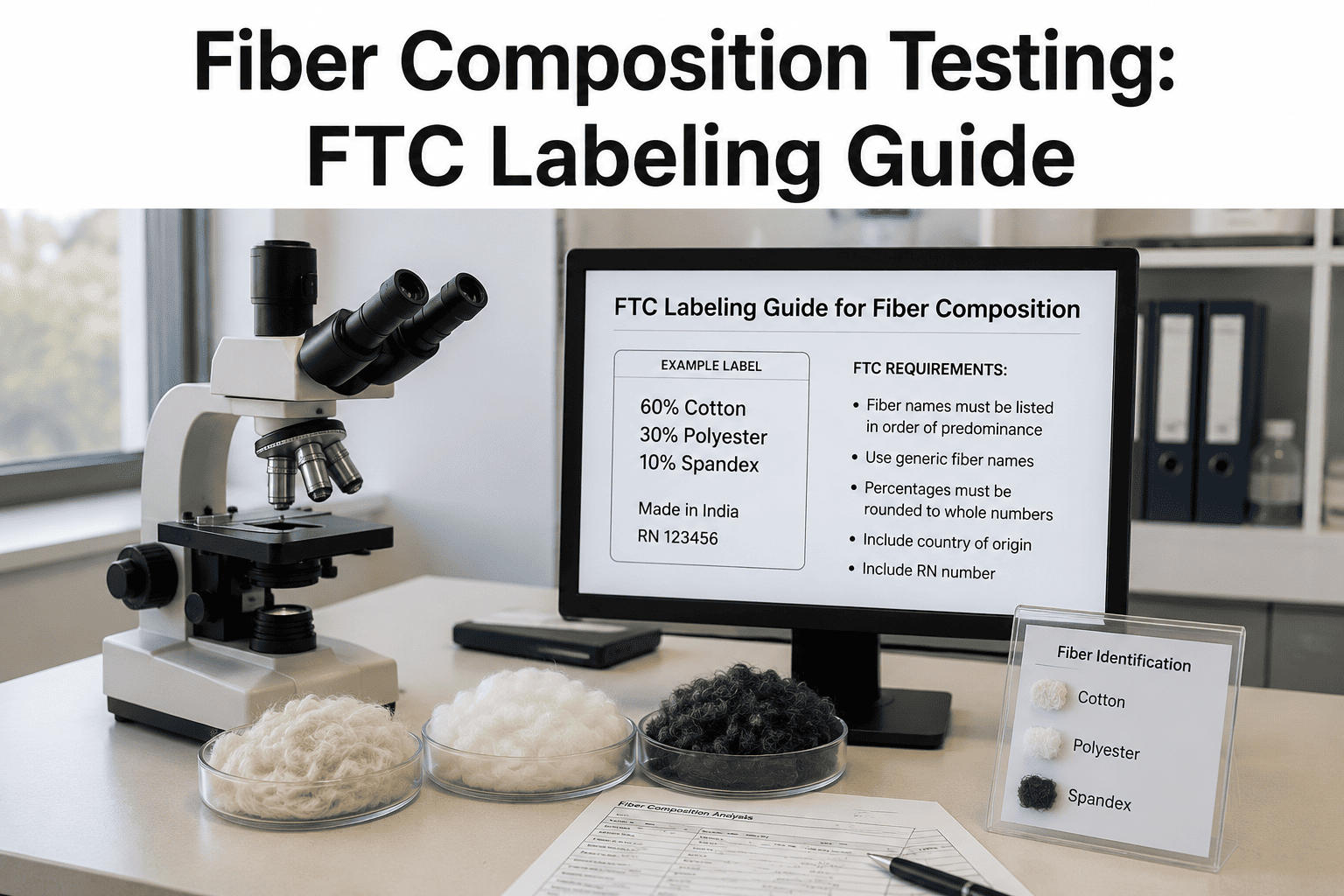
The Textile Fiber Products Identification Act requires that most textile products sold in the United States carry a label disclosing the generic name and percentage by weight of each fiber present, along with the country of origin and the identity of the manufacturer or marketer. The rule is specific about thresholds and terminology in ways that trip up brands relying on supplier claims rather than laboratory verification. Any fiber present at more than 5 percent of total fiber weight must be identified by its FTC-recognized generic name — cotton, polyester, nylon, wool, and so on. Fiber present at 5 percent or less cannot be named individually and must instead be disclosed only as "other fiber" or "other fibers," unless that minor fiber has a clearly established functional significance at that amount, such as spandex added specifically for stretch.
Percentages must be listed in order from highest to lowest, and the tolerance for deviation between the labeled percentage and the actual laboratory-verified percentage is narrow enough that rounding errors or supplier mill-certificate assumptions routinely produce technical misbranding. A label reading "60% Cotton, 40% Polyester" is a specific, testable claim — not a marketing description — and the only way to know whether it holds up is to actually separate and weigh the fibers, not to trust the fabric mill's spec sheet without verification.
Generic fiber names themselves are not a free-for-all vocabulary — the FTC maintains and periodically updates an approved list of generic names for manufactured fibers, aligned in recent revisions with the International Organization for Standardization's naming standard, specifically to make labels comparable across brands and reduce the barrier to using internationally recognized terminology. Brand or trademark names can appear on a label alongside the required generic name, but they cannot substitute for it — a fabric labeled only with a proprietary trademark and no generic fiber designation is out of compliance regardless of how well-known that trademark is to consumers.
The Testing Pyramid: Three Methods, Escalating Certainty
Fiber identification is not a single test — it is a sequence of methods that build on each other, each answering a different question with a different level of confidence. Screening methods are fast and cheap but only qualitative. Quantitative methods are slower and destructive to the sample but produce the defensible percentages a label actually requires. Instrumental methods resolve ambiguity screening and dissolution testing cannot settle on their own. Understanding where each method's evidence stops is what prevents a lab or brand from over-claiming based on a quick screening test.
The practical workflow moves down this pyramid only as far as the sample requires. A visually obvious 100 percent cotton woven fabric may need nothing beyond microscopic confirmation. A five-fiber technical blend with a novel synthetic component may need all three tiers before a lab is willing to sign off on a composition statement. Skipping tiers to save time is the single most common source of mislabeled fiber content — a burn test result treated as sufficient evidence for a percentage claim it was never designed to support.
Cost and turnaround time scale with the tier required, which is worth factoring into a testing budget rather than discovering after the fact. Screening-level microscopic and burn testing can typically be completed in a single day at relatively low cost, making it a reasonable first pass for high-volume, low-risk fabric sourcing decisions. Quantitative dissolution testing under ASTM D629 takes longer — the drying and weighing steps alone require careful timing to avoid moisture-related measurement error — and instrumental FTIR confirmation adds further cost and typically requires access to specialized laboratory equipment not every testing facility maintains in-house. Budgeting for the full pyramid on every new fabric source, while reserving lighter screening-only checks for established, previously verified suppliers, is the approach most compliance programs land on once the cost curve becomes clear.
Chemical Dissolution: The Method Behind the Percentage on the Label
When a label needs to say "65% Polyester, 35% Cotton" rather than simply "polyester and cotton blend," chemical dissolution under ASTM D629 or the equivalent ISO 1833 procedure is the method that produces that number. The underlying principle is solubility difference — different fiber types dissolve in different reagents at different rates, so a solvent chosen specifically to dissolve one fiber component while leaving the other physically intact allows the surviving fiber to be isolated, dried, and weighed against the original sample mass.
This method's reliability comes specifically from the fact that it produces a physical measurement rather than a visual judgment call. Microscopic and burn testing depend on an analyst's trained interpretation of what they observe, which introduces a degree of subjectivity even among experienced testers. Gravimetric dissolution testing removes that subjectivity almost entirely at the final step — once the correct solvent has dissolved the target fiber, the remaining fiber's weight is an objective number on a calibrated balance, not an interpretation. That objectivity is precisely why regulatory and retail compliance programs treat dissolution results, not screening results, as the standard of evidence for a percentage-based label claim.
Two limitations matter enough to plan around before testing begins. Dissolution methods cannot separate fibers within the same generic class that differ only in manufacturer or chemical modification — two different polyester formulations both simply dissolve or survive together, since the solvent responds to fiber chemistry, not brand. And bicomponent fibers, where a single fiber strand combines two polymer types in one structure, cannot be separated by dissolution at all, since there is no physically distinct fiber to isolate. Both limitations are exactly where FTIR analysis becomes necessary rather than optional.
Common Fiber Pairs and Their Selective Solvents
Laboratories work from established solubility reference tables that match fiber class pairings to the reagent that will selectively dissolve one component. The table below covers the pairings most frequently encountered in apparel and home textile testing — not an exhaustive reagent guide, but the combinations a compliance testing program is most likely to need.
| Fiber Pair | Component Dissolved | Typical Reagent Class |
|---|---|---|
| Cotton / Polyester | Cotton | Sulfuric acid solution |
| Wool / Acrylic | Wool | Sodium hypochlorite solution |
| Nylon / Cotton | Nylon | Formic acid solution |
| Nylon / Wool | Nylon | Formic acid solution |
| Acetate / Cotton | Acetate | Acetone |
| Spandex / Cotton or Nylon | Spandex | Dimethylformamide (DMF) |
| Polyester / Wool | Wool | Sodium hypochlorite solution |
Reagent selection is never guesswork left to the analyst's judgment alone — it follows published solubility tables cross-referenced against the fiber classes suspected present, typically established first through microscopic screening or a preliminary burn test. When a blend contains more than two fiber types, sequential solvent treatments are applied, with the order and combination selected carefully, since running solvents in the wrong sequence on a multi-fiber blend can produce different, less accurate results than the same solvents applied in the correct order.
When FTIR Analysis Becomes Necessary
Infrared spectroscopy identifies a fiber by the specific pattern of light absorption produced by its molecular structure — every polymer type produces a distinctive spectral fingerprint, and FTIR compares an unknown sample's spectrum against a reference library to confirm identity. This matters most in the situations chemical dissolution cannot resolve on its own.
FTIR is typically used as a confirming or resolving method layered on top of dissolution results rather than a full replacement for gravimetric quantification — it identifies what a fiber is with high confidence, but it does not independently produce the percentage-by-weight figures a compliant label requires. The two methods are complementary: dissolution measures how much of each fiber is present, and FTIR confirms exactly what each fiber is when that identity is in doubt.
Label Compliance Checklist: What Auditors and the FTC Actually Check
Beyond getting the percentages right, FTC enforcement attention tends to concentrate on a specific set of recurring label elements. Reviewing a label against this list before it goes to print catches the errors that generate the most retailer chargebacks and compliance complaints.
Retailer compliance teams typically run this same checklist, or a close variant of it, against every incoming shipment before it reaches distribution — meaning a label error caught internally before shipment is a minor correction, while the same error caught by a retailer's inbound quality team becomes a chargeback, a rejected shipment, or a delayed launch. Building this checklist into the pre-production label proofing step, rather than treating it as a final compliance gate, moves the catch point earlier and cheaper in the production timeline.