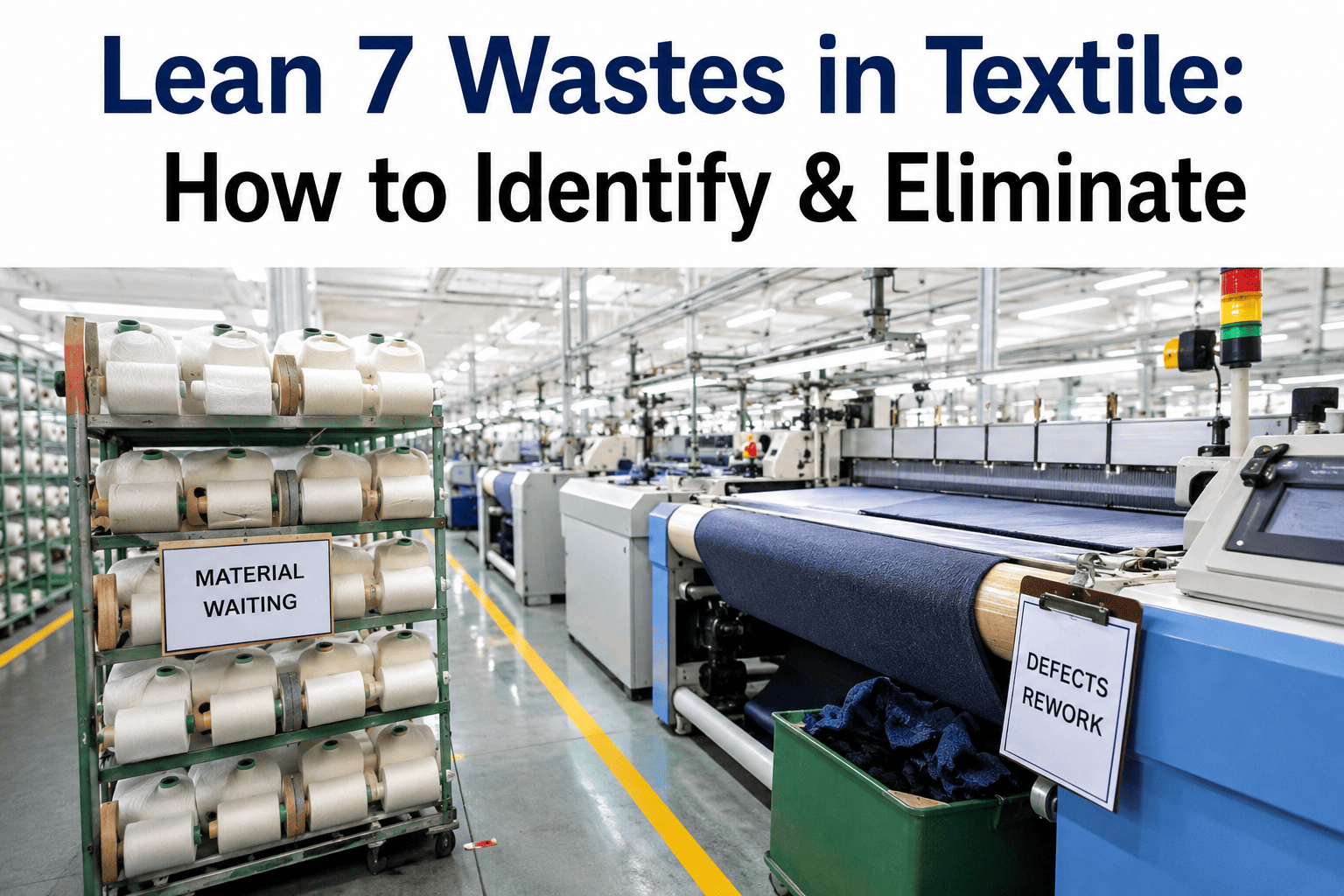
Walk through any textile mill and you will find waste hiding in plain sight, yarn cones stacked three deep waiting for the next process, an operator walking twenty extra steps every cycle, fabric reworked twice because a defect was caught too late. None of this shows up as a single dramatic loss, which is exactly why it survives year after year. Lean manufacturing gives these invisible losses a name and a place to look, turning vague frustration about efficiency into a specific, fixable list. Book a demo to see where waste is hiding across your spinning, weaving, and dyeing departments.
The 7 Wastes, Textile Edition
Where Waste Concentrates by Department
| Department | Most Common Waste | Typical Root Cause |
|---|---|---|
| Spinning | Inventory, Waiting | Batch sizes larger than immediate downstream need |
| Weaving/Knitting | Waiting, Motion | Beam and shuttle changeover inefficiency |
| Dyeing | Over-processing, Defects | Shade approval delays and redundant lab dips |
| Garmenting | Waiting, Defects | Trim shortages and late-stage quality inspection |
Getting Started With Lean Without Stopping Production
What Lean Adoption Typically Delivers
Frequently Asked Questions
Waiting and inventory tend to be the two most costly wastes across textile operations, since batch-based production naturally creates queues between spinning, weaving, and dyeing stages, and safety stock accumulates at each handoff point to buffer against those delays. The two feed each other in a cycle, more waiting encourages holding more buffer inventory, and more inventory can mask the waiting problem instead of forcing a fix, which is why addressing them together tends to work better than tackling either alone. Book a demo to see where your waiting and inventory levels actually stand.
Yes, though it requires adapting concepts developed originally for discrete assembly lines to a batch and process environment. Reducing batch sizes where changeover allows, synchronizing production stages more tightly, and catching defects closer to their source all apply directly, even though the mechanics look different from a car assembly line. The core principle, making waste visible and addressing root causes rather than symptoms, transfers well regardless of industry.
Not necessarily at the start. A small cross-functional group, a production supervisor, a quality lead, and someone from planning, can run an initial value stream mapping exercise and identify the first round of improvements without a formal, dedicated lean department. As the program matures and expands across more departments, a dedicated coordinator role becomes more valuable to maintain consistency and momentum. Contact support to structure your first lean initiative.
Track a small set of specific metrics tied directly to the waste being targeted, WIP inventory levels, changeover time, defect rate at point of origin rather than at final inspection, and machine idle time. Broad efficiency percentages can mask what is actually improving, while these specific, waste-linked metrics show whether a targeted fix produced a real, measurable change rather than a temporary or coincidental improvement.
The most common reason is treating the first improvement as a completed project rather than the start of an ongoing review cycle, once attention moves elsewhere, old habits and old layouts tend to quietly return over a period of months. Building a recurring review cadence into the department's regular operating rhythm, rather than relying on periodic special initiatives, is what keeps waste from creeping back after the initial fix.