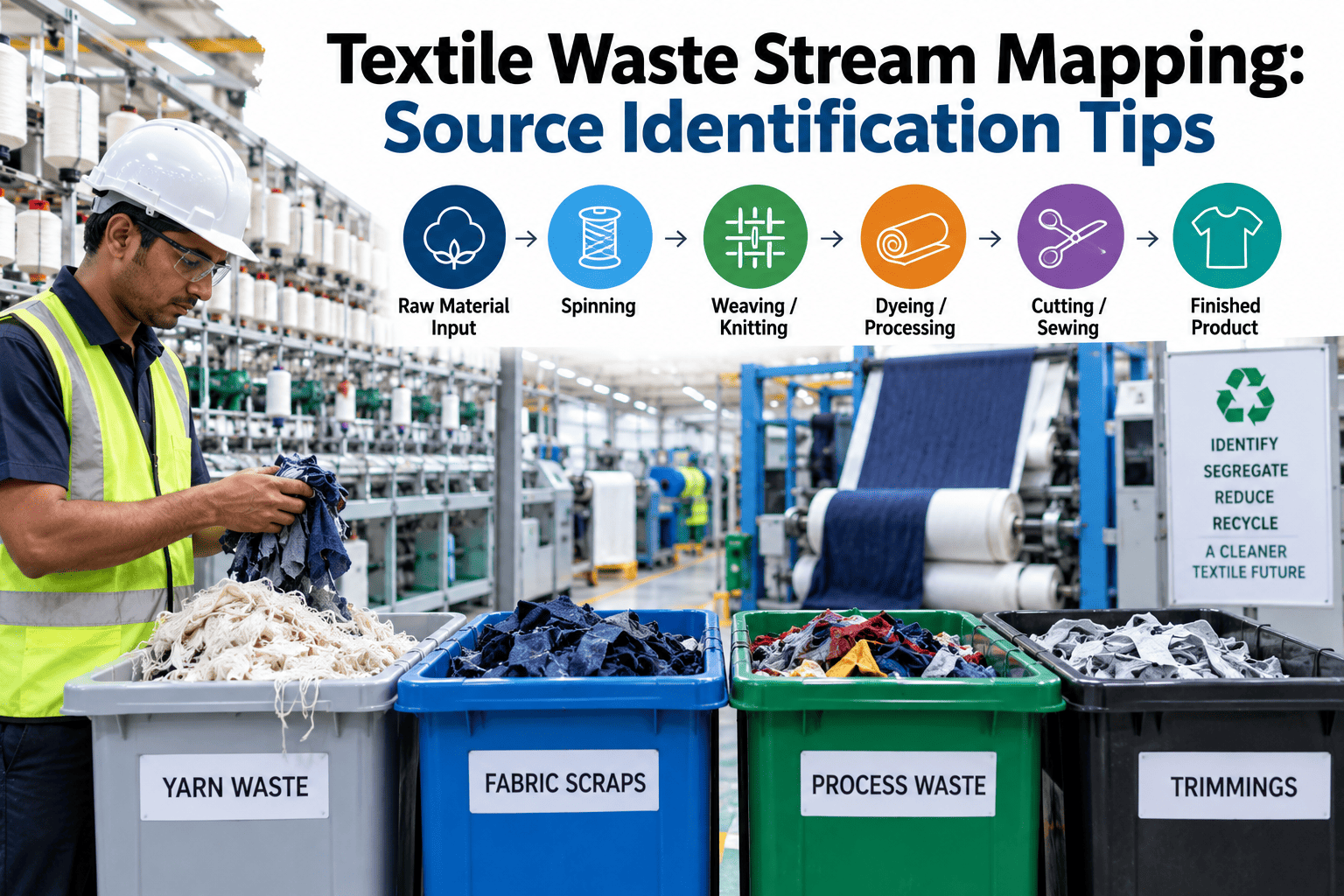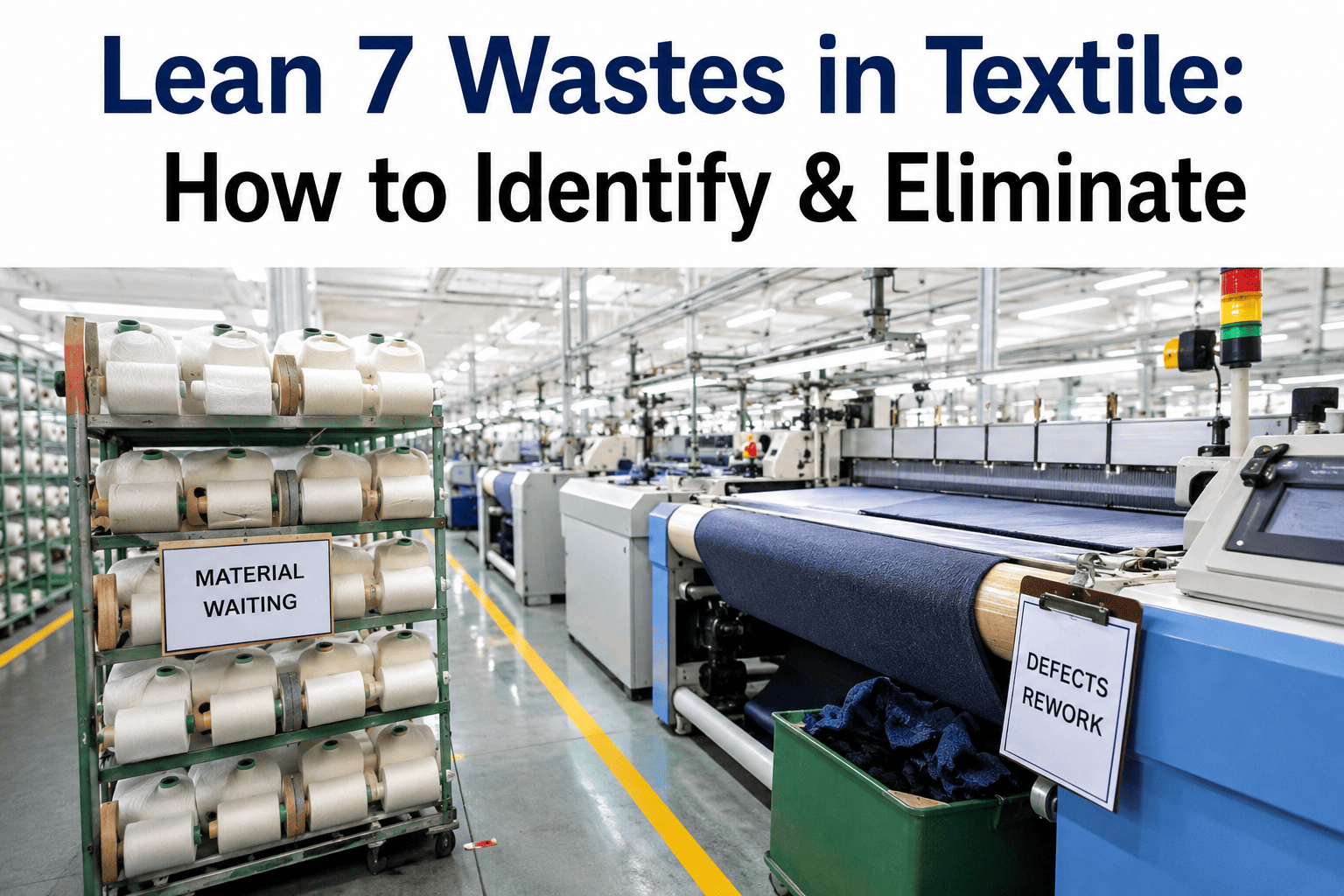
The lean manufacturing framework of seven wastes was developed for automotive assembly lines, but every one of the seven shows up just as clearly on a textile value stream running from fiber to finished garment — it just wears different clothes. Overproduction in a fabric mill looks like running an extra lot because changeover is expensive, not because an order needs it. Waiting looks like a sewing line idle for two hours because a dyed fabric lot is late from finishing. The framework matters not because it's a manufacturing buzzword but because it gives a plant a consistent lens to look at losses that would otherwise get treated as seven unrelated problems instead of seven symptoms of the same underlying flow issues. This guide walks through all seven wastes as they actually appear across spinning, weaving, dyeing, cutting, and sewing, with the specific textile-floor signal that reveals each one. Mills mapping their value stream for waste reduction can book a 30-minute demo to see how iFactory flags each of the seven waste types automatically from production floor data.
Lean 7 Wastes in Textile — How to Identify and Eliminate Each One
Overproduction, waiting, transport, overprocessing, inventory, motion, and defects — what each waste actually looks like on a spinning-to-sewing value stream, and the specific signal that reveals it before it compounds into a bigger loss.
Why a Textile Mill Needs This Framework at All
A textile value stream has more handoff points than most manufacturing operations — fiber to yarn, yarn to fabric, grey fabric to dyed fabric, fabric to cut pieces, cut pieces to sewn garments — and every one of those handoffs is a place where one of the seven wastes can quietly take root. Without a shared framework, a plant tends to treat each department's losses as isolated department-specific problems, which makes it easy to miss that a waiting problem in sewing and a batch-sizing problem in dyeing are actually the same root cause showing up in two places.
Overproduction
Running a fabric or yarn lot larger than the actual order because changeover cost makes small runs feel inefficient. The extra output sits as inventory carrying capital and warehouse space until — or unless — a matching order eventually appears, and in a fashion-driven textile business, it often doesn't.
Waiting
A sewing line sitting idle because dyed fabric is late from finishing, or a dyeing machine sitting empty because grey fabric hasn't arrived from weaving. Waiting waste is the most visible of the seven on a shop floor and usually the easiest to quantify, since idle time shows up directly in machine and labor utilization reports.
Transport
Moving fabric rolls or cut pieces further than necessary between departments laid out inefficiently, or shuttling work-in-process back and forth for a rework step that could have been positioned closer to where the defect originated. Every extra movement adds handling risk to fabric that can snag, crease, or pick up contamination.
Overprocessing
Running an extra finishing pass, a tighter inspection standard, or a quality check that the buyer's specification never actually required. Overprocessing is often the hardest of the seven to spot because it looks like diligence rather than waste — the process is technically adding no value the customer is paying for.
Inventory
Excess grey fabric, dyed fabric, or cut piece stock sitting between process stages well beyond what current demand requires. Textile inventory waste is particularly costly because fabric can shade-shift, develop storage creases, or simply go out of season while it sits waiting for the next process step.
Motion
An operator walking further than necessary to reach trims, tools, or a supervisor for approval, or reaching awkwardly at a sewing station laid out without regard for ergonomics. Motion waste rarely shows up on a cost report directly, but it compounds across thousands of repetitions per shift into a real productivity loss.
Defects
Fabric faults, shade rejects, and sewing defects that require rework or become scrap outright. Defects are the most expensive waste on the list because they carry every cost of the six wastes above them — the material, time, and processing already invested is lost, not just delayed.
Mapping Wastes Across the Value Stream
| Stage | Most Common Waste Type | Typical Root Cause |
|---|---|---|
| Spinning | Motion, defects | Frame layout ergonomics, yarn count variation |
| Weaving / Knitting | Waiting, defects | Yarn supply timing, loom stop causes |
| Dyeing & Finishing | Overproduction, inventory | Batch-size minimums, shade approval delays |
| Cutting | Overprocessing, transport | Marker layout inefficiency, department distance |
| Sewing & Packing | Waiting, defects | Upstream fabric delay, line balance mismatch |
Value stream mapping exercises consistently find that a waste appearing at one stage is often triggered by a decision made two or three stages earlier — a dyeing batch-size decision, for example, is a common upstream cause of a sewing line waiting problem downstream.
Where to Start Elimination Work
Start with defects, not the biggest-looking waste
Defects carry the compounded cost of every other waste already invested in that unit of production, which makes defect elimination consistently the highest financial-return starting point even when another waste type looks more visually obvious on the floor.
Trace waiting waste upstream before fixing it locally
A sewing line waiting for fabric is rarely a sewing line problem — chasing the root cause back to a dyeing batch schedule or a weaving supply delay usually reveals the real fix rather than adding buffer inventory to mask the symptom.
Question overprocessing against the actual buyer specification
A finishing pass or inspection standard tighter than what the buyer's technical package actually requires is pure cost with no corresponding value, and it's often inherited from an old specification that was never revisited after the current program started.
Frequently Asked Questions
Which of the seven wastes should a textile mill prioritize first?
Defects are usually the highest-return starting point because they carry the compounded cost of every process already invested in that unit — fiber, spinning, weaving, dyeing, and finishing costs are all lost together when a defect turns fabric into scrap, not just the cost of the final step. Other wastes like motion or transport are real but typically carry a smaller cost per incident, which is why most lean textile programs start with defect reduction even when a different waste looks more visually disruptive on the floor. Contact iFactory Support for help setting up defect tracking as a starting point for a waste reduction program.
Why does a waiting problem in sewing often trace back to dyeing?
Dyeing and finishing batch decisions — how large a batch needs to be to run economically, and how shade approval delays stack up before a batch releases — directly control how consistently fabric flows downstream to cutting and sewing. A sewing line waiting for fabric is frequently downstream of a batch-size or approval-timing decision made in dyeing days earlier, which is why fixing the sewing line's local scheduling rarely solves a waiting problem whose root cause sits two stages upstream.
How is overprocessing different from a legitimate quality standard?
A legitimate quality standard is tied directly to the buyer's technical specification or a genuine downstream requirement, while overprocessing is a step, pass, or inspection tighter than what either actually needs — often inherited from an old program specification or added out of caution without ever being revisited. The test is simple: if removing the step wouldn't change whether the finished product meets the buyer's actual requirement, it's overprocessing rather than quality assurance. Book a demo to see how process steps can be benchmarked against current buyer specifications.
Can inventory waste ever be a deliberate, correct choice in a textile mill?
Yes, in limited cases — a buffer of grey fabric ahead of a dyeing bottleneck, for example, can be a deliberate decision to protect throughput rather than an accidental waste. The distinction is whether the inventory level is sized intentionally against a known constraint and reviewed periodically, versus inventory that simply accumulates because nobody set an explicit limit. Unmanaged inventory drifting upward over time is waste; a sized buffer protecting a known bottleneck is a lean tool.
Does eliminating one waste type ever create a different waste somewhere else?
It can, which is why value stream changes need to be evaluated across the whole flow rather than one stage in isolation. Eliminating overproduction by cutting lot sizes too aggressively, for example, can increase changeover frequency and create new waiting or transport waste if changeover time itself hasn't also been addressed. The seven wastes framework works best when changes are traced through the full value stream rather than optimized department by department. Contact iFactory Support for help modeling how a waste reduction change ripples across the full production flow.
Seven wastes, one value stream — treat them as connected, not isolated.
iFactory tags production floor data against all seven lean waste categories automatically, tracing root causes across spinning, weaving, dyeing, cutting, and sewing instead of leaving each department to chase its own numbers. A 30-minute demo builds a live view against your own value stream data.