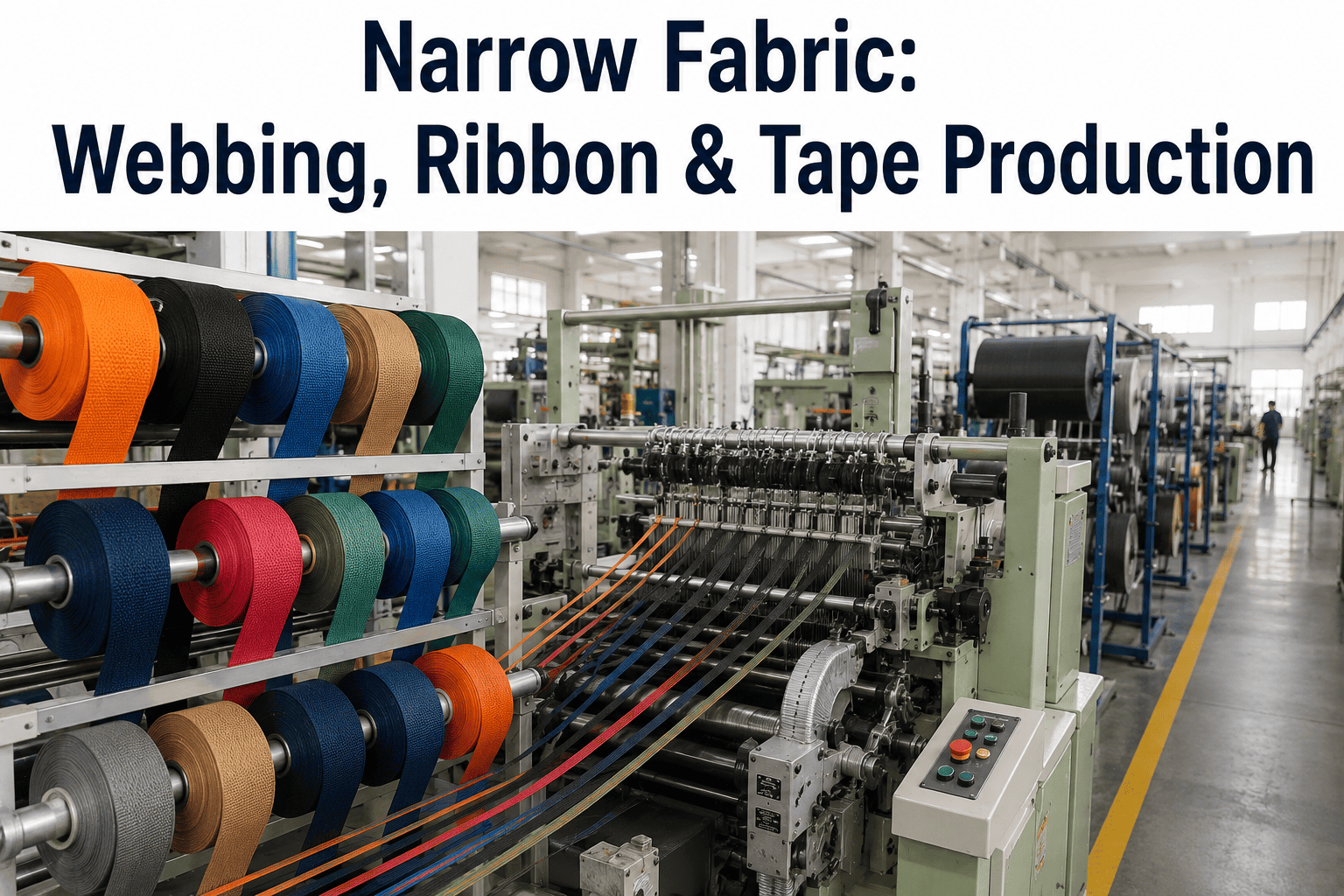
Narrow fabric weaving is one of textile manufacturing's most precision-dependent processes, producing the webbing, ribbon, elastic tape, and woven labels that quietly hold together everything from seatbelts and backpacks to garment waistbands and luggage straps. Unlike broad fabric weaving, narrow fabric runs on needle looms and specialized narrow looms that weave dozens of individual bands simultaneously, each just millimeters to a few inches wide, at speeds where a single yarn tension inconsistency across even one band can scrap an entire production run before anyone notices on the floor. The margin for undetected quality drift is thin, and the applications riding on that quality — automotive safety webbing, medical elastic, military strapping — leave very little room for a defect to reach the customer. Because a single multi-band loom can be weaving dozens of narrow fabrics at once, the traditional approach of periodic manual sampling only ever sees a fraction of the actual output, which is exactly the gap that structured, continuous monitoring is designed to close. iFactory brings AI-powered production monitoring to narrow fabric weaving operations, tracking tension consistency, weave defect patterns, and loom performance across every band on every needle loom, with the full workflow explained at iFactory support.
Weaving Production Excellence · Narrow Fabric Manufacturing
Narrow Fabric Manufacturing: Webbing, Ribbon, Elastic Tape, and Woven Label Production
From needle loom fundamentals to jacquard narrow fabric design and application-specific quality standards — how modern narrow fabric operations weave consistency into every band, every run, every loom.
Dozens
Of individual bands woven simultaneously on a single needle loom
1 Edge
Knitted selvedge produced by needle loom technology, alongside one woven edge
Millimeters
The tension deviation window before a band is considered out of specification
CAD-Driven
Jacquard narrow looms enabling near-unlimited weave pattern design
The Narrow Fabric Product Family
What Actually Falls Under "Narrow Fabric," and Where Each Product Goes
Narrow fabric is defined by width, not by application, which is why the same core weaving technology produces such a wide range of finished goods. Understanding which product category a given order falls into shapes everything downstream, from yarn selection to loom setup to the quality checks that matter most, and conflating categories is a common source of both over-engineering low-stakes product and under-specifying safety-critical product.
Webbing
Seatbelts, harnesses, luggage straps, military slings, FIBC bag straps
Load-bearing flat woven band, typically heavier weight polyester or nylon yarns, engineered for tensile strength and controlled elongation under load.
Ribbon
Apparel trim, gift packaging, decorative and craft applications
Lighter weight, often satin or grosgrain construction, prioritizing visual finish, drape, and color consistency over load-bearing performance.
Elastic Tape
Waistbands, medical compression wear, activewear, undergarments
Woven or knitted structure incorporating rubber or spandex core yarns, engineered for a specific recovery percentage and consistent stretch across the full width.
Woven Labels
Garment care labels, brand labels, size tags, product identification
Fine-gauge jacquard construction capable of woven text and logo detail, requiring the highest pattern precision of any narrow fabric category.
Needle Loom Technology
How a Needle Loom Actually Weaves a Narrow Band
The needle loom, sometimes called a shuttleless loom, replaced the traditional shuttle loom in most high-volume narrow fabric operations because it eliminates the shuttle's physical pass through the shed, allowing dramatically higher speed and the ability to weave many bands side by side on one machine. Understanding the sequence below matters because most quality defects trace directly back to a fault at one of these specific stages rather than the loom as a whole.
01
Warp Let-Off
Warp yarns feed from the beam under precisely controlled tension, since inconsistent let-off tension is the single most common root cause of banding defects and width variation across the finished tape.
02
Shed Formation
Heddle frames raise and lower warp threads to form the shed opening for weft insertion, with the pattern of frame movement determining the weave structure of each individual band.
03
Weft Insertion via Needle
A weft insertion needle carries the weft thread loop through the shed rather than a shuttle passing through, enabling far higher insertion rates and multiple simultaneous weaving stations on one machine frame.
04
Selvedge Formation
Knitting needles secure the weft thread loop at the fabric edge, producing the needle loom's characteristic one woven edge and one knitted edge, a structural signature distinct from shuttle-woven narrow fabric.
05
Beat-Up
The reed pushes each new weft pick against the previously woven fabric, and beat-up force consistency directly determines pick density and the finished band's weight per linear meter.
06
Take-Up & Winding
Finished narrow fabric winds onto take-up rolls at a controlled rate matched to the weaving speed, with tension at this final stage affecting the roll's usability in downstream cutting and finishing.
A Tension Drift of Just a Few Percent on One Band Out of Sixty Can Go Unnoticed for an Entire Shift on a Manually Monitored Needle Loom.
iFactory tracks tension, width, and pick density per band in real time, flagging drift before an out-of-spec run reaches finishing and cutting.
Jacquard Narrow Fabric
Where Pattern Complexity Meets Production Speed
Choosing between standard and jacquard needle loom capability is fundamentally a question of what the finished narrow fabric needs to communicate visually versus what it needs to do mechanically, and many narrow fabric operations run both loom types side by side to cover their full product range efficiently.
Capability
Standard Needle Loom
Jacquard Needle Loom
Pattern Design
Fixed weave structure per setup, limited to loom's mechanical dobby capability
Near-unlimited pattern design via CAD-controlled individual warp thread control
Text & Logo Weaving
Not supported without dedicated tooling changes
Woven text, logos, and fine graphic detail directly from digital design files
Changeover Speed
Faster for simple repeat patterns
Slower per changeover but eliminates physical tooling swaps between designs
Best Fit
High-volume plain webbing, standard elastic tape, undecorated ribbon
Woven labels, decorative ribbon, patterned webbing, brand identification tape
Design Iteration
Requires physical setup change for each design variant
New design loaded digitally, enabling rapid sample and small-batch iteration
Application-Specific Quality Standards
Why a Seatbelt Webbing Defect Standard Cannot Be a Ribbon Defect Standard
The same weaving defect — a missing pick, a tension inconsistency, a width variation — carries entirely different consequences depending on what the finished narrow fabric is used for. Quality programs built around a single generic defect standard for all narrow fabric output miss this distinction and either over-inspect low-risk product, wasting inspection labor on ribbon that does not need it, or under-inspect safety-critical product, missing a defect that genuinely matters.
Safety-Critical
Seatbelt & Harness Webbing
Tensile strength, elongation under load, edge integrity — any weave defect affecting load path is a full reject, not a downgrade
Performance-Critical
Elastic Tape & Medical Compression
Recovery percentage consistency, stretch uniformity across width, core yarn breakage — defects affect function even without safety implication
Brand-Critical
Woven Labels & Logo Tape
Pattern registration accuracy, color consistency, text legibility — defects are primarily visual but directly affect brand perception
Visual-Primary
Decorative Ribbon
Surface finish, color match, drape quality — functional load-bearing performance is rarely a specification concern for this category
Common Weave Defects in Narrow Fabric
The Defect Patterns That Recur Across Needle Loom Production
Most narrow fabric quality issues fall into a small, recognizable set of defect types, each with a fairly predictable root cause once the specific pattern is identified. Building an inspection and monitoring program around these six patterns, rather than a generic "check for flaws" instruction, gives operators and quality staff a much faster path from symptom to fix.
D1
Tension Banding
Visible width or density variation running along the length of the band, almost always traceable to inconsistent warp let-off tension or a worn tension disc on that specific band's yarn path.
D2
Missing or Broken Pick
A weft thread failed to insert or broke mid-pick, creating a visible gap or float in the weave structure that compromises both appearance and, in load-bearing product, mechanical performance.
D3
Selvedge Distortion
The knitted or woven edge curls, puckers, or narrows inconsistently, typically from uneven selvedge tension or a knitting needle timing issue specific to needle loom construction.
D4
Width Drift
Gradual narrowing or widening of the band over the course of a run, often from warp tension changes as the beam unwinds or from reed wear affecting beat-up consistency.
D5
Pattern Misregistration
On jacquard narrow fabric, a shift between the intended pattern position and the actual woven output, usually from a CAD-to-loom synchronization drift or a warp thread break disrupting the pattern sequence.
D6
Core Yarn Breakage in Elastic Tape
Rubber or spandex core yarn snaps under weaving tension, creating a dead zone with no elastic recovery at that point in the tape, a defect invisible until the tape is stretched.
Real-Time Loom Monitoring Approach
From Individual Band Sensors to Plant-Wide Quality Trends
Real-time monitoring for narrow fabric weaving is only as good as its unit of measurement, and the single most important design decision is monitoring at the individual band level rather than aggregating across the whole loom, since aggregation is exactly what allows a single-band defect to hide in plain sight for an entire shift.
Per-Band Sensing
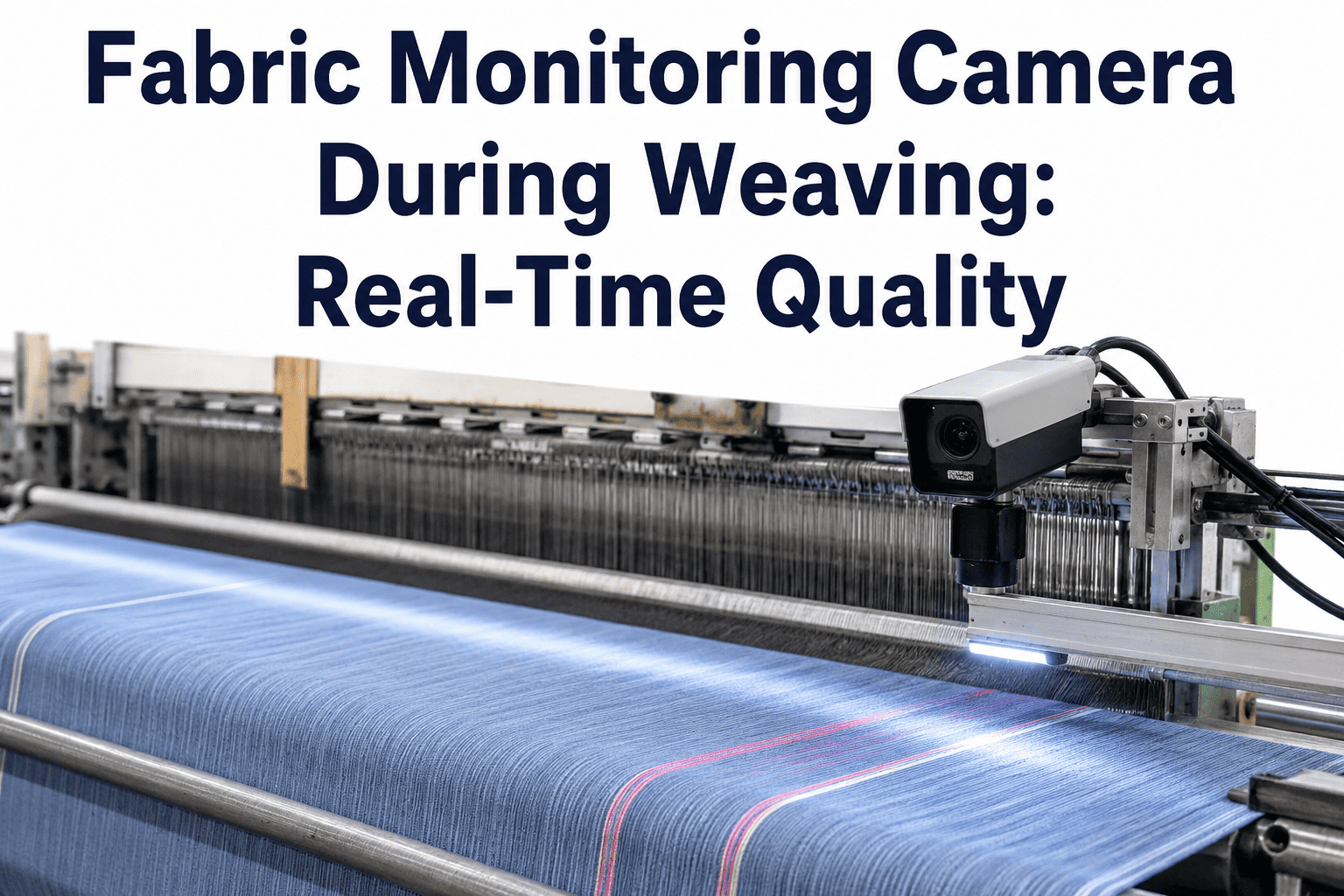
Tension sensors and vision cameras positioned to monitor each individual band on a multi-band needle loom independently, since averaged loom-level data masks a single band drifting out of specification while others run correctly.
Real-Time Defect Detection
Vision analysis identifies missing picks, selvedge distortion, and pattern misregistration as they occur, flagging the specific band and the linear position in the roll where the defect started.
Automated Alert & Hold
Out-of-specification readings trigger an immediate alert to the loom operator, with severity-based logic determining whether the affected band should be flagged for review or the loom stopped outright.
Roll-Level Traceability
Every defect event is tied to the specific roll, band position, and linear meter mark, so downstream cutting and finishing can isolate and remove only the affected section rather than scrapping the full roll.
Trend Analysis Across Looms
Defect rate and type trended per loom and per operator shift over time, surfacing whether a recurring defect pattern is a maintenance issue on a specific machine or a broader process control gap.
Field Example
A Seatbelt Webbing Manufacturer Cutting Scrap Rate by Isolating a Single-Band Tension Fault
An automotive webbing manufacturer running multi-band needle looms for seatbelt production had been experiencing an elevated scrap rate on one specific loom over several months, with quality control identifying tensile strength failures during periodic sample testing but no consistent pattern pointing to a specific cause. Because sample testing checked a subset of bands per shift rather than every band continuously, the plant's investigation had cycled through several hypotheses — yarn lot variation, humidity, operator technique — without resolving the root cause, and the affected loom's output was increasingly held for full re-inspection before release, slowing throughput on a line supplying a safety-critical automotive component.
After deploying per-band tension monitoring across the loom's full width, the plant identified that one specific band position, consistently fed from the same warp beam section, showed a tension pattern diverging from its neighbors during the middle portion of each run — a signature the periodic sampling had never happened to catch since it fell between scheduled sample points roughly half the time. Maintenance traced the divergence to a worn tension disc feeding that specific warp position, replaced the component, and the band's tension profile returned to matching its neighbors immediately.
The loom's scrap rate dropped to match the plant's other comparable looms within the following month, and full re-inspection holds on that loom's output were lifted once thirty consecutive days of in-specification per-band data confirmed the fix had resolved the issue rather than masking it temporarily. The quality team noted that the months of inconclusive investigation prior to per-band monitoring had cost far more in engineering time and held inventory than the eventual fix itself, since the actual repair was a routine component replacement that any technician could have performed in under an hour once the specific band and root cause were identified. The plant has since extended per-band tension monitoring to its remaining needle looms proactively, treating it as a standard commissioning step for any loom running safety-critical webbing rather than a reactive tool deployed only after a scrap problem emerges.
1 band
Isolated as the source of months-long scrap issue
30 days
Clean data required before re-inspection holds were lifted
Matched baseline
Scrap rate restored to plant average
Frequently Asked Questions
What Narrow Fabric Producers Ask Before Investing in Loom-Level Monitoring
Why does per-band monitoring matter more in narrow fabric than in broad fabric weaving?
A broad fabric loom weaves one continuous sheet of fabric, so a defect anywhere across the width is caught by monitoring that single fabric surface. A multi-band needle loom weaves dozens of independent narrow bands simultaneously on the same machine, each with its own warp tension, weft feed, and take-up path, meaning a defect on one band can develop and persist while every other band on the same loom weaves correctly. Loom-level or averaged monitoring simply cannot see this, since a problem on one band out of sixty is statistically invisible in an aggregate reading. This is why per-band sensing, rather than per-loom sensing, is the meaningful unit of monitoring for narrow fabric quality control, and it is worth reviewing whether an existing monitoring setup actually operates at this resolution or only reports loom-level summary statistics that could be quietly averaging out a real problem. To see how per-band monitoring maps onto your specific loom configuration,
book a demo.
Can vision-based defect detection actually keep up with needle loom weaving speeds?
Modern needle looms run at high pick rates, and vision systems designed for this application are built specifically to sample frames fast enough to catch individual pick-level defects rather than only catching gross visible flaws after the fact. The practical approach combines continuous lower-resolution monitoring for gross defects like missing picks or selvedge distortion with periodic higher-resolution capture for finer pattern registration checks on jacquard product, balancing processing load against the level of detail each defect type actually requires to be caught reliably. Camera positioning close to the beat-up point, where the defect is freshest and most visible, generally outperforms downstream inspection stations positioned after take-up, since a defect caught immediately at the point of formation allows the loom to be stopped or adjusted before dozens of additional meters of the same fault accumulate on the roll.
How is quality monitoring different for elastic tape compared to standard webbing?
Elastic tape introduces a defect category that standard webbing and ribbon do not have to account for: core yarn integrity. A broken or weakened rubber or spandex core yarn creates a dead zone with no elastic recovery at that specific point in the tape, and this defect is often invisible under normal tension during weaving, only becoming apparent when the finished tape is stretched during downstream testing or end use. Effective elastic tape monitoring therefore needs either direct core yarn tension sensing during weaving or a validated stretch-test sampling protocol frequent enough to catch a core yarn issue before a large volume of affected tape accumulates on the take-up roll. Plants producing medical-grade compression elastic in particular tend to combine both approaches, since the consequence of a recovery failure reaching a finished garment carries a higher liability profile than a similar defect in a decorative or non-critical application.
Does jacquard narrow fabric require different quality checks than standard needle loom output?
Yes, primarily around pattern registration rather than the structural defects common to plain woven narrow fabric. Because jacquard weaving controls individual warp threads via a CAD-driven design file, the specific failure mode to watch for is a drift between the intended pattern position and the actual woven output, often triggered by a warp thread break disrupting the pattern sequence or a synchronization lag between the design file and the loom's mechanical cycle. Text and logo weaving on labels raises the stakes further, since a registration drift that would be a minor cosmetic issue on a decorative ribbon becomes a legibility failure on a brand or care label, which is typically a full reject rather than a downgrade. Because jacquard changeovers happen more frequently for label and short-run decorative work, the registration check is often built into the startup sequence for each new pattern rather than treated purely as an in-process monitoring concern.
How does iFactory support narrow fabric weaving operations day to day?
iFactory monitors tension, width, and defect patterns per individual band across multi-band needle looms, with vision-based detection identifying missing picks, selvedge distortion, and pattern misregistration in real time as they occur on the loom. Every defect event is tied to the specific band, roll, and linear meter position, enabling downstream cutting and finishing teams to isolate only the affected section rather than holding or scrapping an entire roll. Defect trends are tracked per loom and per shift, surfacing whether a recurring issue traces back to a specific machine component, a yarn lot, or an operator pattern, and the full production and quality history stays queryable for customer quality claims and internal process improvement work. Roll-level traceability also supports faster response when a customer reports a quality issue after shipment, since the specific loom, band, and production window can be pulled up immediately rather than requiring a manual search through paper production logs. To see the platform configured against your specific loom fleet and product mix,
book a demo.
Turn Every Band on Every Loom Into a Continuously Monitored Quality Point.
Per-band tension tracking, real-time defect detection, and roll-level traceability — built for the precision narrow fabric weaving actually demands.


.jpg)