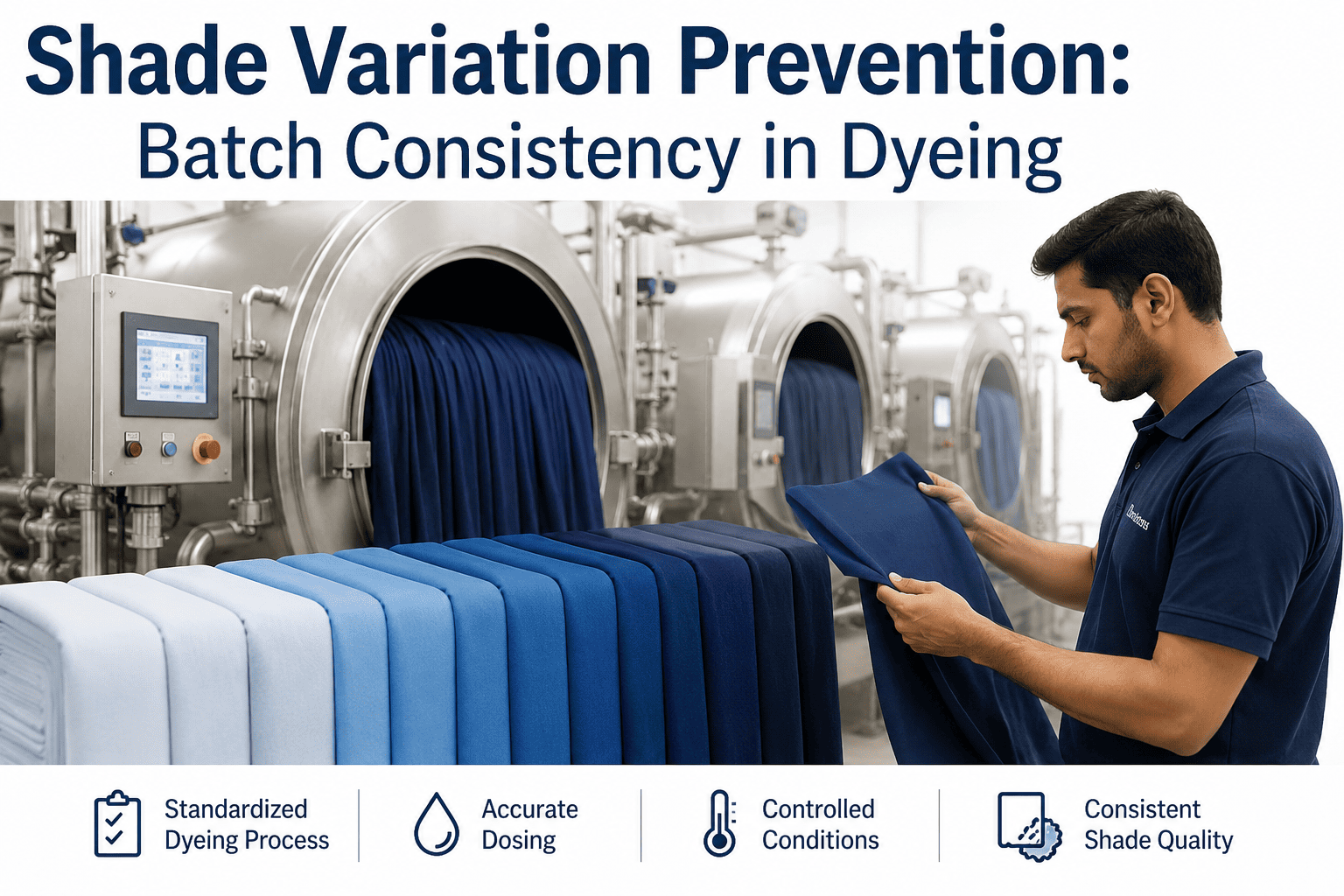
Two lots dyed to the same recipe, on the same machine, a week apart, and the buyer rejects one for shade mismatch. Nobody changed the formula, nobody swapped the dye, and yet the fabric came out visibly different under the light box. Shade variation between batches rarely comes from a single dramatic mistake — it comes from small, uncontrolled drift in process parameters, water quality, and dye lot consistency that never gets tracked closely enough to catch before the fabric leaves the machine. See how iFactory tracks batch parameters for consistent shade outcomes.
The Recipe Was Identical. The Shade Wasn't. Here's Why That Keeps Happening.
Shade variation between dye batches is almost always the product of small, compounding drift across temperature, time, water quality, and dye lot consistency — none of them individually dramatic, but together enough to shift a color measurably off standard.
The Four Variables That Drift Without Anyone Noticing
None of these four categories operate in isolation, which is part of why shade troubleshooting so often stalls when a mill investigates them one at a time rather than together. A slightly weak dye lot combined with a slightly fast heating rate can cancel each other out and produce an acceptable shade, while the same weak dye lot paired with a normal heating rate produces a visible deviation — meaning two batches can share one identical "problem" variable and still land on opposite sides of the approval threshold depending on what else was happening at the same time.
Standardizing Process Parameters Across Every Batch
A dyeing recipe on paper specifies a target temperature, a hold time, and a liquor ratio, but the actual machine run rarely matches those numbers with the precision the recipe implies. Heating rate in particular is an underappreciated variable — two batches that reach the same peak temperature but get there at different rates can develop noticeably different depth of shade, because dye uptake rate is sensitive to how quickly the bath approaches its target rather than only the final temperature reached. Standardizing heating rate, not just peak temperature, closes a gap that many mills don't realize they're leaving open.
Hold time drift is just as common and just as invisible on a summary report. A recipe calling for a 30-minute hold that actually runs anywhere from 25 to 40 minutes across different operators and shifts, because the timer starts at slightly different points in the cycle, will produce measurable shade inconsistency even though every other input looks identical. Locking hold time to a defined trigger event — bath reaching target temperature, not an operator's manual start — removes this ambiguity entirely.
Catch Parameter Drift Before It Reaches the Fabric
iFactory logs actual heating rate, hold time, and liquor ratio against the recipe standard for every batch, flagging drift while there's still time to correct it mid-cycle.
Dye Lot Management: The Variable Hiding in the Storeroom
Dye strength varies between manufacturing lots even from the same supplier, a fact printed in fine detail on most technical data sheets but rarely accounted for in day-to-day dosing practice. A mill that doses purely by recipe weight, without adjusting for the strength variance noted on each lot's certificate of analysis, is effectively introducing a variable the recipe was never designed to absorb. This becomes especially visible when a mill switches between two dye suppliers mid-production run, or when older stock with slightly degraded strength gets mixed into a batch alongside fresher material without any compensating adjustment.
| Dye Lot Management Practice | Shade Consistency Impact | Implementation Effort |
|---|---|---|
| Strength-adjusted dosing per lot certificate | High | Low |
| First-in-first-out stock rotation | Medium | Low |
| Single-supplier sourcing per production run | High | Medium |
| Automated weighing with digital verification | High | Medium |
Water Quality: The Variable Most Mills Test Once and Forget
Water hardness, pH, and trace metal content directly affect dye uptake and fixation, yet many mills test their water supply once during initial setup and never revisit it, treating water as a fixed input rather than the variable it actually is. Municipal or borewell water quality shifts seasonally — monsoon runoff can change hardness and turbidity meaningfully compared to dry-season supply, and a borewell's mineral content can drift as the water table itself changes over a year. A recipe validated against one season's water chemistry can produce a subtly different shade once the underlying water has shifted, with nothing about the recipe or the operator's execution having changed at all.
Iron and other trace metal contamination deserves particular attention because its effects on shade are disproportionate to the concentration involved — even trace amounts of iron can dull or shift certain dye classes measurably, and the source is often not the raw water supply itself but corrosion inside aging pipework or fittings between the water source and the dye bath. Periodic water testing, ideally tied to seasonal changes rather than a single annual check, catches this drift before it shows up as an unexplained shade complaint from a buyer.
Fabric Condition: The Variable That Arrives Before the Recipe Even Starts
Shade consistency conversations tend to focus heavily on what happens inside the dye bath, but a meaningful share of variation is already baked in before the fabric ever reaches the machine. Pre-treatment consistency — how thoroughly and evenly scouring and bleaching were carried out on the greige fabric — directly affects how evenly dye can penetrate and fix, and inconsistent pre-treatment produces a fabric that will dye unevenly no matter how tightly the dyeing parameters themselves are controlled. A mill that has standardized every dyeing parameter but still sees shade complaints often needs to look one step earlier in the process, at the pre-treatment stage that's easy to overlook because it happens in a separate department with its own separate quality checks.
Fiber batch variation compounds this further, particularly with natural fibers like cotton where moisture regain, maturity, and micronaire can vary meaningfully between cotton lots even when sourced from the same supplier and region. Fabric moisture content at the moment of loading into the dye machine is a smaller but still real factor — fabric loaded wetter or drier than the recipe assumes effectively changes the liquor ratio the moment it enters the bath, shifting dye concentration relative to fabric weight in a way that a recipe calculated on nominal fabric weight doesn't account for. None of these fabric-side variables are as visible or as easy to control as a machine's temperature setpoint, which is exactly why they tend to be the ones overlooked when a mill is troubleshooting an unexplained shade complaint.
A Before-and-After Look at Batch Consistency Improvement
A Composite Case: Tracing an Intermittent Shade Complaint
A dyeing unit supplying cotton fabric for a garment exporter had been fielding shade complaints on roughly one in eight batches for several months, with no obvious pattern the quality team could pin down. Each individual batch, reviewed in isolation, looked like it had followed the recipe correctly. It was only when the team began logging heating rate, actual hold time, and water test results alongside each batch's shade approval outcome that a pattern emerged: nearly every rejected batch had been processed during the first two hours of the morning shift, when the boiler was still reaching stable operating pressure after the overnight shutdown, producing a heating rate roughly 20% slower than the recipe's validated profile.
The fix required no change to the dye recipe itself — the unit adjusted its production schedule to avoid loading shade-critical orders during the boiler's morning ramp-up window, and added a heating-rate check as a go/no-go gate before starting any critical batch. The shade complaint rate dropped to roughly one in thirty batches within two months, confirming that the root cause had been a mechanical constraint on process consistency rather than any error in the recipe, the dye, or the operator's execution.
What made this case instructive beyond the specific fix was how long the pattern had gone unnoticed despite affecting a meaningful share of production. Every individual rejected batch had been investigated on its own terms by the quality team, and each investigation, looking only at that single batch's recipe compliance, came back clean because the recipe itself genuinely had been followed correctly. The pattern only became visible once someone looked across batches rather than within any one of them — a reminder that shade variation troubleshooting often fails not from a lack of diligence on individual batches, but from a lack of a structure that connects those individual investigations into a comparable dataset.
Building a Shade Tolerance Standard the Whole Team Actually Uses
A surprising number of shade disputes trace back not to an actual process failure but to an undefined or inconsistently applied tolerance standard — one quality inspector approving a batch that a second inspector, or the buyer's own quality team, would reject under a stricter reading of the same specification. Without a documented, numerically defined tolerance — typically expressed as a delta-E value under a specified light source and viewing condition — shade approval decisions end up depending on individual judgment, which varies between inspectors and even for the same inspector across a tiring shift. This inconsistency creates a second, entirely avoidable source of "shade variation" that has nothing to do with the dyeing process itself and everything to do with how approval decisions get made.
Establishing a clear delta-E threshold, verified with a spectrophotometer rather than visual judgment alone, and training every quality inspector to apply it the same way removes this ambiguity. It also creates a useful diagnostic separation: once approval decisions are objective and consistent, any remaining pattern of rejected batches can be attributed with confidence to an actual process variable — heating rate, water quality, dye lot strength — rather than lost in the noise of inconsistent human judgment calls. Mills that skip this step often chase phantom process problems for months that were, in reality, inspector disagreement dressed up as a manufacturing defect.
Seasonal Planning: Anticipating Water Quality Shifts Before They Hit Production
Rather than treating water quality testing as a reactive response to a shade complaint, mills that manage this variable well build a seasonal testing calendar in advance, anticipating the specific windows when water chemistry is most likely to shift — the onset of monsoon runoff, the peak of dry-season groundwater drawdown, or any period following known changes to a municipal supply's treatment process. Testing proactively at these anticipated transition points, rather than only after a shade problem has already reached a buyer, allows a mill to adjust its recipe's water pre-treatment step — additional softening, pH correction, or sequestering agent dosage — before the shift actually affects a production batch rather than after.
This kind of proactive scheduling requires almost no additional cost beyond the testing itself, since the corrective actions available — adjusting a sequestering agent dose, tightening pH correction — are typically inexpensive process steps rather than capital investments. The barrier is almost entirely organizational: someone has to own the calendar, ensure the tests actually happen on schedule even during a busy production period, and have the authority to trigger a recipe adjustment when a test result crosses a defined threshold. Mills without a named owner for this responsibility consistently let water testing lapse during their busiest months, which is unfortunately often exactly when seasonal water shifts are most likely to be occurring.
Why the Same Corrective Action Doesn't Work Twice
A pattern worth watching for once a mill starts tracking batch parameters systematically is a corrective action that worked once but fails to hold on a repeat occurrence of what looks like the same shade complaint. This usually signals that two genuinely different root causes are producing similar-looking symptoms — a shade shift that reads as "too pale" could stem from under-dosing, from a weaker-than-expected dye lot, from a heating rate that undershot the recipe profile, or from water hardness interfering with fixation, and each of these calls for a completely different fix. Treating every pale-shade complaint as the same problem, because the last one was solved by adjusting dosage, risks applying the wrong correction to a batch whose actual cause was water chemistry, wasting the correction and leaving the real driver unaddressed.
This is precisely why parameter-level logging matters more than outcome-level logging alone. A record that only notes "batch rejected — shade too pale" gives a quality team nothing to work with beyond guesswork on the next occurrence, while a record that captures the actual heating rate, hold time, water test result, and dye lot certificate alongside the rejection lets the team compare this occurrence against the last one and confirm — or rule out — whether the same driver is responsible before committing to a corrective action. Over enough batches, this comparison becomes fast and almost automatic, but only if the underlying data was captured consistently from the start rather than reconstructed from memory after the fact.
A Practical Checklist for Reducing Shade Variation
Lock heating rate and hold time to system triggers, not manual timers
Removing operator judgment from timing decisions eliminates one of the most common sources of unrecorded batch-to-batch variation.
Adjust dosing by dye lot strength, not recipe weight alone
A five-minute check of the lot certificate before dosing prevents a strength mismatch from ever reaching the bath.
Test water quality on a seasonal schedule, not a single annual check
Water chemistry drifts with the seasons even when the source itself hasn't changed, and a recipe validated once can quietly fall out of alignment.
Log every batch's actual parameters against the recipe standard
Without this record, a pattern like a boiler ramp-up window causing morning shade issues stays invisible no matter how many batches accumulate.
Frequently Asked Questions
How much does dye lot strength typically vary between manufacturing batches?
Strength variance between lots from the same supplier commonly falls in a range of a few percentage points either side of nominal, though this varies by dye class and manufacturer, and the certificate of analysis accompanying each lot should specify the actual figure rather than leaving it assumed. Reactive and vat dyes tend to show more lot-to-lot variance than simpler direct dyes, which is part of why strength-adjusted dosing matters more for some dye classes than others. Visit support to see how lot strength adjustments integrate with batch recipes.
How often should a dyeing unit test its water supply?
A monthly test, with additional checks immediately following any known seasonal transition like the onset of monsoon runoff, catches most meaningful drift without becoming an excessive testing burden. Units on municipal supply with a stable, well-monitored source can sometimes extend this interval, while units on borewell supply — which tends to show more variability as groundwater tables shift — generally benefit from more frequent monitoring.
Why do two batches with identical recipe parameters sometimes still show shade variation?
Recipe parameters capture the intended process, but the actual execution can diverge in ways a static recipe document never records — heating rate, exact hold time, incoming fabric moisture, and water chemistry all vary batch to batch even when every listed recipe number matches. This is exactly why tracking actual process data alongside the recipe, rather than trusting the recipe alone as a proxy for what happened, is necessary to catch the real source of variation.
Can shade variation be corrected after dyeing, or does it require a full re-dye?
Minor shade deviations can sometimes be corrected with a top-up or shade correction dip, adding a small, calculated quantity of dye to shift the result back toward standard, but this only works within a limited range and carries its own risk of overcorrection if the original deviation wasn't precisely measured. Larger deviations typically require a full re-dye, which is significantly more costly in time, water, energy, and fabric handling than getting the original batch right, reinforcing why prevention is worth more effort than correction.
What's the first process parameter a mill should standardize if starting from scratch?
Heating rate consistency tends to offer the highest return for the effort involved, since it's both a common source of unrecorded variation and relatively straightforward to lock to a system-controlled trigger rather than operator judgment. Water quality testing is a close second, particularly for mills that have never established a seasonal testing baseline. Book a demo to see how batch parameter tracking is typically phased in.
Stop Guessing Why the Shade Came Out Different
iFactory tracks every batch's actual heating rate, hold time, water quality, and dye lot data against the recipe standard, turning shade complaints from a mystery into a traceable pattern.