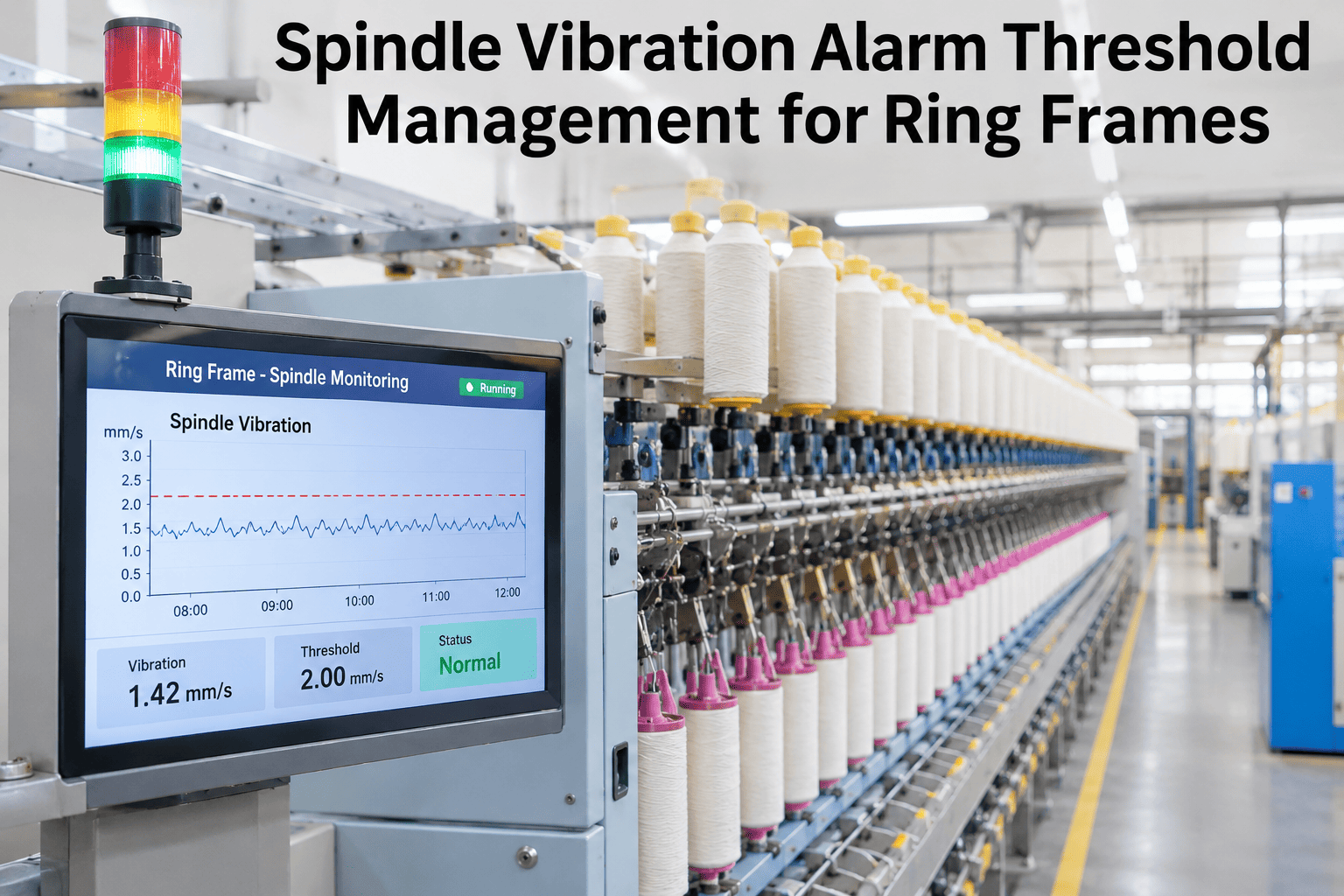
A spindle vibration threshold copied from a vendor's default setting is a guess dressed up as a specification, and it fails in both directions at once: too tight, and the maintenance team drowns in alerts on spindles that are perfectly healthy; too loose, and a genuinely failing spindle runs long enough to damage its neighbors before anyone notices. A practical threshold comes from the machine's own baseline, its operating speed, its failure history and the quality impact a given vibration level actually causes. iFactory AI's textile specialists can set practical thresholds against your own ring frame's baseline data before the next alarm storm.
A Threshold Set From a Vendor Default Isn't a Threshold, It's a Guess
Practical spindle vibration thresholds come from the frame's own baseline, its operating speed, its failure history and the quality impact of a given vibration level — not a number copied from a manual.
Why a Single Global Threshold Always Fails Somewhere
A ring frame carries hundreds to over a thousand spindles, and no two positions vibrate identically even when both are perfectly healthy — differences in mounting, bearing age and local balance mean a threshold that's correctly tight for one position is nuisance-prone for another. Mills that set one global threshold across the whole frame either tolerate constant false alarms on naturally noisier positions or miss early warning on quieter ones where the same absolute vibration level actually signals real trouble.
Each spindle's own healthy signature, not a frame-wide average.
A threshold set at one operating speed doesn't transfer to another count.
Past failures on a position reveal what an early warning actually looks like.
The threshold should trigger before vibration affects yarn, not after.
The Checklist: Setting a Threshold That Actually Works
Work through these steps per machine class, not once for the whole mill. Our specialists can run this checklist against your current ring frames during a site review.
Record normal vibration across every spindle before setting any alert level.
A threshold set for Ne 20 at 18,000 rpm doesn't transfer to Ne 40 at 22,000 rpm.
Match the vibration trend that preceded each past failure to today's alert level.
Set the alert threshold below the vibration level that measurably affects hairiness or unevenness.
A three-tier system avoids treating every deviation as an emergency.
Thresholds drift out of tune as bearings age; revisit them on a schedule.
Threshold Inputs by Source
| Input | What It Tells You | How Often to Refresh |
|---|---|---|
| Position baseline | What normal actually looks like for this spindle | After any bearing or component change |
| Operating speed / count | How the threshold should scale with running parameters | Whenever the product mix changes |
| Failure history | What a real pre-failure trend looked like last time | Reviewed quarterly |
| Quality impact data | The vibration level at which yarn quality actually degrades | Reviewed against Uster trend data |
Stop Choosing Between Alarm Fatigue and Missed Failures
Share a few weeks of vibration data from one frame and get thresholds set from your own baseline, not a vendor default.
A Composite Scenario: The Frame That Cried Wolf
Picture a ring frame where a single global vibration threshold, copied from the equipment manual, generated so many alerts across naturally noisier end positions that technicians stopped investigating most of them.
Rebuilding thresholds from each position's own baseline quieted the chronically noisy end positions while tightening sensitivity on the quieter middle positions, where a real early-stage bearing trend had previously gone unnoticed under the same blanket limit. The pattern described is illustrative; actual results depend on the frame's own history.
Where iFactory AI Fits
iFactory AI builds position-specific thresholds from each spindle's own baseline, adjusted for operating speed and informed by the frame's failure and quality history, rather than applying one setting across the whole machine.
Every spindle's threshold reflects its own healthy signature.
Watch, alert and critical levels, not a single binary trigger.
False-alarm and miss rates reviewed monthly as bearings age.
Frequently Asked Questions
Two to four weeks of normal running typically captures enough variation to set a position-specific baseline, though frames running varied product mixes may need longer to see the full range of normal. Scope a baseline window for your frame's product mix.
Yes, operating speed and spindle load both shift with count, so a threshold tuned for one product can be too tight or too loose for another unless it's adjusted alongside the changeover. Ask about count-aware threshold profiles.
Monthly, at minimum, since bearing wear and mechanical changes gradually shift what "normal" looks like, and a threshold left untouched for a year often drifts out of tune with the machine's actual condition. Set a review cadence that fits your maintenance schedule.
Watch flags an upward trend with no action required yet, alert calls for a maintenance review within a defined window, and critical signals a failure risk serious enough to affect neighboring spindles if not addressed immediately. See a sample three-tier structure for a ring frame.
Yes, cross-referencing vibration trend data against Uster quality metrics on the same position often reveals the vibration level at which yarn unevenness or hairiness actually starts to degrade, which is a more defensible threshold than an arbitrary number. Discuss linking vibration and quality data for your frames.
Set Thresholds From Your Own Machines, Not a Manual
iFactory AI builds position-specific spindle vibration thresholds from baseline, speed, failure history and quality impact, so alarms mean something again.