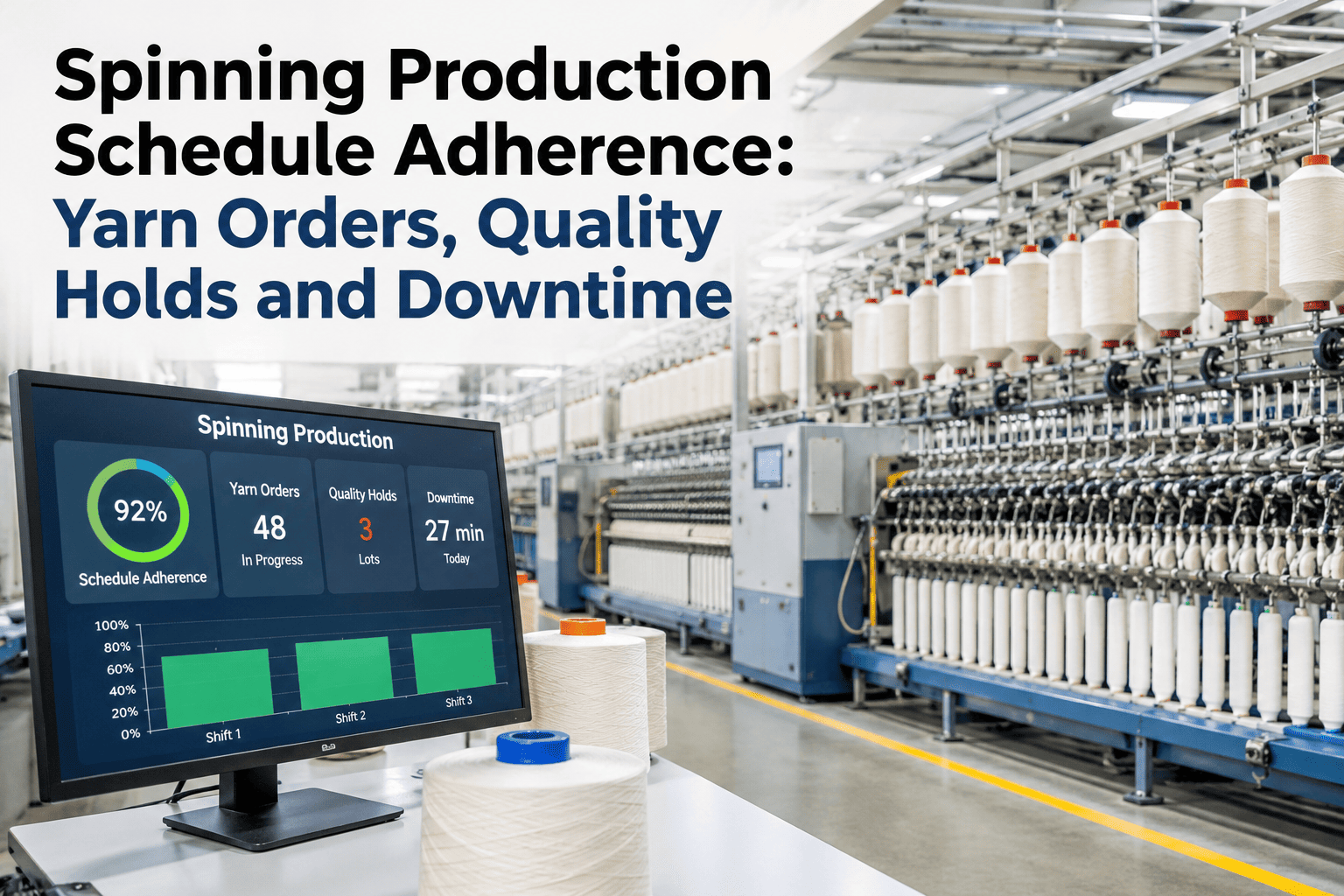
A spinning schedule that looked achievable on Monday morning can fall apart by Wednesday for reasons that have nothing to do with the plan itself, a quality hold on a lot that was supposed to feed the next order, a spindle failure nobody saw coming, or a material delay from a supplier. Tracking planned versus actual production only tells half the story unless it also accounts for exactly which of those three forces pulled the schedule off course. iFactory AI, an on-premise AI platform for manufacturing, tracks a mill's own yarn orders against the specific causes behind any variance, and production planners can see their own schedule adherence broken down by actual cause with our team.
Schedule Adherence, 2027
Planned Versus Actual, With the Real Cause Attached
Spinning production schedule adherence tracking compares planned versus actual yarn output while attributing any gap to spindle failures, quality holds, material constraints or maintenance downtime.
Why a gap number isn't enough
Why "We Missed the Schedule by 8 Percent" Doesn't Help
Knowing the schedule was missed by a certain percentage tells a planner nothing about what to change for next week. An 8 percent miss driven by a quality hold calls for a different response than the same 8 percent miss driven by a spindle failure or a late material delivery, and a planning process that only tracks the size of the gap, not its cause, ends up repeating the same miss for a different reason every week.
The four causes
What Actually Pulls a Schedule Off Course
Spindle failures
Unplanned mechanical stops that take capacity offline mid-run.
Yarn-quality holds
Output held for testing or disposition before it can count toward the order.
Material constraints
Fiber or blend not available when the schedule assumed it would be.
Maintenance downtime
Planned or unplanned service time that wasn't accounted for in the plan.
From plan to variance
How a Miss Gets Traced to Its Real Cause
1
Schedule set
A planned output is assigned to each frame for the period.
2
Actual tracked
Real output is logged continuously against the plan.
3
Gap flagged
Any shortfall is flagged as it happens, not only at period close.
4
Cause attributed
The gap is tied to a spindle failure, quality hold, material constraint or downtime.
See Your Own Variance Traced to Its Cause
Share a recent week where your schedule missed, and iFactory AI will show how the gap would break down by actual cause.
Gap size vs gap cause
Tracking the Size of a Miss Against Tracking Its Cause
Gap size only
"Missed by 8 percent" repeated weekly
Same corrective conversation every time
No clear owner for the fix
Gap size and cause
"Missed by 8 percent, mostly quality holds" this week
A different, specific conversation each time
A clear owner, quality or maintenance or planning
Quality holds specifically
Why Quality Holds Deserve Their Own Category, Not a Generic One
It is tempting to lump a quality hold in with general downtime, but the two call for completely different responses. Downtime is a capacity problem solved by fixing or scheduling around a machine. A quality hold is a disposition problem solved by testing, reviewing and releasing or rejecting a specific lot, and the schedule impact of a hold depends entirely on how quickly that disposition decision gets made, not on any mechanical repair.
Separating the two categories means a planner looking at a schedule miss driven mostly by holds knows to go talk to quality about disposition turnaround time, not to maintenance about a machine that was never actually broken.
Common mistakes
Mistakes That Undercut Schedule Adherence Tracking
1
Reviewing the gap only at period close
A cause flagged mid-week can still be corrected before the period ends; one flagged after cannot.
2
Lumping holds into generic downtime
A quality disposition delay gets treated as a mechanical problem it isn't.
3
No feedback loop into the next schedule
A recurring material constraint should change how future schedules are built, not just get logged again.
Expert review
What a Production Planner Would Check First
The cause attribution is only useful if it's specific enough to act on. Confirm each variance is tied to a named frame, lot or material, not a vague category, before trusting the weekly review to actually change next week's plan.
Watch for
A large share of variance landing in an unattributed "other" category.
Do next
Start with your most schedule-sensitive product line for the clearest early value.
FAQ
What Planners Ask About Schedule Adherence Tracking
How is a quality hold's impact actually measured against the schedule?
The output held is tracked as unavailable to the order until disposition, so the schedule impact reflects exactly how long that lot sat in hold rather than being lumped into a generic downtime figure.
Ask how holds are measured against your schedule.
Can this flag a likely miss before the period actually ends?
Yes, tracking actual output against plan continuously, rather than only at period close, lets a flagged gap trigger a response while there is still time to adjust the remaining schedule.
Ask about mid-period alerting.
Does this connect to our existing yarn order management system?
Most mills connect schedule adherence tracking directly to their existing order and planning system, so the plan being compared against is the same one planners already work from.
Ask about your current planning system.
How do recurring material constraints get fed back into future scheduling?
A pattern of repeated material-related misses on a specific fiber or blend can inform more realistic lead-time assumptions in the next schedule, rather than repeating the same optimistic assumption each cycle.
Discuss feeding patterns back into planning.
Can this handle multiple frames running different yarn counts on the same schedule?
Yes, each frame's plan and actual output is tracked against its own rated capacity for the count it's running, so frames producing different yarn counts are compared fairly rather than against one shared baseline.
See a multi-count schedule example.
Know why, not just by how much
Give Every Schedule Miss a Real Cause
Book a session with iFactory AI to track your own yarn orders against the actual causes behind any schedule variance.