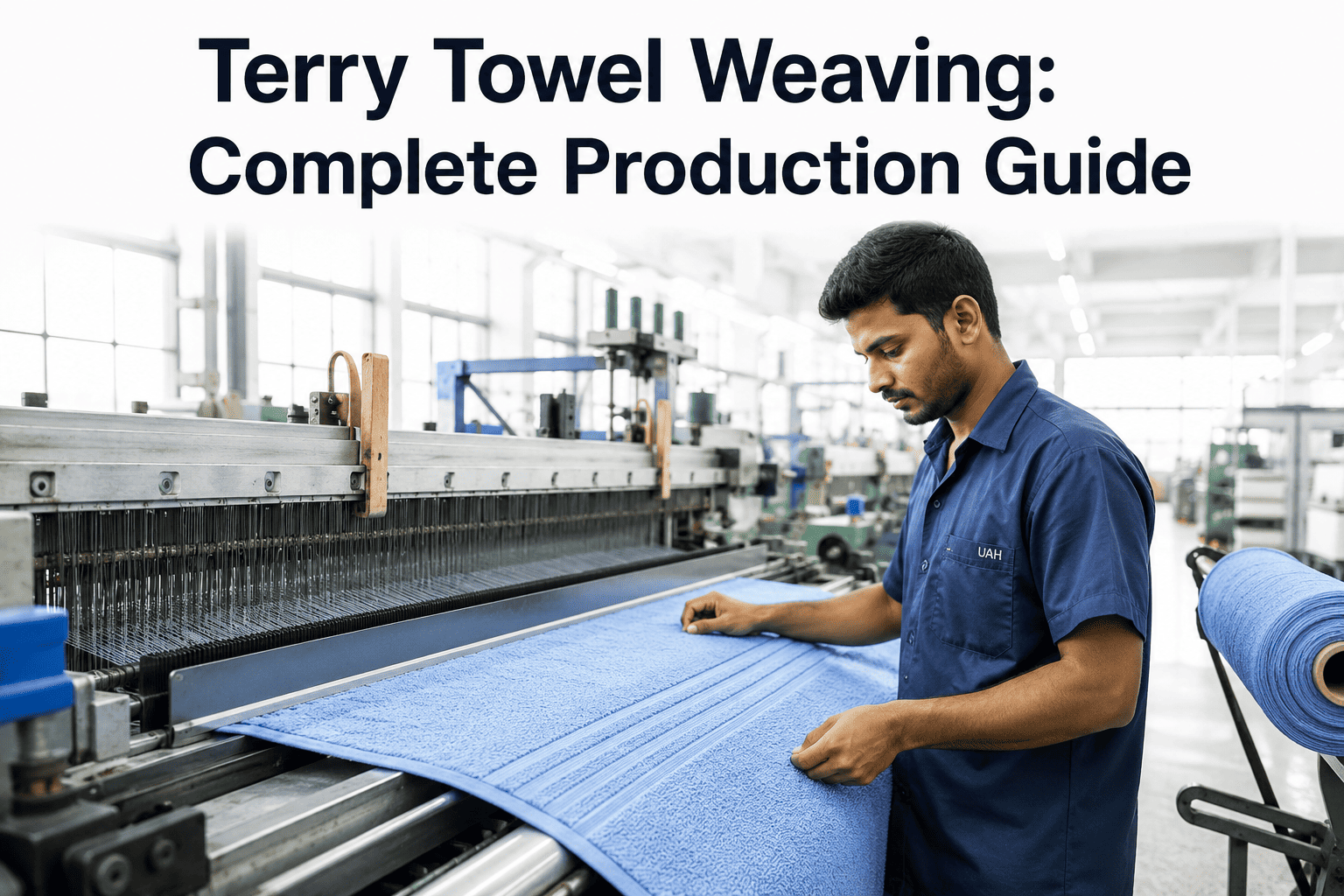
Terry towel weaving looks like a simple fabric until the pile loops on a batch come back uneven, and a mill realizes that loop formation is one of the more mechanically demanding processes in all of weaving — it requires three separate warp beams running at different tensions simultaneously, precisely timed reed movement, and a pile warp that must be allowed to slacken and snap forward at exactly the right moment in the weaving cycle. Terry fabric gets its absorbency and texture from thousands of small yarn loops standing up from a woven ground fabric, and every part of that loop — height, density, uniformity — is controlled by a specific combination of pile warp tension, ground warp tension, and reed beat-up timing that must stay in balance pick after pick. This guide covers how terry pile actually forms, the ground fabric construction underneath it, loop height and density control, and the quality factors that separate a premium towel from a thin, uneven one. Mills running or scaling terry production can book a 30-minute demo to see how iFactory tracks pile height consistency and ground fabric quality together across a terry weaving line.
Terry Towel Weaving — Pile Formation, Ground Fabric, and Loop Control
How the pile loop actually forms during weaving, the three-beam warp system terry fabric requires, ground fabric construction, loop height and density control, and the quality checks that determine finished towel performance.
Terry fabric requires two separate warp systems woven simultaneously — a tightly tensioned ground warp that forms the base fabric, and a loosely tensioned pile warp that is allowed to slacken and snap forward into a standing loop on a controlled group of picks. This two-tension system, combined with precisely timed reed beat-up, is what standard weaving equipment cannot produce without dedicated terry loom modifications.
The Pile Formation Mechanism — How a Loop Actually Forms
Terry pile formation happens over a repeating cycle of several picks, not on every single pick, and understanding this cycle is the foundation for understanding every quality parameter that follows.
Ground Picks Beat Firmly
The first group of picks in each pile cycle — typically two or three — are beaten up to the fell of the cloth at full reed force, locking the ground warp tightly and building the base fabric structure.
Pile Warp Tension Releases
Simultaneously, the pile warp beam lets out slack yarn under deliberately low tension, since this slack length is exactly what will be pulled forward into the standing loop on the next beat.
Reed Under-Beats the Pile Pick
On the pile-forming pick, the reed does not beat all the way to the fell of the cloth — it stops short, leaving the slack pile yarn positioned to be pushed into a loop rather than packed flat against the ground.
Full Beat Snaps the Loop Upright
A final full-force reed beat then drives all the accumulated slack pile yarn forward at once, snapping it into a standing loop anchored at the ground fabric — the defining terry loop structure.
Ground Fabric Construction — The Foundation Under Every Loop
The ground fabric that anchors terry pile is typically a simple plain weave, chosen deliberately for its strength and stability since it must securely hold thousands of pile loop anchor points under the stress of repeated washing and use.
Ground Warp Tension
Held significantly tighter than pile warp throughout weaving, since the ground fabric's job is dimensional stability while the pile warp's job is controlled slack — mixing these roles up produces a towel that distorts under wash.
Ground Weave Structure
Plain weave is standard for ground fabric because its high interlacement frequency locks pile loop anchor points firmly, resisting loop pull-out during use far better than a looser weave structure would.
Ground Yarn Count
Typically a stronger, tighter-spun yarn than the pile yarn itself, since the ground carries the fabric's structural load while the pile yarn's main job is absorbency and surface texture rather than strength.
Loop Height and Pile Density — The Parameters That Define Towel Quality
Loop height and pile density together determine a towel's absorbency, bulk, and hand feel, and both are controlled primarily through pile warp let-off tension and the number of pile picks per cycle.
Single-Sided vs Double-Sided Pile
Terry fabric can be woven with pile loops on one face only or on both faces, and this choice affects both the fabric's use case and its production complexity.
Single-Sided Terry
Pile loops form on one face while the other remains a flatter woven surface — common in fabric intended for one-sided use such as bathrobes with a smooth exterior, or where cost efficiency matters more than double-sided absorbency.
Double-Sided (Standard Bath Towel)
Pile loops form on both fabric faces simultaneously, requiring two separate pile warp systems with independent tension control — this is the standard construction for bath towels, face towels, and most household terry products.
Terry Weight Categories and Their Applications
Finished terry fabric is typically specified by weight, which correlates directly with pile density and yarn count, and different weight categories serve distinctly different end-use segments.
Lighter pile density suited to quick-drying use and lower cost per unit.
The most common household bath towel range, balancing absorbency, weight, and drying time.
Dense, plush pile for maximum absorbency and a heavier hand feel, common in premium hospitality linen programs.
Lower pile density favors print clarity and lighter carry weight over maximum absorbency.
Common Terry Weaving Defects and Their Causes
Because terry weaving involves two independently tensioned warp systems working in precise coordination, most terry-specific defects trace back to a tension or timing mismatch between the ground and pile warp beams.
Usually caused by inconsistent pile warp let-off tension across the beam width, or wear in the let-off mechanism causing tension drift over the length of a running warp beam.
Ground fabric interlacement too loose to securely anchor the pile loop base, often from ground warp tension set too low or ground weave density below specification.
Missed or skipped pile picks in the weaving cycle, typically a mechanical timing fault in the reed under-beat sequence rather than a yarn quality issue.
Ground warp tension too close to pile warp tension during weaving, failing to give the ground fabric the dimensional stability it needs to resist distortion under wash and dry cycles.
Terry quality is a tension-balance problem before it is a yarn quality problem.
Consistent loop height and secure pile anchoring both come down to keeping ground warp tension, pile warp tension, and reed under-beat timing in precise, repeatable balance across the full width and length of every warp beam. iFactory tracks these parameters together with loop height measurement by roll, flagging drift before an inconsistent batch reaches the cutting or finishing stage.
Frequently Asked Questions
Why does terry fabric need three warp beams instead of the usual one or two?
Standard weaving uses one warp beam feeding one warp tension system, but terry construction requires the ground warp held at firm, stable tension separately from the pile warp held at deliberately low, controlled tension — and in double-sided terry, the top and bottom pile warps often run on their own separate beams as well since their let-off behavior must be independently tuned for symmetric loop formation on both faces. Running ground and pile yarn from a shared beam at a shared tension is mechanically impossible because their tension requirements are fundamentally opposed — the ground needs firm control for stability while the pile needs slack for loop formation. This is precisely why terry weaving requires purpose-built terry looms rather than a standard loom with a minor adjustment, and why terry capacity cannot simply be added to a standard weaving shed without dedicated equipment. Book a demo to see multi-beam tension tracking built specifically for terry production.
What causes loop height to vary between the beginning and end of a warp beam?
Pile warp let-off tension needs to stay constant as the beam unwinds, but beam diameter changes continuously from full to empty, and a let-off mechanism that doesn't compensate for this changing diameter will apply subtly different tension at the start versus the end of the beam — producing a gradual loop height drift across the length of the roll rather than a sudden defect. Modern electronically controlled let-off systems compensate for beam diameter automatically and hold tension far more consistently than older mechanical let-off systems, which is one of the more cost-effective upgrades available to a mill experiencing chronic loop height drift on longer warp beam runs. Checking loop height at the start, middle, and end of a beam run is a simple diagnostic that quickly confirms whether beam-diameter compensation is the actual root cause before investing in mechanical upgrades.
Is higher pile density always better for towel quality?
Not necessarily — higher pile density increases absorbency and bulk up to a point, but beyond that point it mainly adds weight and cost without a proportional gain in actual drying performance, and very dense pile can also slow the towel's own drying time between uses, which some end-users specifically dislike. The right pile density depends on the intended end-use: a hotel program prioritizing plush guest experience may specifically want higher density despite the cost, while a fast-turnover gym or spa towel program may prefer a lighter, quicker-drying pile density even at a lower headline GSM number. Treating GSM or pile density as a simple "higher is better" quality signal misses that the correct target depends entirely on the towel's actual use case. Contact iFactory Support for help matching pile density specification to a specific end-use program.
Why do some towels lose loops or develop bald patches after repeated washing even though they wove correctly?
A towel that weaves with correct loop height and no visible defects can still be vulnerable to loop pull-out in use if ground fabric interlacement density was set at the minimum acceptable specification rather than with a margin above it — repeated wash and dry cycling applies mechanical stress to the ground-to-pile anchor point thousands of times over a towel's service life, and a marginal anchor that looked fine at inspection can gradually fail under that cumulative stress. This is why terry quality specifications typically call for ground fabric density somewhat above the bare structural minimum, treating the wash-cycle stress test as part of the real specification rather than relying on as-woven inspection alone. Any terry program experiencing complaints about loop loss after a few wash cycles should review ground fabric density against specification before assuming the pile yarn itself is defective.
How does single-sided terry production differ in cost and speed from double-sided?
Single-sided terry requires only one pile warp system rather than two, which simplifies the loom's mechanical setup, reduces the number of warp beams that must be prepared and tensioned independently, and generally allows somewhat higher weaving speed since there is one fewer tension system to coordinate on every pick cycle. This makes single-sided terry meaningfully cheaper to produce than double-sided terry at a comparable pile density and yarn count, which is why it remains common in cost-sensitive applications like one-sided bathrobe fabric or budget-tier towel lines where full double-sided absorbency isn't the primary selling point. A mill considering single-sided production purely as a cost-reduction measure for a product that traditionally expects double-sided pile should weigh the cost savings against the risk of the change being visible and unwelcome to end customers used to a double-sided feel. Book a demo to model cost and speed differences between single- and double-sided terry lines using your own production data.
Consistent pile height and secure loop anchoring, tracked roll by roll.
iFactory brings ground warp tension, pile warp tension, and loop height measurement together in one view across every terry loom on the floor, catching drift before it becomes a finishing-stage rejection. A 30-minute demo builds this view against your current terry production line.