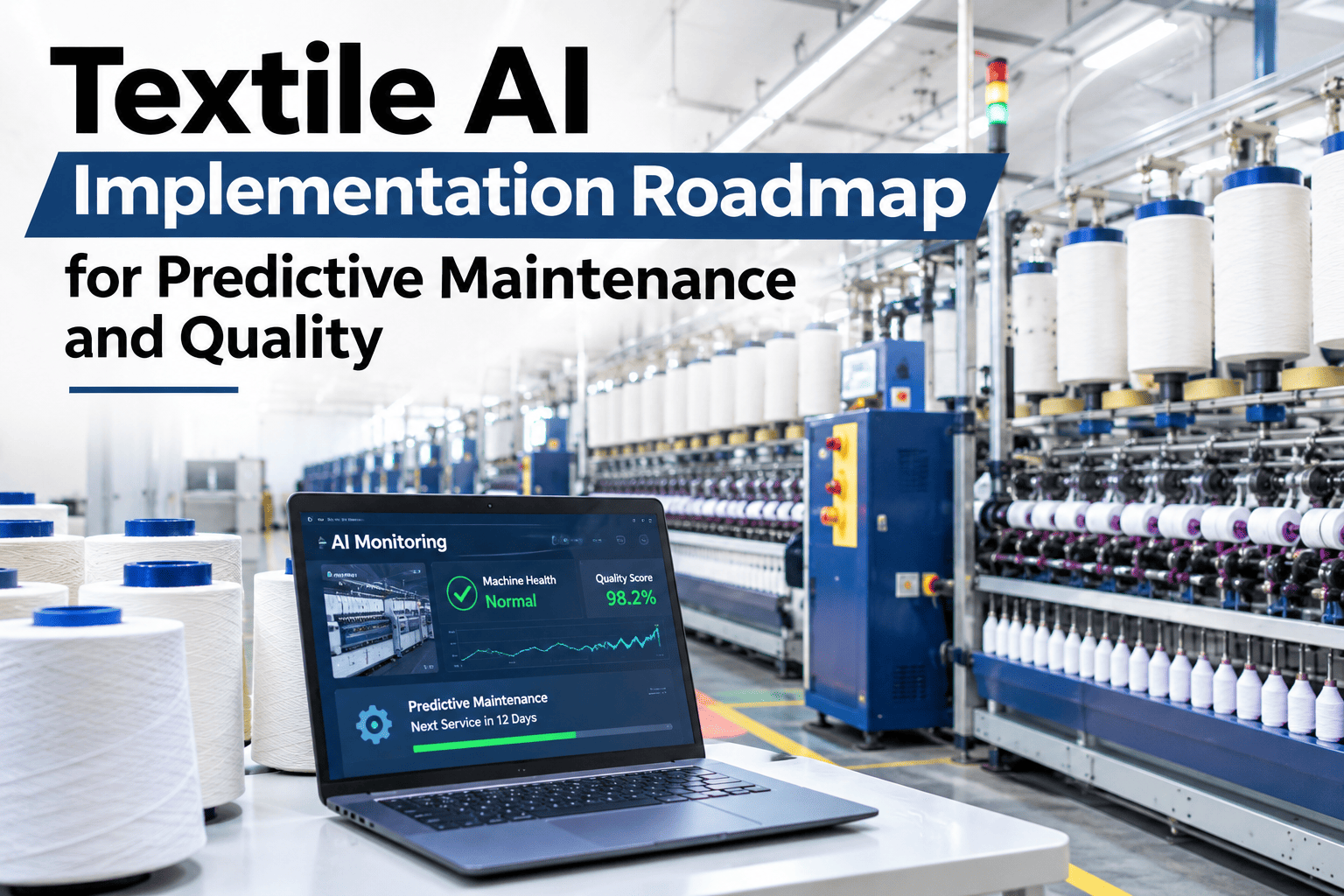
Most textile mills that invest in AI fail in the first year — not because the technology does not work, but because the deployment skipped data readiness, started with the wrong problem, or put a model in production before anyone trusted it enough to act on it. A textile AI implementation roadmap is not a technology plan; it is a trust-building process that earns operator and management confidence at each phase by delivering visible, measurable results before moving to the next. iFactory AI has deployed predictive maintenance, yarn quality prediction, and dyeing analytics across textile mills, and the roadmap that works consistently follows the same phase structure. Teams that want to map this for their own mill can review a phased AI implementation plan with iFactory AI's textile team.
Build AI Into Your Textile Mill in Phases That Earn Trust Before Asking for It
iFactory AI's textile deployment roadmap covers data readiness, sensor connectivity, machine health, yarn quality prediction, dyeing quality analytics, model validation, and operator workflows — in a sequence proven to deliver results in 6–12 weeks.
Why Most Textile AI Projects Stall — and How a Roadmap Prevents It
AI deployment in textile manufacturing fails in predictable ways. Understanding the failure modes before starting is the most valuable preparation a mill management team can do.
Phase 1: Data Readiness — What You Need Before AI Training
Data readiness is the foundation every AI use case in a textile mill builds on. It covers data availability (do the signals exist?), data quality (are they accurate and consistent?), data labeling (do we know which events correspond to which outcomes?), and data history (is there enough history to train a meaningful model?).
iFactory AI assesses data readiness as the first step of every textile deployment. Where gaps exist, the team designs the sensor additions, data collection workflows, and labeling processes needed to fill them before model training begins. Ask the support team what a data readiness assessment looks like for your mill.
Find Out If Your Mill's Data Is AI-Ready
iFactory AI runs a structured data readiness assessment for each AI use case you want to deploy — identifying what you have, what is missing, and how to fill the gaps before training begins.
Phase 2: Machine Health AI — Predictive Maintenance for Textile
Machine health AI is the right starting point for most textile mills because maintenance cost is high, failure events are recorded (in work orders), and the financial impact of a correct early prediction is immediate and visible. The goal in Phase 2 is to demonstrate one reliable failure prediction for one machine type before expanding.
Phase 3: Yarn Quality Prediction — From Parameters to Uster Forecast
Yarn quality prediction AI learns the relationship between process parameters — drafting settings, humidity, spindle speed, raw material properties — and resulting Uster quality values. The model predicts whether the current production conditions will yield yarn within specification, allowing supervisors to adjust parameters before the yarn is tested.
The model's predictions improve as more labeled Uster data accumulates. In the first 60 days, it operates in advisory mode — supervisors see the prediction and decide. After 90 days of validated performance, some mills move specific alert types to automatic work order generation. See a yarn quality prediction walkthrough for your count range.
Phase 4: Dyeing Quality AI — Predicting RFT Failure Before Shade Check
Dyeing quality AI is the highest-ROI phase for mills with significant re-dyeing costs. The model learns which combinations of temperature profile deviation, liquor ratio, water hardness, and recipe variation predict RFT failure — and alerts the dyehouse supervisor while the batch is still in progress, when correction is still possible.
Model Validation: What "Good Enough to Deploy" Means in Textile AI
A model that is accurate on training data but wrong on new production data is worse than no model — it creates false confidence. iFactory AI uses a standard validation framework before any model goes live in a textile mill.
| Metric | What it measures | Deployment threshold |
|---|---|---|
| Precision | Of all alerts generated, what fraction were real failures? | >70% (too many false alarms destroys trust) |
| Recall | Of all real failures that occurred, what fraction did the model alert on? | >80% (missing failures is the primary risk) |
| Lead time | How many hours before failure does the alert trigger? | >24 hours (must be enough time to plan maintenance) |
| False alarm rate | Alerts per month that did not correspond to a real event | <2 per machine per month |
Frequently Asked Questions
How much historical data does a textile mill need before starting AI training?
For predictive maintenance, a minimum of 6 months of sensor data including at least 10–15 failure events per machine type is needed to train a model with meaningful precision. For yarn quality prediction, 3 months of Uster data linked to machine and shift is a workable minimum. For dyeing quality, 200+ labeled batches per shade family is the threshold. If a mill has less history, iFactory AI collects new data in a structured way during Phase 1 before training begins — typically 60–90 days. Book a data readiness review to assess what your mill already has.
What is the difference between predictive maintenance and condition monitoring in a textile context?
Condition monitoring displays the current state of a machine — vibration level, temperature, bearing health — and alerts when a threshold is crossed. Predictive maintenance uses AI to learn from historical patterns and predict when a failure is likely before any threshold is crossed, often days in advance. Condition monitoring is Level 4 maturity; predictive maintenance is Level 5. iFactory AI supports both, with condition monitoring available as soon as sensors are connected and predictive models deployed after the validation phase. Ask the support team how condition monitoring and predictive maintenance coexist in a deployment.
Can yarn quality prediction AI work without changing machine settings automatically?
Yes — and this is the standard starting point. The model runs in advisory mode, displaying the predicted quality outcome and the parameter deviation causing it. The supervisor decides whether and how to adjust. Automatic parameter adjustment (closed loop) is an optional Phase 5 step that requires validated model performance, operator trust, and an agreed safety limit framework. Most mills run advisory mode permanently for quality and only move to closed loop for specific, well-understood parameter adjustments. See how advisory mode works in a live yarn quality prediction walkthrough.
How long does it take to see the first measurable result from textile AI with iFactory AI?
The first measurable results typically appear in Weeks 9–12 when the first predictive maintenance alert successfully prevents an unplanned stoppage, or when the dyeing AI alert prevents a re-dyeing event. Some mills see energy KPI improvements sooner — in Weeks 4–6 — simply from having machine-level energy data visible for the first time. Full production value from all three AI use cases (maintenance, quality, dyeing) is typically established by Month 6 of deployment. Ask about typical results timelines for mills similar to yours.
Does iFactory AI use a cloud-based AI model or an on-premise model for textile deployments?
All AI models in iFactory AI run on-premise on the NVIDIA GPU server deployed inside your mill. No textile production data, sensor readings, or quality records are sent to any cloud system. The model is trained on your mill's own historical data and runs inference locally — which means predictions are available even during internet outages, and data sovereignty is fully maintained. For mills with regulatory or buyer compliance requirements around data localisation, this is a critical differentiator. Book a demo to see the on-premise AI architecture for textile mills.
Build an AI Roadmap Your Mill Will Actually Follow — and Trust
iFactory AI deploys on-premise in textile mills with a phased roadmap that delivers measurable results at each stage — from data readiness to live predictive maintenance and quality prediction.