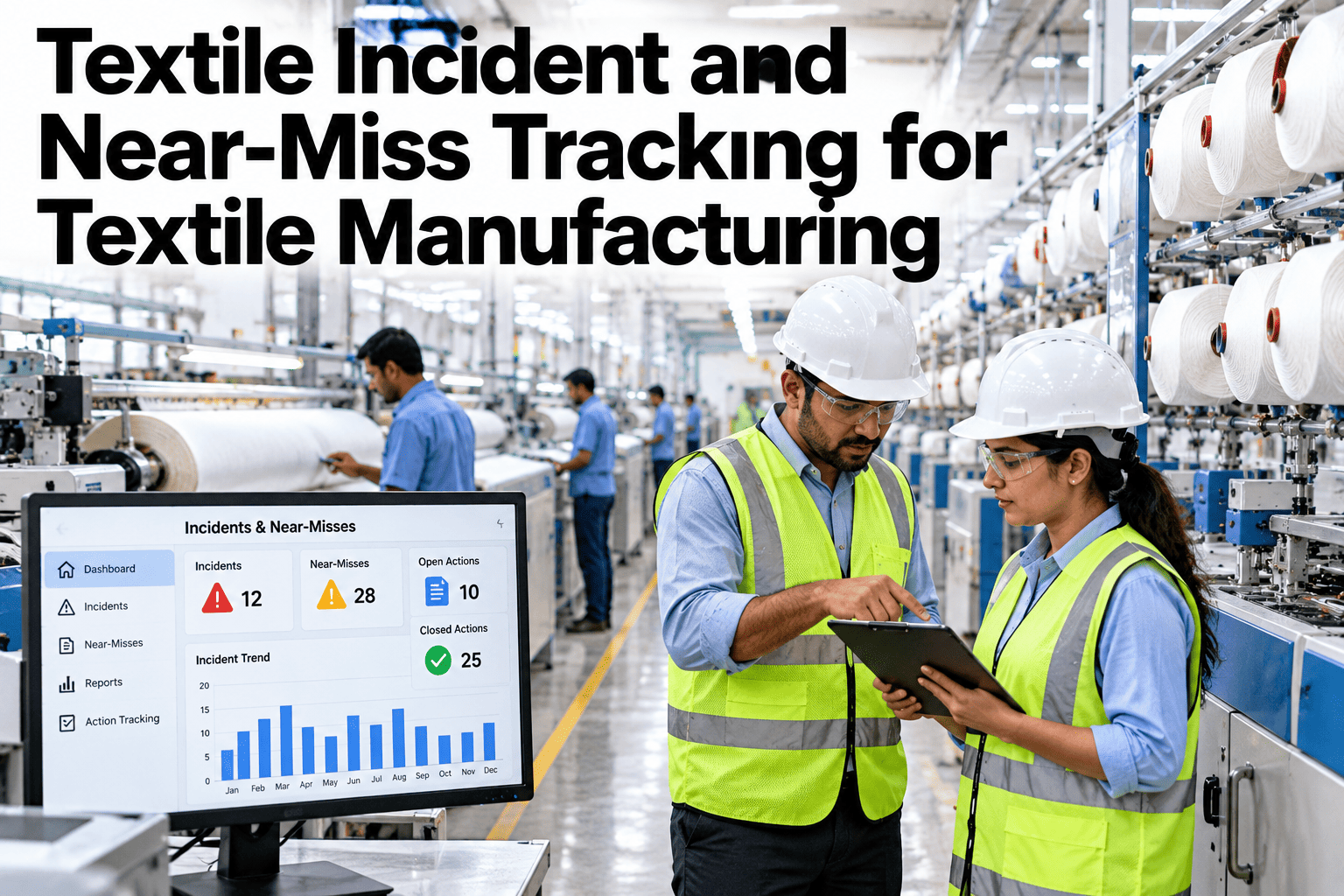
A near miss is a free lesson. Someone nearly caught a sleeve in a machine, slipped on a wet dyehouse floor or noticed a guard missing, and nothing happened this time. Mills that record and act on those moments prevent the injuries that would follow, while mills that ignore them wait for the real incident. Tracking incidents and near misses through to corrective action turns scattered stories into a safer plant. Teams who want that system can ask iFactory AI how incidents and near misses are captured and followed up.
Track Incidents and Near Misses Through to Corrective Action
iFactory AI makes reporting quick, classifies each event, assigns actions and checks they were closed, so every near miss reduces future risk.
Why Near Misses Matter More Than Incidents
Near misses are more frequent and carry the same causes as injuries. The chart shows an illustrative picture of that idea.
The Life of a Report
Every report follows the same path. Each step should have a clear owner and time.
Common Textile Hazards Worth Tracking
Textile floors share a set of recurring hazards. The matrix, shown as an illustration, ranks them by typical likelihood and severity.
| Hazard | Likelihood | Potential Severity |
|---|---|---|
| Entanglement in moving machinery | Moderate | High |
| Chemical splashes and fumes in dyeing | Moderate | High |
| Hot surfaces and steam | Moderate | High |
| Slips on wet or oily floors | High | Moderate |
| Lint and dust build-up with fire risk | Moderate | High |
| Noise exposure | High | Moderate |
Classifying Events Consistently
Consistent categories make trends visible. This table shows a simple scheme.
| Category | Example | Typical Response |
|---|---|---|
| Unsafe condition | Missing guard or wet floor | Fix quickly and record |
| Near miss | Sleeve caught but released without injury | Investigate and assign action |
| First aid or minor injury | Small cut treated on site | Investigate and review controls |
| Serious incident | Lost time or major damage | Full investigation and management review |
Turn Every Near Miss Into a Closed Action
Book a 30-minute session and iFactory AI will review your reporting process and recent events to show how near misses can lead to closed corrective actions.
Hierarchy of Controls: Choosing the Right Corrective Action
Not all fixes are equal. Stronger controls come first.
Reporting Culture: Making It Easy and Safe
People report when it is quick and nobody is punished for it. Four things matter most.
Speed
A report should take under a minute, from a phone or a floor terminal.
No blame
Reports are about conditions and systems, not individuals.
Feedback
Reporters see what happened to their report.
Visible leadership
Supervisors act on reports and thank people for them.
Reporting Versus Responding
Programs often measure how many reports arrive but not what happens next. Both matter.
Near-Miss Review Checklist
Use this list at the weekly safety meeting. Each box should be answerable from the record.
A Composite Scenario: The Guard That Kept Being Removed
This is a composite example, not a named mill. It shows how tracking leads to a better control.
Mistakes That Weaken Safety Programs
These habits turn reporting into paperwork.
Treating reports as blame
People stop reporting.
Counting reports but not actions
Safety does not improve by logging alone.
Relying on training as the fix
Stronger controls are usually available.
Closing actions without verifying
The hazard may still be there.
What iFactory AI Adds to Safety Tracking
iFactory AI is smart manufacturing and industrial software for textile operations. Explore incident tracking in a live product tour on realistic safety data.
A 30-Day Plan to Start
A month is enough to start a working near-miss process in one department.
Review of Incident and Near-Miss Tracking
A practical review of what makes safety reporting effective, written as editorial guidance rather than a named expert quote.
Make reporting effortless
The easier it is to report, the more lessons you collect.
Rate potential, not just outcome
A near miss with serious potential deserves a serious response.
Verify the fix
A closed action is only real when the hazard is confirmed gone.
Frequently Asked Questions
What is a near miss?
It is an event that could have caused injury or damage but did not, this time. See near misses recorded and followed up in a live demo with realistic examples. Learning from them prevents the real incident.
How do we encourage people to report?
Make reporting quick, avoid blame, show what happened to each report and have leaders respond visibly. People report when they see results. Thanking reporters helps.
How should corrective actions be chosen?
Prefer stronger controls such as eliminating or guarding a hazard over training or protective equipment alone. Ask support how control strength is recorded for each action in the system. Strong controls last longer.
Which events should be investigated first?
Those with the highest potential severity, even if nobody was hurt. Frequency and repeat patterns also matter. A simple severity scheme guides the order.
How soon can a mill start?
Many mills launch quick reporting and a first review routine within a month. Book time to scope a near-miss tracking pilot on one department. Closed actions build trust and participation.
Learn From Every Near Miss Before It Becomes an Injury
iFactory AI captures reports quickly, tracks actions to closure and shows where hazards cluster. Book a walkthrough to see it on your own plant.