A loss review meeting that wanders between downtime anecdotes, a quality complaint and someone's theory about the boiler rarely produces an action anyone follows up on. The meetings that actually reduce loss work through the same fixed agenda every time — downtime, yarn breaks, quality rejection, energy intensity, rework and re-dyeing — so nothing gets skipped because it wasn't top of mind that day. iFactory AI, an on-premise AI platform for textile operations, can pre-populate this template with your mill's own loss data before your next review meeting.
A Loss Review Without a Fixed Agenda Finds Whatever Was Loudest That Week
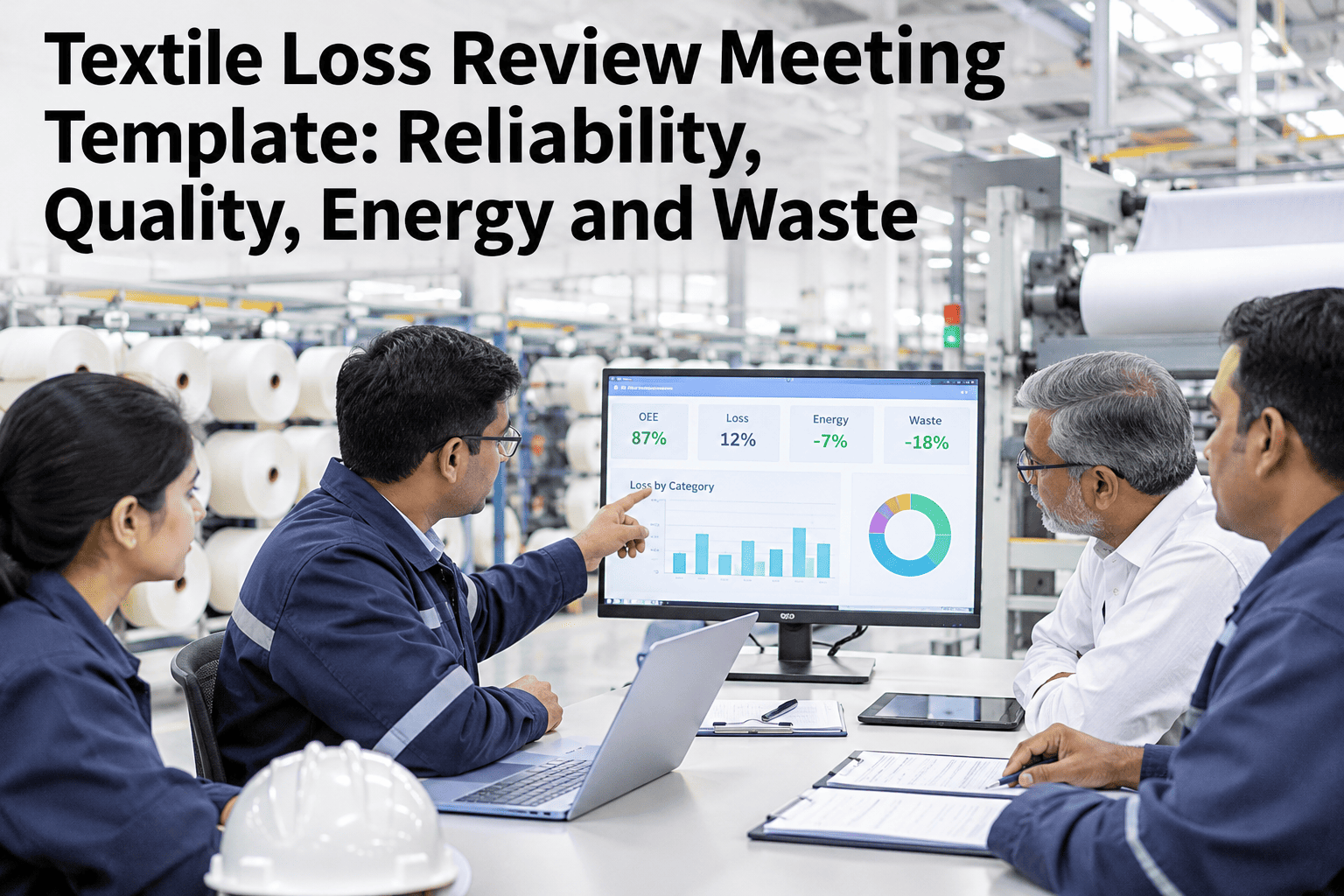
A structured template covering downtime, yarn breaks, quality rejection, energy intensity, rework and re-dyeing keeps the review from drifting toward whichever loss happened to be most visible.
Why a Fixed Agenda Beats an Open Discussion
An open-format loss meeting tends to spend most of its time on whatever loss someone in the room feels most strongly about, which is rarely the same as the loss costing the most. A fixed six-category agenda, run in the same order every week, forces every loss type onto the table regardless of who's in the room or what happened to be top of mind.
Nothing gets skipped because the meeting ran long before reaching it.
Each category opens with the week's numbers, not a recollection of events.
An action without an owner by the end of the meeting doesn't count as an action.
Open items from last week open this week's meeting, not the newest complaint.
The Six-Category Checklist
Work through these in order. Our team can pre-load each section with your mill's actual week-over-week data before the meeting starts.
Top three downtime contributors this week, compared against the prior four-week average.
Frames running above their normal break-rate band, with maintenance status noted.
Rejection rate by category, flagged against the plant's internal target.
This week's energy-per-kg figure against trend, with any spike events named.
Batches reworked or re-dyed this week, grouped by root cause where known.
Every open item from the five categories above assigned a name and a date.
A Sample Weekly Scorecard
| Category | This Week | 4-Week Avg | Trend |
|---|---|---|---|
| Downtime (hours) | 38 | 42 | Improving |
| Yarn breaks / 1000 spindle-hrs | 16 | 14 | Worsening |
| Quality rejection rate | 2.1% | 1.9% | Worsening |
| Energy intensity (kWh/kg) | 1.42 | 1.45 | Improving |
Run Your Next Review With Pre-Loaded Numbers
Bring your current loss data and leave with this template populated against your own four-week trend, ready for the meeting.
Who Should Be in the Room
Speaks to downtime and yarn break categories directly.
Owns rejection data and rework root-cause findings.
Explains any intensity spike against known causes.
Confirms owners and holds the group to last week's actions.
A Composite Scenario: The Meeting That Finally Closed Its Own Loop
Picture a mill where loss reviews had drifted into open discussion, with yarn break data presented inconsistently and rework rarely making the agenda at all.
Moving to a fixed six-category template with pre-loaded data cut meeting time while ensuring rework and re-dyeing — previously an afterthought — finally received weekly scrutiny. Three months in, a recurring re-dyeing cause traced to a single recipe step was identified only because the category had a guaranteed slot every week. The scenario illustrates the method, not a guaranteed outcome for every mill.
Where iFactory AI Fits
iFactory AI pulls downtime, yarn break, quality, energy and rework data automatically into this six-category template ahead of each review, so the meeting opens with numbers already in front of the room.
Each category's numbers pulled from live systems before the meeting starts.
Owners and deadlines carried forward automatically to the next review.
Every figure shown against its four-week average, not in isolation.
Frequently Asked Questions
Most mills complete all six categories within 30 minutes once the template is pre-loaded with data, since the discussion moves to the numbers already on the page instead of gathering them live. See a sample 30-minute agenda for your team.
It still gets its slot, even briefly, since the point of a fixed agenda is consistency — a category skipped because "nothing happened" is often where a slow-building pattern goes unnoticed. Ask how to handle quiet weeks without losing the habit.
Each item keeps its owner, due date and status visible until it's marked closed, so an unresolved action from three weeks ago still opens the relevant category instead of being quietly dropped. See how carry-forward tracking works.
Yes, the six categories can be adjusted to match what a specific mill actually runs, dropping or adding categories as long as the fixed-agenda discipline stays intact. Discuss a version for your operation.
A plant manager or operations lead typically facilitates, keeping the agenda on schedule and holding the room accountable to actions confirmed in the previous week's review. Talk through facilitation roles for your team.
Give Your Next Loss Review a Fixed Agenda
iFactory AI pre-populates this six-category template with your mill's own data, so the meeting starts with numbers, not recollection.