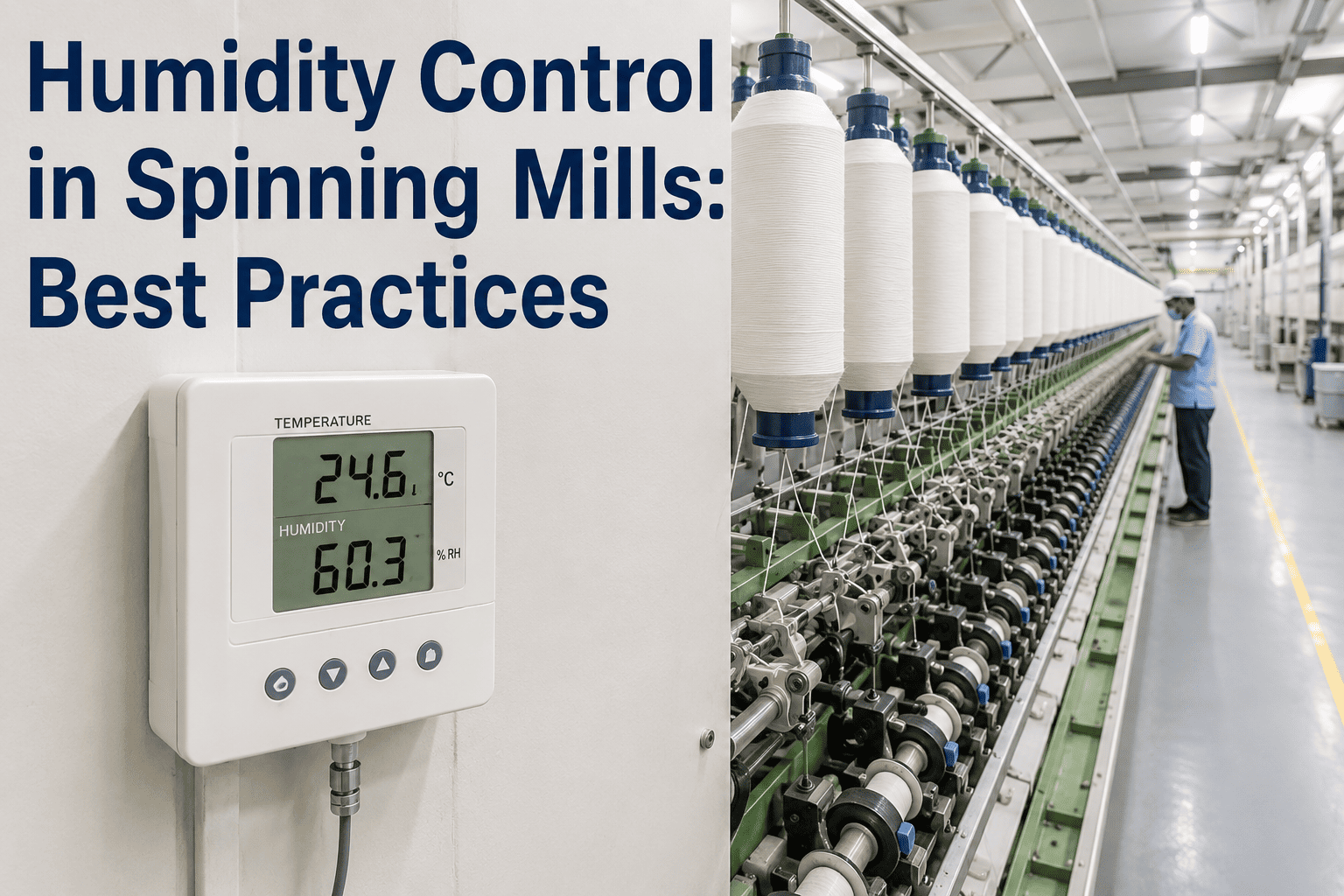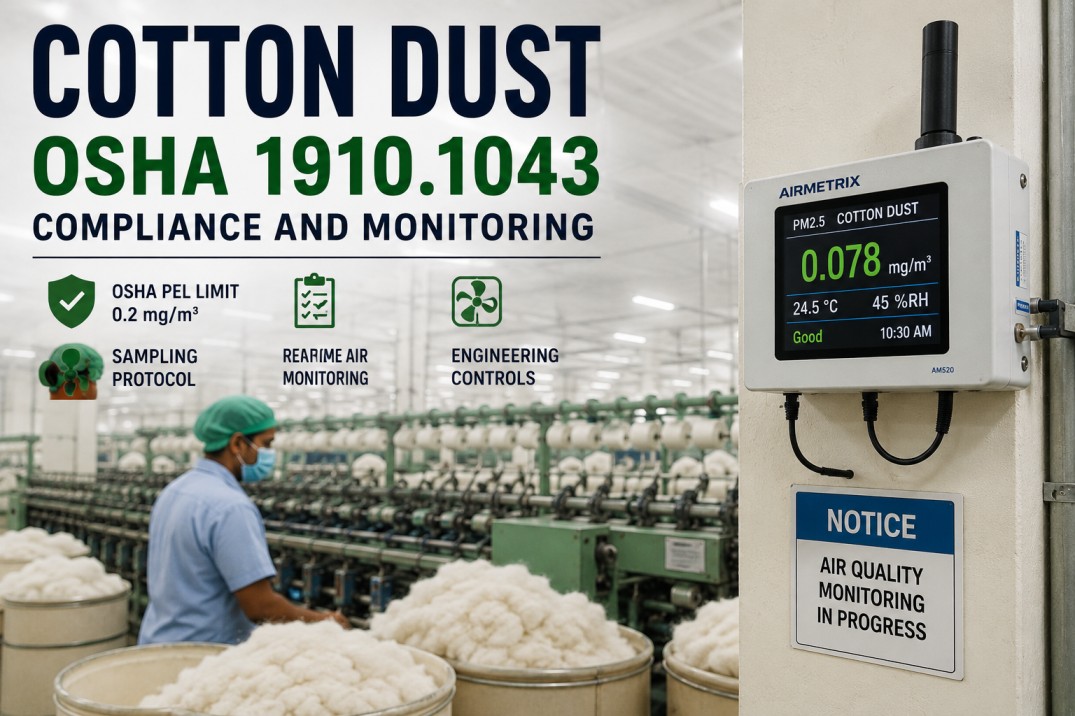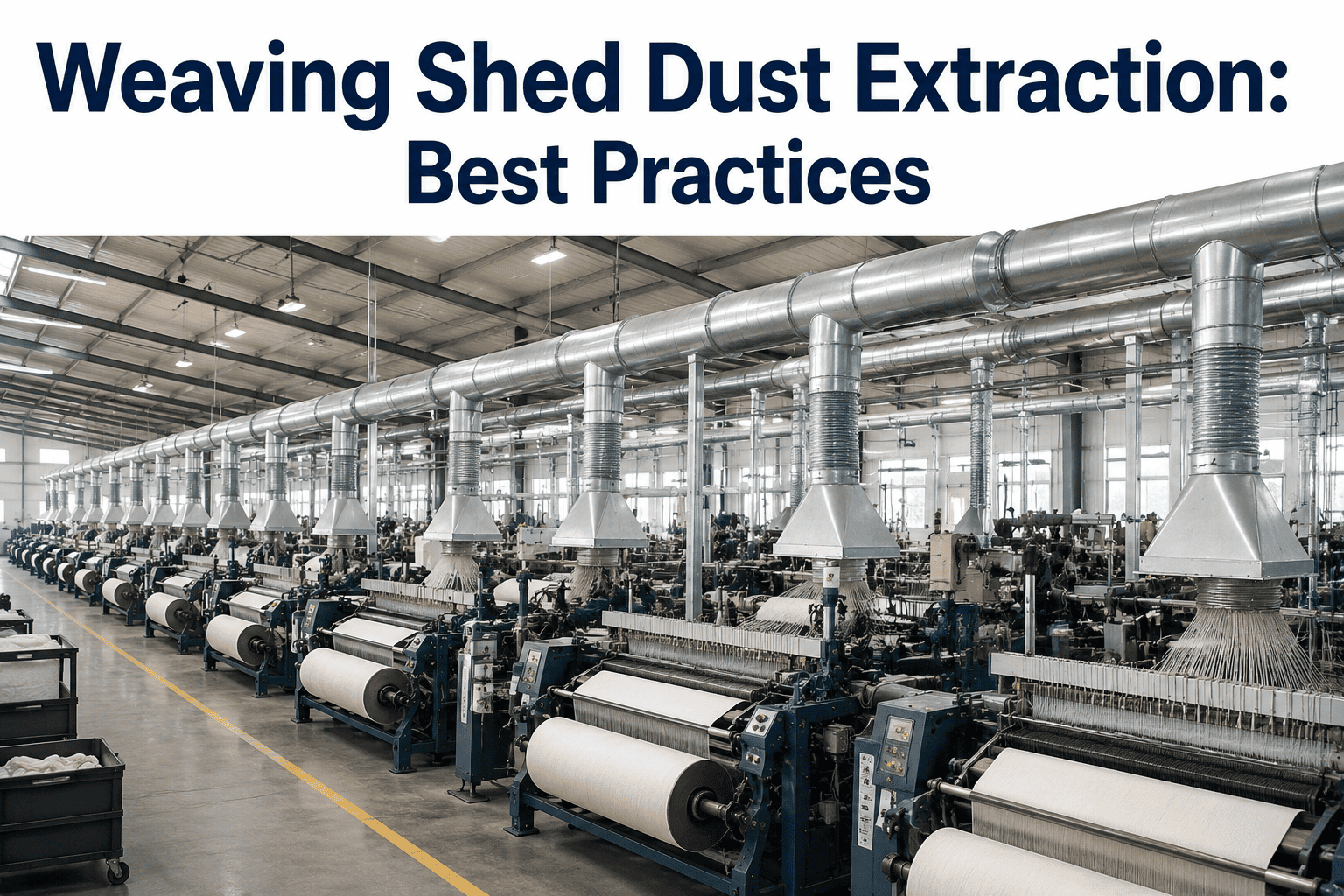
A weaving shed runs on a contradiction most facility managers never fully resolve: the fabric needs high humidity to keep yarn from breaking, and the room needs aggressive air extraction to keep cotton fly and lint from accumulating into a fire hazard and a respiratory one. Get the balance wrong in either direction and the cost shows up somewhere — warp breaks and lost production if humidity drops too low, or dust loading on light fittings and rafters that OSHA and NFPA both treat as a serious violation if extraction falls short. Facility and engineering teams designing or auditing a weaving shed's air system can Book a Demo to see how iFactory tracks air change rates, filter maintenance, and dust housekeeping compliance in one system.Most weaving operations discover this tension the hard way, through symptoms rather than a deliberate design review — a run of warp breaks that traces back to unusually dry weather outside coinciding with reduced humidification capacity, or a fire inspection finding overhead dust accumulation that had been building for months without anyone noticing during routine floor-level housekeeping. Both problems are preventable with the right combination of zonal air design, source-capture extraction, and scheduled verification, but only if the facility treats environmental control as an engineered system rather than a set of independent equipment purchases layered on top of each other over time.
The Central Tension: High Humidity Versus Aggressive Extraction
Every other industrial ventilation problem optimizes toward one goal — remove the contaminant, dilute the hazard, done. Weaving sheds optimize toward two goals that actively work against each other. Cotton yarn needs relative humidity commonly maintained above 70 to 80 percent at the loom to stay pliable and resist breaking under the mechanical stress of high-speed weaving; low humidity causes static buildup and brittle yarn that snaps constantly, driving warp breaks and lost production. But that same humid, still air is exactly the environment that lets cotton fly and fine dust settle and accumulate rather than staying airborne long enough to be captured and extracted.
The engineering answer most modern weaving mills converge on is zonal separation rather than a single room-wide compromise: a laminar, humidified air supply delivered directly into the loom's immediate working zone, paired with strong extraction capturing fly and dust at or near its source before it can disperse into the wider shed atmosphere. This lets the loom zone run at the high humidity yarn quality demands while the surrounding shed air stays dry enough, and dust-free enough, to avoid the accumulation that drives both respiratory exposure and fire risk.
Air Change Rates: How Much Airflow a Weaving Shed Actually Needs
Air changes per hour — the number of times the entire room's air volume is replaced in an hour — is the primary sizing metric for weaving shed ventilation, and the target range varies dramatically depending on whether the goal is general dust dilution or full process-zone environmental control. Facilities investing in a modern laminar-flow loom zone system operate at the high end of this range; facilities relying on general dilution ventilation without zonal separation need less total airflow but correspondingly weaker dust control.
The gap between the low end and high end of this range is not a matter of one number being wrong — it reflects genuinely different design philosophies and loom technology generations. Older shuttle-loom sheds running at lower speeds generate less fly and can operate acceptably at the lower ACH tier with general dilution ventilation. Modern high-speed air-jet and rapier looms generate substantially more fly and micro-dust per hour of operation, and only the higher-tier laminar-flow zonal approach keeps both dust levels and humidity within acceptable ranges simultaneously at those production speeds.
Sizing an extraction system to the wrong ACH tier for the loom technology actually installed is a recurring and expensive mistake. A facility that retrofits high-speed air-jet looms into a shed originally ventilated for older shuttle looms, without correspondingly upgrading the air change rate and source-capture design, tends to see dust levels climb steadily even though nothing about the ventilation system itself has changed — the equipment generating the dust simply outpaced the air system's original design assumptions. Reviewing ACH targets whenever loom technology is upgraded, rather than treating the original HVAC design as a fixed constraint, is the practical safeguard against this drift.
Source Capture: Where Extraction Hoods Actually Belong
Dust extraction that relies solely on room-wide dilution ventilation is fighting an uphill battle — it is far more effective, and far cheaper in total airflow required, to capture fly and dust at the specific points where looms and preparatory equipment generate it, before that material disperses into the general shed atmosphere. Source capture hierarchy runs from the equipment generating the most concentrated dust down to general area ventilation as a backstop for whatever source capture misses.
The economic argument for prioritizing source capture over dilution is straightforward once the underlying physics is understood. Capturing dust at a concentrated source point, where velocity and airflow can be tightly controlled around a small opening, requires dramatically less total air volume than diluting the same quantity of dust once it has dispersed across an entire room's air volume. A shed that under-invests in source-capture hoods and instead tries to compensate with ever-higher general ventilation air changes typically ends up spending more on total fan horsepower and energy cost than a comparable shed with well-designed source capture, while still achieving worse dust control at the loom operator's actual breathing zone.
Filter Technology: Matching the Collector to the Dust Load
Cotton fly and lint are bulky, fibrous, and hygroscopic — they hold moisture and behave differently in a filtration system than fine mineral or metal dust does. Selecting the wrong collector technology for this specific dust profile leads to premature filter blinding, excessive pressure drop, or a system that simply cannot keep pace with the volume of material a modern high-speed weaving operation generates.
Whichever collector technology is selected, combustible dust safety standards apply directly to cotton fly and lint, which are recognized combustible dusts capable of flash fire and explosion under the right concentration and ignition conditions. NFPA 654 governs prevention of fire and dust explosions from combustible particulate handling broadly, setting requirements around filter media placement, collector siting relative to ignition sources, and housekeeping thresholds that weaving facility engineering teams need to design around from the outset rather than retrofit later.
Exposure Limits and Regulatory Thresholds
Cotton dust exposure in weaving and slashing operations is directly regulated in the United States under OSHA's cotton dust standard, which sets specific airborne concentration limits that ventilation and extraction system design must be capable of meeting, not just aspiring toward.
| Process Area | Permissible Exposure Limit | Measurement Basis |
|---|---|---|
| Slashing and weaving | 375 µg/m³ mean concentration | 8-hour average, lint-free respirable cotton dust, vertical elutriator or equivalent instrument |
| Yarn manufacturing and cotton washing | 200 µg/m³ mean concentration | 8-hour average, lint-free respirable cotton dust |
| Waste house operations | Separate, more stringent limits apply | Per specific lower-grade washed cotton provisions |
These are exposure limits on the fine, respirable fraction of cotton dust specifically — particles of approximately 15 micrometers or less — measured with a vertical elutriator sampler, not a general dust or lint measurement taken with an ordinary particle counter. Facilities relying only on visible housekeeping standards or general air quality impressions without periodic vertical elutriator sampling cannot actually demonstrate compliance with the regulatory exposure limit, since fine respirable dust concentration and visible dust accumulation do not correlate reliably enough to substitute one for the other.
Housekeeping and Fire Prevention: The Overhead Blind Spot
Ventilation and extraction system design handles the airborne dust problem. Housekeeping handles the accumulated dust problem, and the two are equally important for fire prevention — a well-designed extraction system that captures 95 percent of generated dust still leaves the remaining 5 percent to settle somewhere, and where it settles matters enormously for fire risk.
Building a housekeeping schedule around this reality means treating overhead cleaning as a distinct, scheduled task rather than an incidental byproduct of general floor cleaning. Floor-level sweeping and vacuuming, however thorough, does nothing to address dust settling on rafters, light fittings twenty feet overhead, or the tops of cable trays running above the weaving floor. A documented overhead cleaning schedule, with a defined frequency tied to actual dust generation rates rather than a generic annual or semi-annual default, closes the gap that routine housekeeping otherwise leaves wide open.