Most pattern rooms treat fabric waste as an unavoidable byproduct of cutting, something to minimize at the margins rather than eliminate at the source. That mindset is exactly why the industry still loses an average of 15 percent of every fabric roll before a single seam is sewn. Zero-waste pattern design rejects that framing entirely, treating the fabric width itself as the canvas and shaping every pattern piece to interlock with its neighbors like a puzzle rather than sit inside its own isolated block. For a mill or brand still relying on conventional layouts, see how AI-assisted pattern design fits your production line.
CIRCULAR TEXTILE PRODUCTION · ZERO-WASTE PATTERN DESIGN · FABRIC UTILIZATION
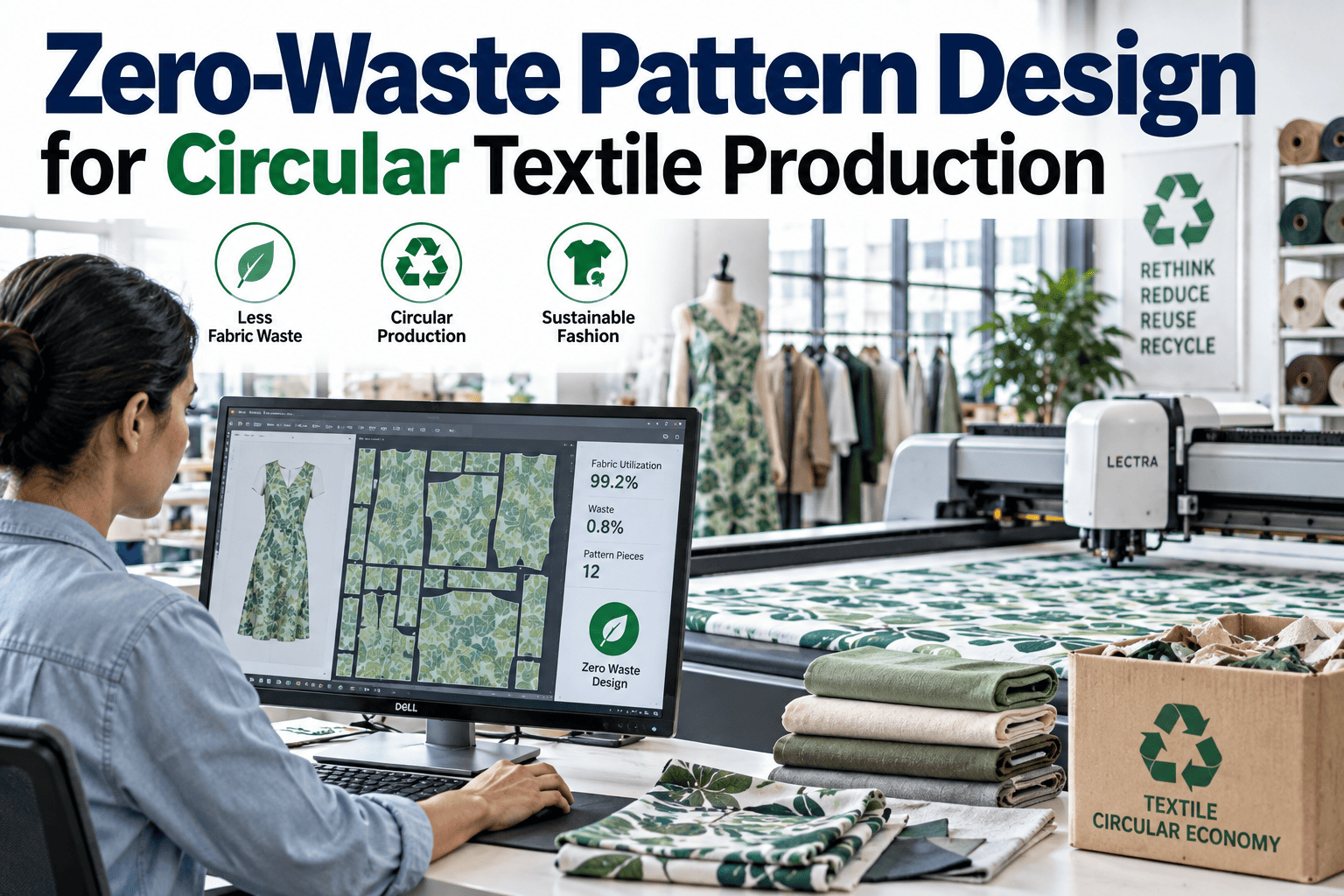
Zero-Waste Pattern Design Turns Cutting Room Waste Into Usable Fabric
iFactory AI helps circular-focused mills and brands redesign pattern layouts so every centimeter of fabric width becomes a garment piece, replacing the 10-20 percent waste standard in conventional cutting with layouts engineered to leave nothing behind.
Same Fabric Width, Two Completely Different Outcomes
Conventional Cutting Layout
~15-20% Waste
Zero-Waste Tessellated Layout
~0-2% Waste
THE PROBLEM
The Real Cost of Conventional Pattern Cutting
Fabric typically accounts for 50 to 60 percent of total garment manufacturing cost, which means every percentage point lost in the cutting room is not a rounding error, it is a direct hit to margin. The "cut and sew" method that has dominated garment production for centuries generally achieves only around 85 percent fabric consumption efficiency.
| Waste Source |
Why It Happens |
Typical Range |
| Irregular Pattern Piece Shapes |
Curved seams, darts, and flared edges leave gaps no adjacent piece can fill |
10-20% of fabric consumed |
| Design-First Pattern Making |
Patterns drawn to match a sketch before any layout efficiency is considered |
Adds 3-8% beyond baseline waste |
| Marker Planning Constraints |
Fixed fabric width and grain direction rules limit how pieces can be arranged |
Varies by fabric type and width |
| Sample and Development Waste |
Multiple pattern iterations before a style is finalized for production |
Separate from cutting-floor waste |
None of this waste is intentional, it is structural. As long as pattern pieces are designed as independent shapes and only afterward arranged onto fabric, some percentage of that fabric will always be left over, regardless of how sophisticated the arrangement software becomes.
THE APPROACH
Five Core Techniques Behind Zero-Waste Pattern Design
Zero-waste pattern design is not one single method, it is a family of techniques that all share the same underlying principle: design the pieces and the layout together, instead of designing pieces first and hoping they fit later.
Subtraction Cutting
Garment shape is created by cutting negative space out of a single connected piece of fabric rather than assembling separate panels.
Jigsaw Tessellation
Every pattern piece is drafted with an edge shaped to match its neighbor, so pieces interlock across the full fabric width with no gaps.
Draping and One-Piece Construction
Fabric is shaped directly on a mannequin through tucking and layering, an approach with roots in traditional kimono and sari construction.
Geometric Grid Patterning
Pieces built from rectangles, triangles, and other simple geometric shapes that nest against each other with mathematical precision.
AI-Assisted Pattern Generation
Algorithms transform a conventional pattern into a zero-waste layout automatically, then simulate the result on a virtual body before cutting.
Find out how much fabric your current patterns are actually leaving behind
iFactory AI compares your existing pattern library against a zero-waste alternative and shows the fabric savings in real numbers.
A COMMON MISCONCEPTION
Why Standard Nesting Software Still Leaves Waste on the Floor
Many mills already run automated nesting software and assume that counts as a zero-waste strategy. It doesn't, and the reason matters for anyone deciding where to invest next.
| Approach |
What It Optimizes |
Realistic Fabric Savings |
| Automated Nesting Algorithm |
Arrangement of existing, unchanged pattern pieces |
Around 4%, since piece shapes stay irregular |
| Manual Marker Planning |
Experienced planner's judgment on piece placement |
Similar range, highly dependent on planner skill |
| Zero-Waste Pattern Redesign |
The piece shapes themselves, engineered to interlock |
Can approach 0-2% residual waste |
Nesting software rearranges puzzle pieces that were never designed to fit together in the first place. Zero-waste pattern design redraws the puzzle pieces themselves, which is a fundamentally different intervention and the only one that closes most of the remaining gap.
BEYOND THE CUTTING TABLE
Designing Modular, Circular-Ready Garment Systems
Zero-waste pattern design pairs naturally with circular production goals, because both disciplines start from the same question: what happens to every part of this fabric, from the first cut to the garment's eventual end of life.
Interchangeable Panels
Standardized pattern pieces reused across multiple styles, reducing the number of unique shapes a mill has to plan around.
Standardized Geometric Components
Building garments from a shared library of simple shapes that already nest efficiently, rather than one-off silhouettes.
Design for Disassembly
Seam and construction choices that make a garment easier to take apart and recycle its fabric at end of life.
Waste as a Design Feature
Small unavoidable remnants intentionally incorporated as trims or accents instead of discarded.
GETTING STARTED
A Practical Sequence for Adopting Zero-Waste Pattern Design
Redesigning an entire pattern library overnight is not realistic for most production teams. A staged rollout builds capability and proves fabric savings before asking a full design team to change how they work.
1
Audit Current Fabric Utilization
Measure exactly how much fabric your best-selling styles waste today, so improvement has a real baseline.
2
Pick One High-Volume Style to Redesign
Choose a style with high production volume so the fabric savings compound quickly across many units.
3
Apply a Zero-Waste Technique and Simulate the Fit
Redraft the pattern using tessellation or geometric grid principles, then validate fit digitally before cutting fabric.
4
Compare Fabric Consumption Against the Baseline
Confirm the redesigned pattern actually reduces waste in practice, not just on paper.
5
Expand the Technique Across the Pattern Library
Apply the validated approach to additional styles, growing a reusable library of zero-waste components over time.
HOW IFACTORY AI HELPS
How iFactory AI Supports Zero-Waste, Circular Production
iFactory AI's role is to make the transition from conventional to zero-waste pattern design measurable and repeatable, rather than dependent on one designer's individual expertise.
What Gets Assessed
Current fabric utilization rate across your top-volume styles
Where pattern piece shapes create the largest layout gaps
Existing nesting software performance versus a redesigned baseline
Readiness of pattern data for AI-assisted layout generation
Deployment Approach
Phase 1: Baseline fabric utilization audit on selected styles
Phase 2: AI-generated zero-waste pattern alternatives with fit simulation
Phase 3: Rollout across the broader pattern library with ongoing tracking
FREQUENTLY ASKED QUESTIONS
What Brands and Mills Ask About Zero-Waste Pattern Design
Does zero-waste pattern design mean sacrificing style or fit?
Not necessarily, though it does require the designer and pattern maker to work together from the start rather than in sequence. Techniques like draping and geometric grid patterning have produced fashion-forward, well-fitted garments for decades, and digital simulation now lets a pattern maker check fit before ever cutting fabric.
Our team can walk through fit-preserving zero-waste methods suited to your specific style categories.
How much fabric can zero-waste pattern design actually save compared to standard nesting software?
Standard nesting algorithms typically save around 4 percent because they only rearrange pieces that remain irregularly shaped. A true zero-waste pattern redesign changes the piece shapes themselves and can bring residual waste down close to zero, which is a meaningfully larger gain than better arrangement alone can deliver.
Get a fabric utilization comparison for your current patterns to see the realistic gap for your styles.
Can zero-waste techniques be retrofitted onto existing best-selling styles, or only new designs?
Existing styles can often be redesigned using zero-waste principles while keeping the original silhouette recognizable to customers, since the technique changes how pieces are shaped and arranged rather than the garment's overall look. This is usually the fastest path to savings because high-volume styles compound any fabric reduction across large production runs.
Our specialists can review your existing pattern library to identify strong retrofit candidates.
What's the difference between zero-waste pattern design and simply improving nesting algorithms?
Nesting algorithms optimize the placement of pattern pieces that were never designed to fit together, which caps their savings at only a few percentage points. Zero-waste pattern design instead redraws the pieces themselves so their edges interlock across the fabric width, addressing the root cause of waste rather than its arrangement.
Request a side-by-side layout efficiency breakdown comparing both approaches on your patterns.
How does zero-waste pattern design support broader circular textile production goals?
Reducing cutting waste is one of the highest-leverage circular economy actions available, since it prevents waste before it is ever generated rather than managing it after the fact through recycling or upcycling. Combined with modular construction and design-for-disassembly principles, it forms a foundation that makes end-of-life recovery meaningfully easier.
Connect with our circular production advisors to align pattern design with your sustainability targets.
ELIMINATE WASTE AT THE SOURCE
Redesign Your Patterns Before Fabric Ever Hits the Cutting Table
iFactory AI turns conventional pattern libraries into zero-waste layouts, showing exactly how much fabric, cost, and landfill waste your production line can eliminate.