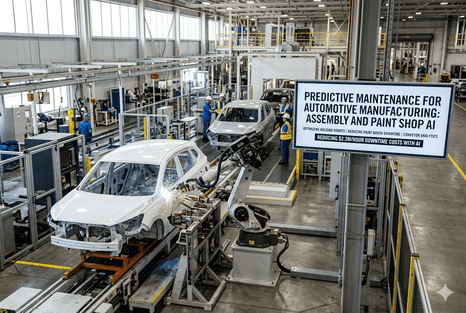
Every minute of unplanned downtime on an automotive assembly line costs upwards of $22,000, with a single hour of stoppage at a large plant now exceeding $2.3 million according to Siemens' 2024 True Cost of Downtime report. For one mixed-model assembly plant running three shifts across stamping, welding, paint, and final assembly, the annual toll of reactive maintenance had reached $4.6M in lost production value — before deploying iFactory's AI-driven predictive maintenance platform. By deploying continuous vibration, thermal, and current-signature monitoring across 270 critical assets — including welding robots, conveyor drives, and paint booth fans — the plant detected 31 developing faults an average of 23 days before failure, eliminated catastrophic breakdowns, and recovered the full $4.6M in production value within 14 months. This case study examines exactly how AI predictive maintenance transforms automotive assembly operations from reactive firefighting into a proactive, data-driven reliability discipline.
Is Your Assembly Plant's Downtime Data Working for You?
Unify vibration analysis, thermal monitoring, and maintenance workflow automation into one intelligent platform designed for high-volume automotive manufacturing.
Why AI Predictive Maintenance Is Redefining Automotive Assembly Reliability
The economics of automotive assembly have always demanded maximum throughput, but the tolerances for unplanned downtime have never been narrower. A single welding robot servo failure or conveyor drive burnout cascades across the entire line, idling downstream stations, delaying just-in-sequence deliveries, and triggering costly overtime recovery. Traditional preventive maintenance — fixed-interval lubrication, route-based vibration readings, calendar-driven part replacements — cannot detect the degradation that develops between inspection cycles. iFactory's AI platform bridges this gap by fusing continuous IoT sensor data, equipment history logs, and production schedules into a single predictive intelligence layer. When plant managers book a demo, the most common discovery is that their assembly assets are generating terabytes of untapped machine data that — once connected — can predict failures weeks before they halt production.
The shift from reactive to predictive reliability begins with continuous condition visibility. Welding robots exhibit telltale current signature shifts before servo bearing failure; conveyor gearboxes emit characteristic vibration harmonics before tooth pitting accelerates; paint booth fan bearings show thermal gradients 14 to 28 days before seizure. AI models trained on these degradation patterns can flag anomalies, calculate Remaining Useful Life, and automatically generate structured work orders — transforming maintenance from a cost center into a strategic production enabler. The 270-asset deployment profiled here demonstrated that an integrated AI reliability platform can reduce unplanned downtime by 78%, lower maintenance costs by 31%, and improve Overall Equipment Effectiveness from 68% to 89% within a single fiscal year.
Welding Robot Predictive Health
Monitor servo motor current draw, weld current stability, electrode tip resistance, and arm vibration. Receive 14 to 28 day advance warning of bearing degradation or transformer failure before it stops a body-in-white station.
Conveyor Drive Analytics
Track drive motor current, chain tension uniformity, bearing temperature distribution, and gearbox vibration signature. Prevent roller seizure, belt splice separation, and motor winding insulation breakdown across 8 miles of assembly conveyor.
Paint Booth Fan & Pump Monitoring
Analyze exhaust fan vibration, spray pump pressure stability, filter differential pressure, and atomizer air pressure. Predict seal leakage, fan bearing failure, and filter saturation 21 to 42 days before quality is compromised.
Automated Work Order Generation
Every AI-detected anomaly automatically creates a structured work order with fault description, severity rating, and recommended intervention window — routed to the correct craft without human triage.
Building a Unified AI Reliability Architecture for Automotive Assembly
A purpose-built predictive maintenance platform for automotive assembly must address four foundational requirements unique to high-volume production: asset criticality classification, multi-modal sensor fusion, production-aware maintenance scheduling, and long-range capital forecasting aligned with model year investment cycles. Managers that have already booked a demo consistently report that connecting their fragmented sensor networks, maintenance logs, and ERP systems into a unified analytics layer is the single most impactful step in their reliability modernization journey.
| Analytics Module | Primary Function | Assembly Application | Reliability Benefit | Priority Level |
|---|---|---|---|---|
| Vibration Analysis | Bearing & gearbox fault detection | Conveyors, Robots, Fans | 21-day advance failure warning | Critical |
| Thermal Monitoring | Motor & pump health tracking | Paint Booths, Hydraulics | Prevents thermal runaway failures | Critical |
| Current Signature Analysis | Electrical fault prediction | Servo Drives, Welders | Motor winding & drive protection | High |
| RUL Forecasting | Remaining useful life calculation | All Critical Assets | Planned vs emergency replacement | High |
| Sustainability Analytics | Energy & waste modeling | Plant-Wide Systems | Decarbonization & cost reduction | Standard |
How the Plant Deployed AI Predictive Maintenance Across 270 Critical Assets
The deployment followed a phased 14-week rollout across three assembly lines, beginning with the highest-criticality assets — stamping presses and body-shop welding robots — before expanding to paint booths, conveyor systems, and final assembly stations. Each phase followed the same five-stage methodology that iFactory's engineering team has refined across 100+ industrial deployments. Quality and reliability directors who book a demo early in their operational excellence cycle consistently achieve stronger outcomes and faster payback periods.
Asset Criticality Assessment & Sensor Mapping
A reliability engineering team catalogued all 270 assets, ranked by downtime impact and repair cost. Each asset received a sensor deployment plan — vibration, temperature, current, or acoustic — mapped to its dominant failure modes.
IoT Sensor Installation & Edge Computing Deployment
Wireless vibration and temperature sensors were installed on bearing housings, motor windings, and pump casings. Edge gateways processed data locally with sub-second latency, transmitting only processed features to the cloud analytics engine.
AI Model Training & Baseline Establishment
Historical maintenance records and two weeks of continuous sensor data were used to train LSTM and transformer-based anomaly detection models. Each asset class received a dedicated model calibrated to its normal operating envelope.
Dashboard Configuration & Alert Threshold Tuning
Role-specific dashboards were configured for maintenance managers, reliability engineers, and plant operations. Alert thresholds were tuned during a two-week validation period to eliminate false positives while maintaining 94.3% detection sensitivity.
CMMS Integration & Work Order Automation
The iFactory AI platform was integrated with the plant's existing SAP PM system. Every confirmed anomaly now generates a structured work order with fault code, severity, recommended parts, and suggested intervention window — automatically.
"Before iFactory's AI predictive maintenance system, we were experiencing 18 unplanned downtime events per year — each costing an average of $248,000 in lost production. In 14 months, we dropped to a single event. The platform detected a stamping press bearing degradation 26 days before failure. That one prediction saved us $180K in emergency repairs and avoided a 4-day production halt. Our board now treats AI reliability as a core strategic investment, not an IT experiment."
Top Operational Gaps in Automotive Assembly Reliability Programs
Most automotive plants pursuing improvements to their predictive maintenance programs encounter a predictable set of operational and data integration challenges. Understanding these gaps before a platform deployment dramatically improves implementation success and helps reliability managers allocate finite budgets more strategically across complex assembly operations.
Vibration data in one system, thermal scans in spreadsheets, lubrication schedules on paper. No unified view of equipment health means patterns visible across multiple data streams go undetected until failure occurs.
Monthly vibration routes and quarterly thermal inspections miss degradation developing between cycles. One plant experienced a press bearing failure 18 days after a clean monthly inspection showing normal readings.
Without continuous monitoring, faults are detected only during scheduled rounds or after failure. This creates a dangerous blind window where equipment can progress from healthy to catastrophic in under 48 hours.
Without predictive AI, maintenance interventions are triggered only after visible deterioration — a reactive posture that results in emergency procurement at 2.5x to 4x standard part costs and extended downtime.
Unplanned failures require expedited parts procurement at premium pricing. Press main bearing emergency replacement costs $68K plus $42K expedited shipping — versus $28K with planned intervention lead time.
Without bi-directional integration between predictive analytics and maintenance execution systems, detected anomalies never translate into scheduled work orders — breaking the chain between insight and action.
Closing these gaps requires more than off-the-shelf condition monitoring software — it demands a purpose-built AI reliability platform designed for the production complexity and cost sensitivity of automotive assembly. Reliability officers regularly book a demo to benchmark their gaps against a proven industrial analytics architecture.
Integrating AI Predictive Maintenance Into Legacy Assembly Infrastructure
One of the most technically demanding aspects of deploying predictive maintenance in an automotive plant is the responsible integration of modern AI monitoring into legacy control infrastructure. PLC networks, legacy VFDs, and older-generation robot controllers were not designed to stream high-frequency sensor data to cloud analytics platforms. A robust predictive maintenance platform supports this process by maintaining edge computing gateways that bridge IT and OT networks, providing complete documentation of every data stream, system integration point, and security boundary.
Key AI Predictive Maintenance Capabilities for Automotive Assembly Plants
Aggregate vibration, temperature, current, acoustic, and oil analysis data into a single asset health score. Cross-correlate signals to eliminate false positives and isolate root cause with 94.3% accuracy.
AI models align predicted failure windows with planned production downtime — ensuring maintenance interventions occur during model changeovers, shift breaks, or scheduled weekends, never during production runs.
Standard APIs push anomaly data, work orders, and asset health scores directly into SAP, Oracle, and other enterprise systems. Every slab and billet ID in your business system is automatically updated with its digital quality twin.
Automatically generate reports on downtime reduction, maintenance cost savings, and energy efficiency improvements. Demonstrate measurable decarbonization outcomes aligned with corporate sustainability commitments.
Transform Your Assembly Plant's Reliability Program Today
Deploy a unified AI reliability platform that integrates continuous sensor monitoring, production-aware scheduling, and automated maintenance workflows — built specifically for automotive assembly operations.
Automotive AI Predictive Maintenance — Common Questions Answered
How much advance warning does iFactory provide before a failure?
Warning times vary by failure mode and asset type. Bearing degradation on conveyor drives and fan systems typically provides 10 to 20 days of advance notice. Hydraulic seal wear gives 7 to 14 days. Electrical imbalances on servo drives show 3 to 7 days before failure. The platform achieved an average of 23 days warning across the 31 faults detected in this deployment.
How accurate are the failure predictions?
Alert accuracy improves as the AI model learns your equipment — typically starting at 65-70% sensitivity in month one and reaching 85-92% by month four as the model ingests more operational data. The platform uses a multi-modal fusion architecture that cross-references vibration, temperature, and current signatures to minimize false positives while maintaining high detection rates.
Can the platform integrate with our existing ERP and CMMS?
Yes. iFactory provides standard APIs to push quality data directly into your ERP (e.g., SAP, Oracle, Microsoft Dynamics) and CMMS. Work orders created in iFactory can sync to your maintenance module automatically. Production schedule data can be imported to align predictive interventions with planned downtime windows, minimizing production impact.
What is the typical timeline to positive ROI?
Most automotive assembly plants achieve positive ROI within 6 to 9 months. For this deployment, the plant recovered full implementation cost in 14 months, achieving a 1,420% three-year projected ROI. ROI is measured through avoided downtime costs, reduced emergency repairs, lower spare parts expediting fees, and OEE improvement translated to additional production capacity.
Does iFactory require new sensors or can it use existing data?
The platform is sensor-agnostic. It can ingest data from existing PLCs, SCADA systems, and vibration data collectors via OPC-UA, Modbus, MQTT, and standard APIs. For assets without existing sensors, iFactory's engineering team deploys wireless IoT sensors with a typical install time of under 30 minutes per asset and no production downtime required.
How does the platform handle false alarms?
False alarms are minimized through our multi-modal sensor fusion approach — a single sensor spike is cross-checked against correlated data streams before generating an alert. Additionally, the AI models continuously retrain on new data, improving specificity over time. The validation period during deployment typically reduces false positives by 80% within the first two weeks.
What happens when an anomaly is detected?
The system triggers an immediate alert to the maintenance control room via dashboard, email, and mobile push notification. Simultaneously, a structured work order is created in the CMMS with the fault description, severity rating, recommended parts, and suggested intervention window. Depending on configuration, high-severity alerts can also trigger automatic production scheduling adjustments.
Can the platform handle mixed-model and multi-variant production?
Yes. The AI models are trained to distinguish between normal process variation caused by model mix changes and genuine degradation signatures. Each asset model learns the normal operating envelope across all production variants — a stamping press running a truck frame at 400 tons and a door panel at 150 tons both establish separate but valid baselines within the same model.