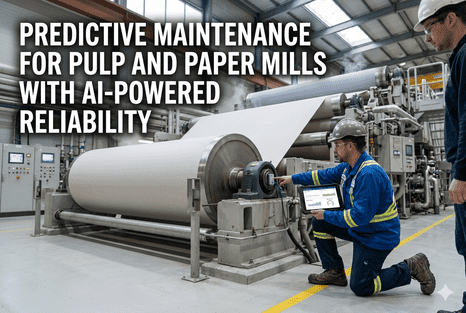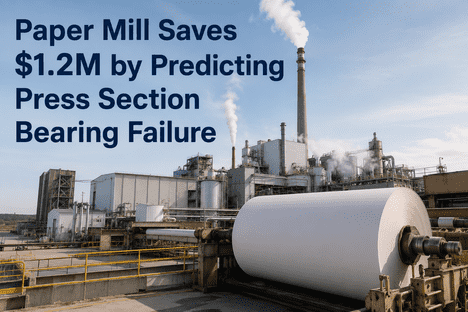
A sheet break on a high-speed paper machine running at 1,800 meters per minute does not merely stop production — it cascades into broke handling, felt contamination, dryer section wrap-ups, and hours of lost throughput that compound into hundreds of thousands of dollars before the reel is threading again. Among the most frequent and most severe root causes of sheet breaks is undetected bearing degradation in the press section rolls — where a single inner race fatigue crack on a suction roll or grooved press roll can introduce vibration that destabilizes the nip, tears the sheet, and triggers an emergency shutdown that costs $17,000 to $50,000 per event in lost production, restart waste, and emergency maintenance labor. This case study examines how a mid-sized containerboard mill producing 850 tonnes per day deployed iFactory's AI-driven predictive maintenance platform on its press section rolls and Yankee dryer — detecting inner race bearing damage 8 weeks before projected failure on a critical press section roll, preventing an estimated $1.2M in avoided sheet breaks, emergency repairs, and catastrophic roll damage that would have idled the paper machine for 6 to 9 days.
Why Press Section Bearing Analytics Is Structurally Different from Routine Vibration Monitoring
The analytical challenge in a paper machine press section is fundamentally different from rotating equipment in most other industrial environments — and applying generic vibration monitoring methodologies to press section rolls produces incomplete, often misleading results. In a paper machine, press section rolls operate in a saturated, high-temperature environment where water, steam, and paper fiber contamination accelerate bearing degradation in ways that standard vibration analysis alone cannot reliably track. A suction roll bearing operates submerged in a water-lubricated environment where traditional grease analysis is ineffective. A Yankee dryer bearing operates at surface temperatures exceeding 150°C, where thermal expansion can mask the vibration signatures of developing spalls. And every press roll bearing is subjected to nip-load-induced deflection that creates asymmetric loading patterns on the bearing races — accelerating fatigue on the loaded zone while leaving the unloaded zone apparently healthy in a standard vibration spectrum.
This operating complexity means that meaningful press section bearing analytics must integrate vibration data with temperature trending, lubrication condition monitoring, and nip load profiling simultaneously — correlating changes across all four domains before a fault classification can be confirmed with confidence. iFactory's paper machine monitoring engine ingests data at the bearing event resolution, linking each roll's vibration signature to its temperature profile, lubrication condition, and nip load history to produce a composite bearing health score that identifies developing faults at the earliest metallurgical stage — not after the spall has propagated far enough to appear in the vibration spectrum. The result is a causal chain from nip loading strategy to bearing fatigue progression that identifies, for example, that inner race damage on the center press roll is driven by a specific combination of nip load asymmetry and lubrication interval extending beyond 72 hours — a finding that monthly vibration route collection would never surface. Book a Demo to see how the platform detects bearing faults that route-based monitoring misses.
- Bearing faults detected during monthly vibration routes — after spall propagation to stage 3 or 4
- Sheet break root cause attributed to "unknown operational cause" — bearing fault invisible in process data
- Press roll bearings replaced at fixed calendar intervals regardless of actual wear condition
- Yankee dryer bearing temperature monitored in isolation — no correlation with vibration or load
- Lubrication intervals based on manufacturer recommendations, not actual oil degradation or contamination
- Emergency roll changes cost $90,000–$220,000 per event including replacement bearing, crane, and lost production
- Inner race and outer race defects detected at stage 1 — 4 to 8 weeks before functional failure
- Composite bearing health score trends correlated with sheet break frequency — causal links established
- Press roll bearing replacement triggered by vibration + temperature + oil debris trend — not calendar
- Yankee dryer bearing health composite index integrates vibration, temperature, and load asymmetry
- AI-optimized lubrication intervals based on oil condition sensors and bearing hours-in-service
- Planned roll change during grade transition costs $18,000–$45,000 — 80% reduction vs emergency replacement
Press Section Bearing Analytics: Roll-by-Roll Health Monitoring
The press section is the highest-load, highest-moisture, and highest-defect-risk mechanical system on the paper machine. It is also the stage where real-time bearing analytics delivers the most concentrated value — because each press roll bearing operates under different loading conditions, at different speeds, and in different contamination environments, and the fault progression timeline varies dramatically across roll positions. A suction roll inner bearing that fails in a water-contaminated environment can progress from stage 1 to catastrophic seizure in 14 days. A Yankee dryer bearing in a clean, high-temperature environment may show measurable degradation for 8 to 12 weeks before requiring intervention. iFactory's press section analytics operates at the individual bearing level, capturing and analyzing the full set of condition indicators that determine bearing health and failure risk simultaneously. Book a Demo to monitor your press section bearing health in real time.
Yankee Dryer & Press Roll Bearing Analytics: Quantifying Bearing Health Per Position
The Yankee dryer and press section rolls represent the highest-value bearing assets on a paper machine — a single catastrophic failure on any of these assets can idle the machine for 5 to 10 days and cost $500,000 to $1.2M in repairs and lost production. In most paper mills, bearing condition on these critical rolls is assessed through monthly or quarterly vibration routes, periodic oil sampling, and operator-reported temperature anomalies. This fragmented approach creates a 3 to 4 week blind window between measurements during which a developing spall can progress from stage 1 to stage 4 — the difference between a scheduled bearing replacement during a planned outage and a catastrophic roll failure that requires an emergency shutdown.
iFactory's paper machine bearing analytics module quantifies the full health profile for every bearing on every press section roll and the Yankee dryer — continuously. Vibration envelope spectra are collected at 15-minute intervals, temperature trends are logged and correlated with production load changes, and oil debris data is integrated from online particle counters where available. Plotted across thousands of bearing-hours of operation, this data reveals the specific failure progression patterns for each bearing position: the rate at which BPFO amplitude grows under different nip loads, the temperature increase associated with specific spall sizes, and the lead time available between first detection and the point at which the bearing condition threatens a sheet break. This performance mapping is unavailable through any means other than continuous multi-modal condition monitoring. Schedule a Yankee dryer analytics review to see how the platform quantifies bearing health at every position.
Predictive Maintenance Integration: Yankee Dryer, Press Rolls, and Reel Section Bearings
The equipment in a paper machine's press and drying sections operates under some of the most severe bearing loading conditions in any continuous process industry. Yankee dryer bearings must accommodate thermal expansion from cold start to 150°C+ operating temperature while maintaining concentricity within microns. Press roll bearings must withstand nip loads of 200 to 600 kN/m while operating in a saturated steam environment. Reel spool bearings must manage cantilevered loads that vary with every meter of paper wound. The maintenance cost of these bearings is significant — and the throughput cost of unplanned failures is even more significant, because any one of them can idle the entire paper machine. iFactory's predictive maintenance integration applies condition monitoring analytics to each bearing position, shifting the replacement strategy from calendar-based to condition-based at the bearing level that matters most. Book a Demo to see the platform's full bearing health dashboard.
| Paper Machine Asset | iFactory Monitoring Parameters | Failure Mode Detected | Warning Lead Time | Estimated Avoided Cost / Event |
|---|---|---|---|---|
| Yankee Dryer Bearings | Envelope vibration, housing temperature, thermal expansion trend, grease debris analysis | Inner race spalling, cage fatigue, thermal clearance loss | 6–10 weeks | $420,000–$980,000 |
| Suction Press Roll Bearings | Vibration (radial + axial), water ingress detection, lubrication pressure, housing temp | Water contamination wear, outer race spalling, seal failure | 4–8 weeks | $280,000–$620,000 |
| Grooved / Blind Drilled Press Roll Bearings | Vibration envelope spectrum, nip load asymmetry, bearing temperature, oil debris | Inner race fatigue, roller element spalling, misalignment wear | 4–7 weeks | $180,000–$450,000 |
| Center / Pick-Up Roll Bearings | Vibration trending, felt tension load correlation, temperature gradient, grease sampling | Outer race fatigue, cage degradation, lubrication starvation | 3–6 weeks | $120,000–$310,000 |
| Reel Spool Bearings | Vibration at reel drum frequency, cantilever load variation, temperature, grease analysis | Inner race cracking, roller element fatigue, misalignment wear | 3–5 weeks | $90,000–$210,000 |
| Jogger / Guide Roll Bearings | Vibration trending, position accuracy, temperature, lubrication interval tracking | Seal failure, contamination wear, cage fracture | 5–8 weeks | $45,000–$110,000 |
Expert Perspective: What AI Bearing Analytics Changes in Paper Mill Operations
We had been replacing press section roll bearings on a fixed 18-month calendar interval for over a decade. The interval was set conservatively based on a single catastrophic failure in 2009 — we never wanted to repeat that experience. When we deployed iFactory's bearing health monitoring, the first finding was that we were replacing bearings on average 6.5 months earlier than the actual condition warranted. That is 6.5 months of additional bearing life we were throwing away on every roll, every cycle — roughly $340,000 per year in unnecessary bearing procurement and roll change labor. The second finding changed our entire maintenance strategy: three specific press roll positions showed a consistent inner race failure pattern at 11 to 13 months in service, and the root cause was a lubrication line blockage that had been present since installation but never appeared in any maintenance record because the grease route confirmation was paper-based. The AI correlated the high-temperature trend on those positions with the lubrication event log and showed us the gap. We corrected the blockages, and those three positions went from 12-month average bearing life to 28 months in the following cycle. The single platform paid for itself in the first quarter on bearing procurement savings alone.
Frequently Asked Questions: Paper Machine Bearing Analytics
At minimum, iFactory requires access to the paper machine's DCS or SCADA historian where bearing temperature, nip load, machine speed, and production status data are recorded. This is sufficient to begin correlating bearing condition trends with operating parameters. For full vibration analytics, wireless triaxial accelerometers are installed on each bearing housing — typically 8 to 14 sensors per press section depending on roll configuration. Installation requires one planned outage of 8 to 12 hours for sensor mounting and baseline data collection, after which no production downtime is required. For lubrication monitoring, online oil debris sensors are installed on recirculating oil systems where available. A data readiness assessment is available at no cost to determine the specific analytics scope your current infrastructure supports.