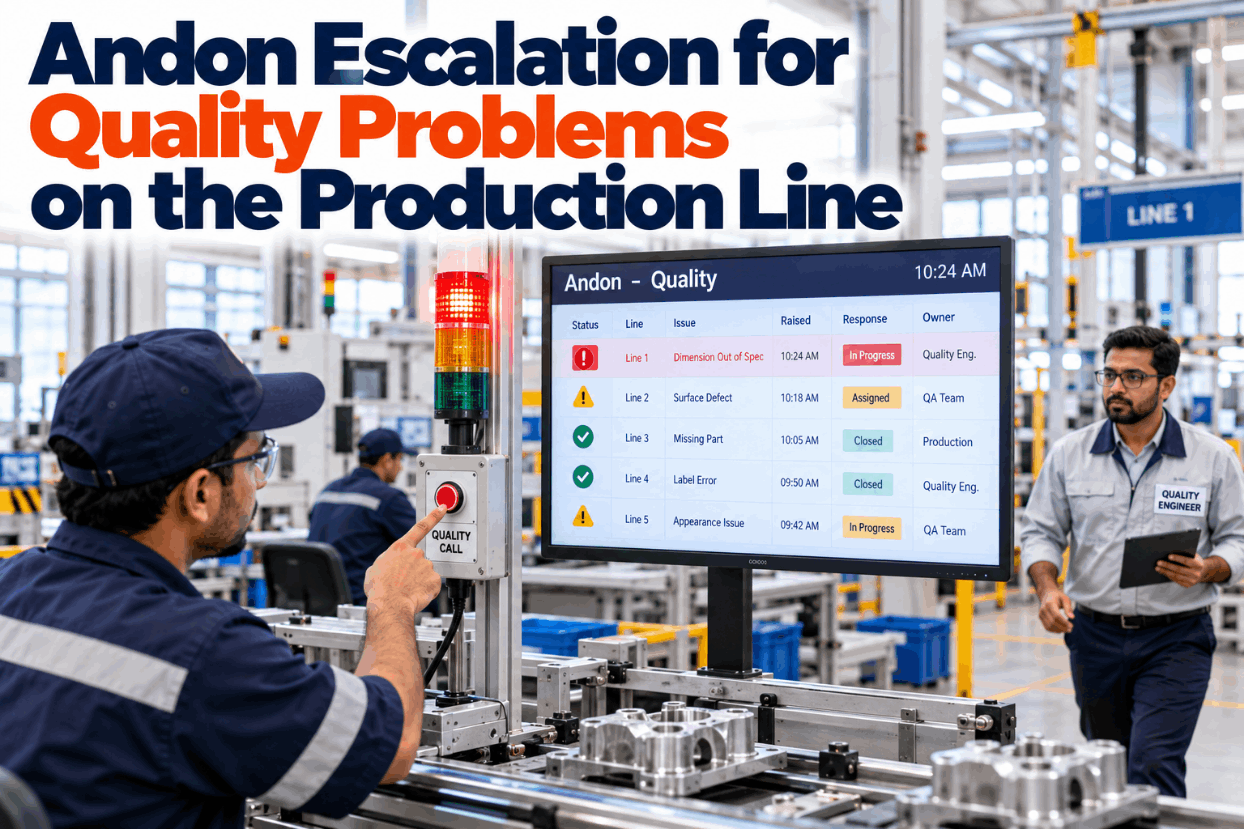
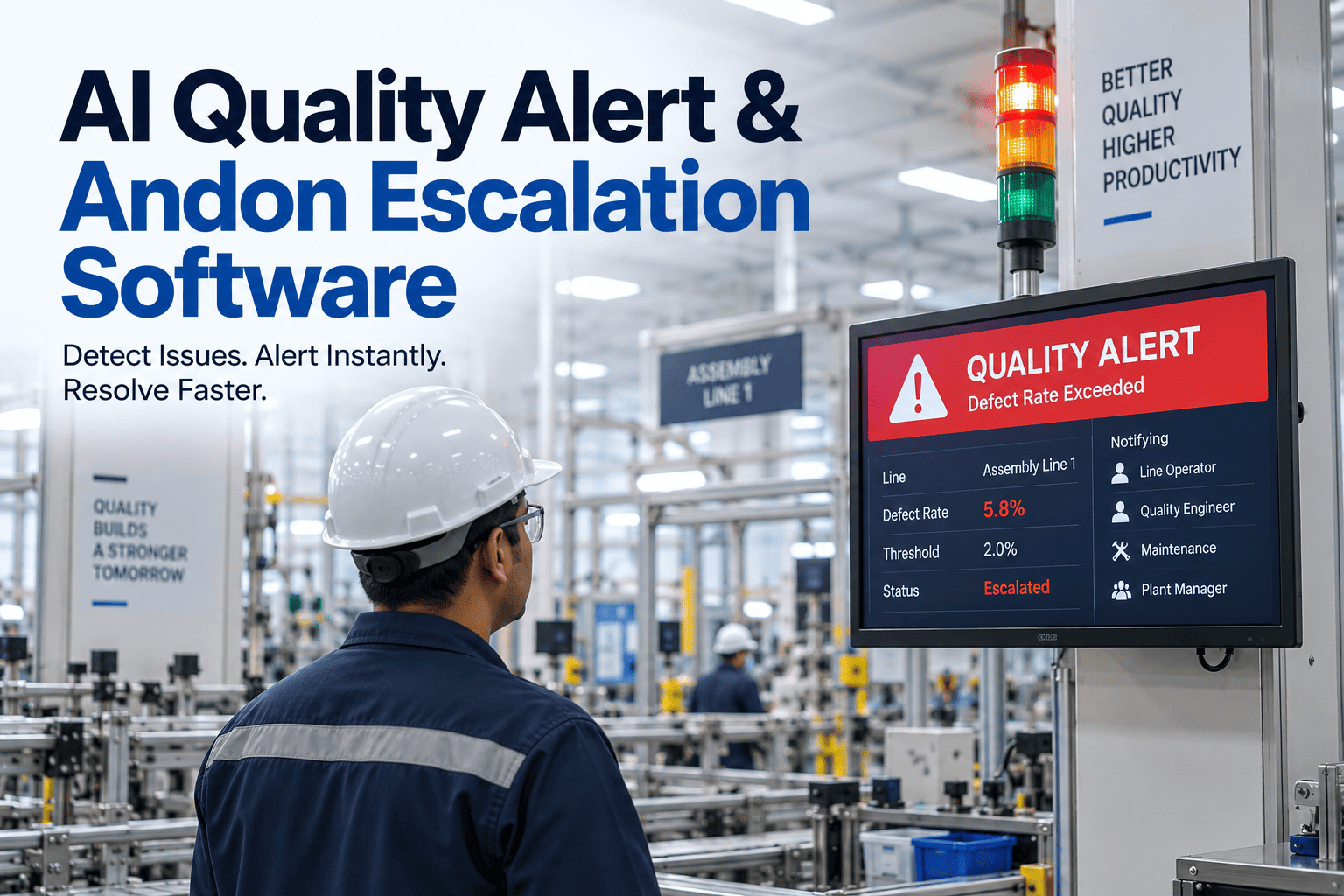
A quality problem on the line behaves differently from a breakdown. The machine keeps running, the parts keep coming and every minute adds to the pile that someone must sort later. Andon escalation for quality problems gets a quality engineer to the station fast, opens containment on the spot and records how long each step took. Watch a defect call reach the right engineer in a short quality andon demo.
QUALITY ANDON · DEFECT ESCALATION
Get a Quality Engineer to the Station Before Bad Parts Leave It
iFactory Quality Andon Agent takes the operator's call by button or voice, routes it by defect type and starts the escalation clock. The containment checklist opens the moment the call is raised.
Line 2 · Op 30 · Bore over limit
0 minOperatorCall raised by voice, station held
QE paged · 03:125 minQuality engineerOn station, containment open
15 minQuality managerPaged if still not contained
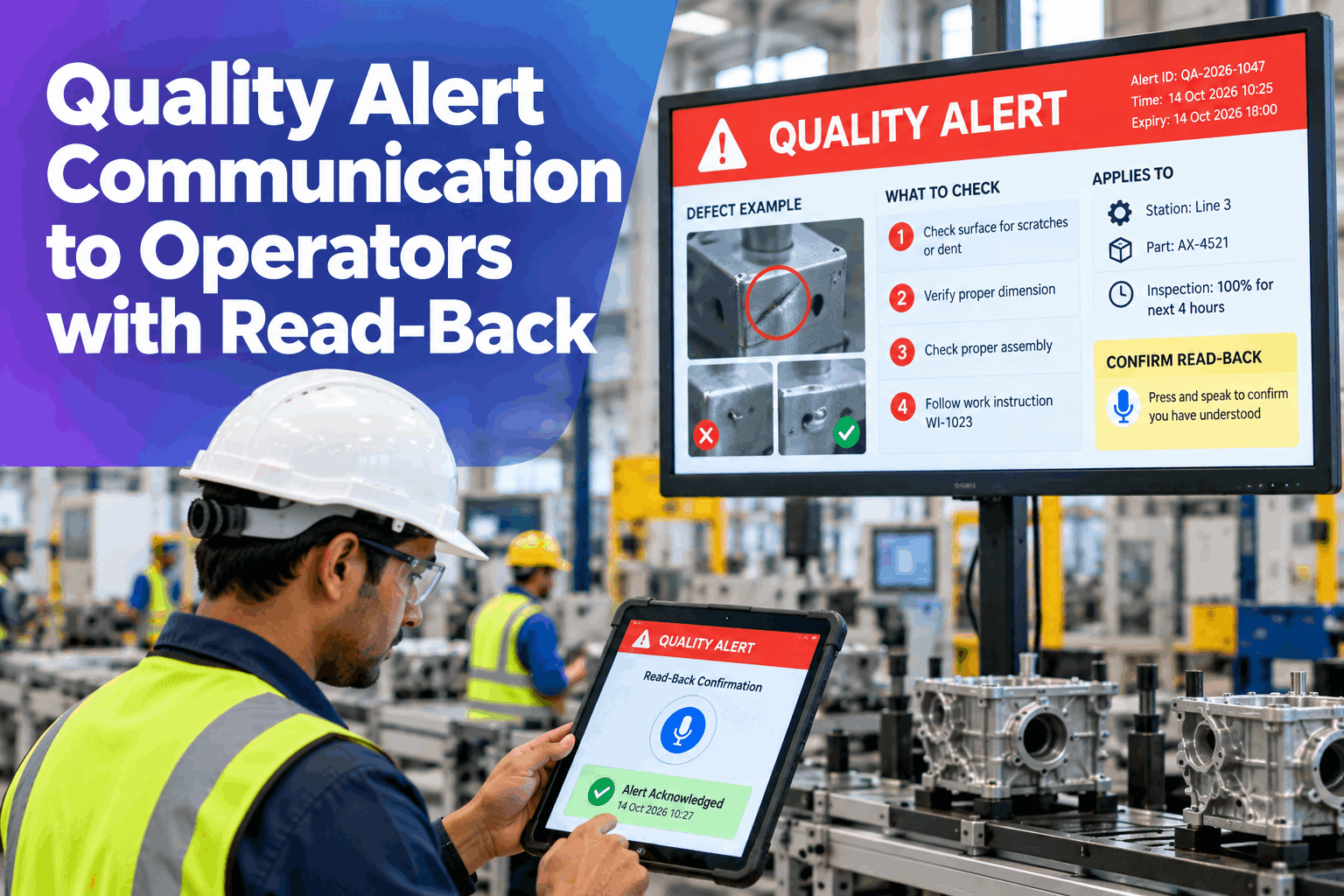
QUALITY ALERT LINE
Why a Quality Call Can't Wait Like Other Calls
When a press jams, output stops and the loss is plain to see. When a bore drifts oversize, the machine runs at full rate and makes scrap that looks like good product. Every minute between the defect and containment adds parts to the suspect range, which reaches back to the last good check. The example below uses assumed numbers to show the arithmetic. Ask our quality support team to run it on one of your lines.
07:48
Last good checkBore Ø 24.012 mm, inside 24.000–24.02508:23
Defect foundBore Ø 24.031 mm, operator raises the call08:35
ContainedStation held, suspect range set, sort started
Suspect window35 min before the call + 12 min to contain = 47 min
Line rate, assumed30 s cycle = 2 parts per minute
Suspect parts to sort47 × 2 = 94 parts
DEFECT-TYPE ROUTING
Send Each Defect Call to the Engineer Who Owns It
A general quality call that rings every phone gets slow answers. Asking the operator one question, what kind of defect it is, lets the system page the person best placed to judge it and set the line state to match the risk. The routing below is a typical starting point for discrete manufacturing, not a rule. Build your own defect list in a routing workshop.
Keep the list short enough to say aloud
Six or seven defect types cover most calls. If operators hesitate over which one to pick, merge types. The engineer can always reclassify the call once at the station, and the change is kept on the record.
STOP THE LINE AUTHORITY
Who May Stop What, Agreed Before Anyone Needs It
Jidoka, one of the two pillars of the Toyota Production System, means a process stops itself when something is abnormal so the problem can't pass downstream. People need the same right. IATF 16949 clause 5.3.2 expects the people responsible for product conformity to have the authority to stop shipment and stop production to correct quality problems. A quality andon works best when that authority is spelled out per role and named on every shift. Talk through your authority matrix with our support team.
Operator
Stops the stationHolds the part, raises the call and keeps suspect parts at the station. Never needs permission to call.Quality engineer
Stops the line, holds the lotDecides the line state, sets the suspect range and starts the sort with the right gauge.Quality manager
Stops shipmentHolds finished goods at the dock and decides on customer notice or a concession request.
A stop usually costs less than a sort
A held station costs minutes of output. A suspect range that reaches the shipping dock can cost a sort at the customer's site and a formal complaint.
Say the Defect, and the Right Engineer Hears It
Operators raise a quality call by button or by voice. The agent repeats what it heard, pages the engineer for that defect type, starts the clock and opens the containment checklist on the engineer's handheld.
Line 2 · Operator and iFactory
Operator"Line two, op thirty, bore oversize, twenty-four point oh three one."
iFactory"Quality call, Line 2, Op 30, bore over limit at 24.031. Station held. Paging process QE M. Okafor. Correct?"
Operator"Correct."
iFactory"Confirmed. Last good check 07:48. Containment checklist is open for the QE. The quality manager is paged at 15 minutes if it is not contained."
ANDON ESCALATION QUALITY PROBLEMS TEMPLATE
The Containment Checklist That Opens With the Call
Containment is where quality calls tend to slip. An engineer under pressure skips a step, usually the one that reaches furthest from the station. A short list that opens with the call keeps the order the same every time. ISO 9001 clause 8.7 sets out the ways to deal with nonconforming output: correction; segregation, containment, return or suspension; informing the customer; and acceptance under concession. Use the list below as a starting template, and see it working in a containment demo.
QUALITY ENGINEER DISPATCH
What Lands on the Engineer's Handheld
The page should save the engineer a walk to the office and three questions to the operator. Everything needed to judge the call travels with it, pulled from the inspection plan, the latest measurements and open nonconformances. The record below is illustrative. Check which fields your systems can supply with our integration team.
CallQ-0417 · Line 2, Op 30
Defect typeDimensional · bore Ø
Spec24.000–24.025 mm
Reading24.031 mm on bore gauge B-12
Last good check07:48 · 24.012 mm
Suspect so far70 parts at 08:23, rising by 2 a minute
Part and revisionPH-220 Rev D
ClockPaged 08:23 · manager at 08:38
QUALITY RESPONSE TIME
Six Measures That Show Whether Containment Is Getting Faster
Response time on its own says little about quality. What matters is how long suspect parts kept coming and how many there were. Define each measure once and let the system stamp the times, so lines and shifts can be compared fairly. Review these against your own calls in a metrics walkthrough.
Time to pageCall raised to engineer paged. Seconds, when routing is automatic.
Time to stationEngineer paged to engineer at the station, against the 5-minute target.
Time to containmentCall raised to suspect range set and held. The headline measure.
Suspect parts per callParts inside the suspect range. Falls when checks run more often.
Calls reaching the managerShare of calls still open at the 15-minute step.
Repeat callsSame defect type at the same operation within 30 days.
Fast arrival, slow containment
When engineers reach the station quickly but containment still takes long, the delay is usually in finding the last good check. Frequent, recorded in-process checks shrink both the search and the suspect range.
ANDON ESCALATION QUALITY PROBLEMS EXAMPLES
Four Calls From Four Industries
These illustrations show how routing and containment change with the defect. They are not case studies. Talk your own defect types through with our support team.
Automotive machining
Bore drifting oversizeProcess QE finds tool wear, the offset is corrected and the suspect parts are sorted with a bore gauge before the station restarts.Medical devices
Low seal strength on a pouchA special characteristic, so the line stops and the whole lot is held while the sealer temperature record is reviewed.Electronics assembly
Test failures on one fixtureThe test engineer finds a worn fixture pin. Boards are retested and the call closes as a test fault, not a product defect.Aerospace assembly
Loose fastener found insideThe area stops, tools and hardware are counted and every assembly since the last clean check is opened for inspection.
ANDON ESCALATION QUALITY PROBLEMS COST AND ROI
Size the Suspect Parts You Stop Sorting
The direct value of a faster quality andon is a smaller suspect range. Put your own figures in place of each assumed input, and leave avoided complaints and customer sorts out of the sum unless your records support a number. Build the full case in a value session.
Quality calls per week, all lines15, assumed
Minutes cut from call to containment6, assumed
Line rate2 parts per minute, assumed
Suspect parts avoided per week15 × 6 × 2 = 180 parts
Sort and handling cost per part$1.20, assumed
Sort cost avoided per week180 × $1.20 = $216
TURNKEY AI DEPLOYMENT
Call Points, Engineer Handhelds and AI Server in One Delivery
iFactory delivers the Quality Andon Agent as a turnkey package: call buttons and headsets for the line, handhelds for quality engineers, and routing set up for your defect types. A pre-configured NVIDIA AI server ships racked and ready with the voice and routing models pre-loaded, so calls are understood on site. You rack it, plug in power and Ethernet, and the AI is live. Scope it with our deployment team.
What's Included
- Pre-configured NVIDIA AI server, racked and ready
- Station call buttons and voice headsets
- Handhelds for quality engineers and managers
- Defect types, routing and escalation steps set up
- Containment checklists for each defect type
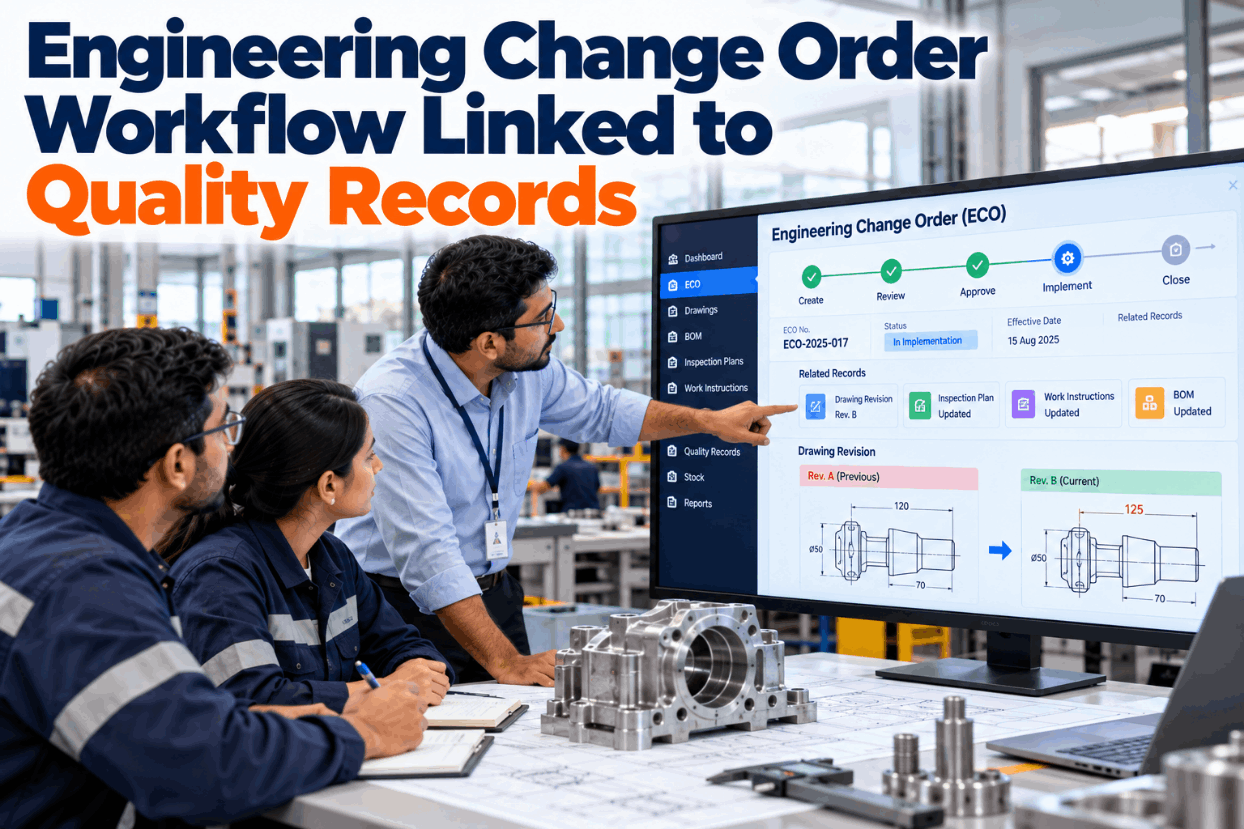
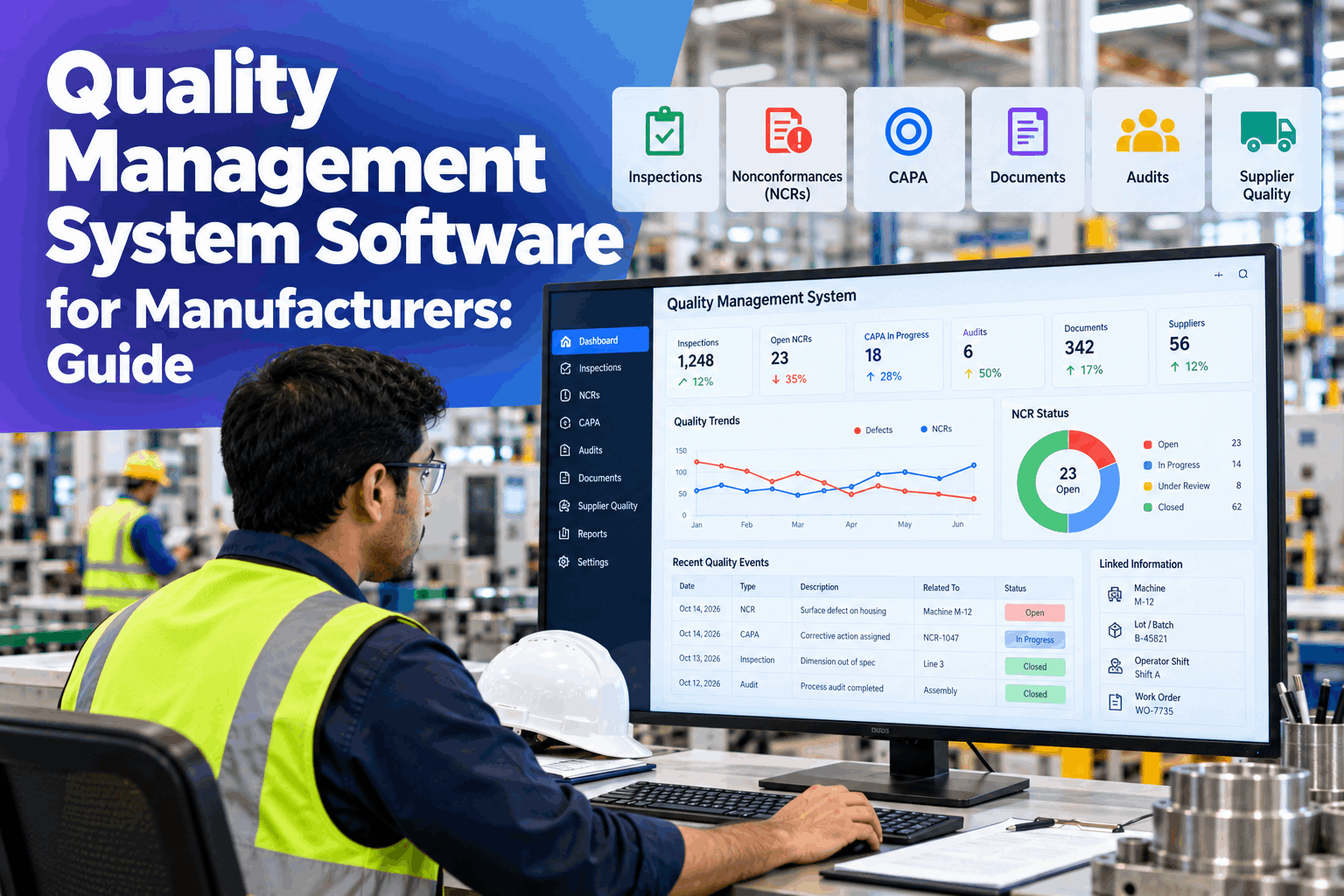
- Links to inspection plans, NCR and CAPA records
- 24×7 remote monitoring of models and hardware
Live in 6–12 weeks
Wk 1–4
Map and Install
Defect types drawn from your recent nonconformances, responders named per shift, server installed.
Wk 5–8
Pilot Line
One line live, response targets tuned and containment checklists tested on real calls.
Wk 9–12
Roll Out
Remaining lines live, and response measures added to the weekly quality review.
HOW iFACTORY FITS
A Quality Andon Built Around Containment
iFactory treats a quality call as the first minute of containment, not just a request for help. See it on a sample line in a live walkthrough.
1
Calls by button or voice. The operator names the line, operation and defect, and hears it confirmed back.
2
Routes by defect type. Dimensional, cosmetic, test, supplier and special characteristic calls each reach their own engineer.
3
Escalation timers run. The engineer is expected within 5 minutes, and the manager is paged at 15 if the call is still open.
4
Containment opens instantly. The checklist, suspect count and last good check reach the engineer with the page.
1000+
Industrial clients running iFactory
99.9%
Platform uptime across production shifts
6-12 wks
From racked server to live quality calls
FREQUENTLY ASKED QUESTIONS
What Quality Leaders Ask About Andon Escalation
What is andon escalation for quality problems?
It is a line call reserved for suspected defects, kept apart from maintenance and material calls. The operator raises it, the system pages the engineer who owns that defect type and a clock starts. If nobody contains the problem within the agreed time, the call moves up to the quality manager.
How is a quality andon different from a general andon?
A general andon asks for help. A quality andon also has to protect the customer, so it carries the defect type, the last good check and a containment checklist, and it measures time to containment rather than time to arrive. You can
see a quality call routed on a sample line.
Who should be able to stop the line for a quality problem?
Anyone should be able to stop their own station and call. IATF 16949 clause 5.3.2 expects the people responsible for product conformity to hold authority to stop production and shipment. Most plants give the line stop to the quality engineer and the shipment stop to the quality manager. Write it down per role so nobody hesitates on a night shift. Our
support team can help you draft it.
How do we choose the 5 and 15 minute steps?
Start from line rate and risk. A fast line adds suspect parts quickly, so it needs a short first step. Special characteristics usually page the manager at once. Record real times for two weeks, then tighten the targets where engineers are already arriving early. Review them again whenever line rate or staffing changes.
What happens to suspect parts after containment?
They stay in quarantine with hold tags until a sort or a review decides each one: use, rework, scrap or a concession request to the customer. The call then hands over to corrective action.
Walk through containment with our team to see the hand-off.
How do we get started?
List your defect types from recent nonconformances, name an engineer for each on every shift and pilot on one line with a written containment checklist. To plan that first line,
book a 30-minute demo.
Contain Quality Problems in Minutes, Not Shifts
Route every defect call to the engineer who owns it, run the escalation clock and open containment the moment the call is raised. Delivered turnkey and live in 6 to 12 weeks.
Example call · Line 2, Op 30
Defect typeDimensional, bore Ø
Routed toProcess QE, paged 08:23
Contained08:35, 94 parts held
EscalationManager step not needed
Every call timed from page to containment