The andon idea is fifty years old and still one of the best manufacturing ever produced: give every operator the power to raise the alarm the instant something looks wrong. Toyota strung a cord above the line in the 1970s, and the principle — stop and notify, don't let the defect propagate — became a pillar of lean. What hasn't kept pace is everything after the signal. In most plants a cord pull still triggers a light, a tone, and a hope the right supervisor notices in time. That's not escalation; it's a broadcast into the void — and when the responder doesn't come, a single quality escape becomes thousands of defective units on the same shift. Real quality andon is what happens in the seconds after the alarm. You can book a demo to see that response on the floor.
The Andon Pull Is the Easy Part. The Escalation Behind It Is What Stops Defects.
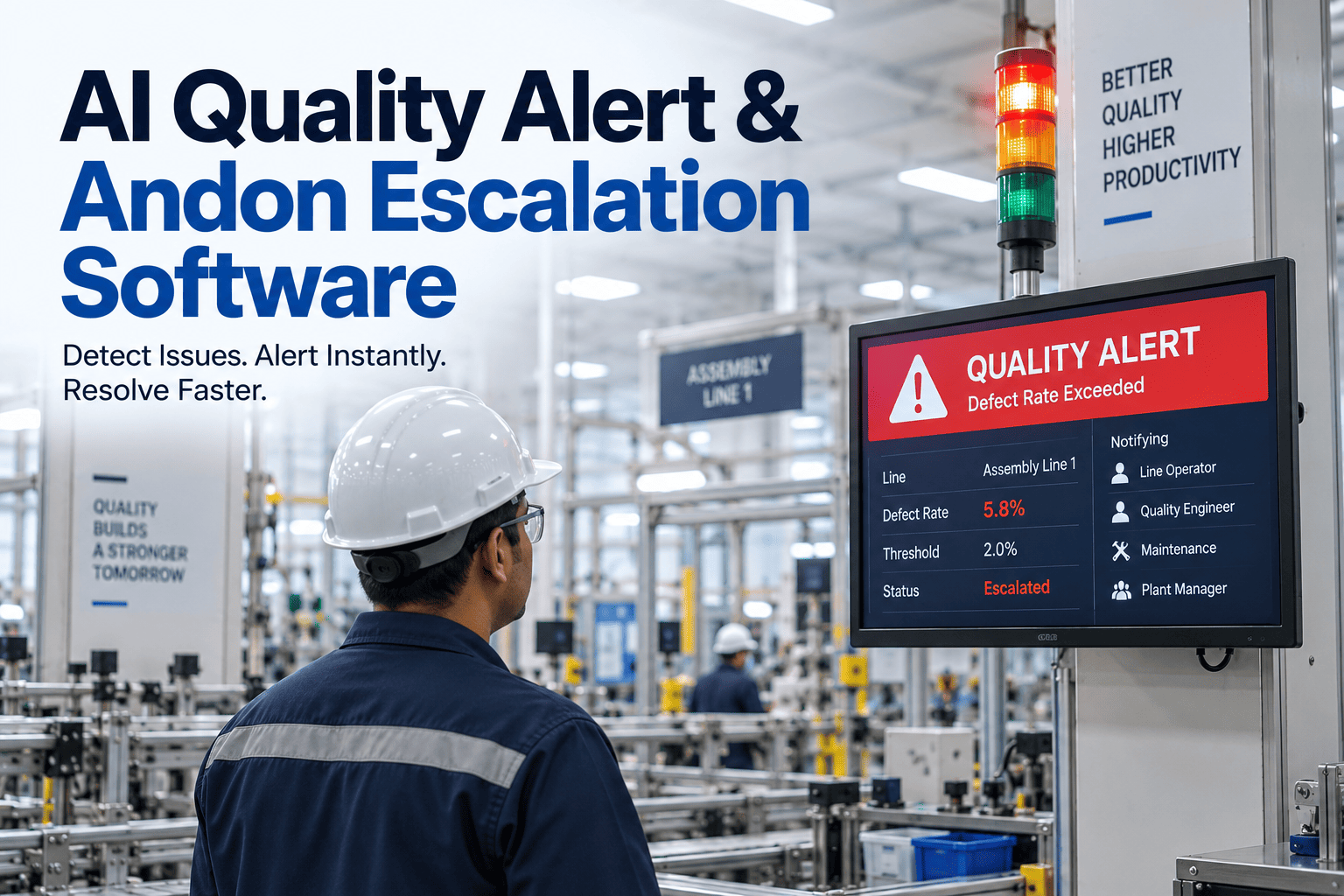
Trigger instant quality alerts when defects spike, route them to the right responder — not a general broadcast — and escalate automatically when the clock runs out. So a quality escape is contained the same shift, not found in tomorrow's inspection report.
A Light and a Tone Isn't Escalation
The genius of andon was never the cord; it was the permission — any worker, any time, stop and signal. That part still works. What breaks in most plants is the response layer bolted on top of it: a signal that broadcasts to everyone and therefore to no one, with no intelligence about who should respond first, how long they have, or what happens if they don't come. These are the gaps that let a raised alarm still end in propagated defects.
A general light-and-tone alerts everyone equally, so no one owns it. A quality defect, a material shortfall, and a safety issue each need a different responder — routing to the specific right person is what a broadcast can't do.
Without a defined response time, "someone will get to it" stretches into minutes the defect doesn't have. A machine fault unacknowledged for two minutes on an assembly line can cascade into a full shift stoppage.
If the first responder doesn't come, nothing happens next — the alarm just keeps blinking. Real containment needs the alert to climb to the next tier automatically the moment the clock runs out, not wait for someone to notice it was missed.
An analog pull captures no data — no call type, no response time, no record of whether this exact pattern has caused a bigger problem before. The event that should feed root-cause analysis simply disappears when the light goes off.
A Quality Escape Propagates in Units per Minute
The reason the response layer matters so much in quality specifically is the math of propagation. Unlike a machine breakdown, which stops making things, a quality escape keeps making things — bad ones. Every minute between the defect starting and the line stopping is another batch of nonconforming units heading downstream, and the cost of each one multiplies the further it travels before someone catches it.
A single quality escape on a high-mix line can become thousands of defective units before an inspection report the next day ever surfaces it. Andon-triggered alerts stop the propagation at the source, on the same shift — the entire point of catching it live.
A defect caught at the source costs a fraction of the same defect caught at final inspection, at the customer, or in the field. Speed of containment isn't a nicety — it's the difference between scrapping one part and sorting a whole shipment.
How wide the containment net has to be cast is set in the first few minutes — how many units carry the defect depends entirely on how fast the line is stopped or the process corrected. A fast, routed response shrinks the recall or rework scope before it grows.
Contain the Escape Before It Becomes a Shipment
iFactory turns a quality alert into a routed, clocked, escalating response — so the defect is stopped at the source the same shift, not sorted out of a truckload next week.
Every Alert Has a Responder, a Clock, and a Next Tier
Intelligent andon runs on a tiered escalation model: each alert carries a call type, an assigned first responder, a response-time target, and a defined path upward if that target is missed. This is the structure that guarantees an alarm is always owned by someone and never stalls, no matter who's available. Here's how the escalation flows.
An operator or an automated check detects the problem and raises an alert tagged with its type — quality, material, equipment, safety. The call type determines everything that follows, because a quality defect and a material shortfall route to entirely different people.
The alert goes to the specific responder assigned to that call type and area — the quality tech for a defect, not a floor-wide broadcast — with a response-time target attached. Targeted routing is the single biggest upgrade over an analog pull.
If the first responder doesn't acknowledge within the target, the alert climbs automatically to the next tier — team leader, then area manager — without anyone having to notice the miss. The clock, not a human, drives the escalation.
The responder fixes it on the spot if it's minor, or, if it's systemic, the line stops and a nonconformance opens for investigation — the "stop and fix" decision made deliberately rather than by default, with the whole timeline captured.
One Alert Type Can't Route Four Kinds of Problem
A complete andon system recognizes that production deviations aren't all the same — a quality defect, a material shortfall, an equipment fault, and a safety issue each need their own signal, their own responder, and their own escalation rule. Collapsing them into one generic alarm is why generic systems misroute and stall. These are the distinct signals a quality-focused system coordinates.
A defect or out-of-spec condition routes to quality, with the tightest propagation clock because bad units keep being made until it's addressed. This is the signal that most directly stops a quality escape at the source.
A line running low on material is a performance loss, not a breakdown, and it doesn't show up in breakdown data. An alert the moment material runs low — not after it runs out — routes to the handler with time to respond before production stops.
A machine fault routes to maintenance, with a short acknowledge window because an unattended fault can cascade into a full stoppage. Routing to the right technician rather than a general call is what closes the response gap.
A safety condition carries the highest priority and its own immediate escalation path, never buried among lower-priority alerts — the one signal that must always cut through regardless of what else is active.
Every Andon Event Should Make the Next One Rarer
In a lean environment an andon event is never treated as a failure — it's treated as valuable data, surfaced while the evidence is still fresh. A digital system captures what an analog pull throws away, so the same alert that contains today's defect also feeds the analysis that prevents tomorrow's. This is where quality andon connects to the wider non-conformance system.
A quality alert can open a nonconformance record automatically, carrying its call type, timeline, and context — so containment flows straight into disposition and corrective action rather than being logged separately after the fact.
Detection time, response time, escalation tier reached, and resolution are all recorded, turning each event into the raw material for root-cause analysis instead of a light that blinked and went out.
When every event is captured, the recurring call — the station that pulls andon every shift, the defect that keeps returning — rises as a pattern worth a permanent fix rather than a repeated response.
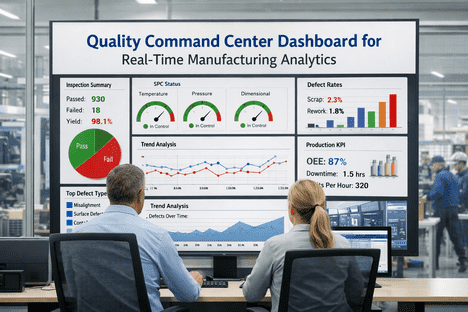
Average response time, alerts escalated past the first tier, and alerts resolved per shift become live metrics, so the response system itself is managed and improved, not just the production it protects.
Instant Alert, Intelligent Routing, Automatic Escalation, Full Record
iFactory rebuilds the response layer behind the andon pull: it routes each typed alert to the right responder, runs the response clock, escalates automatically when the clock expires, and captures the whole event into the non-conformance record — so the fifty-year-old signal finally gets a response system worthy of it.
What Operations Teams Ask About Quality Alert & Andon Escalation
Give Your Andon Pull the Response It Deserves
iFactory routes every quality alert to the right responder, runs the response clock, escalates automatically when it expires, and captures the event into non-conformance — so defects are contained at the source and every alarm becomes data that prevents the next one.