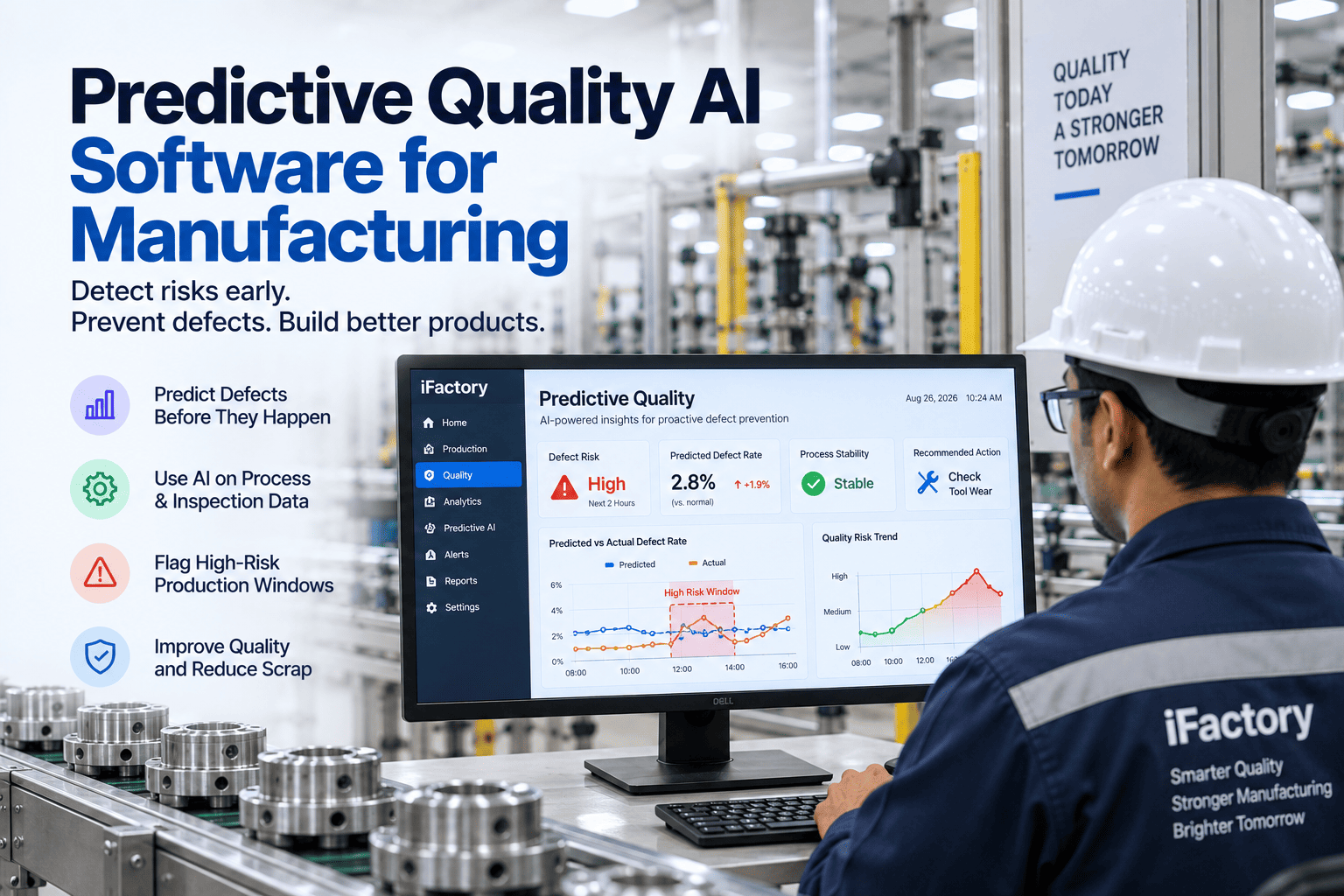
Every quality tool a plant owns answers the same question a little faster: is a defect happening? Final inspection catches it after the part is built. In-process inspection catches it as the part is made. Even real-time SPC only signals once the process has started drifting on measured output. Predictive quality AI answers a different question — is a defect about to happen? By learning the multidimensional pattern of process conditions that precede non-conforming output, it flags a high-risk window while the parts are still good, before a single bad unit exists. That's the shift from detection to prevention: you adjust the process during the window the model warned about, and the defect never gets made. It also moves quality from chasing symptoms to fixing the upstream conditions that cause them. You can book a demo to see it on your data.
Know a Defect Is Coming Before a Single Non-Conforming Unit Is Made
Machine learning on your process and inspection data learns the conditions that precede defects — and flags high-risk production windows before non-conforming units are produced, so you adjust the process and prevent the defect instead of detecting it.
The Difference Between Catching a Defect and Preventing One
It's worth being precise about what makes predictive quality different, because it's easy to lump it in with the faster detection tools. Detection — even instant, real-time detection — happens on the output: something is measured, and the tool tells you whether it's good or bad. Prediction happens on the inputs: the model watches the process conditions and tells you the output is likely to go bad before it's produced. That single distinction is what moves the intervention point ahead of the defect.
Inspection and SPC evaluate a unit or a measurement that already happened — the part is built, or the process has already drifted. The best case is catching it fast, but the defect, or the condition that guarantees it, already exists.
Predictive quality reads the process conditions and forecasts that output is heading toward non-conforming while the parts are still good — so the intervention happens in the window before the defect, not after it. Prevention, not reaction.
SPC is a powerful but fundamentally univariate, statistical view — it watches one measured characteristic against its control limits and signals when that measurement misbehaves. Predictive quality is multivariate and learned: it finds the pattern across many process variables at once — temperatures, pressures, speeds, material lots, ambient conditions, upstream results — that together precede a defect, even when no single one has crossed a limit yet. That's how it can warn before the measured output shows anything wrong, which a control chart on that output, by definition, cannot do.
The Fingerprint of a Production Window That Goes Bad
A predictive quality model is trained on the data a plant already generates — process parameters, inspection results, and defect history — to learn the conditions that separate a good production run from one that produces non-conforming units. What it learns isn't a single threshold; it's a multidimensional fingerprint. These are the pieces that go into it.
Temperatures, pressures, speeds, torques, cycle times, and machine states from the equipment and PLCs — the operating conditions in effect while parts are being produced, which is where the causes of defects actually live.
The record of which runs produced conforming versus non-conforming output — the labels the model learns from, connecting past process conditions to the quality outcomes they actually produced, so it recognizes the pattern next time.
Material lot, ambient conditions, tool age, and the results of upstream operations — the contextual variables that shift defect risk but never appear on a single control chart, and that a multivariate model can weigh together.
The real signal is often in combinations — a certain material lot at a certain temperature at a certain line speed — that are individually fine but jointly risky. Learning those interactions is exactly what a model does that rule-based limits can't.
Turn Your Existing Data Into a Defect Forecast
iFactory trains a predictive quality model on the process, inspection, and defect data you already collect — so the conditions that precede your defects become a live risk score, not a post-mortem.
A Risk Score Is Only Useful If It Changes What Happens Next
Predicting risk matters only if the prediction reaches the floor in time to act and tells the operator enough to act correctly. The loop isn't complete at the forecast — it's complete when the process was adjusted during the high-risk window and the defect that would have happened didn't. This is the path from a model's score to a prevented defect.
As the line runs, the model scores the current conditions against what it learned, producing a live defect-risk level for the running product rather than a periodic report — so risk is visible as it forms, not after the run.
When the risk crosses the threshold, the system flags the window before non-conforming units are produced, so the warning arrives while the output is still good and there's time to act rather than sort.
Because a black-box "risk is high" alert isn't actionable, the system surfaces the variables pushing risk up — the temperature, the lot, the speed — so the operator knows not just that risk rose but what to adjust to bring it down.
The operator corrects the flagged condition during the window, and the run that was heading toward non-conforming stays in spec — the defect is prevented rather than caught, which is the entire value of predicting instead of detecting.
Explainability Is What Makes the Model Trustworthy on the Floor
The biggest barrier to predictive quality in practice isn't accuracy — it's trust. A black-box model that says "risk is high" without saying why gives an operator nothing to act on and a quality engineer no reason to believe it, which is why opaque models stall in deployment. Explainability isn't a nice-to-have here; it's what turns a prediction into an action and earns the model its place in a regulated quality system.
Explainable-AI techniques surface which process variables are driving a given risk prediction, so a high-risk flag comes with the specific conditions behind it rather than an unexplained number.
Knowing the drivers makes the prediction actionable: if a lot-and-temperature combination is pushing risk, the operator knows the lever to pull. The explanation is what connects the forecast to a fix.
When a quality engineer can see the model's reasoning trace to real, sensible process physics, the model earns credibility. Trust built on transparency is what gets the prediction acted on instead of ignored.
In audited settings, an unexplainable model is a liability. Being able to show why a decision was made keeps predictive quality defensible where black-box AI can't go.
Addressing the Cause Instead of Sorting the Symptom
The return on predictive quality comes from acting earlier in the chain than any detection tool allows. By anticipating where and when risk will occur and pointing at the conditions behind it, it lets teams fix root causes rather than sort product — which is where the durable savings in scrap, rework, and warranty live.
A defect that never gets made is worth more than one caught at inspection — no material, labor, or machine time is spent on a bad unit at all. Prevention removes the cost rather than containing it.
Because the model points at the conditions that drive defects, it moves the team upstream to the cause instead of repeatedly catching the same symptom — the difference between fixing a problem and managing it.
Preventing non-conforming units from being produced shrinks the pool that could ever escape to a customer, cutting the warranty and containment costs that dwarf in-plant scrap.
As root causes are addressed run after run, process stability improves over time, so predictive quality compounds — each prevented pattern is one less recurring loss, not a one-time catch.
Learn the Pattern, Score the Risk, Explain the Driver, Prevent the Defect
iFactory builds predictive quality on the data your operation already generates: it learns the multivariate pattern that precedes your defects, scores live production risk continuously, explains which variables are driving each flag, and delivers the warning to the floor in time to adjust — turning quality from detection into prevention.
What Quality Teams Ask About Predictive Quality AI
Move Your Quality From Detection to Prevention
iFactory learns the conditions that precede your defects, scores live production risk, and explains every flag — so you adjust the process during the high-risk window and prevent non-conforming units instead of catching them after the fact.