Engineering change is where product improvements enter production — and where uncontrolled change enters as escape risk. An ECO (engineering change order) or ECN (engineering change notice) that ships without a quality impact review changes the process the FMEA and control plan were built for, without updating either. When the customer's next audit asks whether the current control plan reflects the current process, the answer is no. When AIAG PPAP or VDA PPA rules require re-submission on a customer-notice change and the submission wasn't made, the finding is worse. Engineering change quality is not paperwork — it is the discipline that keeps design intent, process reality, and customer approval in sync as the product evolves.
iFactory / Engineering change quality
Route Every ECO and ECN Through Quality Impact — Before It Reaches the Floor
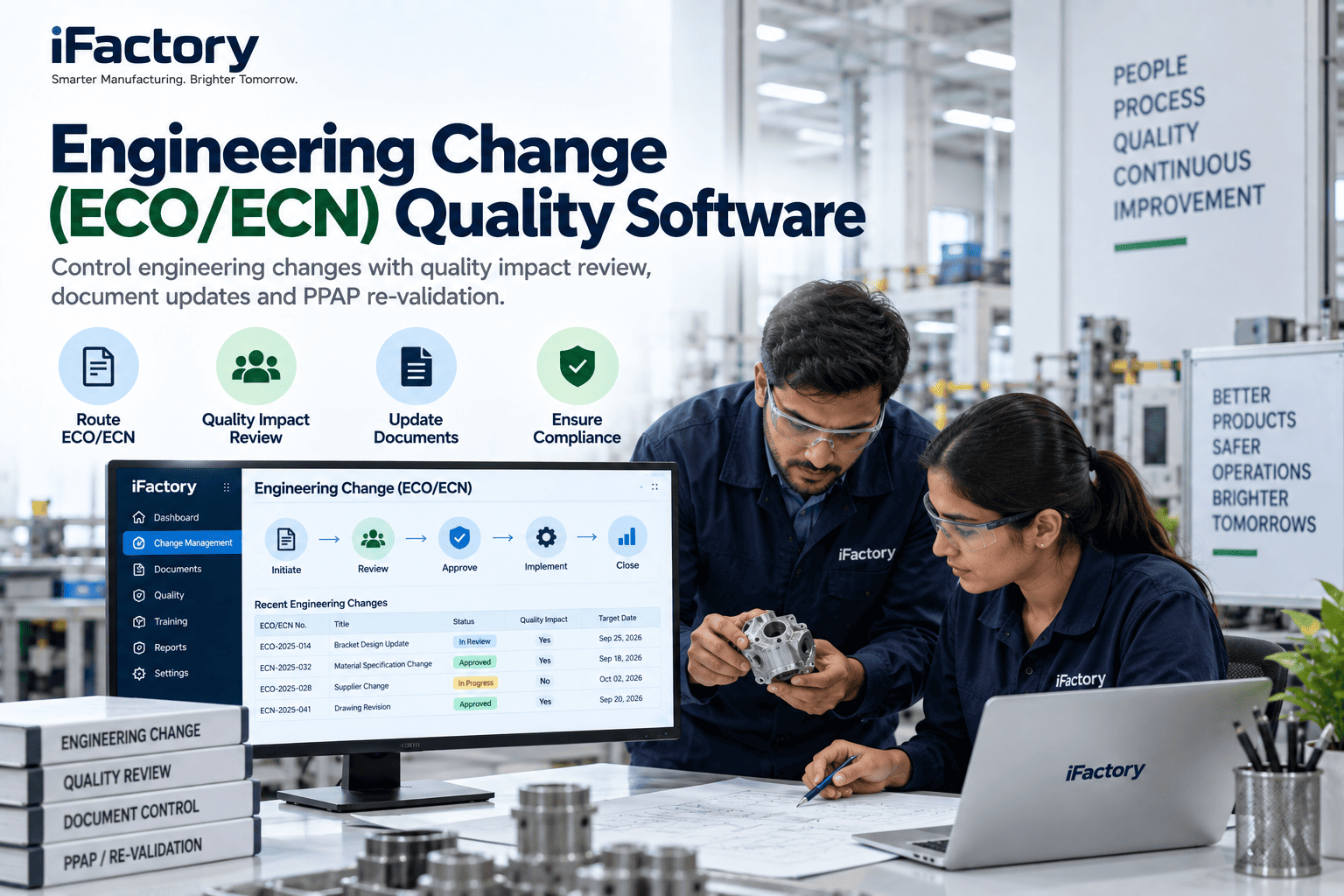
ECO/ECN workflow with mandatory quality impact review, FMEA and control plan refresh, document update propagation to SOP/work-instruction/PLM, and PPAP re-submission triggering aligned to customer-notice rules under AIAG PPAP or VDA PPA.
3
Document updates (PLM · SOP · CP)
4
FMEA + Control Plan refresh
5
PPAP re-submission if required
FMEA + CP
refresh triggered
The Problem in Engineering Change Control
Engineering change in most manufacturers runs on parallel tracks that were never joined. Engineering releases a drawing revision in PLM. Production updates work instructions when they get around to it. Quality is copied on the ECN and files it. Nobody explicitly asks whether the change affects the FMEA, the control plan, operator training, or the customer's PPAP submission. Months later, a customer audit compares current control plan against current process and finds they diverged three revisions ago. Or a defect escapes because the operator's work instruction reflected the pre-change process. Or a customer notice arrives asking why a PPAP re-submission was not made when the change triggered it under AIAG rules.
Where Engineering Change Actually Escapes Quality
ECO/ECN failure modes are consistent across regulated and unregulated manufacturers. Each is a specific IATF 16949 or AS9100 audit finding waiting.
Quality skipped
ECO routed for engineering and production approval. Quality reviewer copied but not required. Change ships without FMEA or control plan refresh.
Control plan drift
Process change (fixture, gauge, sequence) implemented without control plan update. Audit compares current CP against current process — mismatch is a finding.
Training not triggered
Work instruction updated in the document management system. Operator training assignments not triggered. First-shift operators run against the new spec they weren't retrained on.
PPAP re-submission missed
Change meets AIAG PPAP customer-notice criteria (material, source, dimensional, process change per Section I.3). No submission made. Customer discovers at Level 1 audit — trust damaged.
What Good Looks Like in Engineering Change
A working ECO/ECN system holds four disciplines together — unified change workflow with quality impact review, linked FMEA/control plan refresh, cascaded document and training updates, and PPAP re-submission logic aligned to customer rules.
Unified Workflow
ECO and ECN handled in one workflow with the same review discipline. Quality impact review is a mandatory step for every change with a defined manufacturing scope.
One workflow, one discipline
FMEA / CP Refresh
Quality impact review triggers FMEA re-assessment and control plan refresh where the change affects failure modes or controls. Approved change carries the refresh evidence.
Refresh evidence attached
Cascaded Updates
Document updates (SOP, work instruction, PLM drawing) triggered on ECO approval. Training assignments cascade to affected operators through the LMS. Nothing implemented before training complete.
Training gates implementation
PPAP Trigger Logic
Change classified against AIAG PPAP Section I.3 or VDA PPA re-submission criteria. Where re-submission is required, the submission package is drafted from the change record.
Customer-notice logic built in
How iFactory AI Fits
iFactory AI overlays your PLM (PTC Windchill, Siemens Teamcenter, Aras Innovator, Dassault ENOVIA, SAP PLM), LMS, and QMS — adding the change-to-quality workflow layer without replacing the systems your engineering and production teams already use.
Change Record
Workflow Layer
Unified ECO/ECN record with change classification, affected part/process/document list, quality impact review, and approval routing.
Quality Refresh
Workflow + FMEA/CP
FMEA re-assessment prompt where the change affects a failure mode or control. Control plan refresh triggered. Both linked from the change record.
Cascade Manager
Workflow + PLM/LMS
Document updates propagated to PLM, DMS, and MES routings. Training assignments cascaded through LMS with completion tracking before implementation.
PPAP Trigger
Workflow + Compliance
Customer-notice logic per AIAG PPAP Section I.3 or VDA PPA. Where triggered, submission-package drafting workflow launches on change approval.
Ask your engineering change coordinator to produce three ECOs from last quarter with the linked FMEA update, control plan refresh, training completion, and PPAP disposition. If any of those isn't there, the next customer audit is going to find it. Book an engineering change review.
12-Week ECO/ECN Pilot on One Product Family
One product family with active engineering change, twelve weeks. The pilot deploys the unified ECO/ECN workflow with quality impact review, cascade discipline, and PPAP trigger logic.
Weeks 1–2
Change Landscape
Baseline current ECO/ECN process. Load PLM change classification schema. Map customer-specific PPAP notice rules. Identify integration points to LMS and QMS.
Weeks 3–4
Workflow Config
Configure unified workflow with quality impact review as mandatory step. FMEA/CP refresh prompts. Cascade rules to PLM, DMS, LMS. PPAP trigger logic configured per customer.
Weeks 5–8
Live on Product
Workflow live for pilot product family. All ECO/ECN activity routes through the new discipline. Weekly review with engineering, quality, and production.
Weeks 9–12
Audit Simulation
Simulated IATF 16949 or AS9100 audit on current control plan vs current process. Rollout to remaining product families scoped based on drift closure.
Who Owns the KPI
Engineering change crosses engineering, quality, production, and customer-facing account management. Each function owns a specific KPI or the ECO/ECN workflow reverts to parallel tracks.
Engineering Change Coordinator
ECO cycle time with quality review
Owns the workflow velocity — average days from request to implementation with quality review completed. Balance speed with discipline.
Quality Manager
Control plan vs process drift %
Owns the CP integrity — the share of processes where current CP matches current process at audit. 100% is the requirement, not the target.
Production Lead
Operators trained before implementation
Owns the operator readiness — training completion before the change goes live on the floor. First-shift-operator confusion means the cascade broke.
Customer Account Lead
PPAP re-submissions on customer-notice
Owns the customer-facing outcome — the count of PPAP re-submissions made when a customer-notice change triggered them. Zero misses is the requirement.
FAQ
How does the PPAP re-submission trigger logic actually work?
The logic maps each change classification against AIAG PPAP Section I.3 customer-notice criteria (material, source, dimensional, process, or software change) and against customer-specific requirements (many OEMs have additional or stricter rules). Where a change meets the customer-notice threshold, the workflow launches a PPAP submission package drafting task with the correct AIAG level (1-5) per customer requirement. For VDA PPA (Volume 2 6th edition and later) suppliers, the logic maps to the negotiated PPA agreement rather than fixed levels. The workflow doesn't decide whether re-submission is required — the customer contract does — but it applies the rules the customer set consistently every time.
What about our existing PLM change workflow — do we replace it or overlay it?
Overlay. PTC Windchill, Siemens Teamcenter, Aras Innovator, Dassault ENOVIA, and SAP PLM all have native change management — and each is deeply integrated with the drawing and BOM management your engineering team relies on. The overlay reads change records from the PLM, adds the quality impact review and cascade discipline the PLM change workflow rarely covers, and writes back the approval status with linked evidence. What you gain is the quality-to-training-to-PPAP cascade the PLM doesn't do; what you keep is your engineering document management.
Book a demo to see the PLM overlay live.
How does this handle both ECO and ECN — those aren't the same thing?
ECO (engineering change order) is typically an authorized change; ECN (engineering change notice) is typically a notification of a change that may or may not require action. Some organisations use them interchangeably; others distinguish carefully. The workflow supports both distinct types with different routing rules — an ECO carries the full workflow with mandatory approvals, an ECN triggers a review-and-acknowledge routing. Which type applies to which change is configured against your organisation's PLM and change-control practice.
Stop letting engineering change ship without quality review.
Walk Three ECOs Through the Quality Workflow — Live
Bring three recent ECOs from the pilot product family, your current FMEA and control plan revisions, and one customer PPAP notice rule. We'll walk the current-state process, show the workflow that would have caught the gaps, and demonstrate the PPAP trigger logic.
FMEA + CP
refresh triggered