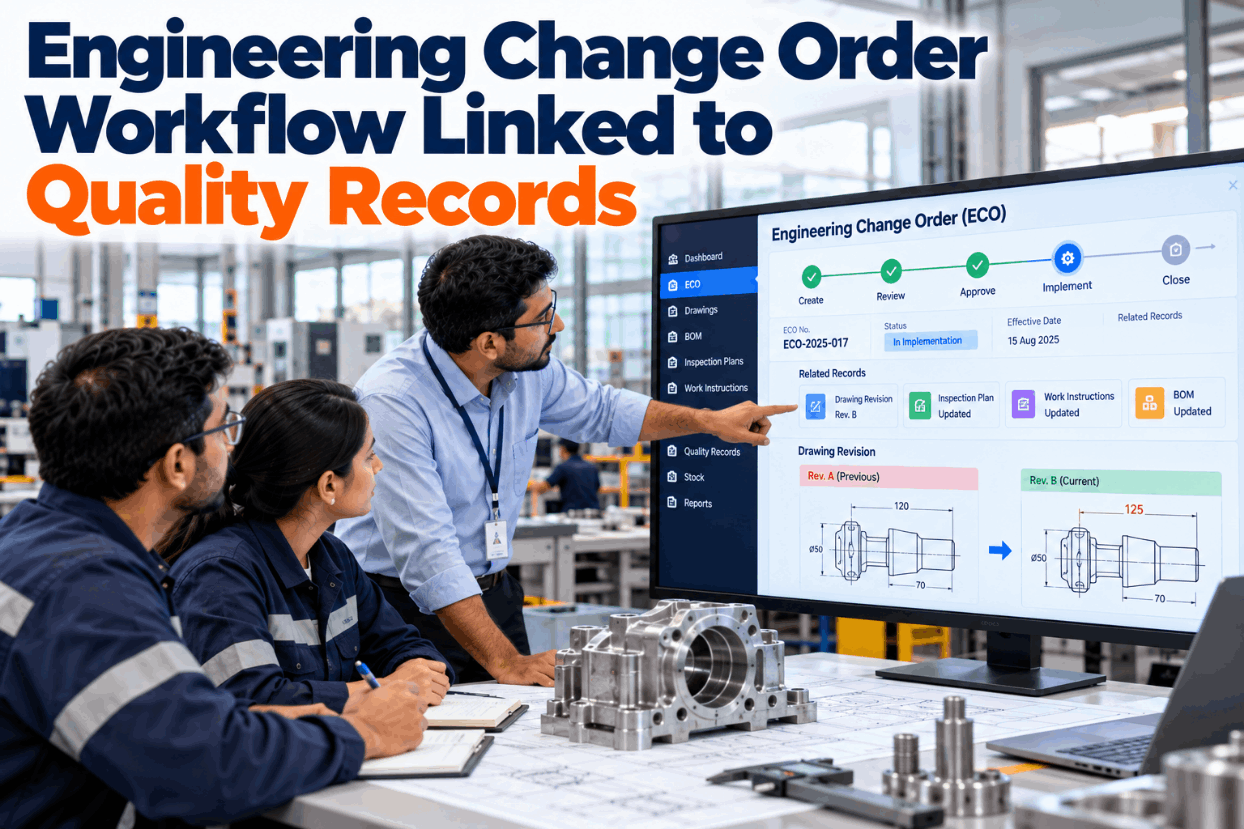
A drawing revision is approved on Tuesday, and on Friday a machinist is still making parts to the old print taped beside the machine. Nothing was wrong with the change itself. What failed was everything that should have moved with it: the inspection plan, the work instruction and the stock on the shelf. An engineering change order workflow linked to quality records moves them together, on a set date. See a change carried through to the stations in a short ECO demo.
Release a Drawing Revision and Every Plan, Station and Bin Follows It
iFactory ECO Module sets the effectivity date, revises the inspection plans automatically and flags old-revision stock for disposition. Operators are notified at their stations and confirm before the first part is made.
Request, Order, Notice: Three Records With Three Jobs
The three terms are often mixed up, and the confusion shows when a change is half done. A request proposes the change and explains why. Once the change board approves it, the order states exactly what changes: part numbers, drawings, BOM lines, when it takes effect and what happens to existing stock. The notice then tells purchasing, production, quality and service that it is in force. Talk through your own change forms with our support team.
Two Clauses, Two Kinds of Change, One Audit Trail
ISO 9001:2015 treats design changes and production changes separately. Clause 8.3.6 covers changes made during or after design and development. Clause 8.5.6 covers changes to how the product is made, such as a new gauge, a revised method or another supplier. Both ask you to review the change, control it and keep a record of who authorised it. Walk through an audit-ready change record in a change control demo.
- The design and development changes
- The results of reviews
- The authorisation of the changes
- Actions taken to prevent adverse impacts
- Results of the review of changes
- The person or people who authorised the change
- Any necessary actions arising from the review
- Scope: changes to production or service provision
For VB-210 Rev C, the tighter bore tolerance is a design change under 8.3.6. The new gauge and work instruction at Op 30 are production changes under 8.5.6. One linked record can cover both.
Roll the Revision or Issue a New Part Number?
The usual test is interchangeability. If the new part can replace the old one in every use with no change to form, fit or function, many plants roll the revision letter and check old stock against the new drawing. If the two can no longer be swapped, most configuration management plans call for a new part number so they never mix in stock. Your own plan decides, and the rows below show typical outcomes, not rules. Check your numbering rules with our support team.
Date, Serial or Lot: Decide Where the Change Starts
Effectivity tells everyone which units get the new revision. Date effectivity suits high-volume parts where the switch can follow the calendar. Serial effectivity is common in aerospace and capital equipment, where each unit's build record must show its configuration. Lot effectivity suits batch work where whole lots run to one revision. Set effectivity rules per product family in a workflow session.
A use-up lets conforming old stock run out before the switch. A hard cut-in stops it on the effective date. The ECO should say which, because the stock disposition depends on it.
Ask What a Change Touches Before You Release It
iFactory reads the ECO against routings, inspection plans, work instructions, gauges and stock, then lists every record that must move and who owns it. The release is not complete until that list is closed.
One ECO, Six Records That Must Move With It
A revised drawing is only the first record. Each one below still points to Rev B until someone changes it, and any record left behind is a route for an old check or an old-revision part. The list comes from ECO-0457, an illustration. Ask our support team which of your records can be linked to the drawing revision.
Every Old-Revision Part Gets a Recorded Decision
Stock made to the old revision does not vanish when an ECO is released. Each piece needs a disposition, with the reason recorded, before the effective date. For VB-210, 340 finished Rev B bodies sit in stores. Measuring the bores split them: 290 already inside the new ±0.03, and 50 outside it but inside the old ±0.05. Plan disposition rules for your parts in a stock review session.
Operators Confirm the New Revision Before the First Part
An email to supervisors is not a notice to the machine. The notice should reach the station that makes or checks the part, and the operator should confirm it there, by tap or by voice, before running. Stations that have not confirmed stay visible to the shift lead. Set station rules with our support team.
Five Places an Old Revision Hides After Release
Most revision mismatches come from copies, not from the master. Each place below keeps its own version until something forces a refresh. Find the hiding places in your own plant during a 30-minute review.
How Sector Rules Add Steps to the Same ECO
The workflow stays the same, but regulated sectors add their own steps. These are illustrations of common requirements, so always check the current standard and your customer's rules. Ask our support team to map them into your change routes.
Count the Follow-Up Hours Each Change Costs Today
The largest cost of a missed change is a batch made to the wrong revision, and that figure should come from your own nonconformance records, not a guess. The routine cost is easier to see: people chasing signatures, revising documents by hand and walking to stations. Every input below is assumed. Rework the numbers with your data in a cost review call.
Then add the parts scrapped or reworked for revision mismatches last year, priced from your own records.
ECO Module and AI Server Delivered Ready to Run
iFactory delivers the ECO Module as a turnkey package. A pre-configured NVIDIA AI server ships racked and ready, with links to your drawing vault, ERP, routings and station screens set up before it arrives. You rack it, plug in power and Ethernet, and the AI is live. Scope the links with our deployment team.
- Pre-configured NVIDIA AI server, racked and ready
- ECR, ECO and ECN workflow with change board sign-off
- Date, serial and lot effectivity per part
- Inspection plans revised automatically from the drawing change
- Work instructions pushed to the affected operations
- Old-revision stock flagged with disposition tracking
- 24×7 remote monitoring of models and hardware
Drawing vault, ERP, routings and stations linked, open ECOs loaded.
One product family runs changes end to end, with station confirmation.
All families switched on, change board trained, mismatch reports started.
Change Control That Reaches the Shop Floor
iFactory connects each change to the records and stations it affects, so a release counts as complete only when all of them follow. See it on a sample part in a 30-minute session.
What Plant Managers Ask About Engineering Changes
Release Changes That Reach Every Station
Effectivity on every ECO, inspection plans revised automatically, old stock decided piece by piece and operators confirming at the station. Delivered turnkey and live within 6 to 12 weeks.