AS9100 Quality Requirements for Aerospace Manufacturers
By David Cook on October 21, 2026
AS9100 takes ISO 9001 and adds what aviation, space and defense customers cannot do without: control of configuration, product safety, counterfeit parts, foreign object debris, key characteristics and first article inspection. Auditors don't only read your procedures. They follow a part through the plant and ask for the evidence at each step. This guide sets out the AS9100 quality requirements a plant manager needs to see working on the floor, with a readiness checklist at the end. To see FAI and receiving checks built into the workflow, book a short aerospace QMS demo.
AEROSPACE QMS PACK · AS9100D
Turn AS9100 Requirements Into Checks Your Floor Already Runs
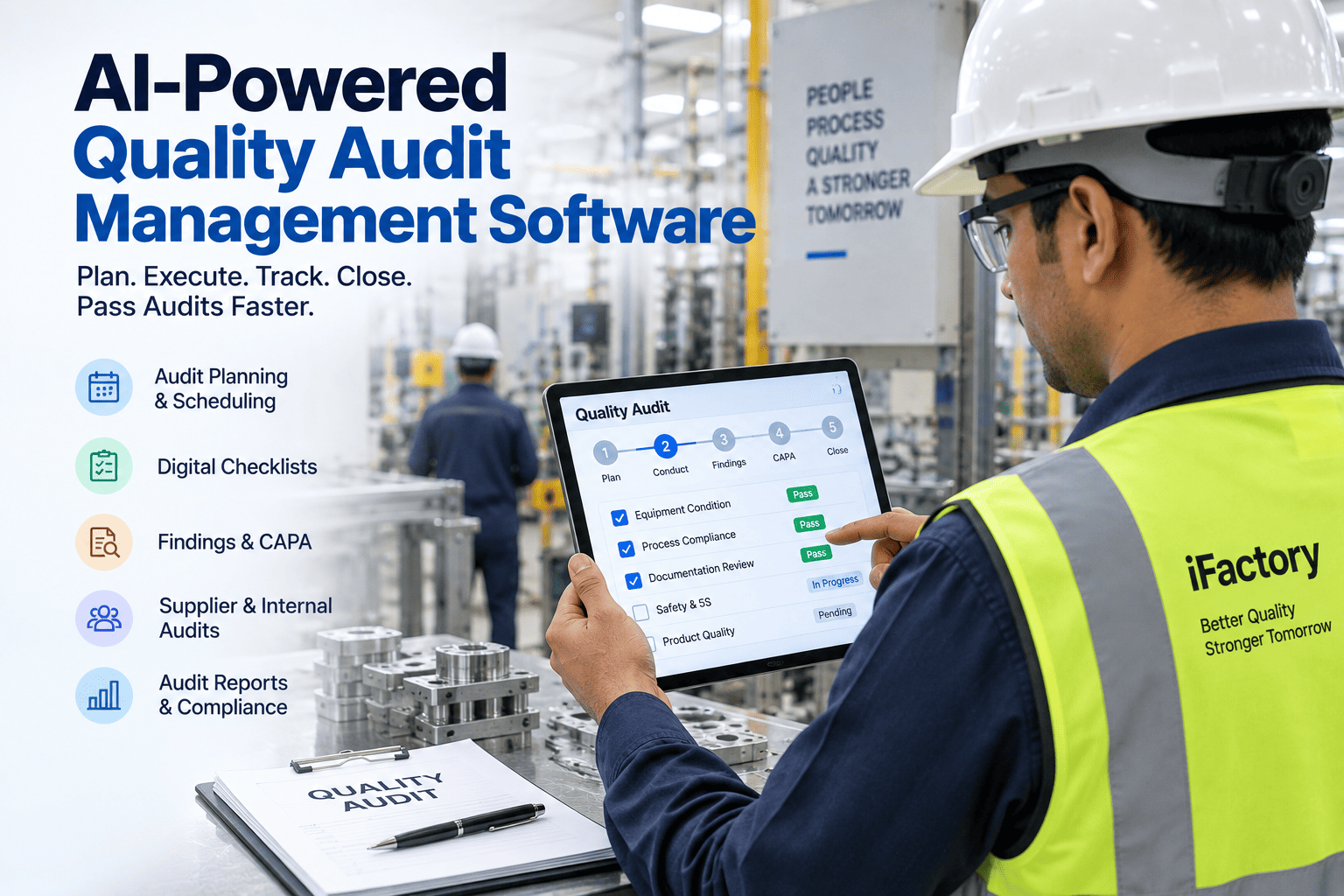
iFactory Aerospace QMS Pack builds FOD audits, counterfeit part checks at receiving, key characteristic SPC and AS9102 first article inspection into daily work, so the evidence exists before the auditor asks.
1 of 42 out of tolerance · FAI on hold, NCR raised
AS9100 QUALITY REQUIREMENTS FOR PLANT MANAGERS
Where AS9100D Goes Beyond ISO 9001
AS9100D keeps the ISO 9001 clause structure and adds aerospace text inside it. Most of the additions sit in clause 8, operation, which is where the plant lives. The map below shows the additions a plant manager will be asked about most, clause by clause. Use it to decide who owns the evidence for each one. Get a clause-by-clause ownership map from our quality team.
7
SupportAwareness of product safety and ethical behaviorCalibration recall and traceability
8.1
Operational planning8.1.1 Operational risk8.1.2 Configuration management8.1.3 Product safety8.1.4 Counterfeit parts
8.4
External providersSupplier risk and performance, including deliveryFlow-down of requirements
8.5
ProductionForeign object preventionKey characteristic controlProduction process verification, FAI
AS9100D was issued in September 2016 and is still the standard certification bodies audit against. IAQG has said its next revision will carry a new number, IA9100, and that the timing is tied to ISO 9001, whose 2026 edition was published on 16 September 2026. The final IA9100 publication date and transition period should be confirmed with IAQG or your certification body before you plan around them. Track the change with our standards specialists.
Confirmed
AS9100 Rev DIssued 20 September 2016, current in the IAQG standards register
ISO 9001:2026Published 16 September 2026, with a transition to 30 September 2029
IA9100 nameNew IAQG documents and revisions take the "IA" prefix
Still to confirm
IA9100 publication dateExpected after ISO 9001:2026, not final at the time of writing
Transition periodNot yet set by IAQG for certified organizations
Clause changesIAQG draft summaries point to firmer product safety and counterfeit requirements
CONFIGURATION MANAGEMENT
Building the Part the Drawing Actually Describes
Clause 8.1.2 asks for a configuration management process that keeps the product's physical and functional attributes identified and controlled through its life. On the floor, that means the router, the program, the inspection plan and the drawing all point to the same revision, and a change reaches every one of them before the next part is made. Most escapes in this area come from a change that reached engineering but not the machine. Check your change path with our support team.
IdentifyPart number, revision and effectivity on every document
Control changeReview, approve and plan the cut-in point
Record statusWhich revision each serial or lot was built to
VerifyProduct matches its documents, checked by audit and FAI
PRODUCT SAFETY AEROSPACE
Product Safety Across the Whole Life of the Part
Clause 8.1.3 requires a planned process for product safety across the product life cycle. The standard's note gives examples: hazard assessment, management of safety-critical items, analysis and reporting of events that affect safety, and communication and training. Clause 7.3 also requires people to be aware of their contribution to product safety. Talk through your safety-critical items in a product safety session.
Design
Hazards assessedSafety-critical items and features identified and flagged on drawings
Make
Critical items controlledSpecial processes, KCs and mandatory inspections protected from shortcuts
Deliver
Evidence completeRecords, certificates and release decisions traceable to the part
In service
Events reportedField events analyzed and fed back to design and production
COUNTERFEIT PARTS PREVENTION
A Receiving Decision Path for Suspect Parts
Clause 8.1.4 requires a process to prevent counterfeit or suspect parts from being used and from reaching the customer. The note lists training, obsolescence monitoring, buying from original or authorized sources, traceability, verification and test methods, monitoring external reports, and quarantine and reporting of suspect parts. Receiving is where most of it becomes real. Map your receiving checks with our supply chain team.
1Bought from the original maker or an authorized source?Yes · continueNo · extra checks required
2Traceability complete back to the original maker?Yes · continueNo · treat as suspect
3Marking, packaging and test results consistent?Yes · accept to stockNo · treat as suspect
!Suspect partQuarantine, keep from useReport per contract and procedure
Counterfeit Checks That Happen at the Dock, Not After Assembly
iFactory checks each receipt against your authorized source list and traceability rules, prompts the inspector for the right verification and quarantines anything suspect with a record attached.
InspectorTwo hundred connectors for PO 55120 from a distributor. No certificate from the original maker in the box.
iFactoryThat distributor is not on the authorized list for this maker. Your procedure requires traceability back to the original maker before acceptance.
InspectorHold them.
iFactoryLot quarantined in bay Q2, buyer asked for traceability documents, quality notified.
FOREIGN OBJECT DEBRIS
FOD Areas Set by Risk, Not by Habit
AS9100D production controls include the prevention, detection and removal of foreign objects. AS9146 sets out a full FOD prevention program, with areas designated from a FOD risk assessment and controls scaled to each designation. Program elements include training before entry, product protection, housekeeping and clean-as-you-go, accounting for consumables and hardware, and tool control with lost-item reporting. Plan FOD audits with our FOD program specialists.
FOD Awareness
General shop areasTraining, housekeeping and clean-as-you-go
FOD Control
Assembly and finishingAdds tool and consumable accounting, protected openings, scheduled audits
FOD Critical
Open engines, fuel and flight-critical systemsAdds controlled entry, tool check-in and check-out, lost-item stop and search
KEY CHARACTERISTICS
Watching Key Characteristics With SPC
A key characteristic is a feature whose variation has a real effect on fit, performance, service life or producibility. AS9100D expects identified key characteristics to be monitored and controlled, and AS9103 describes how to manage their variation, usually with process capability and control charts. The worked example below uses assumed numbers to show the Cpk arithmetic. Ask our SPC team how capability targets are set with customers.
USL 12.010Mean 12.003LSL 11.990
Illustration · bore Ø12.000 ±0.010 · mean drifting toward the upper limit
Upper limit USL12.010
Lower limit LSL11.990
Mean, assumed12.003
Std deviation σ, assumed0.002
Cpu = (USL − mean) ÷ 3σ0.007 ÷ 0.006 = 1.17
Cpl = (mean − LSL) ÷ 3σ0.013 ÷ 0.006 = 2.17
Cpk, the lower of the two1.17 · re-centre the process
FIRST ARTICLE INSPECTION AS9102
Three Forms That Prove the Process Can Make the Part
AS9100D asks for production process verification, and FAI to AS9102 is the usual way to show it. An FAI is a full check of one representative part from the production process against every design requirement. It is repeated, in full or in part, when the design or the production process changes, and AS9102 also calls for a new FAI after a long break in production. See an FAI package built from shop data in a FAI walkthrough.
Form 1
Part number accountabilityThe part, its revision and any sub-assemblies or detail parts
Form 2
Product accountabilityRaw material, special processes and functional tests, with their sources
Form 3
Characteristic accountabilityEvery ballooned characteristic, its requirement and the measured result
Common triggers for a new or partial FAIDesign changeNew machine or programProcess or source changeNew siteLong production breakCustomer request
AS9100 QUALITY REQUIREMENTS TEMPLATE
Plant Readiness Checklist Before the Audit
Tick these off as you walk the plant. Each item is something an auditor can ask to see on the floor, not just in a procedure. Adjust it to your contracts and customer flow-downs. For a version loaded with your own areas and part families, contact our support team.
Configuration and FAI
Counterfeit prevention
FOD prevention
Key characteristics and safety
AS9100 QUALITY REQUIREMENTS EXAMPLES
Three Audit Findings and What Fixed Them
These illustrations show the kind of findings auditors commonly raise against aerospace plants. They are not case studies of any company, and the right fix always depends on your own root cause analysis. Talk through your last audit report in a findings review.
Finding A8.1.2
Machine program one revision behind the drawing
Why it happenedEngineering change released, but no step to confirm the program revision at the machine
FixRevision check at first-off, with the change blocked until every document matches
Finding B8.1.4
Fasteners accepted from an unlisted broker
Why it happenedShortage buy approved by phone, receiving had no way to see source status
FixAuthorized source check at receiving, with automatic quarantine for unlisted sources
Finding C8.5.1
Missing torque bit not reported in a FOD control area
Why it happenedTool boards checked at shift start only, lost-item reporting unclear
FixCheck-out by job, end-of-task count and a defined stop-and-search rule
AS9100 QUALITY REQUIREMENTS COST AND ROI
Sizing the Time Spent Assembling FAI Packages
FAI paperwork is one of the easiest costs to size. Every input below is an assumption to show the arithmetic, so replace each with your own figures. Our team can help you build the full case.
Full or partial FAIs per year, assumed120
Hours to assemble each package by hand, assumed6
Hours per year by hand120 × 6 = 720 h
Hours per package with data captured at source, assumed2
Hours per year with data at source120 × 2 = 240 h
Quality engineering time freed720 − 240 = 480 h per year
TURNKEY AI DEPLOYMENT
Aerospace QMS Pack and AI Server in One Package
iFactory delivers the Aerospace QMS Pack as a turnkey bundle. A pre-configured NVIDIA AI server ships racked and ready with FOD audit, receiving, SPC and FAI workflows pre-loaded, so controlled technical data stays on site. You rack it, plug in power and Ethernet, and the AI is live. To scope it for your plant, request a turnkey quote.
What's Included
Pre-configured NVIDIA AI edge server, racked and ready
FOD area audits with findings and close-out
Counterfeit checks against authorized sources at receiving
Key characteristic SPC with capability tracking
AS9102 FAI forms built from shop and CMM data
Links to ERP, MES and inspection equipment
24×7 remote monitoring of software and hardware
Live in 6–12 weeks
Wk 1–4
Install and Connect
Server installed, ERP, MES and gauges linked, part families and FOD areas loaded.
Wk 5–8
Pilot One Cell
FAI, SPC and receiving checks run on one part family alongside current methods.
Wk 9–12
Go-Live and Training
Workflows extended across the plant, inspectors and leads trained.
HOW iFACTORY FITS
Aerospace Evidence Built Into Daily Work
iFactory puts the AS9100 checks where the work happens, so records are made as a by-product of doing the job. Our support team can plan a pilot on one of your parts.
1
FOD audits. Area audits by designation, with findings tracked to closure.
2
Counterfeit checks at receiving. Sources and traceability checked, suspect lots quarantined.
3
Key characteristic SPC. Charts and capability for every flagged feature, with alerts on drift.
4
AS9102 FAI in the workflow. Forms 1 to 3 built from shop data, with triggers watched.
1000+
Industrial clients running iFactory
99.9%
Platform uptime for production plants
6-12 wks
From racked server to live aerospace checks
FREQUENTLY ASKED QUESTIONS
What Plant Managers Ask About AS9100
What does AS9100 add to ISO 9001?
AS9100D includes the ISO 9001 text and adds aerospace requirements. The main additions cover operational risk, configuration management, product safety, counterfeit parts prevention, foreign object prevention, key characteristics, production process verification and on-time delivery measurement, plus closer control of external providers.
Is AS9100D being replaced?
IAQG has said the next revision will be numbered IA9100 and aligned with ISO 9001, whose 2026 edition was published in September 2026. AS9100D remains current until the new standard is published and a transition period runs. Confirm dates with IAQG or your certification body.
When is a new first article inspection needed?
An FAI is done for a new part or new production process, and repeated in full or in part when the design, process, tooling, source or location changes. AS9102 also calls for one after a long break in production. Customer contracts may add their own triggers.
How do we set up FOD areas?
Run a FOD risk assessment of products and operations, then designate areas, commonly as awareness, control or critical, following AS9146. Each designation gets its own controls for training, housekeeping, tool and hardware accounting and audits.
What is a key characteristic?
A feature whose variation significantly affects fit, performance, service life or producibility. Customers often flag them on the drawing. AS9103 describes how to manage their variation, typically with SPC and a capability target agreed with the customer.
How should we start an implementation?
Choose one part family and one cell. Load its drawings and key characteristics, link the gauges and CMM, run FAI and SPC alongside current methods, and add receiving checks for its parts. Our support team can plan the pilot with you.
Every Part Traceable, Every Requirement Evidenced
Run FOD audits, check parts at receiving, watch key characteristics and build FAI packages from shop data. The full system is delivered turnkey and goes live in 6 to 12 weeks.