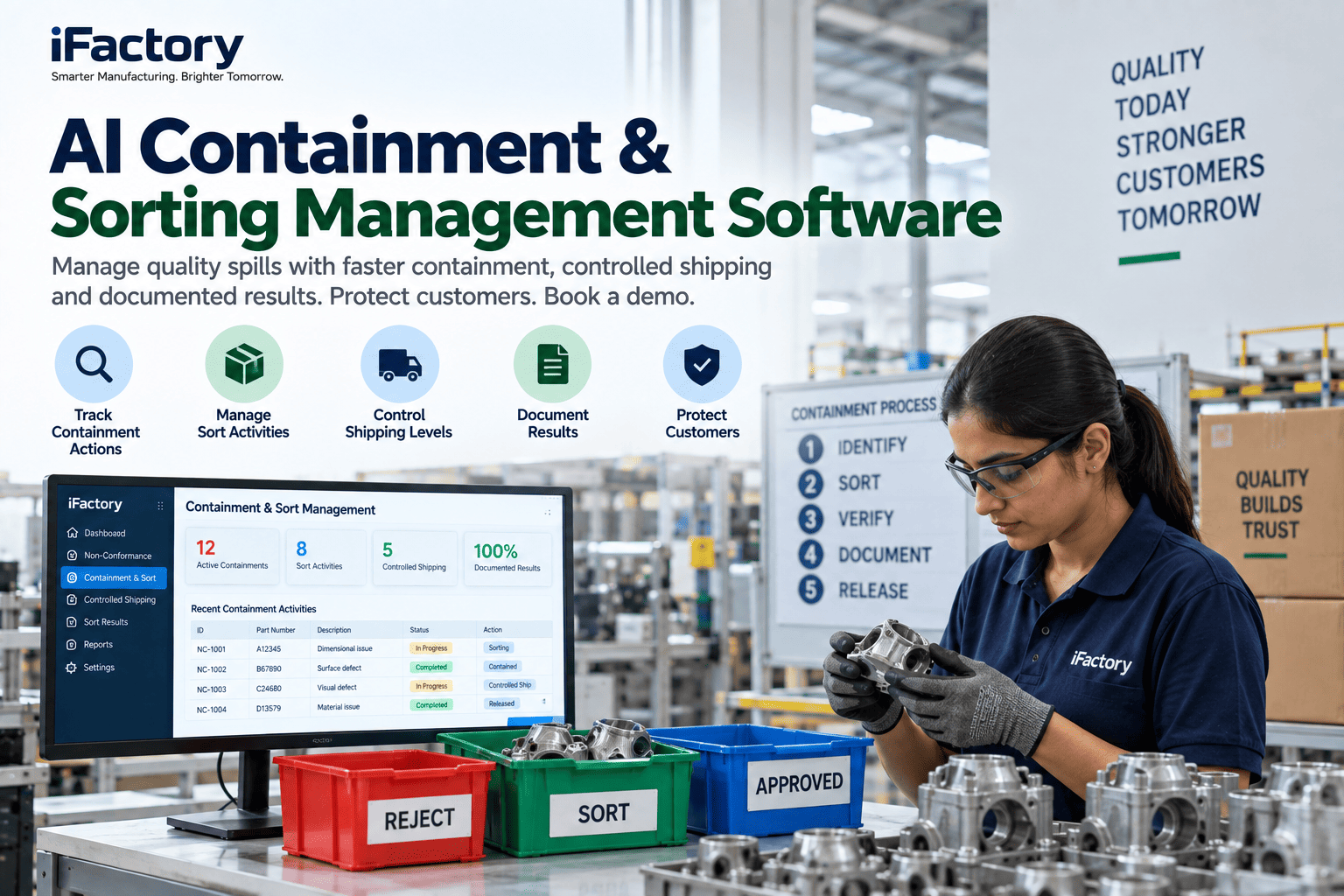
A quality spill is the moment every escape becomes a race against the truck already in transit. Suspect stock has to be identified, contained at all locations (in-house, in-transit, at customer, in the pipeline), sorted to defect vs conform, and documented with sort results the customer will audit — all inside the window the OEM's controlled shipping level allows. Automotive OEMs formalise this as CS1 (internal sort under OEM oversight) and CS2 (third-party sort at supplier cost); other industries use containment action or quality spill protocols with similar structure. What every one of these needs is a workflow that captures the containment scope, tracks the sort by location, holds the disposition record, and produces the daily reporting the customer requires.
iFactory / Containment and sort management
Contain the Spill, Sort with Discipline, Document with the Detail Customers Audit
Manage controlled shipping levels (CS1, CS2), containment actions at every location (in-house, in-transit, at customer, in-pipeline), sort activities with defect / conform disposition tracking, and customer-facing daily reports that satisfy OEM oversight.
ALERT
Internal 100% sort at plant
CS1
OEM-imposed sort · internal
CS2
3rd-party sort · additional cost
CS1 · CS2
OEM-aligned levels
4 locations
in-house · transit · customer · pipeline
Daily report
customer-facing
The Problem in Quality Containment
A customer complaint arrives at 09:00. The suspect part might affect any lot shipped in the last three weeks. In those weeks, product went to three plants, sat at two warehouses, and shipped on approximately 40 trucks. The quality team has hours — not days — to determine what is contained where, what has to be sorted, and what the sort results show, because CS1 or CS2 status may be pending on the customer's decision by end of shift. Most plants run this on a whiteboard, a spreadsheet, and phone calls. Two days in, nobody is sure whether the 200 pieces sorted this morning were part of the affected lot. That ambiguity is where CS1 becomes CS2.
Where the Containment Chain Actually Breaks
Containment and sort management fails in specific ways under time pressure. Each is a documented escape category in automotive supplier CS1/CS2 case studies.
Scope ambiguity
The exact date range and shift window of suspect production not locked before sorting starts. Two overlapping sorts run on overlapping lots. Results reconcile poorly. Customer trust erodes.
Location gap
Sort covers in-house and in-transit but misses the OEM's pipeline stock. Defect reaches the line. CS1 escalates to CS2 because the containment scope did not cover every location.
Sort result drift
Sort team A logs defect count on paper. Sort team B logs on a spreadsheet. Third-party sort site logs in its own system. Numbers don't reconcile at daily update. Customer requests a supervisor briefing.
Exit criteria unclear
Days into containment, nobody defined the exit criteria (X consecutive shifts clean, Y sorted quantity below threshold). Containment continues indefinitely — burning cost and customer patience.
What Good Looks Like in Containment
A working containment system holds four disciplines together — locked containment scope at spill open, location-tracked sort with defect/conform disposition, daily customer reporting with reconciled numbers, and defined exit criteria.
Locked Scope
Containment scope defined at open with part, lot range, date/shift window, and affected locations enumerated. No ambiguity on what is being contained.
Scope, first hour
Location-Tracked Sort
Sort activities logged per location — in-house, in-transit, at customer, in OEM pipeline — with sorted quantity, defect count, and conforming count captured per shift.
Every location tracked
Daily Reporting
Customer-facing daily report auto-generated from sort records. Numbers reconciled across locations before submission. OEM oversight receives the same picture the plant sees.
Reconciled, then submitted
Exit Criteria
Exit criteria (consecutive-shift clean, sort volume below threshold, corrective action verified) defined at open and tracked. Containment closes on evidence, not calendar.
Close on evidence
How iFactory AI Fits
iFactory AI overlays your existing QMS non-conformance module and warehouse/logistics systems (SAP EWM, Oracle WMS, Manhattan) — adding the containment scope, location-tracked sort, and customer-facing daily reporting workflow.
Spill Record
NCR + Overlay
Containment scope with part, lot range, date/shift window, and affected locations. All parent NCRs and complaints linked from one record.
Sort Ledger
Overlay Layer
Sort activities per location per shift with sorted, defect, and conforming counts. Reconciliation across locations at each daily close.
Customer Report
Overlay + Reporting
Daily report generated from sort records to the customer's required format (OEM-specific templates supported). Submitted with reconciled numbers.
Exit Package
Overlay + Compliance
Exit criteria tracked, corrective action verified, evidence of X consecutive shifts clean captured. Formal exit package submitted for OEM sign-off.
Ask your quality manager to describe how the last CS1 was managed — who tracked sort location by location, how daily numbers reconciled, and how exit was signed. If any of those was informal, the next CS1 has a materially higher chance of escalating to CS2. Book a containment workflow review.
8-Week Containment Rollout
One product family or one customer relationship, eight weeks. The pilot deploys the containment workflow, walks a table-top exercise, and is ready for the next real spill.
Weeks 1–2
Playbook Set
Existing containment playbook reviewed. Customer-specific reporting templates loaded (OEM formats). Sort locations mapped. Team roles configured.
Weeks 3–4
Table-Top Drill
Simulated CS1 spill run through the workflow. Sort locations, daily report generation, and exit-criteria evaluation tested with the team. Refinements captured.
Weeks 5–6
Live Response Ready
Workflow live for the pilot scope. First real containment event (if it occurs) runs through the system. Alternately, a controlled internal sort exercises the flow.
Weeks 7–8
Response Metrics
Response cycle time, sort accuracy, and customer-facing reporting quality measured. Rollout scoped based on real-event response and OEM feedback.
Who Owns the KPI
Containment crosses quality, operations, logistics, and customer-facing account management. Each function owns a specific KPI or the response fragments under time pressure.
Quality Manager
Time from complaint to locked scope
Owns the front-end response — hours from complaint receipt to containment scope locked with all locations enumerated. Under 4 hours is the working target.
Operations Lead
Sort accuracy by location
Owns the sort discipline — defect discovery rate consistent across locations, no location under-reporting because the sort team was thin.
Logistics / Warehouse
In-transit and pipeline coverage
Owns the location coverage — every truck, warehouse, and pipeline location traced and contained. Missing one location is where CS1 becomes CS2.
Customer Account Lead
OEM confidence in daily report
Owns the customer-facing outcome — the OEM's ongoing confidence in daily numbers. Reconciliation failures are what escalate.
FAQ
How do CS1 and CS2 actually differ, and how does this help avoid CS2?
CS1 (Controlled Shipping Level 1) is OEM-imposed containment where the supplier performs 100% inspection with dedicated resources under the OEM's oversight. CS2 (Controlled Shipping Level 2) adds a third-party inspection layer, paid by the supplier, when the OEM has lost confidence in CS1. CS2 is expensive — third-party sort houses typically charge per piece — and often signals the OEM is considering re-sourcing. Most CS1-to-CS2 escalations trace to daily-report drift, missed locations, or sort-result reconciliation failures — exactly the disciplines the workflow enforces. Preventing CS2 is measured in the reliability of the daily communication.
What about non-automotive industries — does this apply to aerospace, med device, food?
Yes, with different vocabulary. Aerospace uses containment action under AS9100 8.7 with customer notification per contract. Medical device uses field safety corrective action (FSCA) under ISO 13485 8.5 and 21 CFR 806. Food uses withdrawal and recall under FSMA and BRC/SQF standards. The underlying discipline is the same — lock scope, sort by location, reconcile numbers, define exit — and the workflow supports each industry's specific reporting format.
Book a demo to see the workflow adapted to your industry's reporting rules.
How does this integrate with our existing NCR and CAPA workflow?
The containment record is the parent of one or more NCRs and links to the CAPA that will drive permanent corrective action. Containment addresses immediate quality-spill response; NCR addresses the disposition of specific non-conforming material; CAPA addresses the systemic root cause. The three flows connect: containment scope drives NCR generation for affected lots, sort results feed NCR closure, and CAPA verification is one of the exit-criteria checks. If your QMS already runs NCR and CAPA (Sparta TrackWise, ETQ, MasterControl, Veeva Vault), the containment layer plugs into them rather than replacing.
Stop managing containment on whiteboards under time pressure.
Table-Top a Containment Response — Live
Bring your last CS1 event summary, the customer's reporting template, and your current containment playbook. We'll table-top the response through the workflow, quantify the reconciliation gap, and demonstrate the exit-criteria discipline.
Reconciled
daily reporting