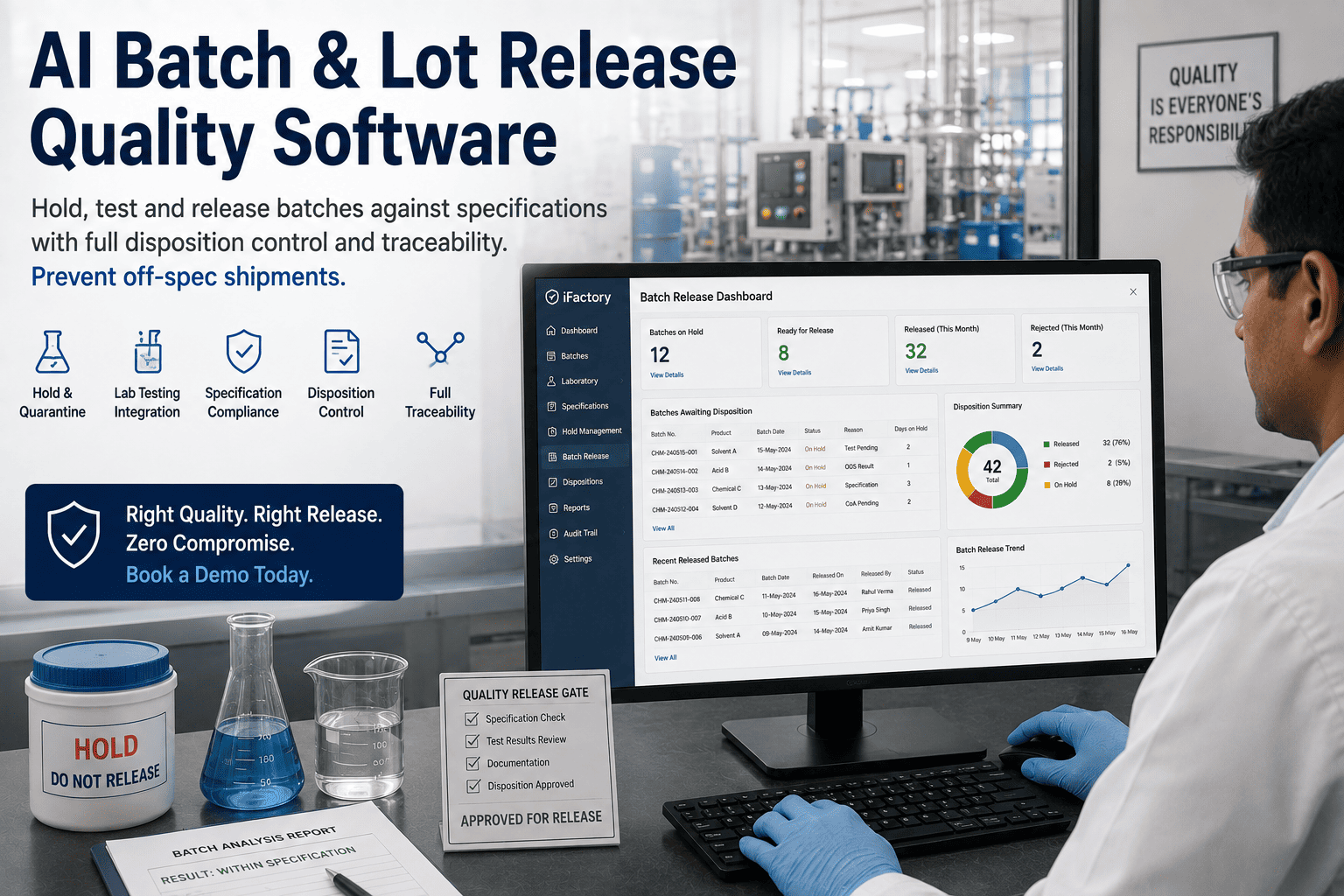
A single batch record can hold hundreds of entries, and under 21 CFR 211.192 the quality unit must review and approve all of it before the batch is released. Most of those entries are within limits, signed on time and complete. Review by exception lets QA spend its hours on the few that are not, without losing sight of the rest. See it on a sample record in a short exception review demo.
REVIEW BY EXCEPTION · PHARMA QA
Batch Record Review That Puts Only the Exceptions in Front of QA
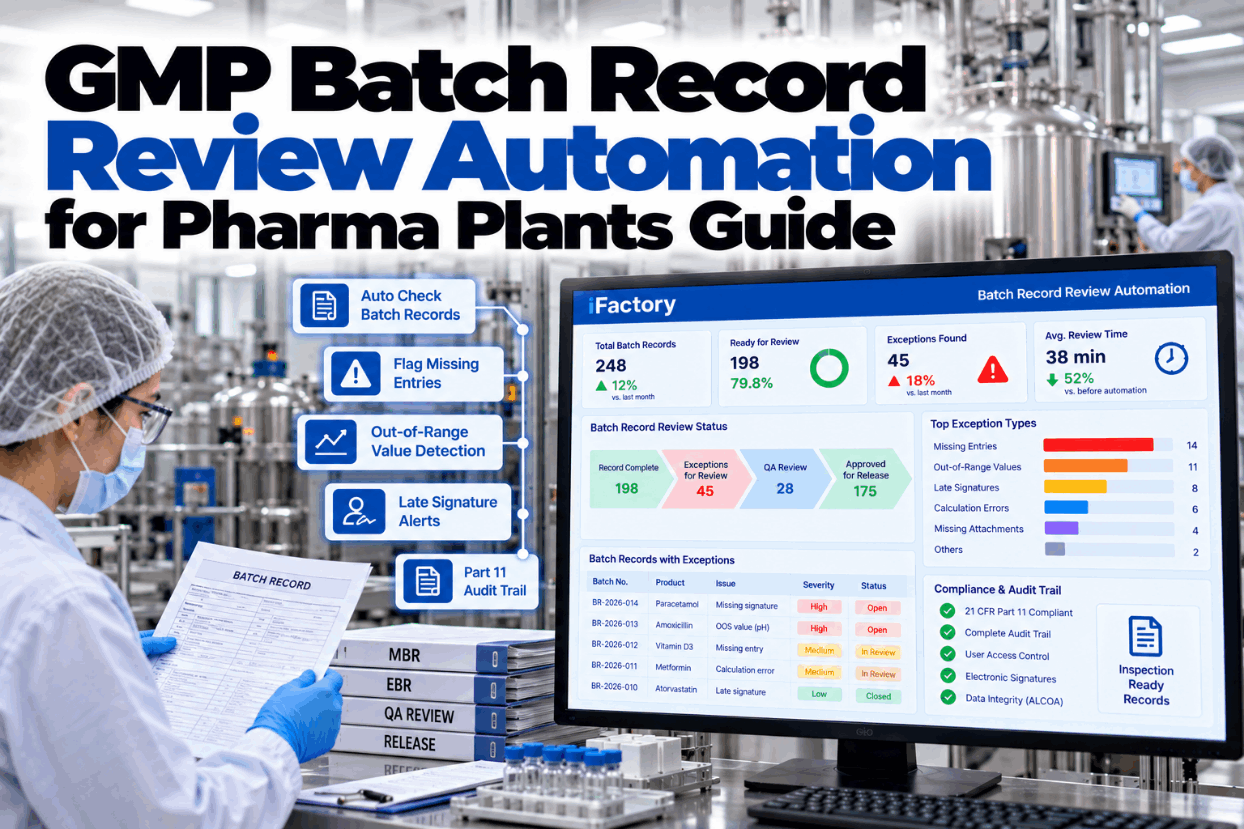
The iFactory Review-by-Exception Agent scans electronic batch records for gaps and deviations and highlights only the exceptions for QA. Every check it makes is kept in a Part 11 audit trail, and the release decision stays with your quality unit.
EBR 24-118 · Oral solid dose7 to review
312 entries checked against the master record
MajorYield 94.1%, limit 95–101%
MajorDeviation DV-0391 still open
MinorLine clearance signed 2 h after step
MinorBlank field: room humidity, step 6.3
WHAT A BATCH RECORD MUST PROVE
What 21 CFR 211.188 Puts Inside Every Batch Record
For cGMP compliance, 21 CFR 211.188 requires a production and control record for each batch, starting from a checked copy of the master record and documenting every significant step. Section 211.22 gives the quality unit authority to review those records, and 211.192 says it must review and approve them, investigating any unexplained discrepancy, before release. Each item below is something an agent can check automatically. Map your own record structure with our support team.
(b)(1)DatesEvery step dated
(b)(2)Equipment and linesEach major item identified
(b)(3)Component lotsEach lot used identified
(b)(4)Weights and measuresActual quantities recorded
(b)(5)In-process and lab resultsCompared with limits
(b)(6)Packaging area checksBefore and after use
(b)(7)YieldActual vs theoretical at set phases
(b)(8)Labelling controlSpecimens or copies kept
(b)(9)Containers and closuresDescribed in the record
(b)(10)SamplingAny sampling recorded
(b)(11)Who did and who checkedPerformer and checker for each significant step
REVIEW BY EXCEPTION
From 312 Entries to the 7 That Need a Person
ISPE describes review by exception as screening manufacturing and quality data so that only critical process exceptions are reported for human review. It works only when the batch record is electronic, the limits are defined in the master record and the system doing the screening is validated. Entries within limits are still captured, stored and open to QA at any time. They simply don't need a line-by-line read. The funnel below is an illustration. Walk through one of your own records in a record walkthrough.
Entries captured in the EBR312
Within limits, signed on time298
Raw flags raised by rules14
Exceptions after grouping7
Release decisionQA
THE EXCEPTION CATALOG
Eight Exceptions the Agent Looks For
Every rule traces back to a requirement or to a limit in your master record, so a reviewer can always see why something was flagged. Classes shown are typical starting points. Your deviation SOP sets the final ones. Review the catalog against your SOPs with our GMP support team.
TRIAGE AND ROUTING
Each Exception Goes to the Person Who Can Close It
A flag is only useful if it lands with the right owner while the batch is still on the floor. The agent routes each exception by class, so minor corrections happen during the shift and QA receives the major and critical items with context attached. Set up routing rules in a routing session.
Minor
Supervisor notified in shift›Correction with reason, original kept›Shown as corrected in QA summary
Major
Owner and QA notified›Assessment and disposition recorded›QA reviews before release decision
Critical
Deviation raised at once›Investigation extends to related batches›QA decides disposition
Spend QA Time on the Entries That Need Judgement
The agent checks every entry against the master record, groups duplicate flags and gives QA a short list with the evidence attached. Reviewers can open the full record or the audit trail from any exception in one step.
Batch 24-118 · QA reviewer and iFactory
QA reviewerWhat is still open on batch 24-118?
iFactoryTwo major items. Deviation DV-0391 is not closed, and yield is 94.1% against a 95% lower limit. Five minor items were corrected with reasons.
QA reviewerWho changed the blend time?
iFactoryOperator 2141 changed it from 12 to 14 min at 10:42, reason "entry error", checked by the supervisor at 10:47. Audit trail attached.
BATCH RECORD REVIEW AUTOMATION SOFTWARE
Part 11 and Annex 11 Controls the Agent Works Under
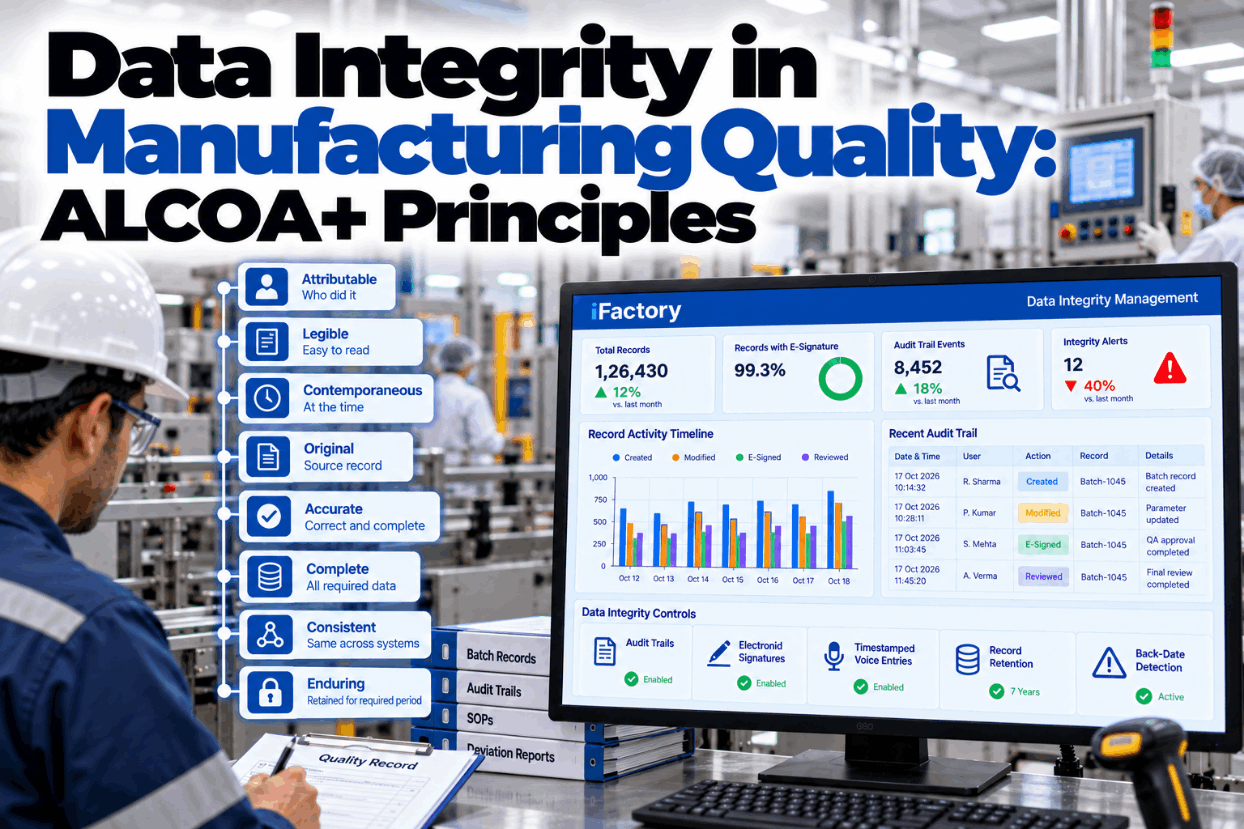
Automating the review does not relax the rules for electronic records. The agent, the EBR and the people using them all work inside the same 21 CFR Part 11 and EU GMP Annex 11 controls, which also underpin data integrity (ALCOA) for the record. Ask our compliance support team how these map to your validation approach.
§11.10(e)Audit trailSecure, computer-generated, time-stamped record of entries and actions. Changes never hide the earlier value.
§11.50Signature meaningPrinted name, date and time, and what the signature means, such as review or approval.
§11.70Signature linkingSignatures cannot be removed, copied or moved to another record.
§11.200Two componentsAt least an ID code and a password for each non-biometric signature.
Annex 11 §9Reason for changeChanges to GMP data carry a documented reason, and audit trails are reviewed regularly.
Annex 11 §15Batch releaseOnly Qualified Persons certify release, identified by electronic signature.
The agent is audited too
Every flag it raises, and every dismissal or comment a reviewer makes on that flag, is written to the same audit trail with user, time and reason.
WHERE QA STAYS IN CHARGE
The Agent Flags. QA Decides.
Pharma QA review is a legal responsibility, not a task to hand to software. Section 211.22 gives the quality unit the authority to approve or reject product, and in the EU a Qualified Person certifies each batch. The draft EU GMP Annex 22 on AI, released for consultation in July 2025, points the same way: deterministic models for critical uses and clear human responsibility. The agent's checks are rules against your master record, so the same record always gives the same result. Talk through the boundary in a QA design session.
The agent
Checks every entry against master record limits
Finds blanks, late signatures and edits
Links open deviations to the batch
Groups and routes exceptions
Logs every check in the audit trail
Release line
The quality unit
Assesses each exception and its impact
Approves or rejects investigations
Opens the full record whenever needed
Owns the exception rules and their changes
Signs the release or rejection
BATCH RECORD REVIEW AUTOMATION TEMPLATE
An Exception Disposition Record
Each exception should close with the same short record, whether it took two minutes or two weeks. These fields give QA what it needs to decide and give inspectors a clear trail. Request an editable copy from our support team.
Exception EX-24118-03Batch 24-118 · Granulation
Step and fieldStep 4.2, final blend time
Rule triggeredEdit to critical data after entry
Original and new value12 min to 14 min
Changed by, when, whyOperator 2141, 10:42, entry error
Class and ownerMinor, production supervisor
EvidenceBlender log shows 14 min run
Impact on other batchesNone identified
QA disposition and signatureAccepted · name, date, time, meaning
BATCH RECORD REVIEW AUTOMATION EXAMPLES
Three Exceptions, Followed From Flag to Close
These are illustrations of how exceptions typically move, not case studies. Your own SOPs decide each step. Try the same flow on your records in a live trial review.
Late signature
09:10Line clearance step completed
11:15Checker signs, 2 h later. Flag raised
11:30Supervisor notes reason. QA accepts as minor
Yield below limit
Day 1Yield 94.1% against 95% lower limit
Day 1Deviation raised, related batches listed
Day 3Investigation closed. QA decides disposition
Blank humidity field
14:02Step 6.3 closed with room humidity blank
14:03Flag sent to the area supervisor
14:20Value taken from room monitoring record, linked
BATCH RECORD REVIEW AUTOMATION COST AND ROI
A Review Time Worksheet With Assumed Inputs
Batch release time depends on lab testing, investigations and logistics as well as record review, so review hours are the cleanest thing to size. Every input below is assumed. Replace each one with your own figures. Build your version with our support team.
Batches per month40assumed
Full manual review per batch16 hassumed
Exceptions per batch18assumed
Minutes per exception10assumed
Final check and e-signature1 hassumed
Exception review per batch18 × 10 min = 180 min = 3 h
Review by exception per batch3 h + 1 h = 4 h
Monthly QA hours, full review40 × 16 h = 640 h
Monthly QA hours, by exception40 × 4 h = 160 h
QA review hours freed per month640 h − 160 h = 480 h
Leave out of the sum anything you can't measure yet. Also count the costs: validation, keeping exception rules current and a parallel review period at the start.
BATCH RECORD REVIEW AUTOMATION FOR PLANT MANAGERS
Five Things to Have in Place Before You Switch It On
Review by exception is only as good as the record and the rules behind it. Plants that get value from it usually build these foundations in order. Check your readiness in a readiness review.
1Numeric limits in master recordsEvery critical parameter has a limit the agent can test
2Data captured at sourceScales, sensors and LIMS write straight to the electronic batch records
3Deviation classes agreedMinor, major and critical defined in one SOP
4Rule set validatedTested on past batches with known exceptions
5Parallel runQA reviews full record and exception list side by side until no misses
TURNKEY AI DEPLOYMENT
The Review Agent, Its Server and Its Connectors in One Package
iFactory delivers the Review-by-Exception Agent as a turnkey system. A pre-configured NVIDIA AI server ships racked and ready, with the agent and your exception rules loaded, so batch data stays on site. You rack it, plug in power and Ethernet, and the AI is live. To scope it for your plant, request a turnkey proposal.
What's Included
- Pre-configured NVIDIA AI server, racked and ready
- Review-by-Exception Agent with your rule set
- Connectors to EBR or MES, LIMS and deviation system
- Part 11 audit trail and e-signature controls
- Exception lists and dashboards for QA
- Documents to support your validation approach
- 24×7 remote monitoring of hardware and agent
Live in 6–12 weeks
Wk 1–4
Map and Connect
Master record limits turned into exception rules, server installed, EBR and LIMS connected.
Wk 5–8
Test and Parallel Run
Rules tested on past batches, then run beside full QA review to confirm nothing is missed.
Wk 9–12
Go Live, First Product Family
Exception review switched on for one family, QA trained, rule changes under change control.
HOW iFACTORY FITS
Exception Review Built Around the Quality Unit
iFactory is built for plants where every record must stand up to inspection and every release is a QA decision. See the full flow in a product walkthrough.
1
Scans every EBR entry. Gaps, out-of-range values, late signatures and edits are checked against the master record.
2
Highlights only exceptions. QA gets a short, grouped list with evidence, not hundreds of pages.
3
Keeps Part 11 audit trails. Every flag, comment and signature is time-stamped and linked to its record.
4
Leaves release with QA. The agent never approves or rejects a batch.
1000+
Industrial clients running iFactory
99.9%
Platform uptime for production and QA
6-12 wks
From racked server to live exception review
FREQUENTLY ASKED QUESTIONS
What QA and Plant Leaders Ask About Batch Record Review Automation
What is review by exception?
It is a way of reviewing electronic batch records in which a validated system screens every entry against defined limits and rules, and only the entries that fail are presented for detailed human review. All data is still captured and kept, and QA can open the full record at any time.
Is review by exception acceptable under cGMP?
The regulations require the quality unit to review and approve all production and control records before release. They don't prescribe a reading method. Review by exception is a way of doing that review when the system is validated, the rules are justified and documented, and QA stays accountable. FDA's 2018 data integrity guidance also treats audit trails as part of the records QA reviews.
Can the agent release or reject a batch?
No. It flags, groups and routes exceptions and keeps the evidence together. Approval and rejection stay with the quality unit, and in the EU certification stays with the Qualified Person.
Does it work with paper or hybrid records?
It needs data in electronic form. Hybrid records, where some steps are still on paper, can be partly covered, but the paper steps still need a full manual review. Most plants move one product family to electronic batch records first.
How are the exception rules validated?
Each rule is traced to a requirement or a master record limit, tested against past batches with known exceptions and then run in parallel with full QA review. After go-live, rule changes go through change control like any other GMP system change.
How do we start?
Choose one product family with electronic records and clear limits. Convert its master record into rules, test them on recent batches and run a parallel review. Our
support team can plan that first rollout with you.
Give QA a Short List Instead of a Long Record
Screen every electronic batch record entry against your master record, route exceptions while the batch is still on the floor and keep a full Part 11 audit trail. The system is delivered turnkey and goes live in 6 to 12 weeks.
Example review summary · Batch 24-118
Entries checked312 against master record
Exceptions2 major, 5 minor
Open itemsDV-0391, yield investigation
Audit trailEvery check and comment logged
Release decision: quality unit only