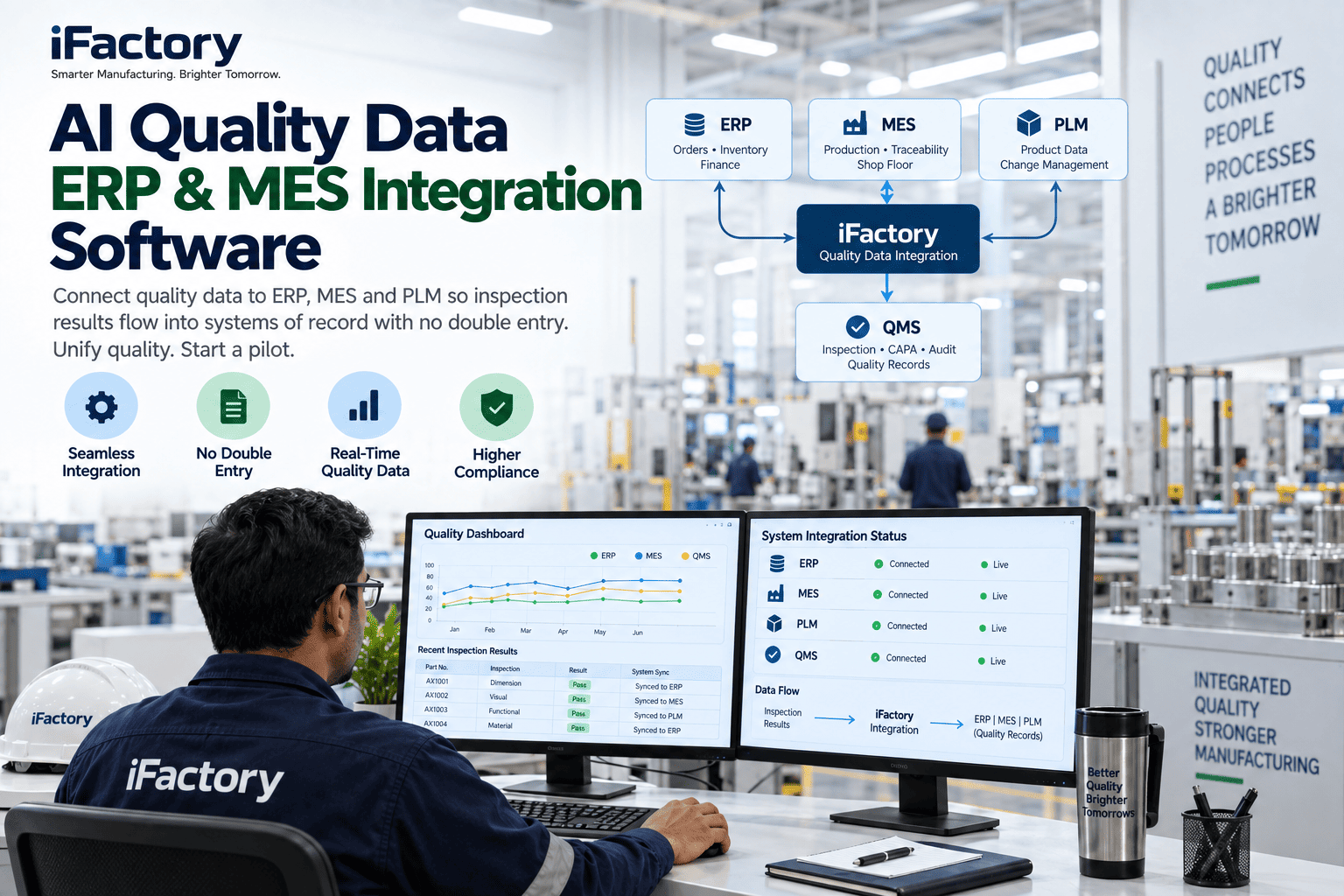
Quality data ends up trapped in the QMS because it never had a native path to ERP, MES, or PLM. A dimensional inspection result gets recorded in the quality system, then re-keyed into ERP for goods-receipt disposition, then re-typed into a spreadsheet that reconciles the MES production batch to QA release. Every hop is a chance for numbers to drift and a defect to escape because dispositions on one system did not match the other. Integration is not middleware for its own sake — it is the discipline that lets one inspection result move a batch through goods-receipt, MES routing, PLM revision, and CMMS calibration reference without human re-keying.
iFactory / Quality data integration
One Inspection Result, Every System of Record Updated — No Double Entry
Native connectors to ERP (SAP, Oracle, Microsoft Dynamics), MES (Rockwell FactoryTalk, AVEVA Wonderware, Siemens Opcenter), PLM (PTC Windchill, Siemens Teamcenter, Aras) — quality events flow to the systems of record with no re-keying and no reconciliation gap.
QMS
PLM
Windchill · Teamcenter
ERP · MES · PLM
native connectors
No re-keying
single-source disposition
API + event
both patterns supported
The Problem in Quality Data Flow
A typical mid-size manufacturer's quality function operates as an island. Inspection results, non-conformances, and dispositions live in the QMS. The ERP holds the material master, goods-receipt records, and batch-level QA hold or release. The MES runs production routing and knows which lot went through which operation on which shift. The PLM holds the drawing revision the inspection was measured against. When quality data lives only in the QMS, ERP disposition gets entered by hand from a QA report, MES lot status updated separately by the production supervisor, PLM revision looked up manually. Every disconnect is where escapes happen — a lot released in ERP that quality had actually placed on hold.
Where Quality Data Actually Escapes
Quality-data disconnect failure modes are consistent across manufacturers. Each maps to a specific system-of-record gap.
QMS-ERP disposition drift
QA places a lot on hold in the QMS. Warehouse ships it because the ERP still shows unrestricted stock. Customer receives held material. Recall and root cause on why the two systems disagreed.
MES revision mismatch
Engineering releases drawing revision C in PLM. MES routing still references revision B. Operators run against the old spec. Inspection catches the mismatch — but only after a full shift is built.
Double-entry error
Operator enters dimensional check in the QMS at 14:23. Warehouse clerk enters same check result in ERP goods-receipt at 15:47 from a printed report. Numbers transposed. Cp/Cpk report months later has a spurious outlier.
Calibration lag
CMMS shows a gauge is due for calibration. QMS continues to use it because the calibration status was not exposed to the inspection workflow. Measurements taken with an out-of-cal gauge — traceability broken.
What Good Looks Like in Quality Integration
A working quality data integration holds four disciplines together — native connector to each system, event-driven bidirectional flow, master-data alignment, and traceability across the full record.
Native Connectors
Purpose-built connectors to SAP QM/PP/MM, Oracle Cloud, Microsoft Dynamics, Rockwell FactoryTalk, AVEVA Wonderware, Siemens Opcenter, PTC Windchill, Siemens Teamcenter, Aras Innovator, IBM Maximo.
Purpose-built, not RPA
Event-Driven Flow
Inspection completion, disposition change, non-conformance opening, and characteristic-out-of-spec each fire events that update ERP, MES, and PLM as appropriate — bidirectional where the systems support it.
Bidirectional events
Master Data Alignment
Material, part, characteristic, and revision master data reconciled across QMS, ERP, MES, and PLM — with mismatch flagged before it becomes a mismatch in operational data.
Master-data governance
Traceability
Every quality event linked to the ERP batch, MES lot, PLM revision, and CMMS calibration status active at the time of inspection. Audit-ready trace across the full record.
Cross-system trace
How iFactory AI Fits
iFactory AI works as a quality-integration hub — reading from the source systems your operations already run (SAP, Oracle, Rockwell, Wonderware, Siemens, PTC, Aras, Maximo) and writing back events on the schedule the QMS process needs, without replacing your ERP, MES, or PLM.
Connector Library
Integration Layer
Native connectors to the enterprise systems your operations run. RESTful API where systems support modern APIs, IDoc/BAPI/OData/RFC where legacy interfaces are required.
Event Broker
Integration Layer
Event-driven propagation of QMS events (inspection complete, disposition, NCR opened, characteristic OOS) to registered subscribers in ERP, MES, and PLM.
Master Data Sync
Integration + Governance
Material, part, characteristic, and revision master reconciled across systems with mismatch alerts before operational impact.
Trace Ledger
Integration + Compliance
Every quality event with linked ERP batch, MES lot, PLM revision, and CMMS calibration status at the time of the event. Audit export by lot, batch, or timeframe.
Ask your quality manager to trace one customer complaint back to the inspection result, the ERP batch, the MES lot, the PLM revision, and the gauge calibration status active at the time. If that trace takes more than half a day, the escape happened at the reconciliation gap. Book a quality integration review.
12-Week Integration Pilot on One Product Family
One product family, one ERP-MES-PLM stack, twelve weeks. The pilot connects the QMS to the systems of record, activates event-driven flow, and closes the reconciliation gap on the pilot scope.
Weeks 1–2
Landscape Map
Map the current systems, integration touch points, and reconciliation gaps for the pilot product family. Baseline the current-state double-entry and drift metrics.
Weeks 3–5
Connectors Live
ERP, MES, PLM, and CMMS connectors configured. Test transactions run end-to-end. Master data reconciled. First live inspection flows through the integrated path.
Weeks 6–9
Event Flow Active
Bidirectional event flow live for the pilot product family. QMS events update ERP disposition, MES lot status, PLM revision reference. Weekly review with quality and IT.
Weeks 10–12
Reconciliation Gap Closed
Twelve-week window closes. Measure double-entry reduction and reconciliation drift. Rollout to remaining product families and integration surfaces scoped.
Who Owns the KPI
Quality integration crosses quality, IT, operations, and finance. Each function owns a specific KPI or the middleware becomes shelf-ware.
Quality Manager
Disposition consistency ERP vs QMS
Owns the consistency outcome — the share of lots where ERP disposition and QMS disposition match on every check. 100% is the requirement, not the target.
IT / EA Lead
Event throughput and error rate
Owns the plumbing — event throughput per hour, error rate per event, retry success. Rising errors mean master-data drift is accumulating and needs governance attention.
Operations Head
Escapes traced to reconciliation gap
Owns the operational outcome — the count of customer escapes or internal misses that trace to system disconnects. Rising is a signal integration is missing a surface.
Finance / Audit
Audit findings on data integrity
Owns the reporting posture — findings from ISO 9001, IATF 16949, or customer audits on quality-record integrity across systems. Zero is the target.
FAQ
Does this replace our existing enterprise QMS — Sparta TrackWise, ETQ, MasterControl?
No. Enterprise QMS platforms remain the source of truth for their scope — deviation, CAPA, complaint, audit management. This layer sits alongside as the integration hub that connects the QMS to the operational systems (ERP, MES, PLM, CMMS) most enterprise QMS platforms integrate poorly with. What you gain is the event-driven cross-system flow that closes the reconciliation gap; what you keep is your validated QMS.
What about legacy ERP with IDoc or RFC — can it handle SAP ECC as well as S/4HANA?
Yes. SAP ECC integrations use IDoc, BAPI, and RFC — supported natively through SAP's certified interface library. SAP S/4HANA integrations prefer OData and RESTful APIs where available and fall back to IDoc where the process area still exposes those. Non-SAP ERP (Oracle EBS, Oracle Cloud, Microsoft Dynamics 365, Infor, Epicor) supported through each vendor's standard API set. The integration adapts to what each system actually exposes rather than requiring the customer to modernise the interface.
Book a demo to see the ERP connector on your platform.
How do we handle master-data mismatch across QMS, ERP, and PLM?
Master-data mismatch is common in older enterprise landscapes and is one of the specific gaps the integration surfaces rather than tries to hide. The reconciliation service compares material, part, characteristic, and revision master across systems on a defined cadence and flags mismatches for governance resolution. Where a system of record can be nominated (typically PLM for engineering data, ERP for material master), the reconciliation writes back to align — with change control if the governance model requires it. What you get is the first honest picture of your master-data hygiene, and a workflow to close the gaps.
Stop re-keying quality data into four systems.
Walk One Inspection Through Every System of Record — Live
Bring one product family's QMS, ERP, MES, and PLM landscape and one recent quality event that took reconciliation time. We'll walk the current-state disconnect and demonstrate the event-driven flow that would have kept every system in sync.
Event-driven
bidirectional