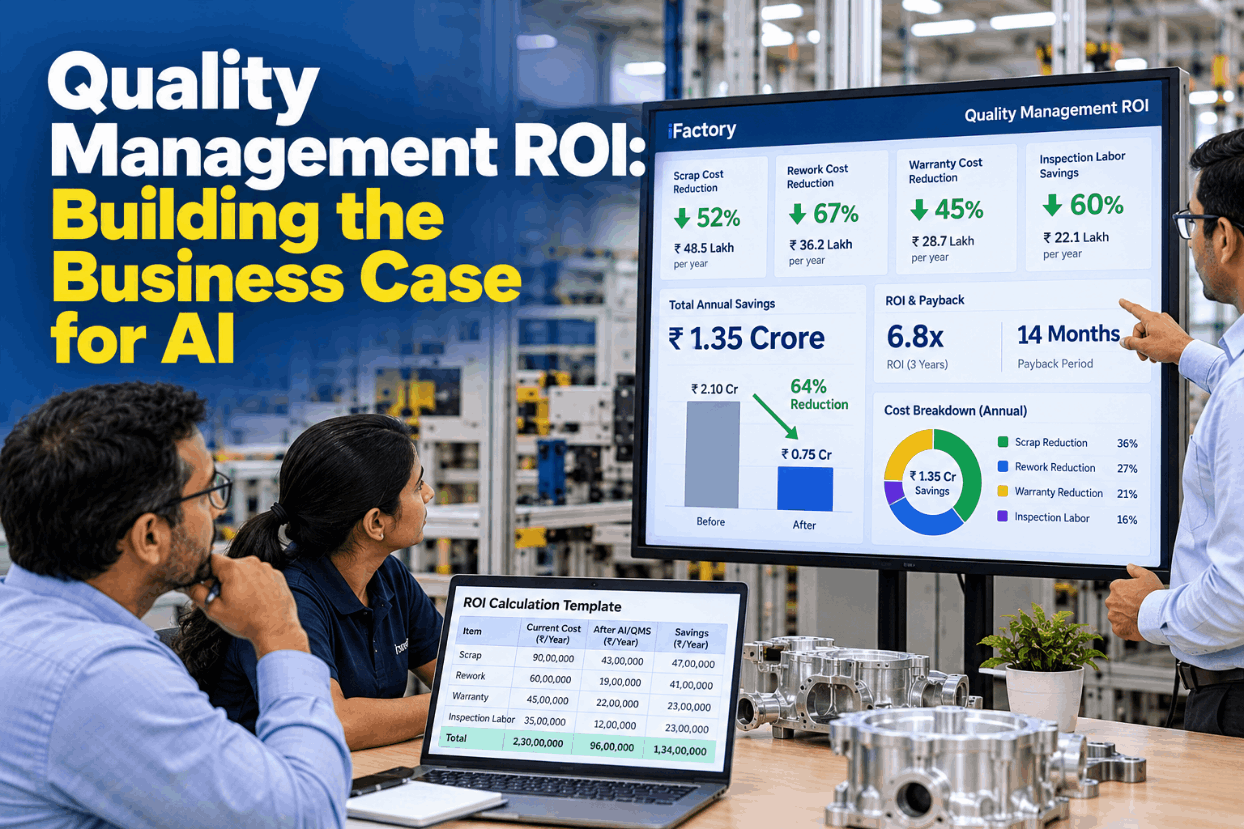
Most quality investments are approved or rejected on one page: what it costs, what it returns and how soon. A QMS business case that leans on vendor averages rarely survives a finance review. One built from your own scrap, rework, warranty, inspection and audit costs usually does. This guide shows how to build that case, with a fully worked example where every input is assumed and every step can be checked. Walk through the model with your own numbers in a short ROI session.
Build a Quality Business Case Finance Can Check Line by Line
iFactory's ROI Model takes your scrap, rework and warranty costs and returns payback for QMS modules and AI inspection, with a turnkey quote and 12-week delivery. Every input stays visible, so finance can test it.
Prevention, Appraisal and Two Kinds of Failure
ASQ's cost of quality model sorts quality spending into four buckets. Prevention and appraisal are what you spend to get quality right. Internal and external failure are what you pay when you don't, and together they make up the cost of poor quality, or COPQ. The idea behind the model is simple: a dollar spent on prevention or smarter appraisal should remove more than a dollar of failure. A good business case moves money from the failure buckets toward prevention, and shows where. Sort your own cost lines with our support team.
Scrap and warranty usually have their own cost codes. Rework, sorting, re-inspection and engineering time spent chasing failures often do not, and sit inside labour budgets. Pull those hours out before you size the case, or the baseline will come in low.
Five Benefit Lines, One Source for Each
Keep the model to lines you can trace to a report. If a number cannot be found again next quarter, it cannot be tracked after go-live either. Each one needs a baseline from your own records, an assumed improvement agreed with the owner and a simple formula. Inspection labor savings and audit effort belong in the appraisal bucket. Scrap, rework and warranty sit in failure. Set up the template on your data in a model setup call.
Payback, NPV and IRR Without the Jargon
Finance teams usually ask for three numbers. Payback shows how fast the money comes back but ignores everything after that point. NPV values each future year in today's money, using a discount rate your finance team sets. IRR is the discount rate at which NPV would be exactly zero, so it can be compared with the company's hurdle rate. Check the formulas against your finance rules with our support team.
Two projects with the same 16-month payback can look identical. If one keeps paying for five years and the other stops after two, only NPV shows the difference. That is why most capital requests carry both numbers.
Count Every Cost on the Investment Side
Cases are often attacked on the cost side first, because a missing item there is easy to spot. List the one-time costs and the yearly running costs separately, and include the internal time your own people will spend. In the worked example below, all of these are rolled into two assumed figures. See a full cost list for your plant in a quote planning call.
A Worked Business Case With Every Input Assumed
This example is a mid-size plant invented for the arithmetic. None of the figures are benchmarks or results from a real site, and the improvement rates are assumptions to replace with your own. Investment covers a turnkey server, cameras, integration and training, and the running cost covers licences and support. Test it with your baseline alongside our support team.
Left out on purpose: recall exposure, lost customers and brand damage. They can be real, but without your own history they turn a checkable case into a debate. Mention them as upside, outside the sum.
Ask the Model the Question Finance Will Ask
Change any input and the ROI Model reruns payback and NPV at once. Plant and finance leaders can ask what-if questions in plain words and see the arithmetic behind every answer.
Discounting the Base Case at an Assumed 10%
Here the net annual benefit is treated as arriving at the end of each year and the investment at the start. The 10% rate is an assumption, so use the rate your finance team gives you. Figures are rounded to the nearest hundred dollars. On these inputs, the IRR works out at about 54%. Rerun it at your own rate in a live model session.
Where the Base-Case Benefit Comes From
Breaking the gross benefit down by line shows finance where the case is exposed. In this example, scrap and inspection labour carry close to two thirds of it, so those two baselines deserve the most checking before anyone signs. Ask our support team to split your own benefit.
Conservative, Base and Stretch Side by Side
A single answer invites doubt. Three answers show the range. Here the conservative case halves every assumed improvement rate and the stretch case raises each by half. Investment and running cost stay the same in all three. Notice that the conservative case does not pay back within three years. Build your own three cases in a sensitivity walkthrough.
If the decision only works in the stretch case, it is not ready. If it holds in the base case and the conservative case loses little, it usually is. Name the one input that moves the answer most and agree how you will measure it after go-live.
What Makes Finance Trust the Number
Most cases fail on credibility, not arithmetic. The habits on the right make a case easy to approve and easy to track afterwards. Send your draft to our support team for a second look.
- Industry averages in place of your own baseline
- Recall or lost-customer costs with no history behind them
- Labour savings counted as cash when nobody leaves the payroll
- One answer with no range
- Baselines from scrap, repair and warranty reports
- Each improvement rate owned by a named manager
- Freed hours shown as capacity, with the plan for them
- Conservative, base and stretch, with a tracking plan
Five Steps From Baseline to Sign-Off
The order matters. Agree the baseline before anyone talks about improvement rates, and agree how you will measure results before the money is spent. Skipping step five is the most common reason a good project looks unproven a year later. Plan the five steps in a case planning call.
A Fixed Quote Makes the Investment Line Firm
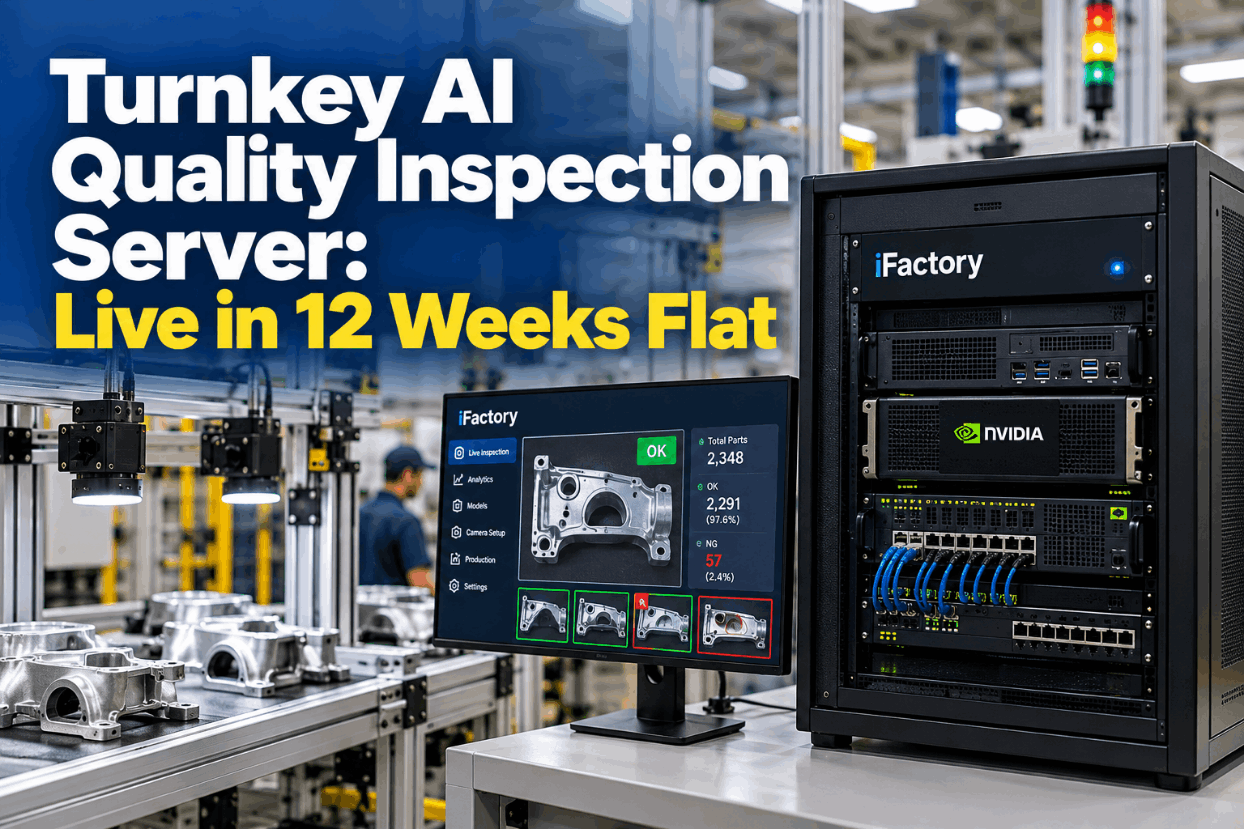
The investment line is only as good as the quote behind it. iFactory quotes QMS modules and AI inspection as one turnkey package. A pre-configured NVIDIA AI server ships racked and ready with the software loaded, so the cost and the date are known up front. You rack it, plug in power and Ethernet, and the AI is live. Get a figure for your case from our support team.
- Pre-configured NVIDIA AI server, racked and ready
- QMS modules for nonconformance, CAPA and audits
- AI inspection models for your parts
- Camera and PLC integration on the chosen lines
- ROI Model loaded with your baseline
- Operator and quality team training
- 24×7 remote monitoring of server and models
Cost baseline locked, server and cameras installed, records linked.
QMS workflows set up, inspection models tuned on your parts.
Lines live, teams trained, first ROI tracking report produced.
Quality Management ROI Software With a Quote Attached
The ROI Model and the turnkey quote come from the same team, so the case and the price match. See your first baseline loaded in a guided model tour.
What Plant and Finance Leaders Ask About Quality ROI
Take a Case to Finance That Holds Up
Your own baselines, assumed rates in plain view, payback and NPV in three cases, and a turnkey quote with 12-week delivery behind the investment line.