Rework Tracking and Repair Station Data Collection Guide

By David Cook on October 26, 2026

rework-tracking-repair-station-data-collection-guide

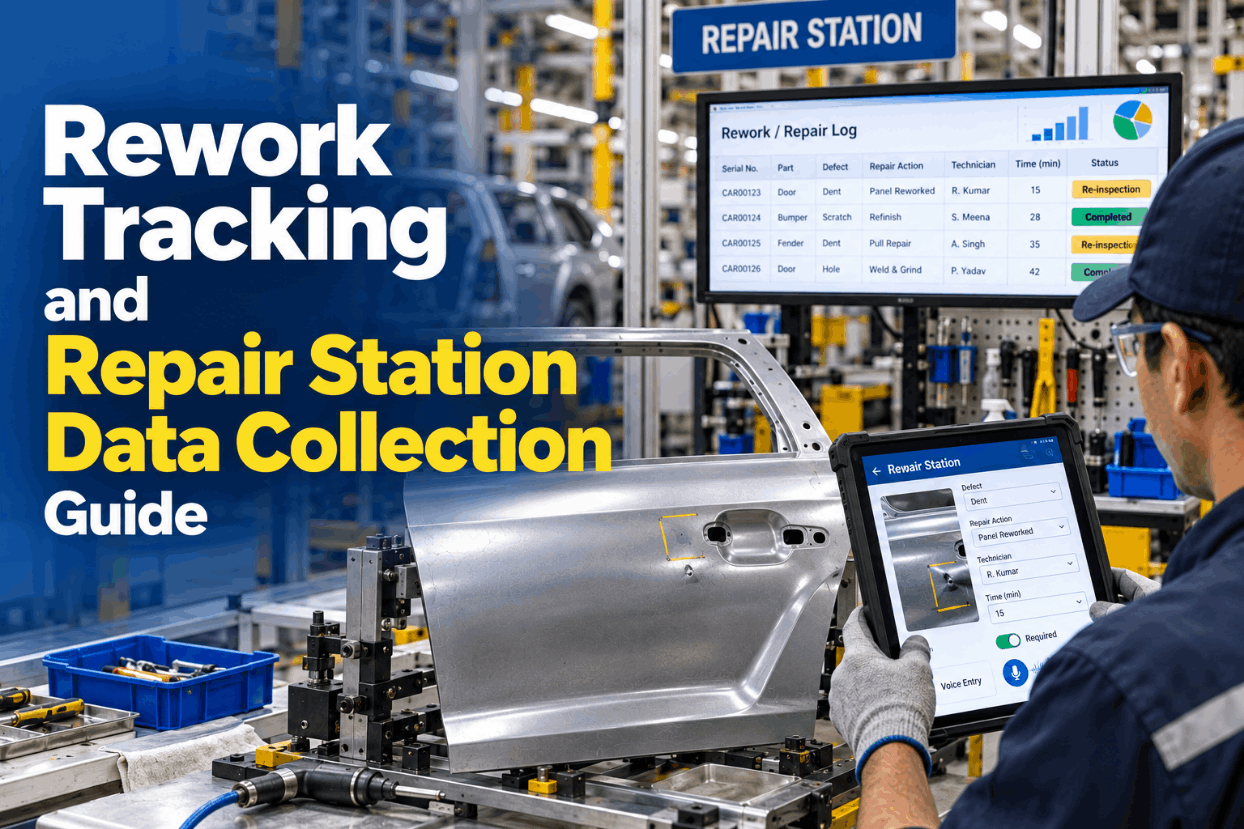
Every plant has a repair bench, and most know roughly how busy it is. Far fewer can say which defects arrive there, how long each repair takes, which serial numbers come back a second time or what all of that costs. Repair stations are often the last place on the line still running on paper tags and memory. Good repair station data collection turns that bench into a source of causes and costs instead of a quiet place where problems disappear. See a repair log built by voice in a short repair station demo.

REPAIR STATION MODULE · REWORK TRACKING

Log Every Repair by Serial, by Voice, Before It Leaves the Bench

iFactory captures the defect and the repair action by voice, blocks release until the unit passes re-inspection and rolls repair labour into cost of poor quality. Technicians keep their hands on the work.

Repair bench 2 · SN 48A-11027On hold
Control board · failed AOI at 09:42
Technician said"U7 solder bridge, pins three to four. Reflowed and wicked, six minutes."
DefectSolder bridge, U7
ActionReflow and wick
Repair time6 min
Loop count1st visit
Release blocked until AOI re-check passes
REWORK VS REPAIR

Two Words That Mean Different Things to an Auditor

ISO 9000:2015 draws a clear line. Rework (3.12.8) is action on a nonconforming product to make it conform to the requirements. Repair (3.12.9) is action to make it acceptable for the intended use, and a note says a successful repair does not necessarily make the product conform. The difference decides who must approve the work and what the record must hold. Check how your own codes map with our quality support team.

REWORK · BACK TO SPEC
  • The unit ends up meeting the original drawing and specification
  • Example: a misplaced resistor replaced with the correct part
  • Example: a weld spatter spot ground and blended within tolerance
  • Confirmed against the same method the line uses
REPAIR · FIT FOR USE
  • The unit works, but no longer matches the original specification
  • Example: a jumper wire added where a board trace was damaged
  • Example: an oversize fastener fitted after a stripped thread
  • Often needs a concession from the customer
REPAIR LOGS BY SERIAL

One Line per Visit, Kept Against the Serial Number

A repair log is only useful if each entry belongs to one unit. Logging by serial shows which units came back, what was done each time and whether the re-check passed. Logging by shift total hides all of that. The entries below are illustrative. See a serial history pulled up in a live log view.

Serial
Found at
Defect
Action
Technician
Minutes
Re-inspection
48A-11027
AOI
Solder bridge U7
Reflow, wick
T. Ruiz
6
AOI pass
48A-11031
ICT
Open joint J2 pin 5
Hand solder
T. Ruiz
9
ICT pass
48A-11044
Functional test
No output on channel 2
Replaced U12
M. Okafor
22
Functional fail
48A-11044
Functional test
No output on channel 2
Reflowed R40 to R42
M. Okafor
14
Functional pass
48A-11058
Visual
Scratch on housing
Polish to standard
L. Chen
4
Visual pass
REWORK LOOPS AND THE HIDDEN FACTORY

Count the Laps, Not Just the Repairs

Armand Feigenbaum described a "hidden plant" inside every factory: the capacity spent fixing work that was not right the first time. Rework loops are where it hides. A unit that fails, is repaired, fails again and is repaired again counts as one good unit at the end, but it took three trips. Find the loops in your own data with our analytics team.

1 visit
Normal repairLog it, re-inspect it and look for patterns across many units
2 visits
The first fix was a guessReview the diagnosis step and the repair instruction for that defect
3+ visits
Stop and escalateQuality engineer decides whether to continue, scrap or quarantine the unit
FPY VS ROLLED THROUGHPUT YIELD

Why a 99% Line Can Build Only 87% Right the First Time

First pass yield (FPY) is the share of units that pass a step the first time, with no repair. Rolled throughput yield (RTY) multiplies the FPY of every step to show the chance a unit gets through the whole line untouched. Final yield after repair can look excellent while RTY shows how busy the repair bench really is. The numbers below are illustrative. Plot your own steps in a yield walkthrough.

StepFPYRunning RTY
SMT and AOI96%0.96
Wave solder98%0.96 × 0.98 = 0.941
In-circuit test97%0.941 × 0.97 = 0.913
Functional test95%0.913 × 0.95 = 0.867
RTY = 0.96 × 0.98 × 0.97 × 0.95 = 0.867. Of 1,000 boards started, about 867 pass every step untouched. If 6 are scrapped, final yield is 994 of 1,000, or 99.4%.

Ask the Repair Bench What It Saw This Week

Every repair is logged against a serial, a defect and a technician, so supervisors can ask plain questions and get answers drawn from real records rather than tally sheets.

Line supervisor and iFactory
SupervisorWhich serials went round the repair loop more than twice this week?
iFactoryFour, all control boards failing channel 2 at functional test. Three had U12 replaced first, then a reflow of R40 to R42 fixed them.
SupervisorSo the first fix is wrong.
iFactoryThat is the pattern. I've flagged the repair instruction for channel 2 faults for the quality engineer to review.
POST REPAIR REINSPECTION

No Repaired Unit Moves On Without a Fresh Check

A repair changes the unit, so the original pass result no longer applies. The unit should be checked again by the same method that caught the defect, and any step the repair could have disturbed. A system hold makes that rule hard to skip. Set up hold rules with our support team.

1Repair loggedDefect, action, time and technician saved to the serial
2Unit on holdRelease is blocked in the system, not just tagged
3Re-inspectSame test that found it, plus any step the repair touched
4Release or loopPass returns it to flow, fail sends it back and adds a loop
REWORK INSTRUCTIONS

What IATF 16949 Asks for Reworked and Repaired Product

For automotive suppliers, IATF 16949 sets out controls in clause 8.7.1.4 for reworked product and 8.7.1.5 for repaired product. The two are close, with stricter customer approval for repair. The matrix summarises the main points; read the standard and your customer-specific requirements for the exact wording. Map them to your repair stations in a compliance session.

Requirement
8.7.1.4 Reworked product
8.7.1.5 Repaired product
Risk analysis first
Use a method such as FMEA to assess rework risk before deciding to rework
Same, for the repair process before deciding to repair
Customer approval
Before rework starts, where the customer requires it
Required before repair starts
Confirmation process
Documented rework confirmation in line with the control plan, to verify original specifications
Documented repair confirmation in line with the control plan or other documented information
Instructions at the bench
Disassembly or rework instructions, including re-inspection and traceability, accessible and used
Disassembly or repair instructions, including re-inspection and traceability, accessible and used
Concession
Not required, the unit conforms
Documented customer concession
Records kept
Quantity, disposition, disposition date and traceability
REWORK CAPTURE APP

Say the Repair, Keep Your Hands on the Unit

A technician holding a soldering iron or a torque wrench should not have to stop and type. With voice entry, they say what they found and what they did, and the system reads it back as structured fields before saving. Hear it on a noisy bench with our voice specialists.

Technician says"Serial 48A-11044, channel 2 dead. Reflowed R40 to R42, cold joints. Fourteen minutes."
Serial48A-11044
SymptomNo output, channel 2
Cause foundCold joints R40 to R42
ActionReflow
Minutes14
Loop count2nd visit
iFactory reads back
"48A-11044, cold joints R40 to R42, reflowed, 14 minutes, second visit. Send to functional re-test?"
Technician
"Yes, send it."
Unit held until functional re-test passes. Repeat visit flagged to the quality engineer.
REPAIR STATION DATA COLLECTION COST AND ROI

Roll Repair Labour Into Cost of Poor Quality

Repair minutes are an internal failure cost, part of cost of poor quality (COPQ), yet they often sit inside direct labour where nobody sees them. Once each repair carries its own minutes, the cost adds up by itself. Every input below is assumed. Run the sum with your own figures in a COPQ review.

Repairs per month640, assumed
Average repair time14 min, assumed
Average re-inspection time5 min, assumed
Loaded labour rate$48 per hour, assumed
Repair labour640 × 14 = 8,960 min ÷ 60 × $48 = $7,168
Re-inspection labour640 × 5 = 3,200 min ÷ 60 × $48 = $2,560
Monthly repair labour in COPQ$7,168 + $2,560 = $9,728, or $116,736 a year

Parts used in repair, scrapped units and extra test time come on top. Add them from your own records, not estimates.

REPAIR STATION DATA COLLECTION TEMPLATE

Release Check for Every Repaired Unit

Use this list at the bench before any repaired unit returns to flow. Tick each line as it is done. Ask our support team for a print-ready version.

01Record the repair
02Before release
REPAIR STATION DATA COLLECTION EXAMPLES

Three Benches, Three Things the Data Showed

These illustrations show the kind of pattern repair data brings out. They are not case studies. Talk through your own benches in a short working session.

Automotive ECU line
One connector, most of the repairsSorting repair logs by location shows a single connector position behind most hand-solder repairs, which points back to a stencil aperture.
Medical device assembly
Repairs that needed a concessionSeparating rework from repair in the log shows which units need concession paperwork before release, so none move on without it.
Fabricated frames
Weld touch-ups by shiftRepair minutes logged per frame show night shift touch-ups taking far longer, which leads to a wire feed check on one welding cell.
REPAIR STATION DATA COLLECTION FOR PLANT MANAGERS

Six Measures Worth a Weekly Look

These come straight from a well-kept repair log. Read them by product and by station, not as one plant number. Set targets for them with our quality team.

Repairs per 1,000 unitsHow often units reach the bench, by product
Repeat visit rateShare of repaired serials that come back a second time
Re-inspection fail rateRepairs that fail the fresh check
Repair minutes per unitBench time spread across all units built
Rolled throughput yieldChance a unit passes every step untouched
Repair labour in COPQMonthly repair and re-check cost, in money
TURNKEY AI DEPLOYMENT

Repair Station Module and AI Server in One Delivery

iFactory delivers the Repair Station Module as a turnkey package. A pre-configured NVIDIA AI server ships racked and ready, with voice models and links to your test stations set up before it arrives. You rack it, plug in power and Ethernet, and the AI is live. Get it scoped in a turnkey planning call.

What's Included
  • Pre-configured NVIDIA AI server, racked and ready
  • Voice entry for defect and repair action at each bench
  • Repair logs kept by serial number
  • Release holds until re-inspection passes
  • Links to AOI, ICT and functional test results
  • Repair labour rolled into COPQ reports
  • 24×7 remote monitoring of models and hardware
Live in 6–12 weeks
Wk 1–4
Install and Link

Server installed, test stations and serial labels linked, defect and action codes agreed.

Wk 5–8
Pilot One Bench

Voice entry and holds run on one repair bench, with technicians shaping the phrases.

Wk 9–12
All Benches Live

Remaining benches added, COPQ reports started, weekly repair review in place.

HOW iFACTORY FITS

Repair Data Built at the Bench, Not After the Shift

iFactory is built for technicians with busy hands and quality teams who need clean records. Our support team can map it to your current repair flow.

1
Defect and action by voice. Technicians speak the repair and confirm the read-back.
2
Re-inspection before release. Repaired units stay on hold until the fresh check passes.
3
Every visit by serial. Loops and repeat repairs show up per unit, not as shift totals.
4
Repair cost in COPQ. Repair and re-check minutes become a monthly cost figure.
1000+
Industrial clients running iFactory
99.9%
Platform uptime for multi-shift lines
6-12 wks
From racked server to live repair benches
FREQUENTLY ASKED QUESTIONS

What Plant Managers Ask About Rework Tracking

What is the difference between rework and repair?
Under ISO 9000:2015, rework makes a nonconforming product conform to the requirements. Repair makes it acceptable for its intended use, even though it may no longer conform, which is why repair often needs a concession. Your quality system should say which actions count as which.
What should a repair station record?
At minimum: serial number, where the defect was found, defect code and location, action taken, parts used, technician, minutes, whether it was rework or repair, and the re-inspection result. See a full record captured by voice in a short demo.
Why track rolled throughput yield as well as final yield?
Final yield counts repaired units as good, so it can look high while a large share of units visit the repair bench. Rolled throughput yield multiplies first pass yield at each step and shows how many units get through untouched, which is where the hidden repair workload shows up.
Does voice entry work on a noisy production floor?
Yes, with the right headset and a short list of agreed defect and action terms. Every entry is read back before it is saved, so mistakes are corrected on the spot. Our support team can advise on headsets for your benches.
How do we stop repaired units skipping re-inspection?
Make it a system hold rather than a tag. The serial cannot move to the next step until a pass result for the re-check is recorded against it. You can see the hold rules on a live line with our team.
Where should we start?
Start with your busiest repair bench and one product. Agree the defect and action terms, switch on voice entry and holds, and review the first month of serial-level data with the line team. To plan that pilot, book a 30-minute demo.

Turn the Repair Bench Into a Source of Causes

Log every repair by serial and by voice, hold every repaired unit until it passes a fresh check and see repair labour as a cost. Delivered turnkey and live in 6 to 12 weeks.


Example week · Control board line
Repairs logged148, all by serial
Repeat visits4 serials, channel 2 faults
Re-inspection holdsAll lifted on a pass result
Repair labourRolled into weekly COPQ
Every repaired unit re-checked before release

Share This Story, Choose Your Platform!