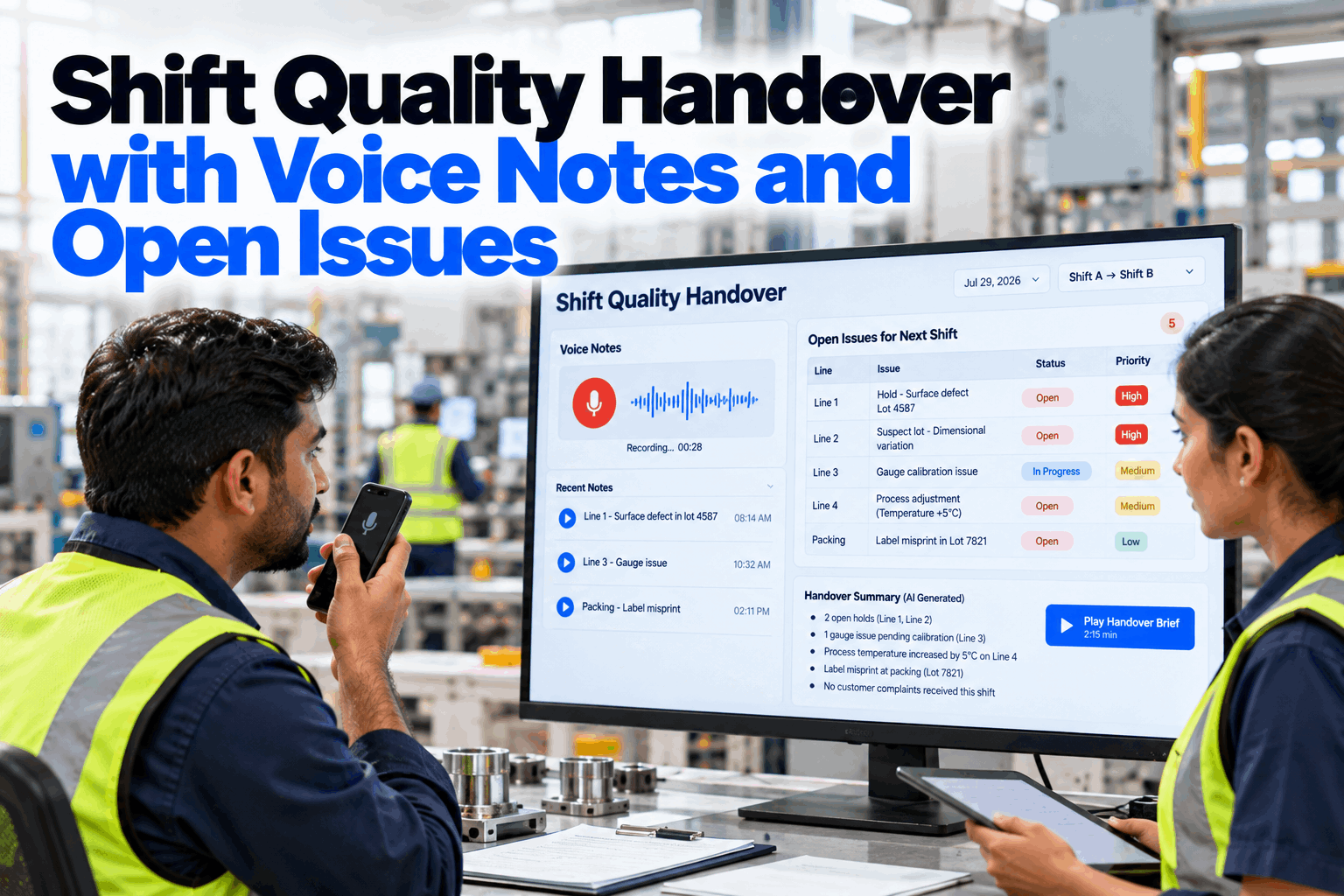
Repeat defects at the start of a shift are rarely a mystery. The night inspector put a lot on hold, flagged a suspect coil and asked the setter to adjust an offset, then wrote half of it on a whiteboard and said the rest in a corridor. The day shift never heard about the offset, reset it to standard and made the same defect again. A shift quality handover with voice notes passes on open holds, suspect lots, gauge issues and process adjustments by line. Plan yours in a handover review.
Shift Quality Handover with Voice Notes and Open Issues
Inspectors dictate open issues as they happen. AI sorts them by line and type, and reads a short brief to the incoming shift on request, so the next crew starts with the facts instead of repeating the defect.
- Holds, suspect lots, gauges and adjustments
- Sorted by line, read aloud on request
- Acknowledged item by item
Lot 4471, 40 housings, burr on flange. Sort not started.
Coil C-219. Check every 10th part for edge crack.
Bore gauge BG-07 out for calibration. Use BG-11.
OP30 offset −0.02 mm at 03:10 for tool wear. Do not reset.
Why Defects Repeat at Shift Change
The knowledge exists. It just does not cross the shift line.
During a shift, an inspector builds up a picture that is never fully written down: which lot looks doubtful, which gauge is reading oddly, which machine had an offset changed and why. At handover there are ten minutes, a noisy floor and a tired person. The production log covers output and downtime, but the quality details are left to memory. The incoming crew then repeats work, releases parts that should stay on hold or undoes an adjustment that was fixing a problem. Night and weekend shifts are often most exposed, because fewer engineers are on site to fill the gaps the next morning. None of this is a people problem. It is a capture problem, and it can be fixed. Our quality specialists can review how your shifts hand over today.
Typical quality handover
- Whiteboard notes and verbal reminders
- Production log with no quality section
- Adjustments known only to the setter
- No record of who heard what
Voice quality handover
- Open issues dictated as they happen
- Sorted by line and item type
- Adjustments logged with reasons
- Each item acknowledged by name
The Four Things Every Quality Handover Must Carry
If it is still open, it goes in the handover.
Most repeat defects trace back to one of four kinds of open item. Defining them, and what each entry must contain, turns the handover from a chat into a checklist the next shift can trust. Keep the list short so it is used every shift, not just on good nights. An item leaves the handover only when it is closed, never because nobody mentioned it. Set your item rules in a working session.
A new operator on a critical station, a material change, a first-off part that only just passed. These are not open items, but they tell the incoming inspector where to look first.
The Process Adjustment Log
The adjustment nobody hears about is the one that gets undone.
Process adjustments are the most fragile item in any handover. A setter changes an offset, a pressure or a temperature to hold a characteristic in tolerance. The next shift sees a setting that differs from the standard and puts it back. Logging every adjustment with its reason and its revert condition stops that loop. It also builds a history that shows when a machine needs repeated adjustments, which usually points to a cause that should be fixed rather than corrected each shift. Review your adjustment records with our process team.
Example entry, illustrative.
How Voice Handover Works
Capture during the shift, not in the last ten minutes.
The best handover is built across the shift, not written at the end of it. Inspectors speak a short note on a phone or headset whenever they open or change an item. The AI turns each note into a structured entry with line, item type, lot or gauge, and the next step. It asks for anything missing, such as a quantity or a location. At handover, the outgoing inspector reviews the list, and the incoming inspector hears it read aloud or reads it on screen. See it working in a short demo.
Dictate
Spoken as the issue happens.
Structure
Line, type, lot and next step.
Fill gaps
AI asks for missing details.
Brief
Read aloud to the next shift.
Acknowledge
Each item confirmed by name.
Hand Over Every Open Quality Issue, Every Shift
Holds, suspect lots, gauge issues and process adjustments dictated by inspectors, sorted by line and read to the incoming shift on request.
The Incoming-Shift Brief
Ask for your line and hear only what matters to you.
An inspector starting on line 4 does not need every item from every line. They can ask for their own line, hear the open items in order of risk and ask follow-up questions. The brief is read from the same structured entries, so nothing is paraphrased away. Each item is then acknowledged, which leaves a dated record of who received what. If an item is missed, the record shows whether it was never handed over or handed over and not acted on, which leads to very different fixes. Supervisors can ask for a whole-area summary in the same way. Ask our team how briefs are built.
Handover Rules That Stop Repeat Defects
A few simple rules matter more than the format.
The format of a handover matters less than the rules around it. Plants that see fewer repeat defects at shift start usually agree a short set of rules and hold every shift to them. These rules work on paper, but voice capture makes them far easier to keep. Agree yours with our quality team.
Open means carried
An item stays until it is closed, however many shifts that takes.
No silent resets
No setting goes back to standard without checking the adjustment log.
Holds are physical
A hold in the handover must match a tag and a location on the floor.
Gauges named
If a gauge is out, the stand-in is named in the same entry.
Acknowledged by name
The incoming inspector confirms each item, not just the list.
Aging items escalate
Items carried for several shifts go to the quality lead.
Shift Quality Handover Checklist
Eight checks before the outgoing inspector leaves.
Use this checklist at every quality handover until the habit is set. Tick items as you go. Get help setting it up from our setup team.
Measuring Handover Quality
Track whether the handover is stopping repeats.
A handover works if fewer problems repeat at the start of the next shift. A few simple measures show whether that is happening, and they come straight from the handover records and inspection results. Review them monthly with the inspectors and setters. A rising count of carried items often means holds are waiting on a decision rather than on work, and the fix is a faster disposition meeting, not a better handover. Plan your measures in a short session.
Repeat defects
Defects in the first hours that match an open item.
Acknowledged items
Share of open items confirmed by the next shift.
Carried items
Holds and adjustments open for several shifts.
Quality Handover Mistakes to Avoid
A handover that relies on memory will fail on a bad night.
These are the patterns that most often let defects repeat across shifts. A short handover review can find them.
What works
- Notes captured during the shift
- Four item types with clear contents
- Adjustments logged with revert rules
- Acknowledgement by name for each item
What fails
- Everything written in the last ten minutes
- Quality buried in the production log
- Offsets reset because they look wrong
- Items lost because nobody said them
How iFactory Runs Voice Quality Handover
Voice Handover, on your own network.
iFactory's Voice Handover lets inspectors dictate open issues during the shift. AI structures them by line and item type, asks for missing details and reads a brief to the incoming shift on request, with each item acknowledged by name. It runs on an on-prem AI server inside your plant.
Dictation
Hands-free notes from the floor.
By line
Items sorted by line and type.
Gap prompts
AI asks for lot, quantity or location.
Spoken brief
Read aloud to the incoming shift.
Acknowledgement
Each item confirmed by name.
Adjustment log
From, to, reason and revert rule.
Holds, dispositions and process changes remain decisions for your team. Figures on this page are worked examples.
Turnkey AI: Delivered, Connected and Live in 6–12 Weeks
You do not build this. It arrives ready.
iFactory ships as a pre-configured NVIDIA AI server with the software pre-loaded, racked and ready. Rack it, plug in power and Ethernet, and the AI is live on your network. Our team handles cabling, network setup, PLC, SCADA, DCS and CMMS integration, MES and quality system links, operator training and 24×7 remote monitoring. Data stays on your network. For a scope matched to your plant, request a turnkey quote.
Ship, network and data
Server installed. Lines, gauges and hold records connected. Item types and rules agreed.
Model training and pilot
Voice capture, gap prompts and spoken briefs configured for one area and its inspectors.
Go-live and training
Voice handover live. Inspectors trained. 24×7 monitoring begins.
Frequently Asked Questions
What should a shift quality handover include?
Open holds, suspect lots, gauge issues and process adjustments, each tied to a line, machine or lot, plus anything unusual the next inspector should watch.
How is this different from a production shift log?
A production log covers output and downtime. A quality handover covers the open quality items that cause repeat defects if they are missed.
Do inspectors have to type anything?
No. They speak short notes on a phone or headset. The AI structures them and asks for any missing details.
Does it work on a noisy shop floor?
It is built for plant use with headsets and push-to-talk. A pilot tests recognition in your own noise conditions before wider rollout.
Can the incoming inspector hear only their own line?
Yes. They ask for a line and hear its open items in order of risk, then confirm each one.
Why log process adjustments separately?
Because they are the item most often undone by the next shift. The log records the reason and when the setting should go back.
Does the AI release holds or change settings?
No. It records and reads back what people report. Holds, dispositions and settings stay with your team.
What happens to items carried for many shifts?
They are flagged as aging and escalated to the quality lead, so a hold does not sit in the handover for weeks.
How do we start?
Start with one area and its inspectors. A 6-week pilot connects records and sets up voice capture and briefs. To plan it, contact our team.
Stop the Same Defect Starting Every Shift
In thirty minutes we review your current quality handover and show how open items would be captured and read back by voice. You keep the review either way.
- 1A recent shift handover sheet
- 2Your hold and quarantine procedure
- 3A list of open holds today
- 4Any adjustment or setting records
- 5One defect that keeps repeating at shift start