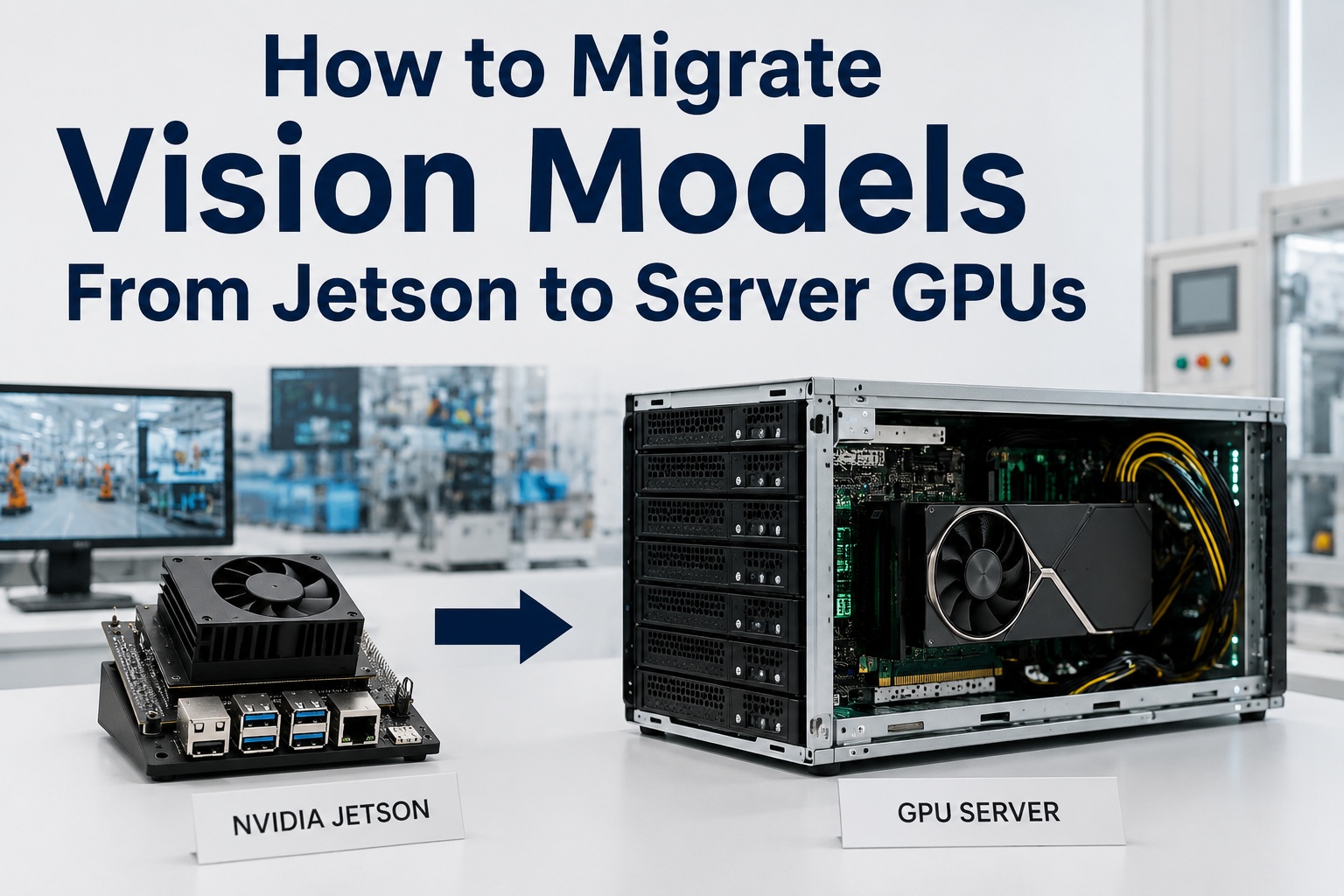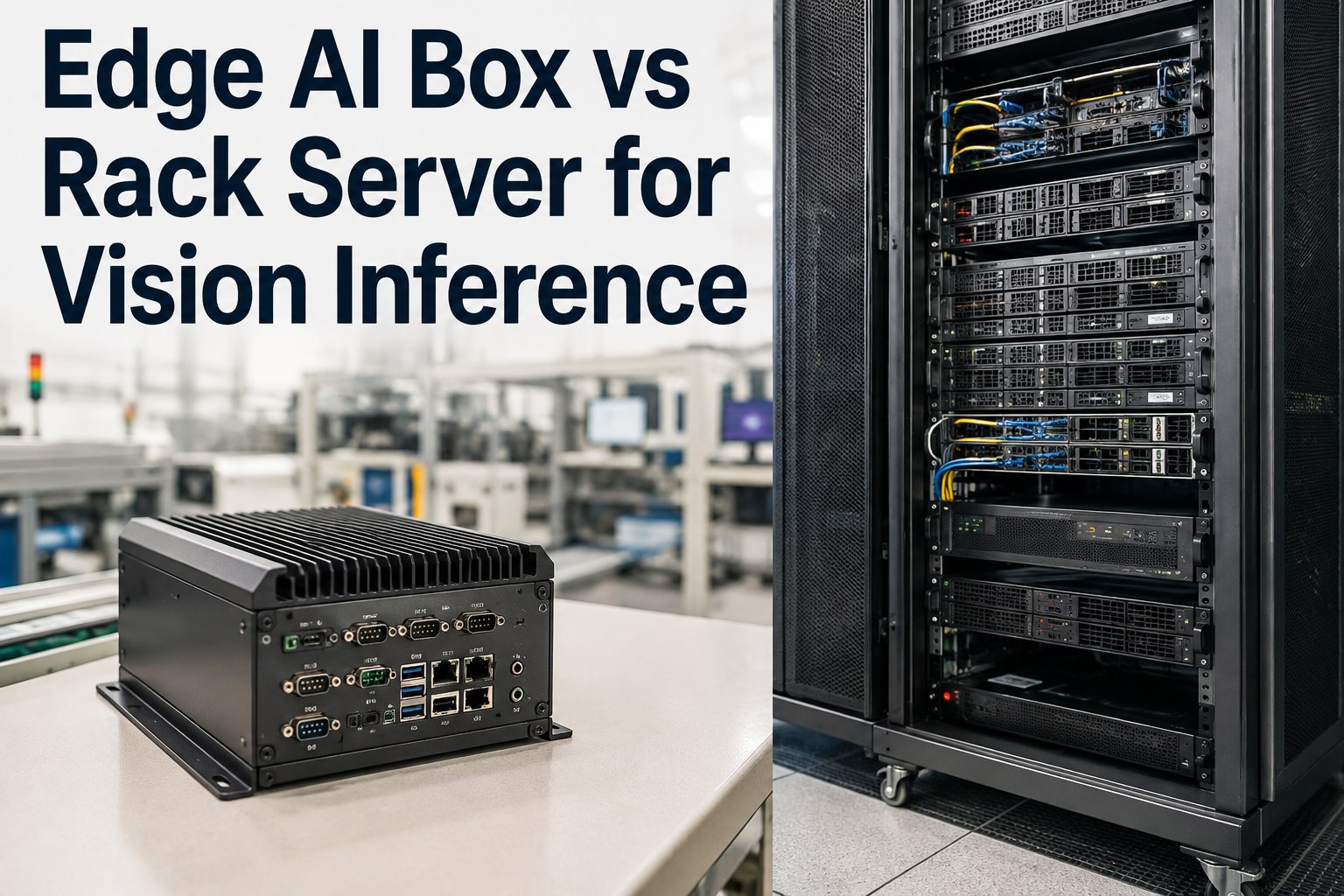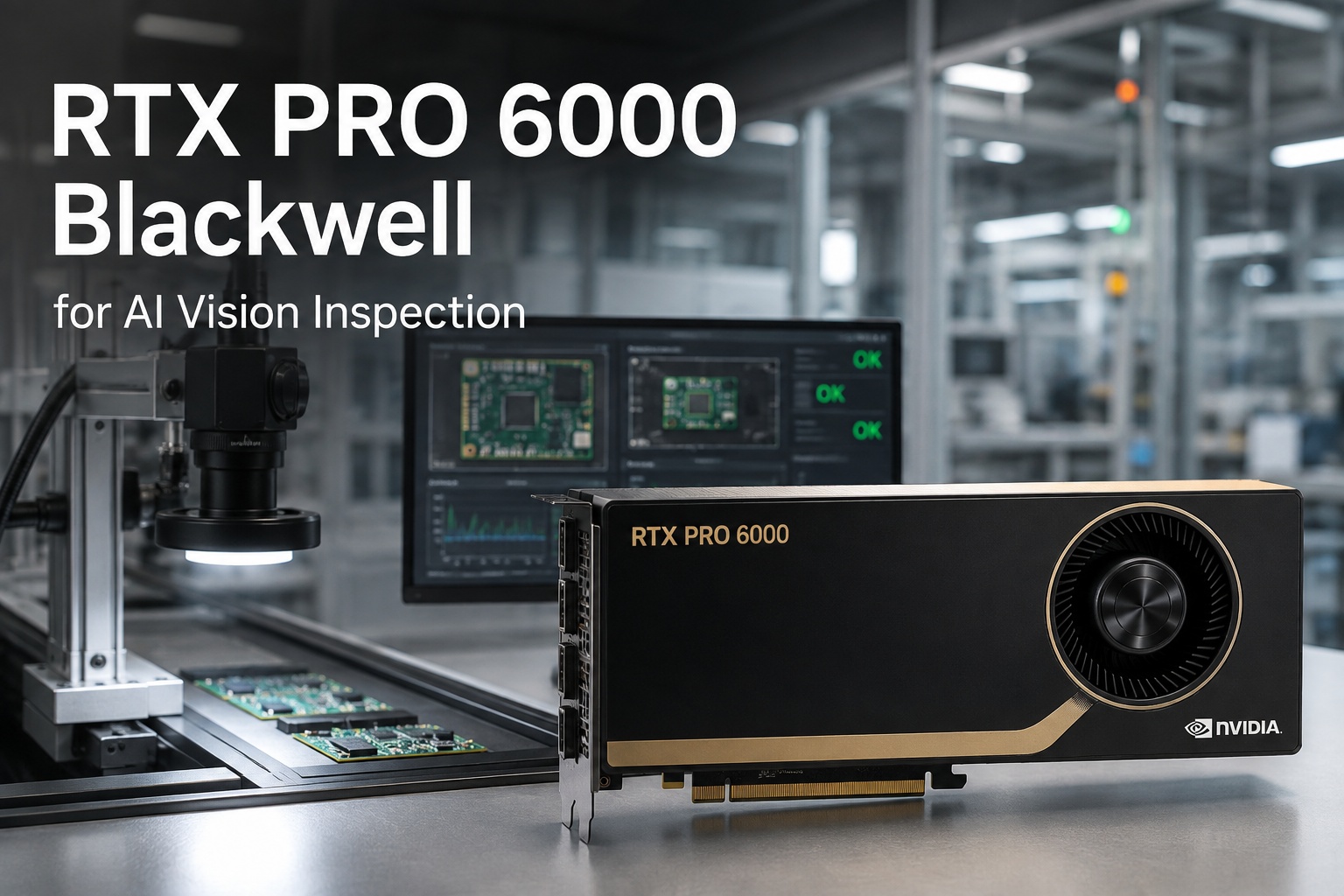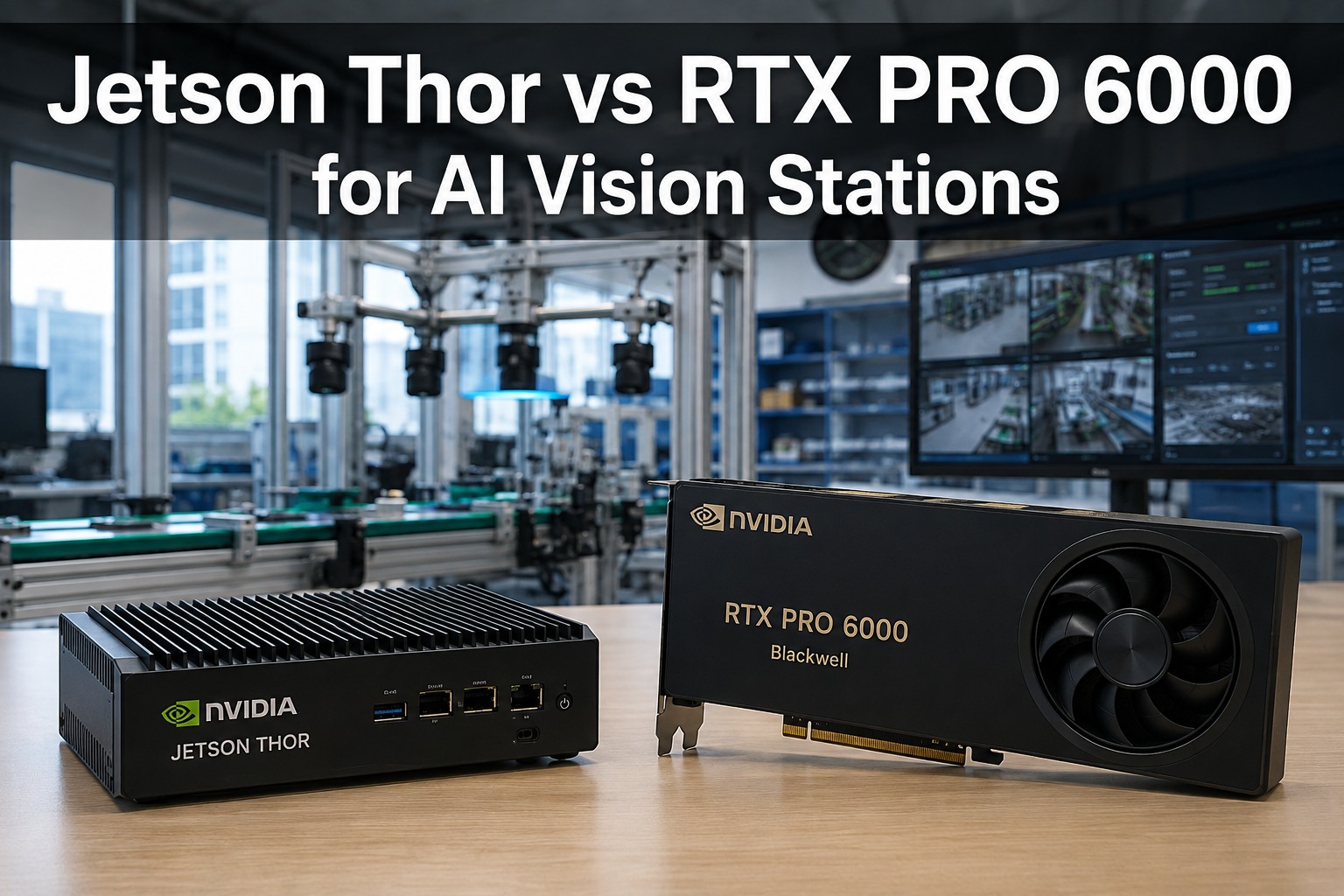
Jetson Thor changed the edge-versus-workstation conversation. Where earlier Jetson modules were clearly a step below a workstation GPU, Thor is NVIDIA's Blackwell-powered robotics supercomputer — up to 2,070 FP4 teraflops and 128GB of memory in a compact module drawing 40 to 130 watts, a 7.5x compute leap over the previous AGX Orin. That puts it in genuine conversation with the RTX PRO 6000 Blackwell, the 96GB, 4,000-TOPS workstation card built to consolidate many camera streams. For AI vision stations, the choice is now a real one: a next-generation edge module that runs vision and robotics models on-device, or a workstation GPU that concentrates the heaviest multi-camera inspection on one serviceable card. This guide compares the Jetson Thor vs the RTX PRO 6000 for AI vision stations across performance, memory, multi-camera inference, power, robotics, and scalability — and how iFactory deploys either, on-premise or in the cloud.
Jetson Thor vs RTX PRO 6000 for AI Vision Stations
NVIDIA's Blackwell edge supercomputer or its workstation vision GPU? Thor brings 2,070 FP4 TFLOPS and 128GB to a compact 40–130W module built for robotics and on-device vision; the RTX PRO 6000 brings 96GB ECC and 4,000 TOPS to consolidate many cameras on one card. Both are Blackwell-class and genuinely close — the right pick is a fit to your station. Compare them, then deploy on-premise or in the cloud.
Two Blackwell Options, Two Roles
What's new with Thor is that both sides of this comparison are Blackwell-generation now — so it's less about raw architecture and more about form and role. Thor is a robotics-grade edge supercomputer built to run vision and physical-AI models on-device; the RTX PRO 6000 is a workstation card built to consolidate the heaviest multi-camera inspection. Both are strong; they're built for different stations.
Blackwell edge supercomputer
2,070 FP4 TFLOPS and 128GB in a compact 40–130W module. Built for robotics and physical AI — runs vision, language, and action models on-device with hardware decode for up to 6x 4Kp60 streams and 25GbE sensor networking.
Workstation vision GPU
96GB ECC memory, 24,064 CUDA cores, 4,000 INT8 TOPS, and MIG. Built to consolidate many high-resolution camera streams and the largest inspection models onto one powerful, serviceable card.
The Comparison — Head to Head
Here's how the Blackwell edge supercomputer and the workstation GPU line up for vision stations. With Thor, the gap is narrower than any previous Jetson — read this as a fit to your station, not a knockout.
Want a fit call between Thor and the RTX PRO 6000 for your vision stations? Book a 30-minute demo — iFactory will map your station type, camera count, models, and any robotics element to the right Blackwell platform. Sessions available this week.
When Jetson Thor Wins
Thor is the right answer wherever a compact, powerful, low-power module on the station — especially one that pairs vision with robotics or on-device generative AI — matters more than central consolidation.
Robotics & physical AI
Purpose-built for robots and physical AI, with Isaac and GR00T support — ideal for vision stations that also drive motion or manipulation.
Power-efficient edge
2,070 TFLOPS in a 40–130W envelope, 3.5x the efficiency of AGX Orin — heavy compute where a workstation's power isn't practical.
On-device large models
128GB hosts large vision-language-action and generative models directly on the station, reducing dependence on remote compute.
Compute at the station
A self-contained module with fast sensor networking mounted right at the vision station — no server room to route to.
When the RTX PRO 6000 Wins
The workstation GPU takes over when the priority is consolidating many cameras and the largest inspection models onto one powerful, serviceable card with error-correcting memory.
Most camera streams
96GB and dedicated decode consolidate many high-resolution feeds on one card, each isolated per line via MIG.
ECC reliability
Error-correcting GDDR7 and certified drivers for continuous 24/7 inspection where memory integrity is non-negotiable.
Peak throughput
4,000 INT8 TOPS of raw inference for the heaviest inspection models at full resolution and precision.
Consolidation & service
One serviceable card in a chassis replaces many modules where cameras converge in a central inspection hall.
Not sure whether a Thor station or an RTX PRO 6000 hall fits your plant? Ask iFactory Support with your station types, camera counts, robotics needs, and power limits, and the team will recommend the platform and a mixed plan if it fits — typically a response within 3 business days, no obligation.
They Also Combine
Thor and the RTX PRO 6000 aren't only rivals — NVIDIA pairs them in industrial edge systems where a Thor module handles on-station sensing and robotics while a discrete RTX PRO 6000 adds workstation-class inference. For vision, that means you can put Thor at robotic stations and an RTX PRO 6000 where many cameras converge, all under one iFactory vision engine.
On-Premise or Cloud — Same Vision Engine
Both Thor and the RTX PRO 6000 are on-premise answers — and iFactory delivers the same vision engine as a managed cloud service too. On-premise is the default where inspection images carry batch genealogy or process IP and reject decisions need line latency. Cloud suits multi-site programs that want the compute managed centrally. Same models, deployed where each station and site needs.
iFactory On-Premise Thor, RTX PRO 6000, or both — in-fence
- Pre-configured hardware — edge module or workstation GPU, sized and ready.
- Images never leave — full data residency behind your firewall.
- Line-latency inference — local, no round-trip, outage-independent.
- Direct camera & PLC wiring — on the plant network.
iFactory Cloud For multi-site, centrally managed vision
- Fully managed — no on-site GPU hardware to maintain.
- Same vision engine — identical models, SPC, and analytics.
- Cross-site consistency — one model version everywhere.
- Elastic scale — add cameras and sites without new local hardware.
Thor or RTX PRO 6000? Fit to the station — often both.
Jetson Thor wins on compact, power-efficient Blackwell compute at the station, especially with robotics; the RTX PRO 6000 wins on ECC reliability, many-camera consolidation, and peak throughput. Both are Blackwell-class, and iFactory can even pair them. Most plants use each where it fits, running one vision engine — on-premise inside your fence or as a managed cloud service. ROI proven on one line first.
Frequently Asked Questions
How is Jetson Thor different from earlier Jetson modules?
Thor is a generational leap. It's built on NVIDIA's Blackwell architecture and delivers up to 2,070 FP4 teraflops with 128GB of memory in a 40–130W module — roughly 7.5x the AI compute and 3.5x the energy efficiency of the previous AGX Orin. It's purpose-built for robotics and physical AI, able to run large vision-language-action and generative models on-device. That puts it far closer to a workstation GPU than any prior Jetson.
Is Jetson Thor as capable as the RTX PRO 6000?
It's the closest any edge module has come, but they're still different tools. Thor offers 2,070 FP4 TFLOPS and 128GB in a compact, low-power module; the RTX PRO 6000 offers 4,000 INT8 TOPS, 96GB of ECC memory, and dedicated decode to consolidate many camera streams on one serviceable card. Thor wins on power efficiency, footprint, and robotics; the RTX wins on peak throughput, ECC reliability, and many-camera consolidation. Match to the station.
Which is better for a robotics-enabled vision station?
Thor, clearly. It's purpose-built for robotics and physical AI, with support for NVIDIA's Isaac platform and GR00T foundation models, and it can run vision, language, and action models together on-device. If your vision station also drives motion, manipulation, or autonomous behavior, Thor is designed for exactly that. The RTX PRO 6000 is focused on high-throughput vision inspection rather than on-robot physical AI.
Which handles more camera streams?
The RTX PRO 6000, for large counts. Its 96GB and dedicated decode hardware consolidate many high-resolution feeds on one card, each isolated via MIG. Thor is very capable too — it decodes up to six 4Kp60 streams on-module with fast 25GbE sensor networking — but for a dense hall with many cameras converging, the workstation card leads. For a robotic station with a handful of cameras, Thor is the cleaner fit.
Can I use both Thor and the RTX PRO 6000 together?
Yes — NVIDIA even pairs them in industrial edge systems, with a Thor module handling on-station sensing and robotics while a discrete RTX PRO 6000 adds workstation-class inference. In a plant, that translates to Thor at robotic and on-device stations and an RTX PRO 6000 where many cameras converge, all under one iFactory vision engine. iFactory sizes the mix and manages both together.
Can this run on-premise, in the cloud, or both?
Both — iFactory offers on-premise (Thor or RTX PRO 6000) and a managed cloud service, with the same vision engine. On-premise is the default where inspection images carry genealogy or process IP and reject decisions need line latency. Cloud suits multi-site programs wanting central management. Many manufacturers mix them across sites. Contact iFactory Support to choose the right deployment.
Right Blackwell platform, right station — on-premise or in the cloud.
Jetson Thor for compact, power-efficient compute and robotics at the station; RTX PRO 6000 for ECC reliability, consolidation, and peak throughput; often both across one plant, running a single vision engine. iFactory sizes and delivers each on-premise inside your fence, or runs the same engine as a managed cloud service. ROI proven on one line first. The next step is a 30-minute demo mapped to your vision stations. Sessions available this week.