Every team building industrial vision AI eventually faces the same fork: assemble your system on NVIDIA's Metropolis framework, or build a custom vision stack from the ground up. Metropolis gives you a powerful, integrated toolkit — TAO for model training, DeepStream for real-time pipelines, microservices and Jetson deployment — that gets you moving fast on proven building blocks. A custom stack gives you total control over every component, at the cost of building and maintaining all of it yourself. Both are legitimate; both are also a lot of engineering. The honest question for most manufacturers isn't which to pick but whether they should be building a vision platform at all, versus deploying one that's already assembled, integrated, and maintained. This guide compares NVIDIA Metropolis vs a custom vision stack across the factors that matter — latency, orchestration, control, scalability, integration, maintenance — and shows where iFactory fits, on-premise or in the cloud.
NVIDIA Metropolis vs Custom Vision Stack for AI
Build on NVIDIA's Metropolis framework, or engineer a custom vision stack from scratch? One trades some control for speed on proven building blocks; the other trades speed for total control and a lot of maintenance. Compare them across latency, orchestration, deployment control, scalability, integration, and upkeep — then see the third path: iFactory, an assembled inspection platform on the same NVIDIA foundation, on-premise or cloud.
What Each Approach Really Is
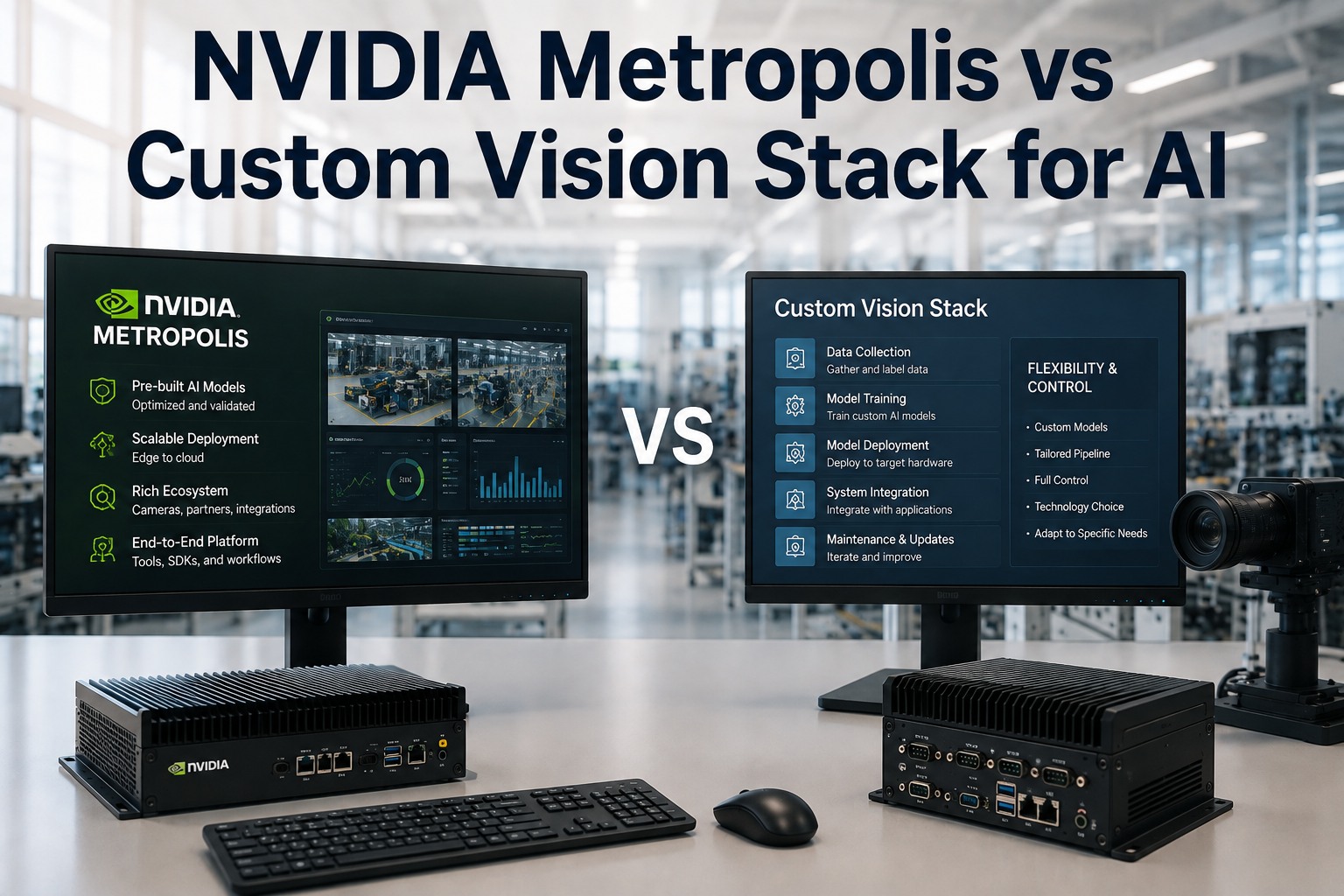
Before comparing, it helps to be precise about what you're choosing between. These aren't opposites so much as different amounts of do-it-yourself — Metropolis is a framework you build on; a custom stack is one you build entirely.
A framework of building blocks
NVIDIA's end-to-end vision platform: TAO Toolkit for model training and fine-tuning, DeepStream for real-time multi-camera pipelines, Metropolis microservices, and Jetson-to-server deployment. Proven components you assemble and configure into your application.
Built from the ground up
Your own choice of frameworks, inference runtimes, orchestration, camera handling, and integration — hand-assembled and glued together. Maximum flexibility to fit any exact need, and maximum responsibility for building, testing, and maintaining all of it.
The Comparison — Six Factors
Here's how the two approaches stack up on the factors that decide an industrial vision deployment. The pattern is the classic build-versus-buy trade: the framework gives you speed and support; the custom stack gives you control and ownership.
Weighing framework versus custom for your inspection project? Book a 30-minute demo — iFactory will walk through where each approach fits your defects, latency targets, and team, and where a ready platform saves the build. Sessions available this week.
Metropolis — Strengths and Trade-Offs
Metropolis is genuinely strong, which is why over a thousand companies build on it. But a framework is still something you assemble into a working inspection system, and that gap is where projects stall.
- Optimized real-time pipelines out of DeepStream
- Transfer learning from pretrained models via TAO
- Proven Jetson-to-server deployment path
- NVIDIA maintains the core components
- Still a framework — you build the application on it
- Requires in-house DeepStream / TAO expertise
- Integration to SAP, MES, and PLCs is your glue
- You own the labeling, tuning, and hardening
Custom Stack — Strengths and Trade-Offs
A custom stack is the right call when your needs are so specific that no framework fits — but the cost is that everything, including the parts nobody enjoys, becomes yours to own.
- Total control over every component choice
- Fits any exact or unusual requirement
- No framework constraints or assumptions
- Full ownership of the intellectual property
- Longest time to production
- You build orchestration, scaling, and failover
- Ongoing maintenance is entirely on your team
- Every dependency and security patch is yours
Not sure your team should be building and maintaining a vision platform at all? Ask iFactory Support about the assembled path — describe your defects and systems, and the team will show what you'd otherwise be building and maintaining yourself — typically a response within 3 business days, no obligation.
The Third Path — iFactory
Here's the option the framework-versus-custom framing hides: not building a vision platform yourself at all. iFactory is an assembled, integrated inspection platform built on the same NVIDIA foundation — it can use Metropolis components under the hood — but delivered as a working product. You get the framework's performance and the custom stack's fit for your defects, without owning the build or the maintenance.
On-Premise or Cloud — Same Vision Engine
Whichever path you'd otherwise take, iFactory runs the assembled engine either way it's deployed. On-premise is the default where inspection images carry batch genealogy or process IP and reject decisions need line latency — a pre-configured NVIDIA appliance inside your fence. Cloud suits multi-site programs that want it managed centrally. Same platform, same models, your choice of where it runs.
iFactory On-Premise The default — images stay in-fence
- Pre-configured NVIDIA appliance — the full stack, racked and ready.
- Images never leave — full data residency behind your firewall.
- Line-latency inference — local, no round-trip, outage-independent.
- Built-in SAP / MES / PLC — integration on the plant network.
iFactory Cloud For multi-site, centrally managed vision
- Fully managed — no on-site GPU hardware to maintain.
- Same vision engine — identical models, orchestration, and SPC.
- Cross-site consistency — one platform version everywhere.
- Elastic scale — add cameras and sites without new local hardware.
Framework or custom? There's a third answer that ships working.
NVIDIA Metropolis gives you fast, proven building blocks; a custom stack gives you total control — both leave you building and maintaining a vision platform. iFactory delivers one already assembled on the same NVIDIA foundation: the performance and defect-fit you want, integration to SAP and PLCs included, maintained for you, with AI SPC built in. On-premise inside your fence or as a managed cloud service, ROI proven on one line first.
Frequently Asked Questions
What is NVIDIA Metropolis?
Metropolis is NVIDIA's end-to-end framework for building and deploying vision AI applications, especially at the edge. It bundles the TAO Toolkit for training and fine-tuning models, the DeepStream SDK for real-time multi-camera analytics pipelines, Metropolis microservices, and a Jetson-to-server deployment path. It's a powerful set of building blocks used by over a thousand companies — but it's a framework you assemble into a working application, not a finished inspection product.
When does a custom vision stack make sense?
When your requirements are specific enough that no framework fits cleanly, and you have the engineering depth to build and maintain the whole thing — orchestration, scaling, failover, integration, security patching, and ongoing model maintenance. A custom stack gives total control and IP ownership, but it has the longest time to production and puts all upkeep on your team indefinitely. For most manufacturers, that cost outweighs the flexibility.
How is iFactory different from both?
iFactory is an assembled inspection platform built on the same NVIDIA foundation — it can use Metropolis components under the hood — but delivered as a working product rather than a toolkit or a from-scratch build. You get the framework's performance and a custom stack's fit for your defects, with SAP/MES/PLC integration included and maintenance handled for you. It's the "don't build a platform, deploy one" path, with AI SPC built in.
Does iFactory lock me out of NVIDIA's ecosystem?
No — it's built on it. iFactory runs on NVIDIA GPUs and can leverage Metropolis components like optimized inference pipelines beneath the surface. The difference is that you don't have to assemble, integrate, and maintain those pieces yourself; iFactory does that and delivers the working inspection system, tuned to your defect classes, with the industrial integration and SPC already in place.
Which approach is fastest to production?
Metropolis is faster than a custom stack because you build on proven blocks rather than from scratch, but you still build the application, integration, and hardening. A custom stack is slowest. An assembled platform like iFactory is typically fastest to real production value because the pipeline, models, dashboards, and integration arrive working — you tune to your defects and deploy, rather than engineering the platform first.
Can this run on-premise, in the cloud, or both?
Both — iFactory offers on-premise and cloud deployment of the same assembled vision engine. On-premise is the default where inspection images carry genealogy or process IP and reject decisions need line latency: a pre-configured NVIDIA appliance runs in-fence. Cloud suits multi-site programs wanting central management. Many manufacturers mix them across sites. Contact iFactory Support to choose the right deployment.
Get the vision system, not the vision project.
Metropolis and a custom stack are both roads to building a platform. iFactory is the platform — assembled on NVIDIA's foundation, tuned to your defects, integrated with SAP and PLCs, maintained for you, with AI SPC built in. Deployed on-premise inside your fence or as a managed cloud service, ROI proven on one line first. The next step is a 30-minute demo mapped to your inspection needs. Sessions available this week.