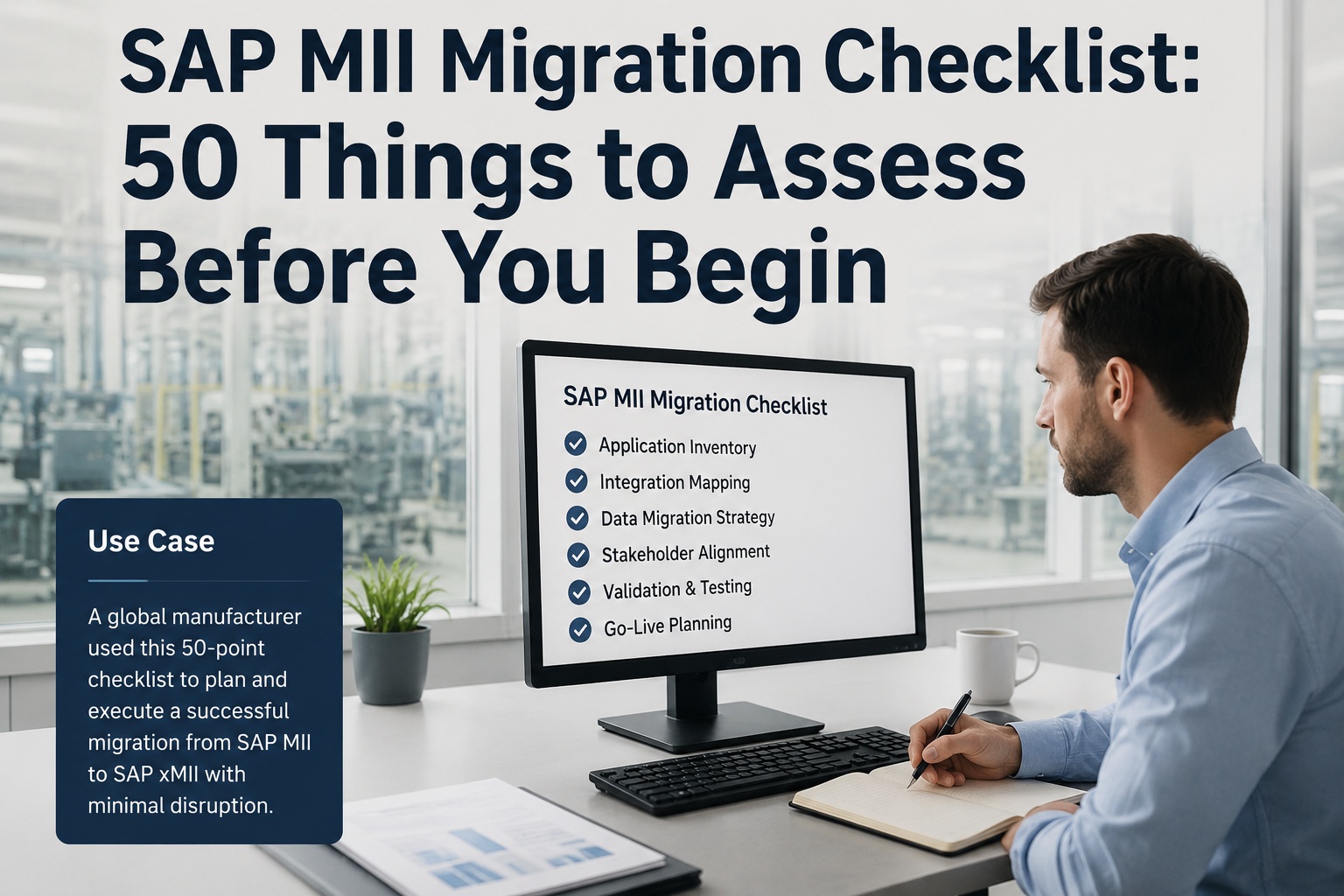
SAP MII Migration Checklist: 50 Things to Assess Before You Begin
By Riley Quinn on May 15, 2026
SAP MII mainstream maintenance ends December 2027. If your team has been quietly hoping that deadline slides one more year, the math no longer works. A typical SAP MII estate at a mid-size manufacturer has 80–150 transactions, 30+ integrations, a decade of dashboards, and at least one piece of custom logic nobody on the current team wrote. Done well, the migration takes 12 to 24 months. Done badly, it takes 36 months and a 3 AM production outage that ends careers. The difference between "done well" and "done badly" is almost entirely the work that happens before you sign the first migration contract. This is that work — fifty assessment questions across the five categories that decide whether your migration is a controlled engineering program or a panicked vendor scramble. Print it. Walk it through with your operations lead, your S/4HANA lead, your IT security lead, and your plant managers. The checklist that drives a real assessment is not a 50-row spreadsheet — it is the most useful four weeks of the entire migration. Book a 30-minute migration assessment with our deployment engineers.
50 POINTS · 5 CATEGORIES · 4-WEEK ASSESSMENT
SAP MII Support Ends Dec 2027. The 50-Point Checklist That Decides If Your Migration Lands Clean.
Most SAP MII migrations slip not because the new platform fails, but because the pre-migration assessment was incomplete. Missed integrations, undocumented transactions, unowned dashboards, change-control collisions with S/4HANA — every one of these costs months in flight. Fifty questions across five categories surface them in four weeks instead. Run on NVIDIA on-prem hardware behind your firewall. Pilot in 6 to 12 weeks. Perpetual license. Source code included.
The On-Prem Server Stack — What the New Platform Runs On
The platforms successfully replacing SAP MII share a common reference architecture — three NVIDIA hardware tiers running behind the plant firewall, never connected to the public internet. Replaces MII's integration backbone, dashboards, transaction logic, and ERP bridge in one platform. Schedule an architecture walkthrough with our deployment engineers.
EDGE · INTEGRATION BRIDGE
NVIDIA Jetson AGX Orin The Integration Bridge
JobReplaces MII shop-floor connectivity — PLC, SCADA, historian
SpeedSub-second tag subscriptions from every machine
WhereMounts in the control room next to PCo or SCADA
FormRuggedized box, fits in switchgear cabinet
What it does: Takes over MII's plant connectivity role. Speaks OPC-UA, OPC DA, Modbus, MQTT, REST. Existing SAP PCo can stay or be replaced. Tag mappings ported as configuration, not rewritten.
OPC-UA+ MODBUS + MQTT + REST
CONTROL ROOM · REPLACEMENT CORE
RTX PRO 6000 Blackwell The MII Replacement Core
JobRuns transactions, dashboards, business logic — all MII replaced
SpeedSub-second dashboard load · live KPI refresh
WhereSits in your control room behind your firewall
FormTower computer, fits under a desk
What it does: Replaces MII transaction logic, dashboards, business rules, and ERP bridge. Workflows ported as code — not rebuilt in proprietary low-code designers. Parallel run with MII supported through cutover.
FULL MIIREPLACEMENT · ONE PLATFORM
ENTERPRISE · HISTORICAL ARCHIVE
NVIDIA DGX Station GB300 · Historical Archive
JobStores 10+ years of MII history · compliance lookups
SpeedAudit query in 2 hours, not days
WhereSits at corporate HQ in a server rack
FormRack-mounted, 24/7 enterprise grade
What it does: Loads MII historical data into time-series storage at full timestamp resolution. Audit queries continue to work. AI surfaces patterns across years of operations history MII could not see.
10+ YRHISTORY · LOSSLESS · QUERYABLE
100%
Stays inside your plant · never goes online
$0/mo
Perpetual license · buy once, own forever
Parallel
Run · MII coexists through cutover
Yours
Source code included · modify it freely
The 50-Point Pre-Migration Checklist · Five Categories That Decide Your Timeline
Fifty assessment questions across the five categories every successful SAP MII migration covers in its first four weeks. Each question is binary — you either have the answer documented or you don't. Counting the unchecked boxes after this exercise is the most honest readiness signal you will get. Talk to our migration support team for the editable checklist template.
C1
APP INVENTORY & ARTIFACTS
10 ITEMS
Complete inventory of every MII transaction in production, including ownership, last-edit date, and dependency map.
Inventory of every Business Logic Service (BLS), Xacute query, and SQL query — with active-vs-deprecated status.
Inventory of every iGrid, iChart, and dashboard, with usage telemetry from the past 90 days.
List of User-Defined Functions (UDFs) and custom Java classes that ship with the MII install.
Inventory of every MII workflow, persistence schema, and KPI definition currently active.
Classification of every MII artifact: keep · transform · retire · replace.
List of MII custom roles and authorization profiles, with user-count by role.
Documented owner of each top-50 artifact (real person, not "the team that left in 2022").
Identification of any third-party MII extensions, plug-ins, or licensed add-ons in production.
Last-known compile date and source repository location of all custom code.
C2
INTEGRATION MAPPING
10 ITEMS
Current topology diagram of every system MII integrates with — ERP, PLC, SCADA, historians, identity, monitoring.
Inbound + outbound interface inventory with message throughput per interface per month.
Authentication method and credential rotation cadence for every external connection.
SAP S/4HANA / ECC interface inventory: IDocs, BAPIs, RFCs, OData services in use.
List of every PLC brand, SCADA system, and historian in scope with firmware versions.
Document data-residency and on-prem constraints driven by regulators or OEM customer audits.
Bandwidth and latency requirements per interface · edge-vs-control-room placement decisions.
Identity-provider integration: SSO, LDAP, OAuth — current state and target state.
Monitoring and alerting integration: Solution Manager, Splunk, Datadog — what fires, who responds.
List of any direct-database integrations between MII and Oracle/SQL Server backends.
C3
DATA MIGRATION & ARCHIVAL
10 ITEMS
Master data ownership matrix: who is the system of record for each entity (material, BOM, routing, operation).
Historical data retention requirement by regulator — pharma, food, defense, environmental.
Decision on historical data: load into new platform · archive read-only · purge after retention period.
Time-series data volume estimate · cardinality · retention period · query patterns.
Compliance lookup requirements: how fast must audit queries return on legacy data?
Data quality assessment of MII production tables · known orphan records · known duplicate keys.
Plan for in-flight transactions during cutover · staging window · rollback design.
Field-level transformation rules from MII schema to target platform schema.
4-Week Assessment · Board-Ready Plan · Quick-Win Use Cases
Run the 50-Point Assessment Before You Sign a Single Migration Contract.
Book a 30-minute call with our migration engineers. We walk through your MII estate, your S/4HANA footprint, your regulatory scope, and your OEM customer constraints. You leave with a tailored 4-week assessment plan, a phased migration roadmap, and a shortlist of 2-3 use cases where the new platform pays back inside the program. Perpetual license. Source code included. Zero hyperscaler dependency.
The most common questions enterprise architects, MES owners, and SAP program leads ask when running the pre-migration assessment for SAP MII. Talk to our migration support team.
How long does the 50-point assessment take?
Four weeks is the standard, and that includes interviews, system scans, integration mapping, and the board-ready output. Week 1 is discovery and stakeholder interviews. Week 2 is automated inventory scans of the MII production server plus integration trace analysis. Week 3 is classification workshops with operations, IT, and compliance leads. Week 4 is the deliverable — phased migration plan, effort estimates, target architecture options, and a shortlist of 2-3 quick-win use cases. Most manufacturers find this is the most useful four weeks of the entire migration.
Do we have to choose between SAP DM and a best-of-breed platform?
Not at the assessment stage. The output of the 50-point checklist is what drives the target architecture decision, not the other way around. For sites with light MII customization, heavy SAP integration, and no data-residency constraints, SAP DM is often the natural fit. For sites with heavy custom logic, regulated compliance scope, OEM customer audit constraints, or on-prem requirements, a best-of-breed platform on NVIDIA hardware is typically the better path. Many manufacturers land on a hybrid: SAP DM for standard execution, best-of-breed for the long-tail of custom workflows. The assessment is what tells you which.
Can we run the new platform parallel with MII during cutover?
Yes — and parallel run is part of every well-designed migration. SAP themselves recommend a hybrid coexistence model during transition. The new platform takes over standard transactions first while MII continues to handle shop-floor integration and custom processes. As the new platform's footprint grows, MII gets phased out one capability at a time. Wave 1 typically handles dashboards and reporting. Wave 2 handles ERP integration. Wave 3 handles shop-floor connectivity. Wave 4 handles custom transactions. By the end of Wave 4, MII has handed off every capability and can be moved to read-only or fully decommissioned.
What happens to our historical MII data?
Three options depending on retention requirements. Option 1: load into the new platform's time-series store at full timestamp resolution — best for sites that actively query historical data for analytics or compliance. Option 2: archive read-only on the DGX with cryptographic integrity proof — best for regulated industries that need audit lookups but not active querying. Option 3: purge after the regulatory retention window expires — best for general industrial data with no compliance retention. The data migration plan is a formal C3 checklist deliverable, finalized before any cutover.
What's the smallest first step we can take this quarter?
A 4-week pre-migration assessment. Inventory MII artifacts, map integrations, classify customizations, define future-state vision, and produce a phased plan with effort estimates. Output is a board-ready paper plus a shortlist of quick-win use cases for the new platform. Talk to our migration support team to scope it for your estate — typical scope is 1 SAP MII production server, up to 5 integrations deep-mapped, and an executive readout at week 4. The assessment runs alongside business-as-usual operations; no production impact.
SAP MII Mainstream Support Ends December 2027
Migrate With a Plan, Not a Panic. Start the Roadmap While You Still Have Runway.
Book a 30-minute call with our migration engineers. Walk through your MII estate. Get a tailored 50-point assessment plan and a 4-week board-ready output. Pilot in 6 to 12 weeks. Perpetual license. Source code included. Zero hyperscaler dependency.