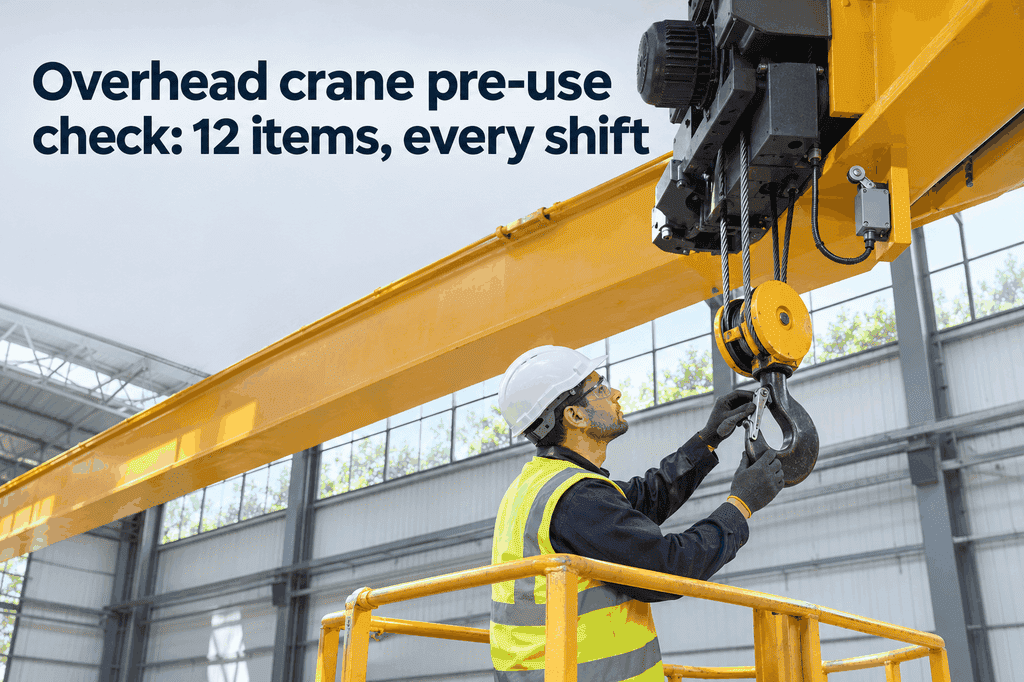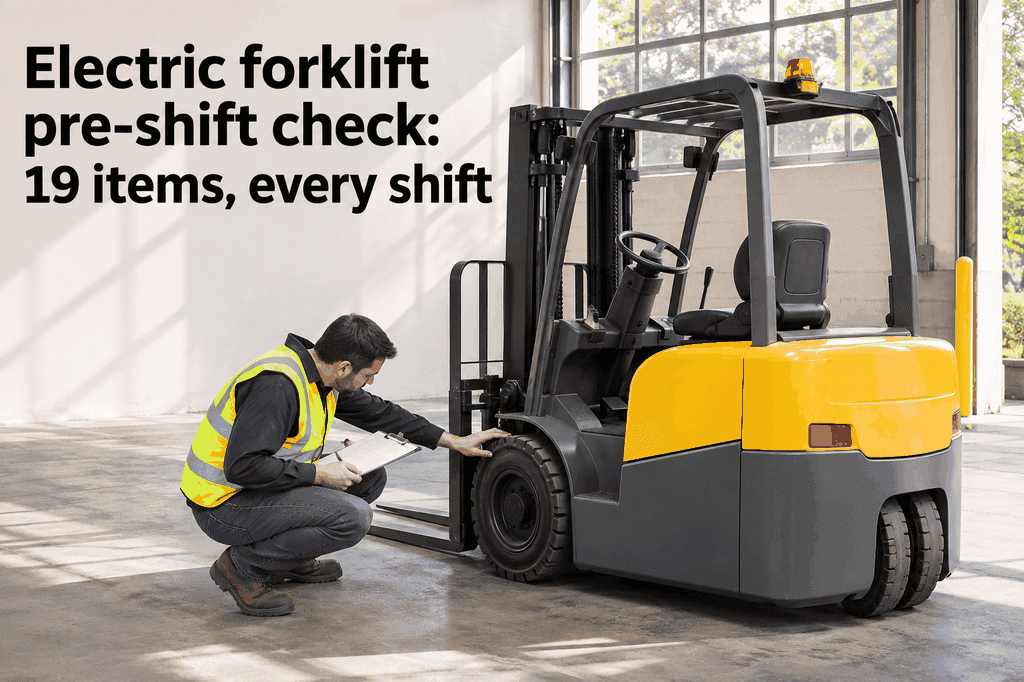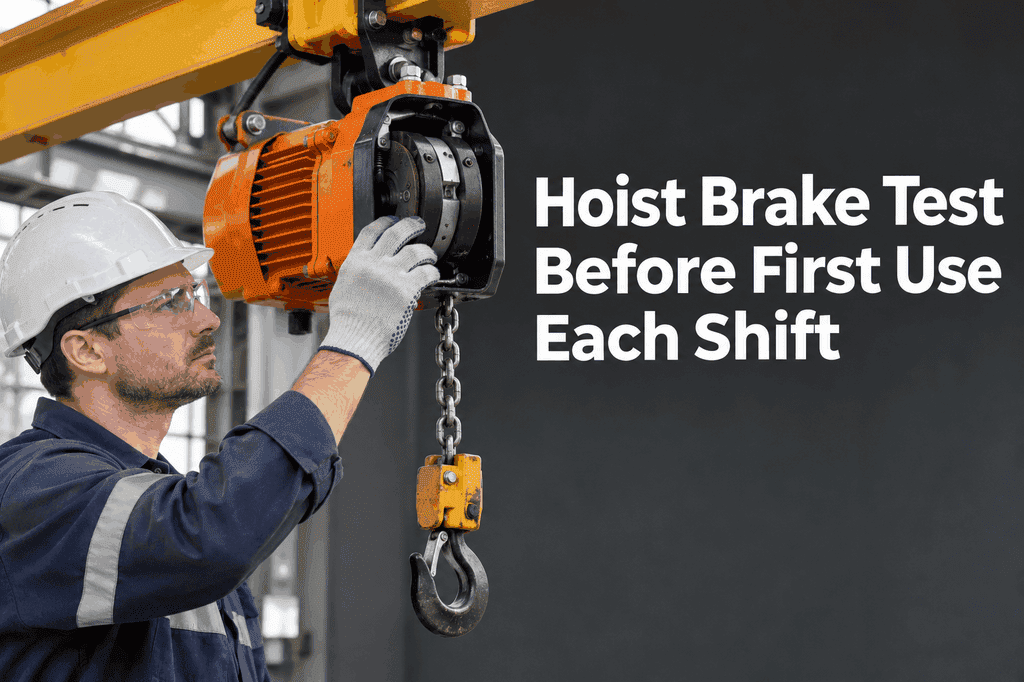
A hoist brake that slips is not a maintenance finding to be dealt with next week. It is the reason the crane should not be used at all. That is why the brake test is an Urgent item in the ready Overhead crane and hoist pre-use check in iFactory Inspection, done by the operator before first use each shift in about five minutes. This page describes the test, what passes, how fast a failure is due and what the app does and does not claim. Add the crane check in your workspace once your company is set up.
Inspection · Hoist brake
Hoist brake test before first use each shift
Lift a light load 100 mm and stop.
How the test is done
The brake test is one written item with its own how-to-check line and a single pass condition, so every operator runs it the same way. It needs the pendant, a light load and a minute of attention, nothing else.
Pick a light load
Choose a light load, well inside the crane's rated capacity. The test is meant to show whether the brake grips, not to stress it, and a slipping brake with a light load is far less dangerous than one found under a full lift.
Lift it 100 mm
Raise the load about 100 mm, just clear of the floor, and stop. Keeping it low means that if the brake does let go, the load has almost nowhere to fall, and nobody needs to be near the load path.
Stop
Let go of the control so the hoist stops and the brake takes the weight. Then watch the load for a moment, because a weak brake often shows itself as a slow creep rather than a sudden drop.
Watch the load
A pass is a load that stays where it stopped, with no slow drift downwards and no slip at the moment the hoist stops. Anything that moves after you release the control fails the item.
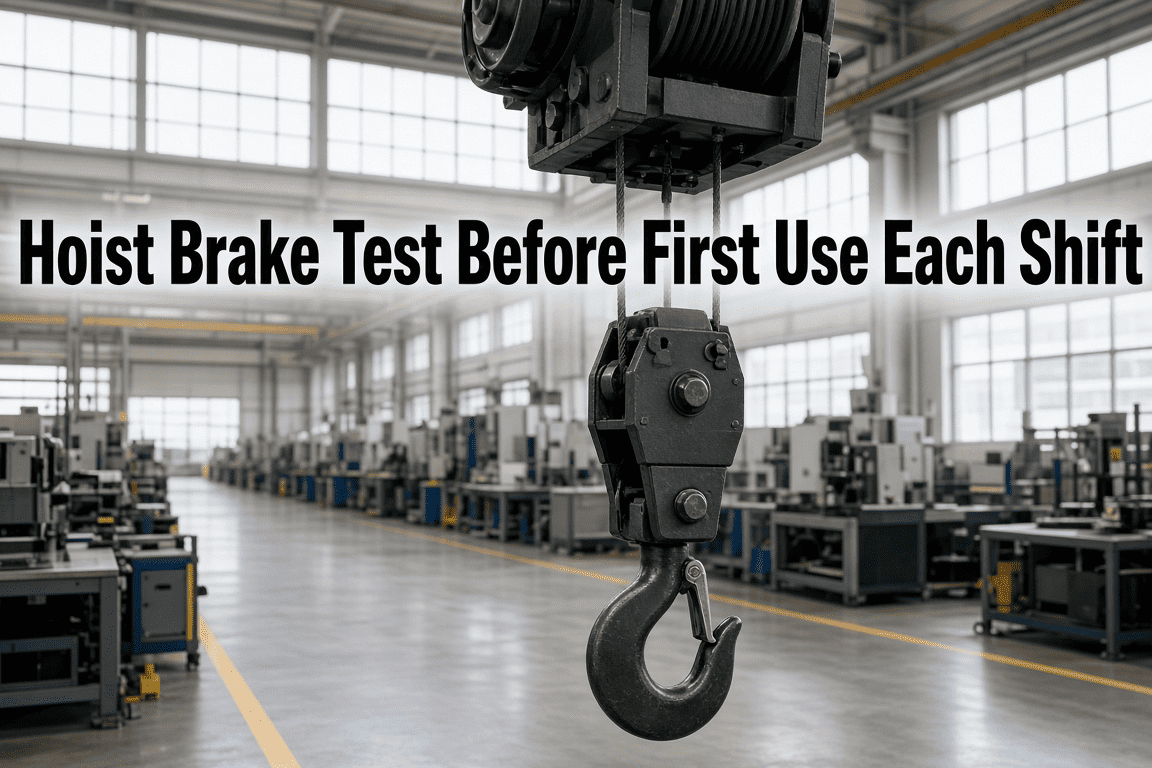
Test the brake before the real lift
Mark the item Failed with a note that says what you saw, for example a slow creep or a drop on stopping. The crane should then stay out of use, according to your own site rules, until the brake is repaired.
Pass and fail
The item asks one question, and the answer decides whether the crane carries on working. Either the light load held after stopping, or it moved, and the two outcomes lead to very different next steps.
Pass
Holds
None
None
Fail
Marked Failed with a note
Raised, due in 4 hours
The crane should not be used until it is fixed, under your own rules
The rest of the Urgent items
The brake is one of several function and condition checks the operator completes before first use each shift. The other items cover the controls, the limit switch and the lifting gear, so the crane is looked at as a whole.
Pendant or radio and E-stop
Press every button, then the E-stop
Press each pendant or radio button and check each motion goes the right way and the buttons spring back, then press the E-stop and confirm it stops everything. This is Urgent, and it runs before the brake test because the same controls are used.
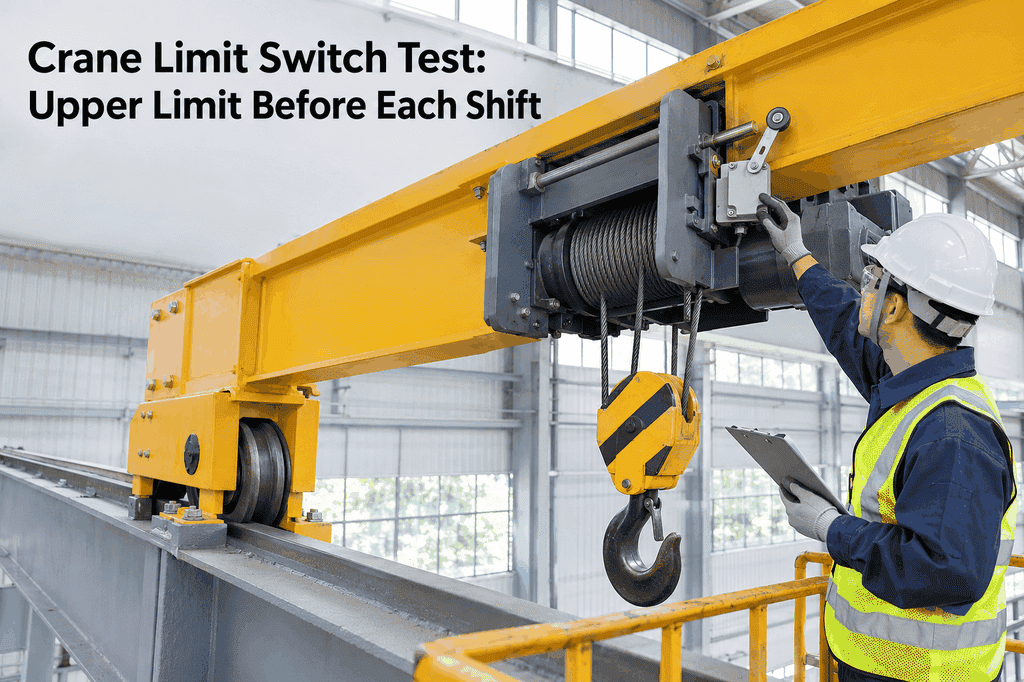
Upper limit switch
Raise the empty hook slowly to the top
Raise the empty hook slowly to the top and check the hoist stops on its own before the block touches the drum or frame. This is also Urgent, because the limit switch is the last protection at the top of travel.
Hook
Look at latch, cracks and opening
Look at the hook for a latch that closes by itself, cracks or twist, and a throat no more than 15% wider than new or within its mark. Hook condition is an Urgent item, because a bent or cracked hook can fail under load.
Wire rope
Run it out and look
Run the rope out and look along its full length for kinks, birdcaging or crushing, fewer than six broken wires in one lay, and a rope that is seated in the drum grooves. A damaged rope is an Urgent item.
Load chain
Look at the links
On a chain hoist, check the load chain for stretched, twisted, nicked or gouged links, and see that the chain runs smoothly through the hoist. Chain condition is an Urgent item for the same reason as the rope.
Where the pre-use round shows up
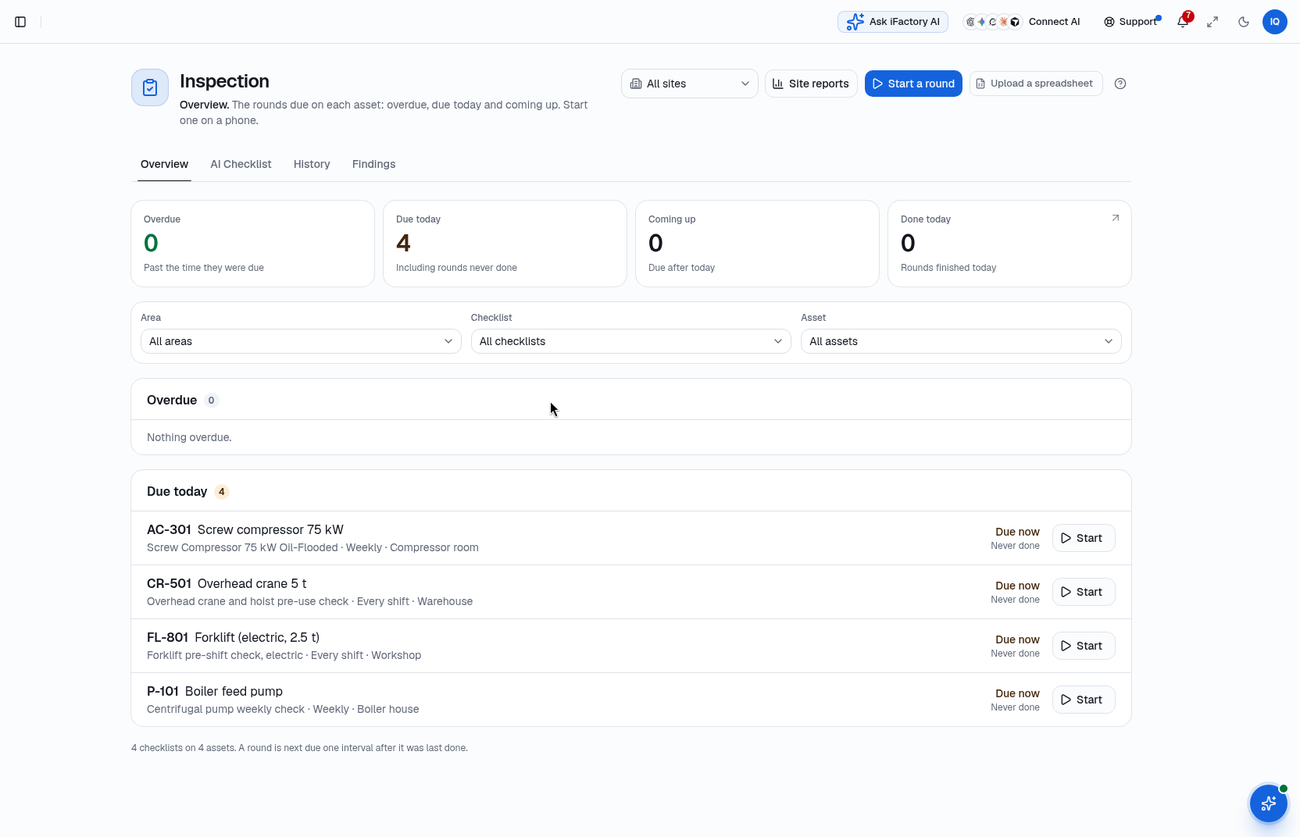
The overview lists the rounds due today and shows overdue rounds first, so the crane check appears for the operator or supervisor without a separate list. A check that was not done before first use shows as outstanding instead of being forgotten.
What the app does not claim
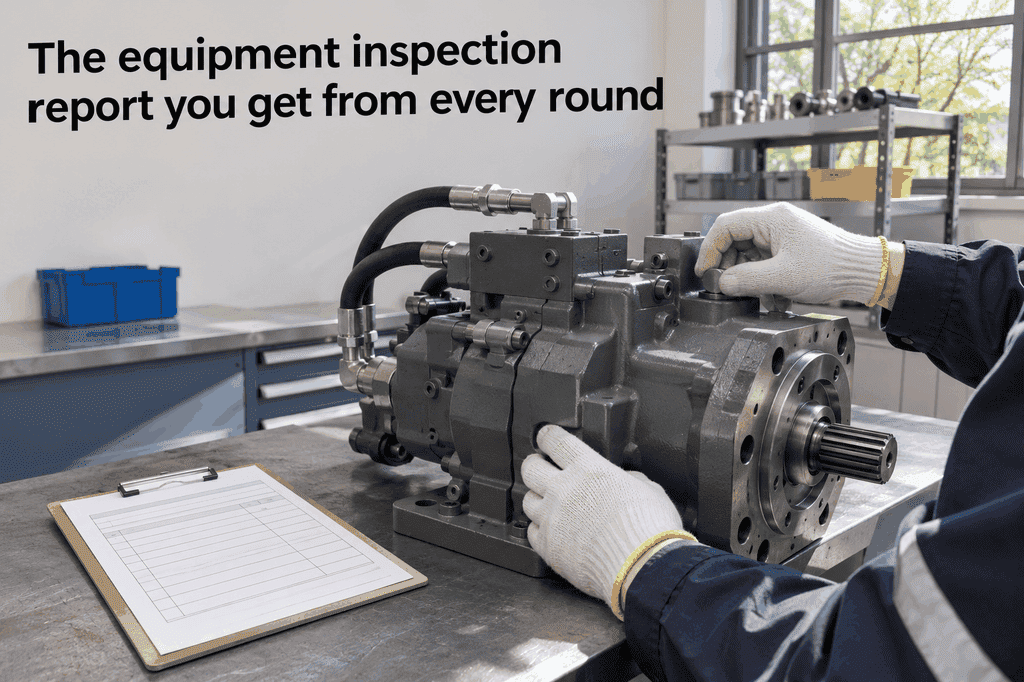
The app is a record of daily checks. It helps you show that the brake test was done and what happened when it failed, and it is clear about the things it cannot do for you.
Not certification
Thorough examinations by a competent person are a separate requirement under the lifting rules where you work. The pre-use record sits next to them and does not replace them.
Does not stop the crane
A failed item raises a work order and keeps a note, but nothing in the app disables the crane. Keeping a failed crane out of use is a physical and procedural step on your site.
Your own rules
Write down who is told, how the crane is tagged and who clears it for use again. The checklist then feeds a process you already control instead of trying to replace it.
Doing the test safely
The hoist brake test is Urgent, and it belongs near the top of the pre-use round. With a light load on the hook, lift it about 100 mm, then stop. The load should hold with no drift and no slip as the hoist stops. Use a light load, not the rated load, and keep people clear of the area under it.
A brake that drifts a little under a light load will not hold a heavy one. That is why the test uses a small lift and a stop rather than waiting for a heavy lift to show the fault.
What a failure sets in motion
If the load drifts or slips, mark the item Failed and write what happened. The Urgent priority raises a work order due in four hours. Stopping the crane is the operator's and supervisor's decision, and the app does not lock the crane out. Follow your own rules and the manufacturer's instructions.
The work order carries the item, the note, the how it is checked line and the limit, so the person who repairs the brake can see how it was tested.
The rest of the pre-use round
The brake is one of six Urgent items on the crane check. The others are the pendant or radio E-stop, the upper limit switch, the hook, the wire rope and the load chain. The whole check takes about five minutes at the start of the shift, so the brake test costs little.
Because the crane round is set to every shift, it appears on the due list at the start of each shift for the crane, and History shows who did it and when.
Doing the test safely
The test uses a light load. Lift it 100 mm and stop, then watch. If the load holds with no drift and no slip when you stop, the brake passes. Use a load that is well within the rated capacity, and do the test where nobody is under the load path.
The item is Urgent, so a brake that drifts raises a work order due in four hours and the hoist should not be used until it is fixed.
The same pre-use list has the area under the crane, the pendant and E-stop and the hook and rope items, so the brake test is part of a set of checks that covers the crane before the first lift.
Frequently asked questions
What is the hoist brake test?
It is an Urgent item in the ready Overhead crane and hoist pre-use check in iFactory Inspection. The operator lifts a light load about 100 mm, stops, and sees whether the load holds. It is done before first use each shift as part of a check that takes about five minutes.
What counts as a pass or a fail?
A pass is a load that holds with no drift and no slip when the hoist stops. A fail is any movement after the control is released, such as a slow creep or a drop at the moment of stopping. The operator marks the item Failed and writes what happened in the note.
How fast does a failure have to be dealt with?
The item is Urgent, so a failure raises a work order due in four hours, carrying the item, the note, the how-to-check text and the pass condition. The crane should not be used until the brake is repaired, and your own site rules decide how it is tagged and kept out of service.
Why use a light load and lift it so little?
The test is meant to find out whether the brake grips, not to stress it. A light load lifted about 100 mm is enough to show drift or slip, and if the brake does let go the load has almost nowhere to fall. Nobody should stand under the load path during the test.
Does the app stop the crane or certify the brake?
No. The app keeps a record of the daily check and raises the work order, but it cannot lock the crane out, and it does not replace a thorough examination by a competent person under the lifting rules where you work. Taking a failed crane out of use is a decision for the operator and supervisor.
Where does the brake test sit in the pre-use round?
It is one of the Mechanical items in the 12-item overhead crane check, alongside the hook, the wire rope or load chain and the bottom block. The Safety items, pendant and E-stop and the upper limit switch, come first, so the controls and the top-of-travel protection are proven before the brake is tested.
Test the hoist brake every shift
Add the pre-use crane check and let a failure become an Urgent work order.
- Urgent brake item
- Work order due in 4 hours
- Done by the operator
14-day free trial · no card needed