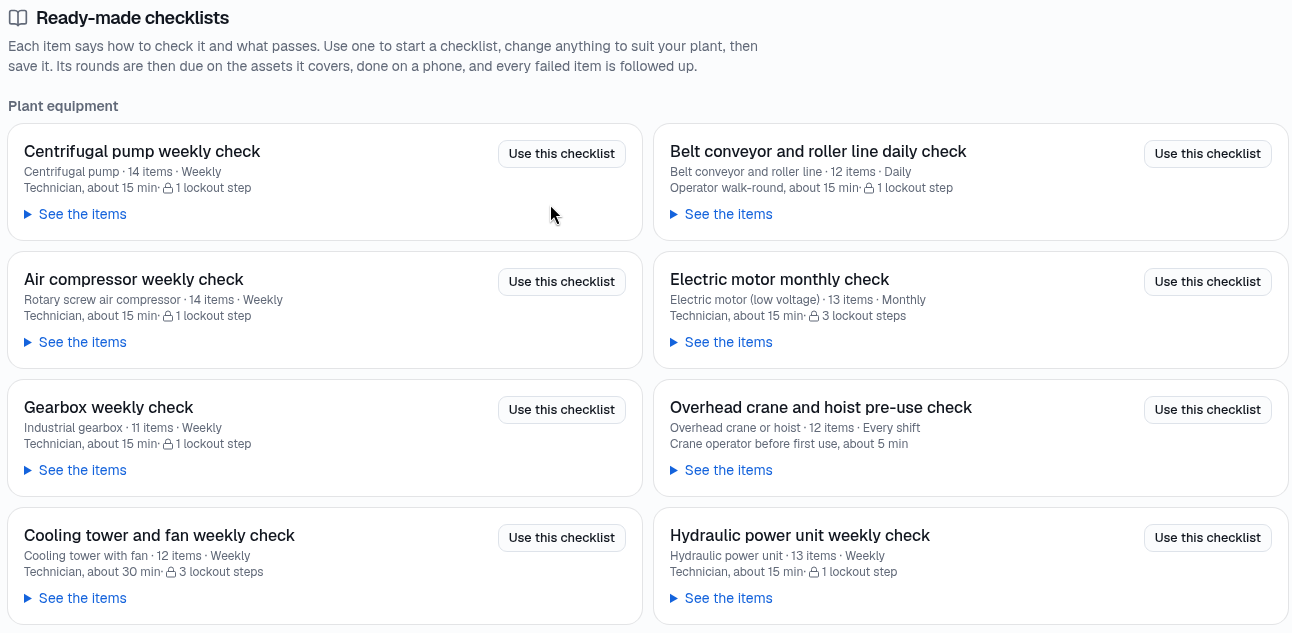
A crane check before the first lift of the shift is short by design: five minutes, done by the operator who is about to use it. What matters is that the same things are looked at every time, and that a hook, a rope or a limit switch that is not right stops the lift and reaches maintenance. The ready Overhead crane and hoist pre-use check in iFactory Inspection is set to every shift and has 12 items, six of them Urgent. This page lists them, the limits written in, what a failure does and what the app does not claim. Add the crane check in your own workspace once your company is set up.
Inspection · Overhead crane
Overhead crane pre-use check: 12 items, every shift
The operator does the check before the first lift of the shift, and it takes about five minutes. Six of the 12 items are Urgent, so a failure on any of them is treated as serious.

The pre-use check at a glance
The check is written for the operator who is about to use the crane and not for a maintenance technician. Every item can be done from the floor or the cab with no tools.
Check before the first lift, every shift
A failed Urgent item raises a work order due in 4 hours. The operator should also tell the supervisor and stop lifting, because the work order does not lock the crane out.
The six Urgent items
These six items must pass before the crane is used. Each one protects against a way the lift can go wrong, from an E-stop that does not work to a brake that slips.
Pendant or radio and E-stop
Press each button with no load on the hook and watch each motion, then press the E-stop to confirm that everything stops.
It passes if each motion goes the right way, the E-stop stops everything and the buttons spring back when released.
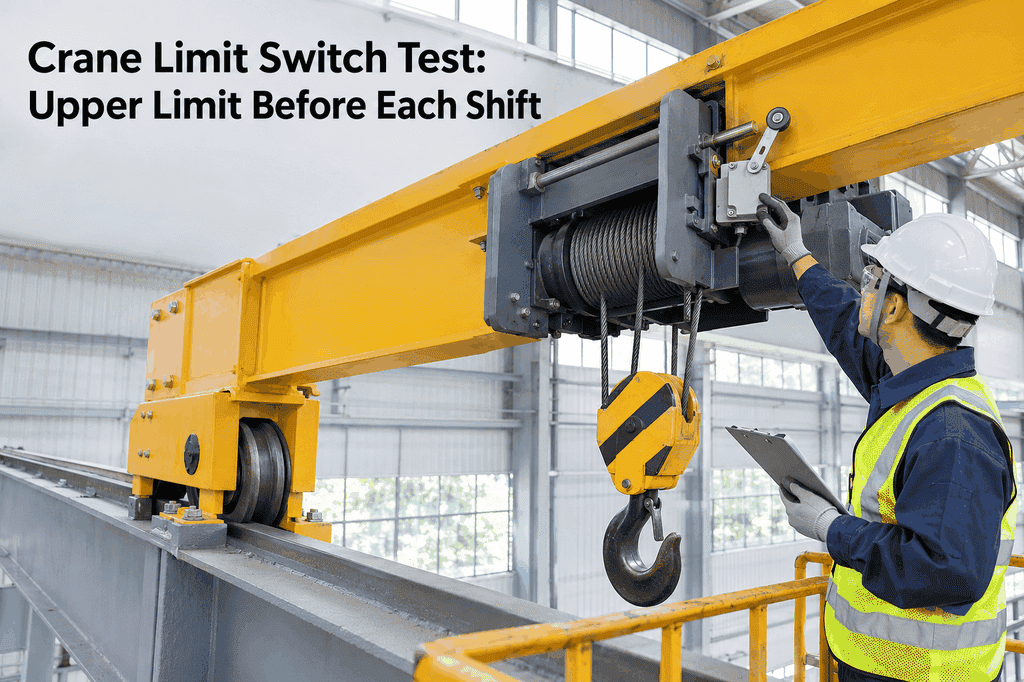
Upper limit switch
Raise the empty hook slowly towards the top of its travel, with a hand ready on the control, so that the limit switch does the stopping and not the operator.
It passes if the hoist stops before the block touches the drum or the frame. If the block gets any closer, the limit switch has failed.
Hook
Look at the hook latch, look for cracks or twist, and look at the throat opening of the hook.
It passes if the latch closes by itself, there are no cracks or twist, and the throat is not more than 15% wider than a new hook.
Wire rope
Run the rope out and look along its whole length, including the part that normally sits on the drum.
It passes if there are no kinks, birdcaging or crushing, fewer than six broken wires in one lay, and the rope sits properly in the drum grooves.
Load chain (chain hoist)
Look at each link of the load chain as it runs through your hand or past your eye.
It passes if no link is stretched, twisted, nicked or gouged, and the chain runs smoothly over the sprocket.
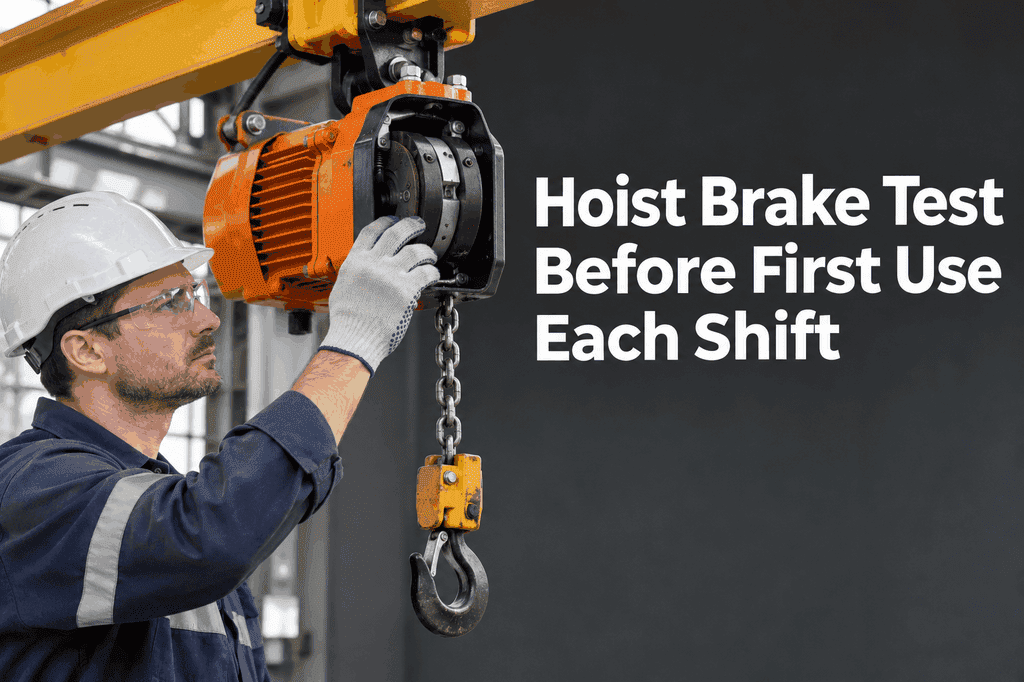
Hoist brake
Lift a light load about 100 mm off the floor and stop, then watch whether it holds.
It passes if the load holds with no drift and no slip. Lower it and tell the supervisor if it moves at all.
The figures are general. Check every limit against the crane maker's manual and your own rules before the first round.
The other six items
The remaining six items are High or Medium priority. They cover the things around the lift, such as the lower limit, the rails, the markings and housekeeping.
What the app does not claim
The app records the daily check. It does not certify a crane, and it is clear about that limit.
Not a certification
Periodic inspection and certification by a competent person are a separate requirement. The daily operator check supports them and does not replace them.
Does not stop the crane
The app cannot lock a crane out. A failed item raises a work order, and your supervisors decide whether the crane stays in use.
Your OEM and local rules
The limits are general. Edit them to match your own crane and the regulations that apply where you work.
Doing the check in five minutes
The pre-use check is written for the operator before first use each shift and takes about five minutes. It starts by walking the travel path to see that nobody and nothing is under the load path. Then, with no load, press each pendant button and the E-stop: every motion should go the right way, the E-stop should stop everything and the buttons should spring back.
The upper limit switch is tested by raising the empty hook slowly to the top; the hoist should stop before the block touches the drum or frame. The horn and travel light are checked, then the hook, rope or chain and travel movements.
Limits written into the check
The hook passes if the latch closes by itself, there are no cracks or twist, and the throat is not more than 15% wider than new, or past the mark. Wire rope passes with no kinks, birdcaging or crushing, under six broken wires in one lay and seated in the drum grooves. A chain hoist load chain passes with no stretched, twisted, nicked or gouged links.
The hoist brake is tested by lifting a light load 100 mm and stopping: the load must hold with no drift and no slip. Long and cross travel should run without jerking, grinding or crabbing, with the end stops and buffers in place. Pendant and festoon cables should be free of cuts and bare wire, with the strain wire carrying the pendant. The rated load marking must be readable on the crane and the hook block.
Frequently asked questions
What is on the ready overhead crane checklist?
The Overhead crane and hoist pre-use check in iFactory Inspection has 12 items, set to every shift. Six are Urgent: the pendant or radio and E-stop, the upper limit switch, the hook, the wire rope, the load chain and the hoist brake. The other six are High and Medium priority. It takes the operator about five minutes.
Who does the crane pre-use check, and when?
The operator who is about to use the crane does it, before the first lift of every shift. It is written so that the operator can do it from the floor or cab with no special tools. The check is short, so it can be done every shift without delaying the work, and the record shows who did it.
Which items are Urgent, and what do they check?
The pendant and E-stop, which must stop every motion; the upper limit switch, which must stop the hook before the block hits the drum; the hook latch and opening; the wire rope; the load chain; and the hoist brake, which must hold a light load without drift. A failure on any of them is due in 4 hours.
What happens when an Urgent item fails?
The operator marks the item Failed, writes a note and can add a photo. A work order is raised, due in 4 hours. The app cannot lock the crane out, so the operator should stop lifting and tell the supervisor straight away. Your site rules decide whether the crane stays out of use until it is repaired.
Does the app certify my crane?
No. It records the daily operator check. Periodic inspection and certification by a competent person are separate from it, and your own regulations decide how often they are needed. The limits written into the items are general figures, so check each one against the crane maker's manual and your local rules.
Does the app lock the crane out when an item fails?
No. A failed item raises a work order and appears in the Findings tab, but the app cannot isolate or lock out a crane. That is a site procedure. The operator and supervisor have to decide to take the crane out of use, and a note on the failed item tells maintenance what was wrong.
Put the pre-use crane check on every crane
Pick the check, apply it to every crane and let the rounds appear every shift.
- 12 items, six Urgent
- Done by the operator in five minutes
- Work order on every failure
14-day free trial · no card needed