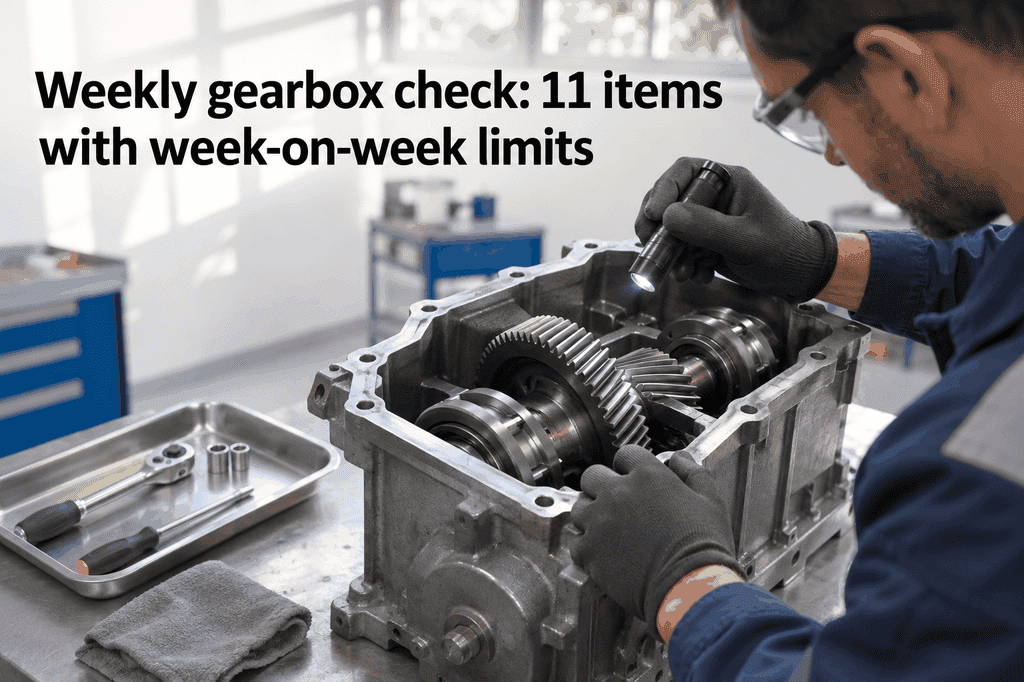
A gearbox seldom fails between one week and the next; it drifts. Oil gets darker, the case runs a few degrees hotter, the whine changes pitch. The useful question on a weekly round is therefore not only "is it within the limit" but "is it worse than last week". The ready Gearbox weekly check in iFactory Inspection has 11 items written around that idea. This page walks through them, the week-on-week limits and the four oil checks, and where the checklist stops. Add the gearbox check in your own workspace once your company is set up.
Inspection · Gearbox
Weekly gearbox check: 11 items with week-on-week limits
Guards, couplings, temperature, vibration, noise, leaks, bolts and oil. About 15 minutes.
This week against last week
Two items carry a condition about change as well as a limit: the case temperature and the vibration. Both are compared with last week as well as with a fixed number.
This week's reading
IR gun near each bearing after 1 hour running
Pen on input and output bearing housings
What passes
Below 80 °C and not more than 10 °C above last week
Below 4.5 mm/s and not rising week on week
Limits are written in °C and mm/s in the ready library and shown in your organisation's units in the app. Check every limit against the OEM manual.
Look for drift, not only for failure
A good note shows the trend the fitter needs, with the reading, the week-on-week change and the place it was taken, so they can see the drift without chasing the technician.
Four oil checks
Oil takes up four of the 11 items, which tells you how much of a gearbox's health depends on its lubricant. They run from the level to the cooler.
Level
Read the sight glass or dipstick after 5 minutes stopped
The level passes when it sits between the min and max marks. Wait five minutes after the gearbox has stopped so that the oil has settled before you read it.
Condition
Small sample from the drain into a clear jar
The oil passes if it is clear, not milky, not dark or burnt-smelling and with no metal glitter. Milky oil means water has got in, and glitter means metal is wearing away.
Breather
Look at it
The breather passes if it is open and clean. A desiccant breather that has fully changed colour has used up its drying material and needs changing.
Cooler or fan
If fitted
If a cooler or fan is fitted, it passes with the fan running, the fins clean and water flowing. A cooler that is not working is a quiet cause of rising temperature.
What else is on the round
The other seven items cover guards, couplings, noise, leaks and bolts. They are quick to check, and several of them need the technician to look rather than measure.
What the gearbox check does not do
The checklist is a visual and hands-on weekly round. It uses an IR gun and a vibration pen for two items, and the rest is looking, feeling and listening.
No oil analysis
The jar test shows obvious problems at a glance. It is not an oil analysis, and a lab result is a separate job if you want one.
Trend by memory and notes
The app records the answer against the written limit. The week-on-week comparison depends on the technician's own sight and last week's notes, so the notes matter.
Your OEM limits
The limits are general figures. Compare them with the gearbox maker's manual before the first round and edit the items that differ.
What the weekly round covers
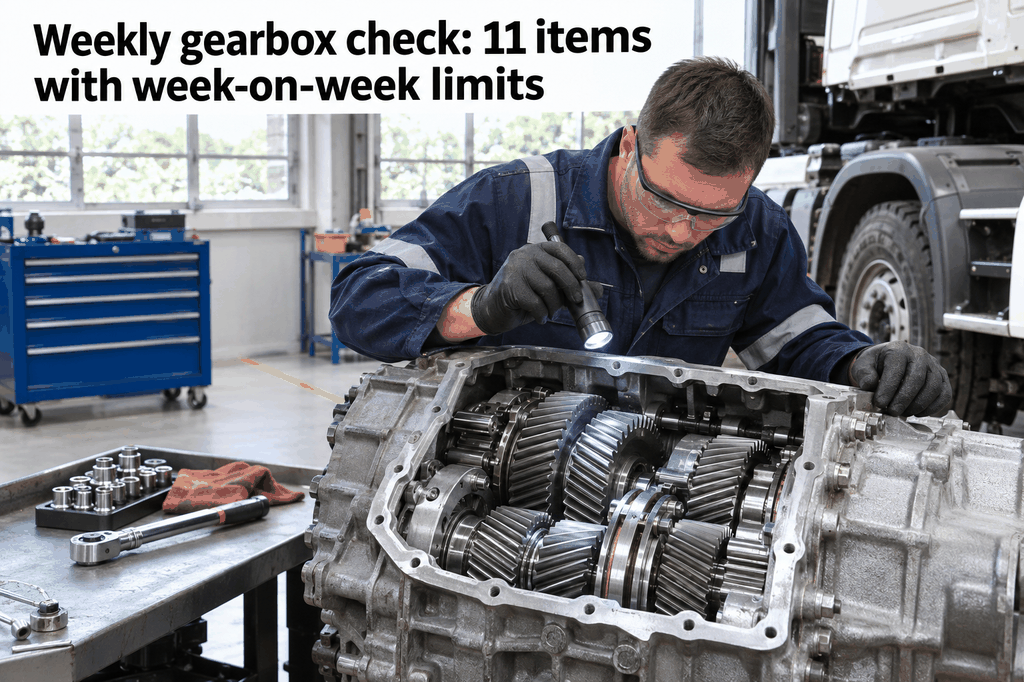
The 11 items start with the shaft and coupling guards, then the couplings themselves, which are checked with the gearbox locked out and the guards off for an intact insert or grid, play you can feel by hand and tight bolts. Case temperature is read with an IR gun near each bearing after an hour of running.
Vibration is read with a pen on the input and output bearing housings. Noise is checked with a stethoscope or a screwdriver on each bearing: a steady whine is normal, while knocking, grinding or a clunk once a turn fails. Seals, joint faces, mounting bolts and the torque arm complete the mechanical group.
Oil is half the check
Four items are about oil. Read the level at the sight glass or dipstick after the gearbox has been stopped for five minutes; it should sit between the minimum and maximum marks. Take a small sample from the drain into a clear jar: clear passes, milky suggests water, dark and burnt-smelling or with metal glitter fails.
The breather should be open and clean, and a desiccant breather should not have fully changed colour. If an oil cooler or fan is fitted, check that it runs, that the fins are clean and that the outlet pipe is warmer than the inlet.
The gearbox does not record a numeric reading. A temperature or vibration reading is judged against the limit and written in the note if it fails.
Recording what you hear
Noise is subjective, so describe it in the note: a steady hum, a knock once a revolution, a whine that rises with load. Different words point to different causes, and the next technician can listen for the same thing.
Frequently asked questions
What is on the ready gearbox checklist?
It has 11 items for a technician doing a weekly round of a gearbox in iFactory Inspection. It covers guards, couplings, case temperature, vibration, noise, leaks, bolts and four oil items: the level, the condition, the breather and the cooler or fan. About 15 minutes, with limits written into the items.
What temperature limit does the gearbox check use?
The case must be below 80 °C and not more than 10 °C above last week's reading. The technician reads with an IR gun near each bearing after the gearbox has been running for an hour. Both parts of the condition have to hold, so a gearbox can fail on the rise even when it is under the limit.
What vibration limit applies?
Below 4.5 mm/s and not rising from week to week. The technician holds a vibration pen on the input and output bearing housings. The app does not store the number, so write it in the note, and compare it with the previous note on the next round to see whether it is rising.
How is the oil condition judged?
By taking a small sample from the drain into a clear jar and looking at it. It passes if it is clear, not milky, not dark and burnt-smelling, and without metal glitter. It is a quick visual check and not a lab analysis, so a doubtful sample should be sent for proper testing.
Which gearbox items need lockout?
The coupling item needs the gearbox locked out, because the guard has to come off to see and feel the coupling. Lock out under your own procedure before opening anything. The checklist flag is only a reminder, and the guard goes back on before the lockout is released.
What happens when a gearbox item fails?
The technician marks the item Failed, writes a note and can add a photo. A work order is raised with the limit and the how-to-check text, due by priority: Urgent in 4 hours, High in 24 hours, Medium in 72 hours or Low in 14 days. The finding is tracked in the Findings tab until it is closed.
Put the weekly gearbox check on every gearbox
Pick the check, apply it to every gearbox and let the rounds appear weekly.
- 11 items with limits
- Week-on-week comparison
- Work order for every failure
14-day free trial · no card needed