Motors rarely fail without telling anyone: they run hotter, vibrate more, draw uneven current or smell of warm varnish for weeks first. A monthly check only helps if it measures those things the same way each time. The ready Electric motor monthly check in iFactory Inspection has 13 items, three of them lockout steps, with the limits written in. This page shows what is checked, the numbers that decide a pass, the insulation test ladder and what the checklist cannot do. Add the motor check in your own workspace once your company is set up.
Inspection · Electric motor
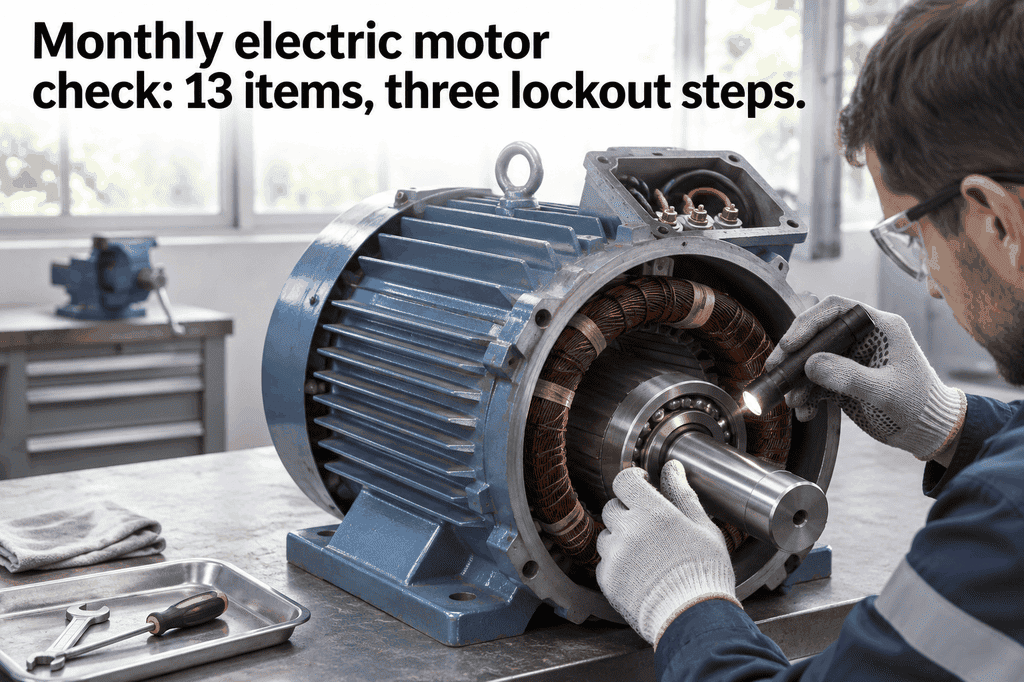
Monthly electric motor check: 13 items, three lockout steps
Terminal box, earth, temperature, vibration, noise, insulation and current on all three phases. About 15 minutes.
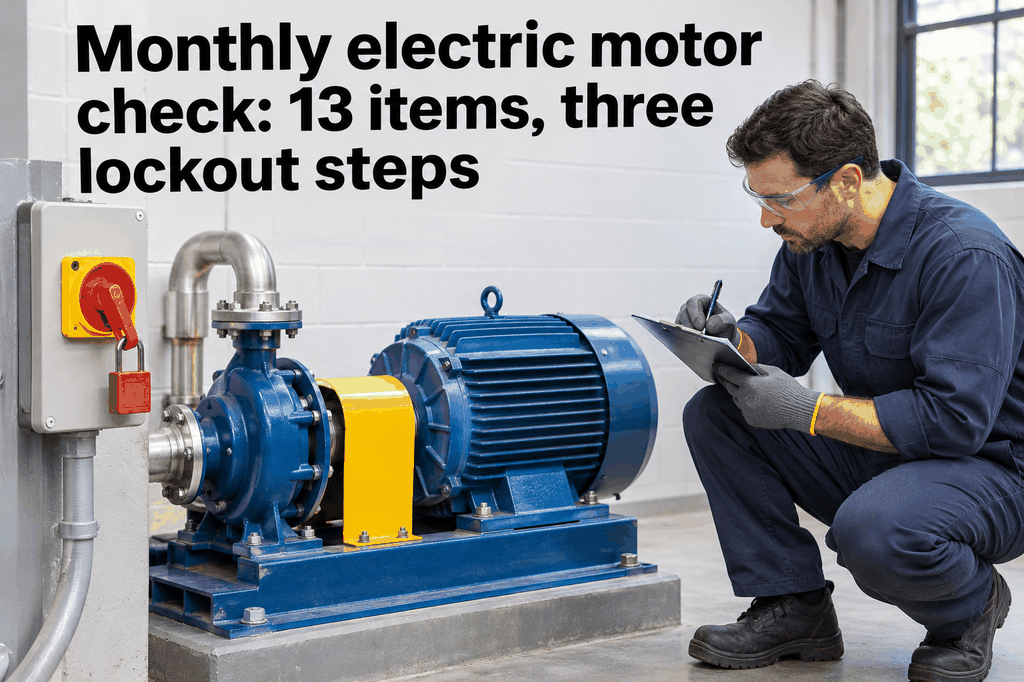
The monthly motor check at a glance
The ready check is written for a low-voltage motor and for a technician with measuring tools. It is a monthly round that mixes quick visual items with a few measured ones.
Three items need the motor locked out first: the hold-down bolts, the coupling or pulley, and the insulation test. The technician does them last, once the running readings are done.
Check the same things the same way every month
A failed item raises a work order that carries the limit, the technician's note and the how-to-check text, so maintenance can see what the reading was compared with.
The insulation test, and what each result means
The insulation test is marked "when due", so it is not run on every monthly round. When it is due, it is a lockout item with its own readings and its own meaning for each result.
How it is done
Motor locked out, cables off at the starter
500 V tester for 1 minute
What the reading says
OK
Report it
Do not start the motor
Limits worth knowing
These six limits are written into the items themselves, so the technician does not need to carry a separate table of numbers.
Frame temperature
IR gun on the frame after 1 hour running
OK below 80 °C, or less than 40 °C above the room.
Bearing temperature
Both bearing housings
OK below 80 °C and within 10 °C of each other.
Bearing vibration
Pen on each bearing, across and up
OK below 2.8 mm/s up to 15 kW, below 4.5 mm/s above.
Running current
Clamp meter on each phase at the starter
OK at or below nameplate amps, phases within 5% of each other.
Terminal box
Look, do not open live
OK with lid on, every screw in, gland tight.
Motor body
Look at the frame
OK with a dust layer under 1 mm and no oil on the frame.
The limits are written in °C and mm/s in the ready library and shown in your organisation's units in the app. They are general figures, so check each one against the maker's manual.
What the motor check does not do
The check is a walk-round that uses measuring tools. It is not an electrical test service, and it does not replace specialist testing on a critical motor.
No readings stored
Each item is answered OK, Failed or N/A. A failed item needs a note, which is where the technician writes the reading that broke the limit.
Low-voltage motors
Low-voltage motors are what the ready check was written for. Edit the items and limits before using it on high-voltage or specialist motors.
Not a testing service
The insulation tester, clamp meter, IR gun and vibration pen are your own tools. The app tells the technician what to measure and keeps the record of the answer.
How the monthly round runs
A motor round starts with the outside before it touches anything electrical. Look at the terminal box lid and cable gland without opening them live, check that the earth strap is bolted to the frame lug and that the fan cowl is secure with the inlet mesh clear. Those three are the Safety group.
The Mechanical group is the longest. With the motor locked out, check the foot bolts and the coupling or pulley, including the key and set screws. With the motor running, read frame and bearing temperatures with an IR gun, check bearing vibration with a pen and listen for noise. Grease the bearings if the plate or log says it is due, then take the three-phase current reading at the starter and look at whether the motor body is clean.
Limits and lockouts
Frame temperature passes below 80 °C, or less than 40 °C above the room, read after an hour of running. Bearings pass below 80 °C and within 10 °C of each other. Vibration passes below 2.8 mm/s up to 15 kW and below 4.5 mm/s above that. Running current should be at or below nameplate amps with the three phases within 5% of each other.
Three items are flagged for lockout: the hold-down bolts, the coupling or pulley and the winding insulation test. That test is done with the cables off at the starter, a 500 V tester for one minute, and is done when due rather than every round.
Getting the most from 15 minutes
Do the live items first, then stop and lock out for the three locked-out items. Bring the infrared gun, the vibration pen, a clamp meter and, when the insulation test is due, a 500 V tester.
Frequently asked questions
What is on the ready electric motor checklist?
It has 13 items for a technician doing a monthly round of a low-voltage motor in iFactory Inspection. It covers the terminal box, earth, frame and bearing temperature, vibration, noise, the body of the motor, the running current on three phases and, when due, the insulation test. Three items are lockout steps.
Which items are lockout steps?
Three: the hold-down bolts, the coupling or pulley, and the insulation test. Each needs the motor isolated and locked out under your own procedure before the guard or terminal cover comes off. The flag in the checklist is a reminder only. The technician should do these last, after the running readings have been taken.
What does the insulation test result mean?
Run with a 500 V tester for one minute with the motor locked out and the cables off at the starter. A reading above 100 MΩ is OK, below 10 MΩ is reported, and below 1 MΩ means do not start the motor. The item is marked when due, so it is not part of every monthly round.
What happens when a motor item fails?
The technician marks the item Failed, writes a note with the reading, and can add a photo. A work order is raised with the limit and how-to-check text, due by priority: Urgent in 4 hours, High in 24 hours, Medium in 72 hours or Low in 14 days. The finding shows in the Findings tab.
Does the app record the readings?
No. Results are OK, Failed or N/A with a note on failures, so the temperature, vibration and current figures are not stored. Write the figure in the note on a failed item. If you want a monthly history of the numbers, keep your own record alongside the app and use the note as the link to the work order.
Can I change the limits or use the check on another motor?
Yes. The ready check is written for low-voltage motors, and the limits are general figures. Edit the items before you save a checklist if your motor has different limits, or if it is a high-voltage or specialist motor. Always check every limit against the maker's manual before the first round.
Put the monthly motor check on every motor
Pick the check, apply it to every motor and let the rounds appear monthly.
- 13 items with limits
- Lockout flagged on three steps
- Work order for every failure
14-day free trial · no card needed