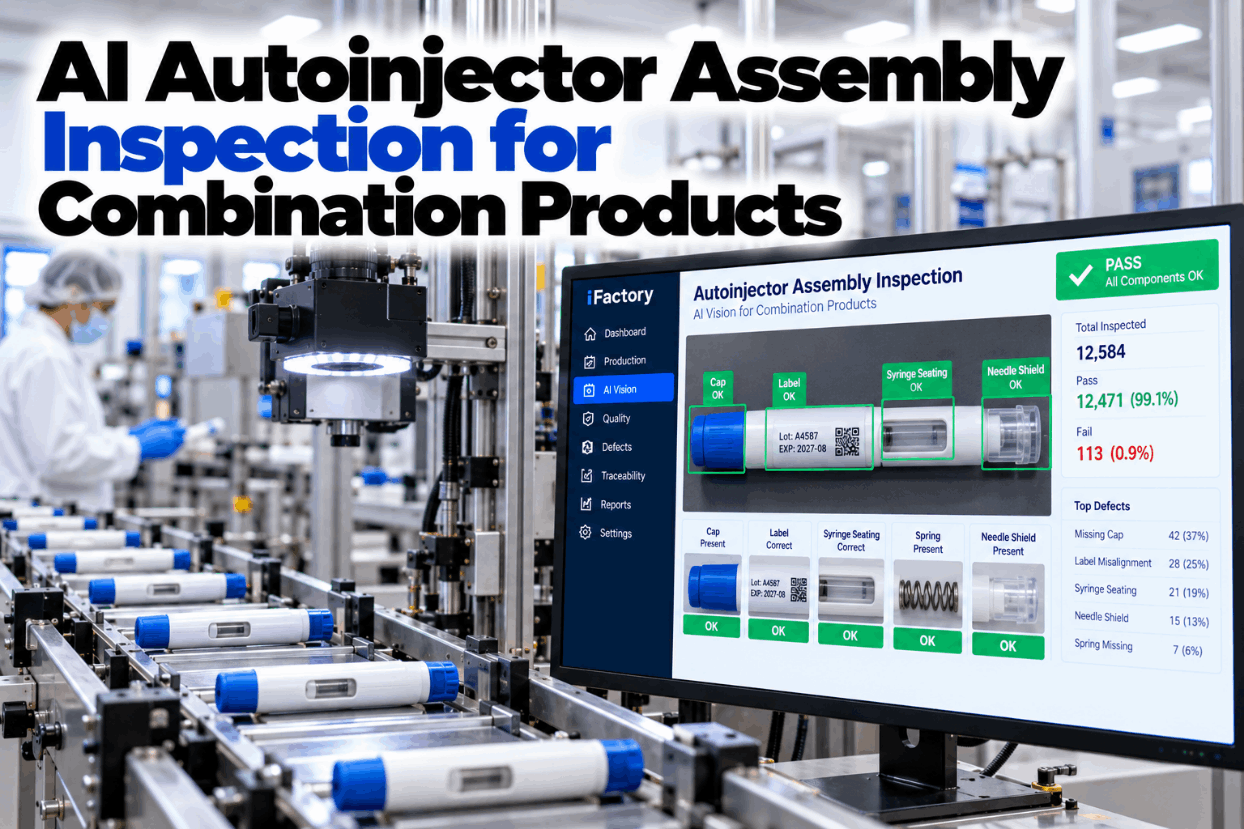
An autoinjector looks simple in the hand, but each pen is a filled syringe, a needle shield, a spring-driven power pack, a cap and a label that all have to come together correctly, thousands of times an hour. One missing shield or a syringe that is not fully seated can stop a dose or put a needle where it should not be. AI vision checks every pen at every assembly station and keeps a record of what it saw. See it on real pens in a short assembly vision demo.
Confirm Every Part of Every Pen Before It Leaves the Line
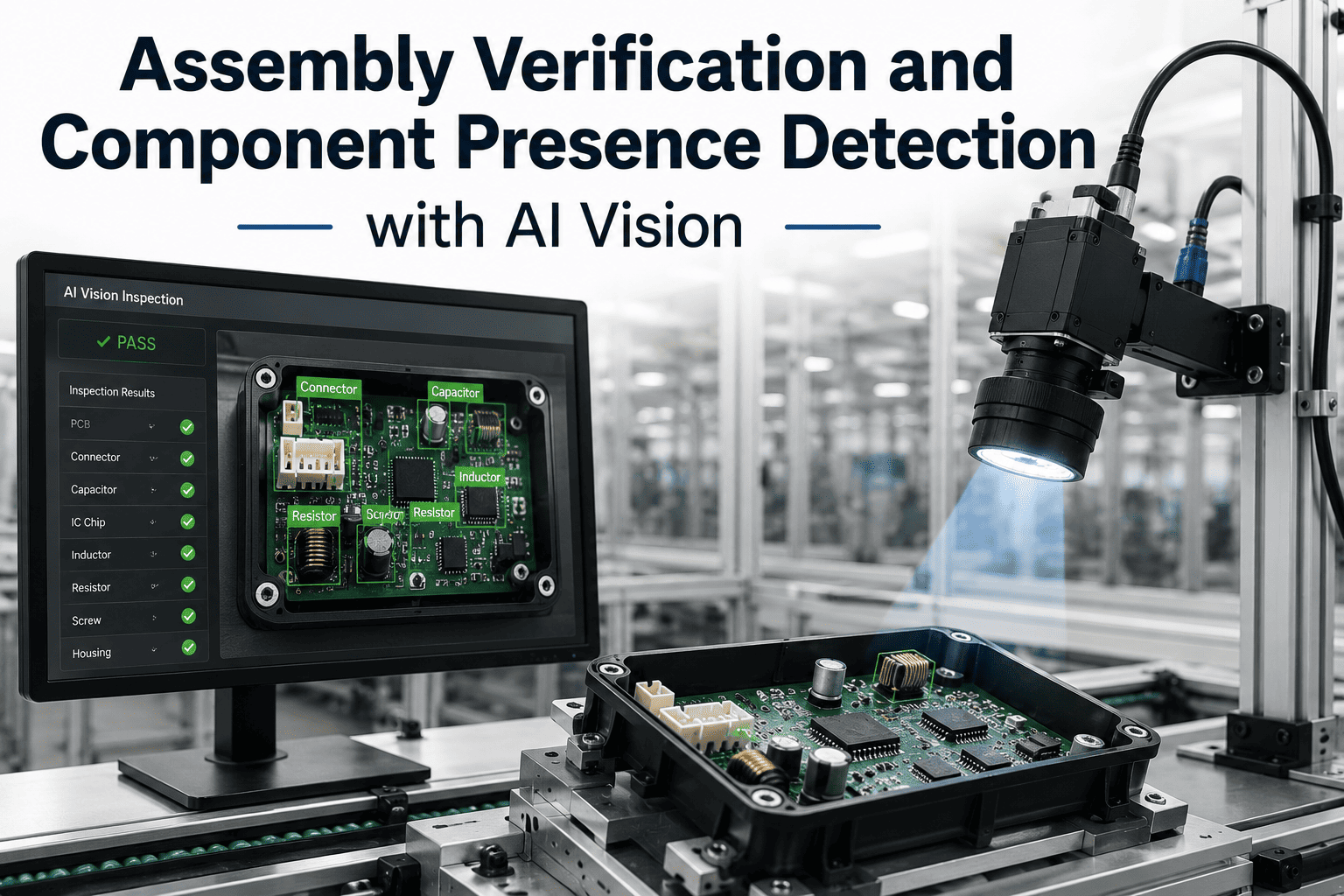
iFactory Vision Object Detection puts cameras at each assembly station to check that the syringe is seated, the needle shield is on, and the spring, plunger rod, cap and label are present and in place. Suspect pens are rejected and every pen gets a record.
Four Groups of Parts That Meet at Final Assembly
Many autoinjector designs arrive at final assembly as separate groups: a front subassembly holding the cap and needle cover, the filled syringe with its rigid needle shield, and a rear drive unit, often called the power pack, with a compressed spring and plunger rod. The line puts the syringe into the front part, joins the power pack and applies the label. ISO 11608-1:2022 sets requirements and test methods for single-patient needle-based injection systems like these. Talk through your own device design with our support team.
What the Streamlined Approach Asks of a Drug-Led Pen
Under 21 CFR Part 4, a pen built on drug CGMP (Parts 210 and 211) can follow the streamlined approach: meet the drug rules, then show compliance with a short list of device provisions. Since the QMSR took effect on 2 February 2026, Part 820 has been amended to incorporate ISO 13485:2016, and section 4.4(b)(1) now lists ISO 13485 clauses in place of the old Part 820 sections. Map your own quality system with our compliance specialists.
For a drug-led pen, day-to-day assembly and labeling run under Part 211. Section 211.134 asks for packaged and labeled product to be examined during finishing operations, with the results recorded in the batch record. Per-pen vision results give that examination a complete, searchable trail.
What the Cameras Look For at Each Step
Each station has one job, so each camera has a short, clear question to answer. Object detection finds every part in the image and checks its position against the limits from your design outputs. A pen passes only when every station has seen what it expects. Because the model learns from images of real parts, it copes with the glare from glass syringes and clear housings that often trips simple rule-based tools. Get a station plan for your line from our vision engineers.
Know Why Every Pen Was Rejected
A reject count alone doesn't help an engineer. iFactory saves the image, the station and the reason for every rejected pen, and answers questions about them in plain language, so the cause is found during the shift instead of after the batch.
Prevent What You Can, Detect the Rest
Good error proofing starts by making mistakes impossible: keyed parts, nests that only accept the right orientation, and presence sensors that stop a machine. The drug labeling rules use the same idea, since 21 CFR 211.122(g) accepts automated techniques that physically prevent wrong labels, or 100-percent electronic examination. Vision covers what fixtures can't, such as a shield that is on but not fully seated. Review your error-proofing plan with our assembly team.
- Keyed housings that only join one way
- Nests shaped for one syringe size
- Presence sensors that halt the machine
- Force and travel limits on press steps
- Part present but not fully seated
- Shield lifted or split
- Wrong colour part for the product
- Label skewed, lifted or illegible
A camera that only shows a warning on a screen is a monitor, not error proofing. Each vision check should drive a reject gate or a line stop through the PLC, with a confirmed reject count that matches the failed pens at the end of every batch.
From Design Output to Station Check
The checks a camera makes should come straight from your design file, not from guesswork on the line. Under ISO 13485 clause 7.3, design outputs and risk management already name the features that matter for a safe injection, such as a syringe seated far enough for the needle to reach its intended depth, or a cap that grips the shield so it comes off in one pull. Each of those becomes a station check with a limit and a proof. Link your design file to station checks with our quality engineers.
Higher Volumes Leave Less Room for Sampling
Demand for GLP-1 medicines has put real pressure on pen supply. FDA listed semaglutide in shortage from 2022 because of rising demand, and announced on 21 February 2025 that the shortage was resolved. Device makers have added capacity too. When volumes climb, checking a sample of pens by hand covers a smaller share of what ships. Discuss inspection at your line speeds in a line speed review.
A Record for Every Pen, Not Just the Rejects
Each pen gets a record that ties together the batch, the incoming subassembly lots and what every station saw. Batch review then reads a summary rather than raw images, and an investigation can go back to any single pen. Field names are set during setup to match your batch record. Ask our validation team for a sample record.
Turning Reject Reasons Into Yield
Rejects at final assembly carry the cost of the filled drug, so the reason behind each one matters. Grouping rejects by station and cause shows where a fix will save the most pens. The bars and worksheet below are illustrations with assumed inputs, not results. Build the case with your own figures in a yield review session.
Swap in your own batch size, reject rate and drug value. Keep recall or field-action costs out of the sum unless your own records support a figure.
Station Cameras, Models and Edge Server in One Package
iFactory delivers assembly vision as a turnkey bundle. Cameras and lighting are fitted at each station, and a pre-configured NVIDIA AI server ships racked and ready with object detection models trained on your pen parts, so every image is processed beside the line. You rack it, plug in power and Ethernet, and the AI is live. To scope it for your line, ask our support team for a turnkey quote.
- Pre-configured NVIDIA AI edge server, racked and ready
- Station cameras and lighting for each assembly step
- Object detection models trained on your parts
- PLC link for reject gates and line stops
- Per-pen records tied to batch and subassembly lots
- Validation document pack for your quality team
- 24×7 remote monitoring of models and hardware
Stations and checks agreed from design outputs, cameras and server installed, PLC linked.
Models trained on good and seeded faulty pens, then run silently beside current checks.
Qualification runs completed, reject gates switched on, operators trained.
Object Detection Built for Drug Delivery Device QC
iFactory is designed for regulated assembly lines, where every check has to be explainable and every pen traceable. We can walk you through a pilot on one line in a short planning call.
What Quality and Operations Leaders Ask About Pen Inspection
Put a Camera on Every Station That Matters
Check every component on every pen, reject the suspect ones and keep a record for batch review. The full system is delivered turnkey and goes live in 6 to 12 weeks.