A twenty-story curtain wall has roughly 40,000 square feet of glass, sealant, and metal working against wind load, thermal cycling, and rainwater every single day. The panels that fail rarely fail loudly — a hairline crack propagates across a spandrel over eighteen months, a sealant joint hardens and pulls back from the mullion over three winters, a water stain behind the vision glass tracks a leak nobody sees from the sidewalk. By the time the property manager gets the call, the repair invoice has already crossed six figures. AI drone inspection changes that math entirely: a single flight captures every square foot of every elevation in a few hours, deep learning models classify every defect against a trained library, and the report lands before the swing stage crew would have finished setting up rigging permits. Building owners running FISP, Chicago Facade Ordinance, and similar programs use iFactory's drone inspection engineering team to map coverage, defect libraries, and CMMS routing to their specific portfolio geometry.
AI Drone Inspection · Building Envelope
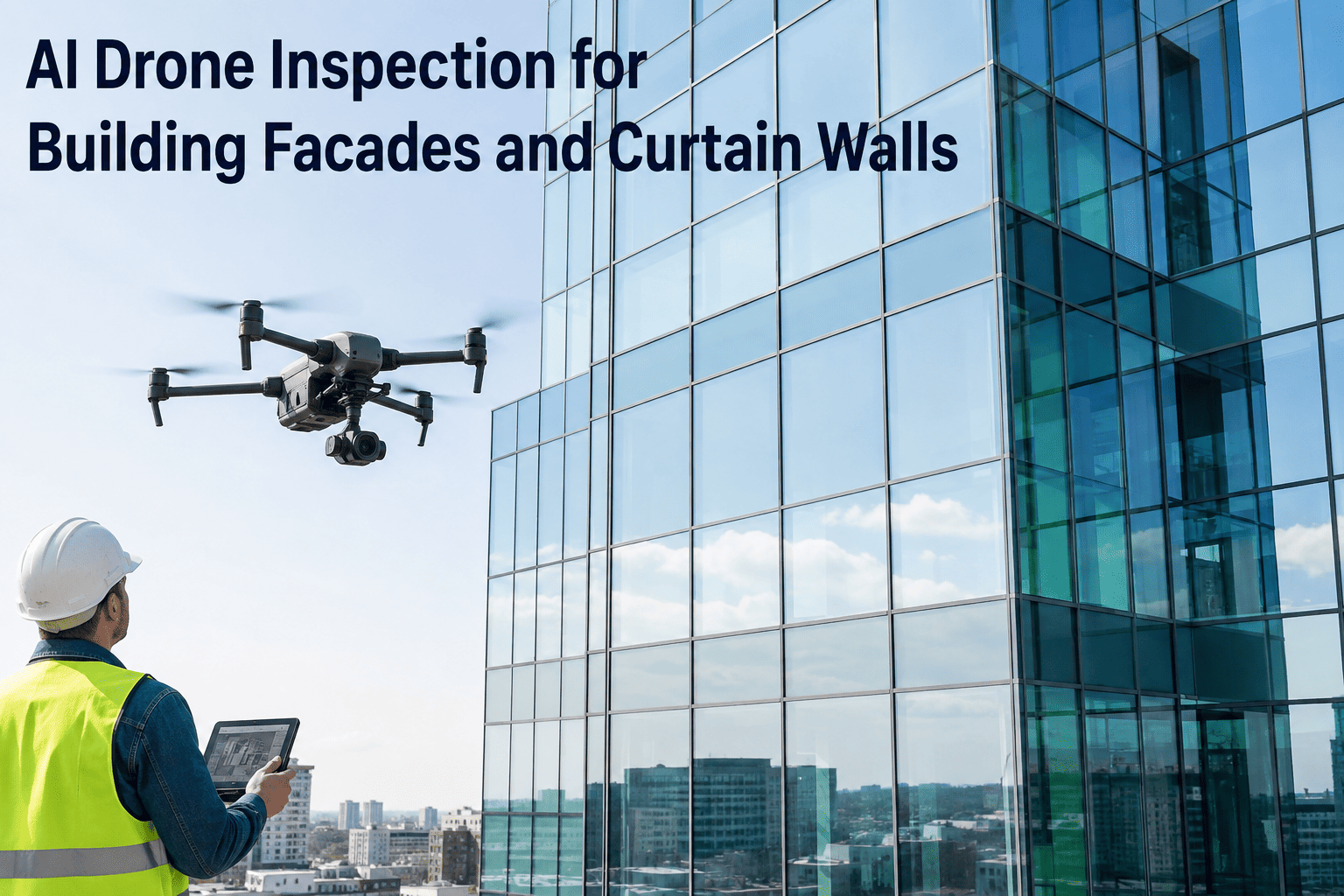
AI Drone Inspection for Building Facades and Curtain Walls
Detect cracked panels, failed sealant joints, and water staining across the entire building envelope in hours — not weeks — without swing stage scaffolding, rope access, or a single worker at height. Every elevation, every panel, every defect classified and mapped to a 3D digital twin the same day the drone lands.
3–6 wks
Swing stage rigging + inspection
2–4 hrs
Drone flight, full envelope
60–80%
Cost reduction vs traditional access
95%
AI defect detection accuracy
The Scaffolding Tax
Why Traditional Facade Inspection Costs What It Costs
Every commercial property owner has felt the same sticker shock: the swing stage line item on a facade inspection budget is often larger than every other line item combined. Scaffold subcontractors typically account for twenty to fifty percent of the total project cost before an engineer looks at a single brick. Add sidewalk shed permits, traffic management plans, tenant notifications, and the weeks of downtime for rigging setup, and the "cost of inspection" balloons into a number that has almost nothing to do with the inspection itself and almost everything to do with the physical logistics of getting a human safely to the facade.
That cost has been the default for so long that most portfolio managers stopped questioning it. But the underlying economics have shifted. Traditional access methods cost anywhere from fifteen to forty dollars per square foot for scaffolding, or between fifteen hundred and five thousand dollars per day for rope access teams, or five hundred to two thousand dollars per day for aerial lifts. Across a mid-rise inspection, those numbers stack into tens of thousands of dollars. A full four-facade inspection of a ten to twenty story building using scaffold access can run twenty thousand to over one hundred thousand dollars. Meanwhile a drone captures the same surfaces in two to four hours for three to ten thousand dollars total.
The safety math is even more lopsided. Falls from height remain the leading cause of construction fatalities in the United States, and facade inspection almost universally triggers OSHA fall protection thresholds. Every scaffold erection, every swing stage drop, every rope access descent is a controlled but real exposure. A drone flight replaces that exposure with a pilot standing on the ground with a controller. When the risk register meets the cost register, the case for AI drone inspection stops being a technology conversation and becomes an operations decision.
What The AI Actually Sees
The Defect Library — Every Failure Mode The Envelope Actually Suffers
Modern envelope AI is trained on tens of thousands of annotated defect images across concrete, glass, metal, stone, and composite facade systems. The model doesn't hunt for a single defect type — it classifies every anomaly it sees against a full failure taxonomy and assigns severity. These are the eight defect categories that account for the overwhelming majority of envelope failures the AI catches on production flights.
01
Cracked Panels & Spalling
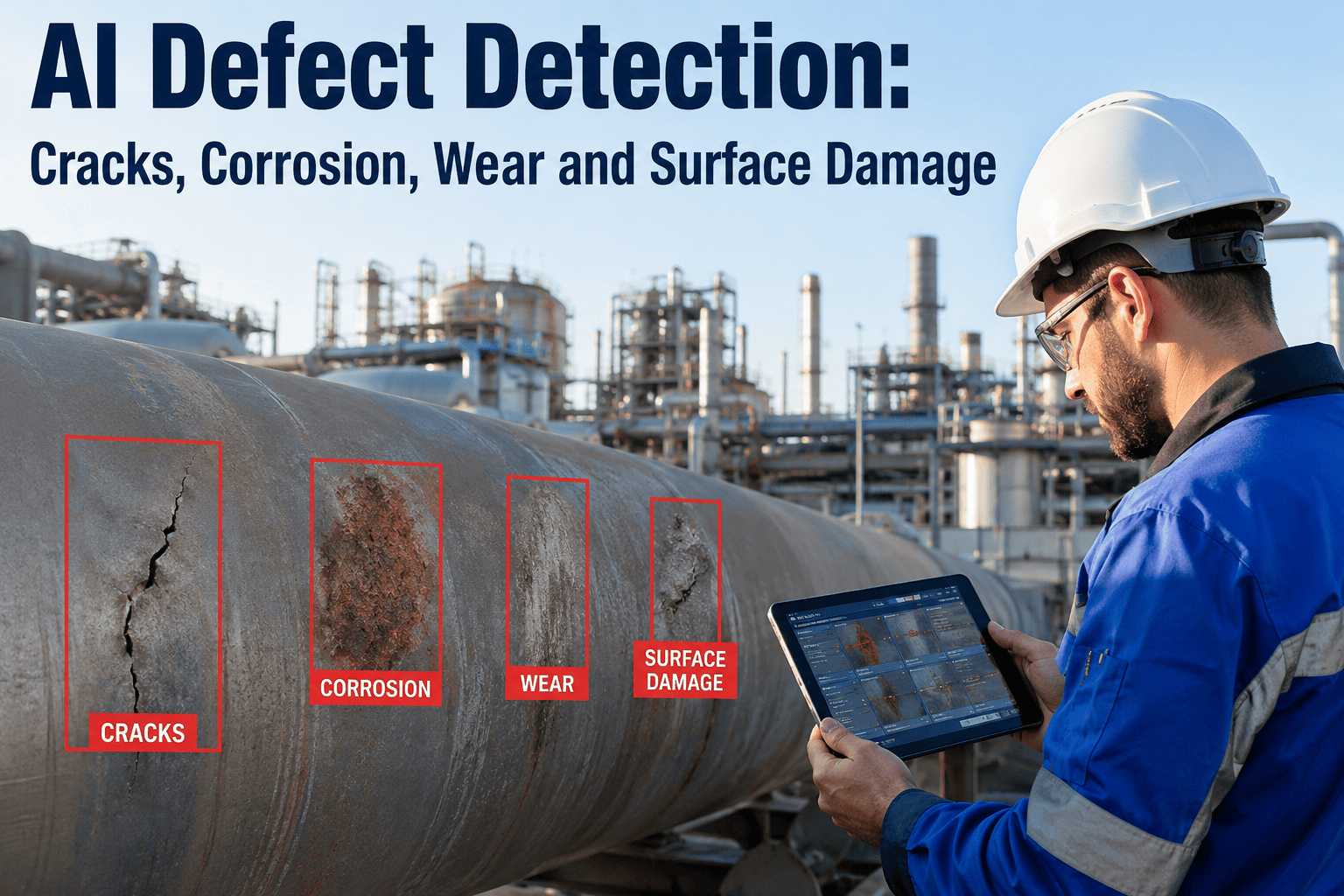
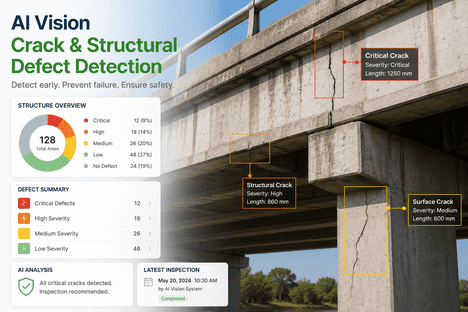
Hairline cracks in concrete spandrels, cracked stone cladding, spalled brick corners, and delaminated GFRC panels. AI segmentation distinguishes structural cracks from thermal cracks by pattern, orientation, and width progression across the panel.
02
Failed Sealant Joints
Perimeter sealant pulling away from mullions, cohesive failure inside the joint, adhesive failure at the substrate interface, and complete gaps at panel intersections. The primary water infiltration pathway on curtain wall — and the highest-value defect for AI to catch early.
03
Water Staining & Efflorescence
Water trails on spandrel panels, efflorescence on masonry indicating moisture migration through the wall, and rust staining from embedded metals leaching outward. All three are surface signals of subsurface water pathways that need mapping.
04
Curtain Wall Gasket Deterioration
EPDM and silicone gaskets hardening, shrinking, or pulling out of the glazing pocket. The defect that turns a rain-tight curtain wall into a leaking one — often invisible from ground level and only detectable with high-resolution close approach the drone can deliver.
05
Mortar Joint Deterioration
Eroded mortar in brick and stone facades, missing pointing, and step cracks tracking mortar failure across multiple courses. Trended over time, joint condition drives the tuckpointing scope and budget for the next capital cycle.
06
Panel Movement & Buckling
Curtain wall panels displaced from plane, bowed metal cladding, and stone displacement at anchor points. Photogrammetric analysis quantifies the displacement in millimeters and flags panels approaching anchor stress limits before failure.
07
Thermal Anomalies & Air Infiltration
Thermal imaging identifies air leakage at window perimeters, insulation voids behind cladding, moisture trapped in wall assemblies, and EIFS delamination — none of which are visible in the RGB camera pass. The thermal layer is where energy loss and hidden moisture live.
08
Corrosion & Rust Patches
Metal cladding corrosion, rusted lintels behind masonry, and embedded steel reinforcement showing through spalled concrete. Corrosion trending predicts when structural intervention crosses from cosmetic to load-bearing intervention.
The Flight-to-Report Pipeline
From Drone Takeoff to Actionable Defect Map — The Six-Stage Workflow
The value of an AI drone inspection isn't the drone itself — it's the pipeline that turns raw imagery into a decision-ready defect map with severity classification, location coordinates, and repair prioritization. Every stage below is what actually happens between the moment the drone lifts off and the moment the property manager opens the report.
Stage 1
Pre-Flight Planning & Airspace Coordination
Building geometry loaded from architectural drawings or 3D scan, flight paths auto-generated for full envelope coverage with overlap for photogrammetry, airspace authorization filed under Part 107 or equivalent, and site-specific safety plan issued to the ground team.
→
Stage 2
Autonomous Multi-Spectrum Data Capture
Drone flies pre-programmed grid pattern at consistent standoff distance, capturing high-resolution RGB imagery and thermal imagery simultaneously. Every image is GPS-tagged and time-stamped, producing thousands of overlapping frames per elevation.
→
Stage 3
Photogrammetric Reconstruction to 3D Digital Twin
Overlapping images processed into a geometrically accurate 3D model of the full building envelope. Orthomosaic facade maps produced for each elevation — unrolled, scaled representations where any defect can be measured in real units.
→
Stage 4
AI Defect Segmentation & Classification
Deep learning model runs across every image, segmenting each pixel into defect classes — crack, spalling, sealant failure, staining, corrosion, thermal anomaly. Severity assigned per detection based on size, propagation pattern, and adjacent defect density.
→
Stage 5
Digital Twin Overlay & Report Generation
Every classified defect pinned to its 3D coordinate on the digital twin. Engineer reviews AI classifications, confirms severity, and issues the certified inspection report — with defect counts by elevation, priority ranking, and recommended repair scope per zone.
→
Stage 6
CMMS Work Order Routing & Historical Trending
Priority defects routed as structured work orders into the maintenance system with photos, coordinates, and repair scope attached. Every subsequent inspection compares against the historical twin — enabling propagation trending and predictive capital planning.
See The Defect Map On Your Building
Watch AI Drone Inspection Run Against A Real 22-Story Curtain Wall
Book a walkthrough with iFactory's drone engineering team and see live defect classification on real high-rise footage — sealant failure detection, thermal anomaly overlay, cracked panel segmentation, and automatic CMMS work order generation with digital twin coordinates.
Traditional Access vs AI Drone Inspection
A Direct Line-by-Line Comparison Across Every Dimension That Matters
The choice between traditional facade access and AI drone inspection isn't just a cost question — it's a data quality question, a safety question, a schedule question, and a portfolio scalability question. The table below is the side-by-side that portfolio managers and building engineers actually run when they make the switch.
| Dimension |
Traditional Swing Stage / Rope Access |
AI Drone Inspection |
| Time to Complete Full Envelope |
3–6 weeks including rigging |
2–4 hours flight time |
| Cost per Mid-Rise Building |
$20,000–$100,000+ scaffold access |
$3,000–$10,000 full inspection |
| Envelope Coverage |
Selective sampling by accessibility |
100% every elevation, every panel |
| Worker Fall Exposure |
Every inspector at height, all days |
Zero — pilot stays on the ground |
| Data Output |
Written notes, hand sketches, spot photos |
3D digital twin, orthomosaic, AI defect map |
| Defect Detection Consistency |
Inspector-dependent, fatigue over shift |
Constant sensitivity across all imagery |
| Tenant Disruption |
Weeks of scaffold, sidewalk sheds, noise |
Hours of drone flight, minimal footprint |
| Historical Comparison |
Qualitative — "worse than last cycle" |
Quantitative — mm-level defect growth |
| Permits & Approvals |
Sidewalk shed, traffic, scaffold permits |
Part 107 authorization only |
| Portfolio Scalability |
Linear labor scaling per building |
Central platform, marginal cost per building |
The gap in every row compounds. A building surveyor doesn't just save money on one inspection — they save weeks of schedule, they get better data, they eliminate a fall exposure, and they build a longitudinal record of the envelope that supports capital planning across cycles. That's the difference between running facade inspection as a compliance chore and running it as a portfolio asset management discipline.
Regulatory Compliance
FISP, Chicago Ordinance, and the Global Mandatory Facade Inspection Landscape
Most portfolio managers first encounter facade inspection because a jurisdiction requires it. The mandatory programs share a core structure — periodic exterior inspection of buildings above a height threshold, engineer certification, and enforcement penalties for missed cycles — but the specifics vary by city. AI drone inspection is increasingly accepted as the primary data-gathering method under these programs, with a licensed engineer certifying the final report.
NYC
Local Law 11 / FISP
New York City's Facade Inspection Safety Program requires facade inspection every five years for buildings over six stories. NYC Department of Buildings has issued guidance accepting drone-collected data as part of FISP inspections, with a licensed professional engineer certifying results.
CHI
Chicago Facade Ordinance
Chicago requires exterior wall inspections on a rolling cycle for buildings over 80 feet or five stories in height. Critical exam and ongoing inspection reports are submitted to the Department of Buildings — a workload well suited to drone-based data capture.
TOR
Toronto Property Standards
Toronto's Property Standards Bylaw requires ongoing facade maintenance and inspection for buildings above defined height thresholds. Drone-collected imagery supports engineer-directed review for compliance documentation across the portfolio.
HK
Mandatory Building Inspection Scheme
Hong Kong's Buildings Ordinance and Mandatory Building Inspection Scheme require periodic facade inspection for private buildings over 30 years old. Drone inspection compliant with Civil Aviation Department rules is a standard approach across the high-rise skyline.
BOS
Boston Exterior Wall Inspection
Boston requires periodic exterior wall inspections for buildings over 70 feet or seven stories, with reports filed to the Inspectional Services Department. Drone-based data collection accelerates the survey while engineer certification preserves the compliance chain.
GLB
Global Trend Toward Drone Acceptance
Building code authorities across North America, Europe, and Asia are updating guidance to explicitly accept drone-collected data as part of mandated facade assessment programs — recognizing that drone coverage often exceeds what scaffold access practically delivers.
The Numbers Behind The Case
Where AI Drone Inspection Actually Pays Back — Line by Line
The ROI on AI drone inspection compounds across four distinct categories, and each one delivers value the moment the first flight replaces the first scaffold. The stack below is how portfolio managers actually model the case internally when they take the switch to their finance committee.
Category 1
Direct Access Cost Elimination
The most visible saving: swing stage rigging, rope access day rates, aerial lift rentals, and scaffold subcontractor fees disappear from the line item. On a full mid-rise inspection, this alone typically drives sixty to eighty percent cost reduction against the traditional access baseline.
Category 2
Schedule Compression & Tenant Impact
Three to six weeks of rigging and inspection collapses to two to four hours of drone flight plus a few days of AI processing. That's weeks of sidewalk sheds, tenant complaints, and street closures avoided per inspection cycle — often worth as much as the direct cost savings in retail-adjacent properties.
Category 3
Predictive Repair Cost Avoidance
The AI catches sealant failure and thermal anomalies months before they cascade into interior water damage. A prevented curtain wall leak typically avoids a hundred and fifty thousand dollars or more in interior reconstruction, mold remediation, and tenant claims — value that never shows up in traditional inspection reports.
Category 4
Liability & Insurance Exposure Reduction
Zero workers at height means zero fall exposure across the inspection cycle. Insurance premiums for property owners running drone-first inspection programs increasingly reflect the reduced workers' comp and general liability risk profile, particularly on high-rise portfolios.
Deployment Timeline
From Pilot Building to Portfolio Rollout — What The First 90 Days Actually Look Like
A common portfolio manager question is how long between the decision to adopt drone inspection and the first certified compliance report in hand. The honest answer is faster than most stakeholders assume, because the drone pipeline compresses the schedule that scaffold-based inspection stretched across weeks.
Week 1–2
Portfolio Assessment & Pilot Building Selection
iFactory's team reviews the portfolio, identifies pilot building candidates based on regulatory cycle timing and geometry complexity, and produces a deployment plan covering airspace considerations, sensor selection, and CMMS integration architecture.
Week 3–4
First Flight & Baseline Digital Twin
Pilot building flown, imagery processed into a 3D digital twin, and the AI defect library run against the baseline. The engineering review team validates classifications and issues the first certified inspection report on the pilot property.
Week 5–8
CMMS Integration & Workflow Configuration
Defect classifications wired into the property management system's work order routing. Severity thresholds calibrated to portfolio standards. Historical defect data uploaded where available, establishing the trending baseline for future cycles.
Week 9–12
Portfolio Rollout & Rolling Inspection Cycle
Remaining portfolio buildings sequenced by regulatory cycle priority. Each subsequent flight benefits from the platform's growing training data — accuracy improves, false positive rate drops, and portfolio-level trend analytics come online across all buildings.
Field Perspective
"
The framing I use with property owners is that traditional facade inspection was never really about the inspection — it was about paying for the access to do the inspection. The engineer's actual work of looking at the facade, classifying defects, and recommending repairs is a small fraction of the total invoice. Everything else is rigging, permits, sidewalk sheds, and tenant management overhead. What drone inspection does is strip that overhead down to almost nothing, so the money that used to fund scaffold subcontractors now funds better data, better AI, and better repair prioritization. The other thing owners consistently underestimate is coverage. A scaffold inspection samples the facade — the inspector looks at what they can reach and infers the rest. A drone inspection captures the entire envelope at high resolution, every panel, every joint, every elevation. When we run the AI defect library against that coverage, we routinely find two to three times more defects than the scaffold-based inspection did on the same building — not because the AI is inventing defects, but because a scaffold inspection physically couldn't reach that many square feet. Once portfolio managers see their own building's defect map for the first time, the conversation stops being about whether to adopt drone inspection and starts being about how fast they can roll it across the rest of the portfolio.
Rasheed Aldana-Whitcomb
Building Envelope Consultant · 19 years in facade inspection engineering, drone program deployment, and high-rise capital planning across North America
Common Questions
Frequently Asked Questions
Does AI drone inspection satisfy FISP, Chicago, and other mandatory facade inspection programs?
Yes, with the understanding that a licensed professional engineer must still certify the final inspection report under every major mandatory program. AI drone inspection handles the data collection and defect classification layer, dramatically expanding coverage and reducing cost, while the engineer of record reviews classifications, validates severity, and issues the certified report to the jurisdiction. NYC Department of Buildings has issued explicit guidance accepting drone-collected data under FISP, and other cities are following the same pattern. The engineering certification chain stays intact — drone inspection strengthens it by providing better underlying data.
Talk to drone engineering about the specific program requirements in your jurisdiction.
How accurate is AI defect detection compared to a human inspector's eye?
Well-trained modern envelope AI models operate at ninety-five percent detection accuracy or higher across common defect categories, with F1 scores in the ninety to ninety-five percent range on validation datasets. In many cases the AI actually outperforms the human inspector because it covers one hundred percent of the envelope at consistent sensitivity, while a human inspector fatigues, sees only what the scaffold reaches, and applies inconsistent severity judgment across a multi-day scope. That said, the AI's role isn't to replace the engineer — it's to feed the engineer a comprehensive, pre-classified defect map so the engineer's attention goes to judgment calls on severity and repair scope rather than to hunting for defects one at a time. The two-layer model consistently outperforms either alone.
Can drone inspection work on complex facade geometries — setbacks, atriums, courtyards, and heavily articulated elevations?
Yes, and this is actually where drone inspection outperforms traditional access most dramatically. Scaffold rigging on complex geometries is exponentially more expensive and time-consuming than on simple rectangular facades, because every setback requires a separate rigging plan, every atrium requires interior access, and every articulated corner adds days to the schedule. A drone captures all of those surfaces on the same flight at the same standoff distance, and photogrammetric processing reconstructs the full three-dimensional geometry regardless of how articulated the facade is. Heritage buildings, mixed-use complexes, and modern parametric designs all fit inside the same drone workflow.
Book a demo to walk through geometry-specific deployment considerations for your building.
What happens on windy days, in wet weather, or in dense urban airspace?
Modern industrial inspection drones have wind tolerance envelopes typically in the range of twenty to thirty knots depending on airframe, with published limits for precipitation and visibility. Flight planning includes weather windows scheduled against forecast conditions, and marginal weather days simply defer the flight rather than compromise data quality. In dense urban airspace, Part 107 authorization procedures cover Class B and Class C airspace operations, and controlled airspace authorizations are typically secured during the pre-flight planning phase. Cities with heavy drone inspection activity — New York, Chicago, Hong Kong — have well-established coordination procedures between operators and aviation authorities, and portfolio-scale programs benefit from standing operational agreements that streamline recurring flights.
How does the digital twin support long-term capital planning across an inspection cycle?
Every drone inspection captures a spatially accurate 3D model of the envelope pinned to real coordinates. When the next inspection cycle flies the same building, the new model overlays against the previous one — enabling literal side-by-side comparison of every defect over time. A hairline crack that measured 0.3mm two years ago and measures 0.9mm today has a documented propagation rate that supports capital planning decisions grounded in data rather than qualitative judgment. Sealant condition trended across three cycles predicts the year the full re-caulking scope becomes necessary. Corrosion progression predicts when cladding intervention crosses from cosmetic to structural. That longitudinal record is what turns facade inspection from a periodic expense into a capital planning asset — and it exists as a byproduct of the drone workflow that scaffold-based inspection could never produce.
Replace The Scaffolding Tax
Move Your Facade Inspection Program From Weeks Of Rigging To Hours Of Flight
iFactory's AI drone inspection platform is built for the specific realities of high-rise facade and curtain wall inspection — full envelope coverage, AI defect classification across the complete failure taxonomy, engineer-certified compliance reporting for FISP and equivalent programs, and CMMS-integrated work order routing. Every flight builds the historical twin that turns compliance inspection into capital planning intelligence.