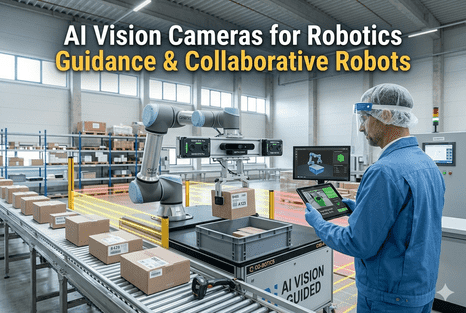
Loose parts in a bin have always been the task automation could not touch. A robot can be taught to repeat a motion with perfect precision, but a bin of randomly oriented, overlapping parts changes every time one is removed — which is exactly why this specific task stayed manual long after everything around it on the line was automated. That is now changing. The global bin picking system market has reached $3.2 billion in 2026 and is growing at roughly 12.5% annually, and the reason is simple: AI vision has finally made random part handling reliable enough to trust at production speed.
Robotic Guidance · AI Vision
The Automation Bottleneck Was Never the Robot. It Was the Bin.
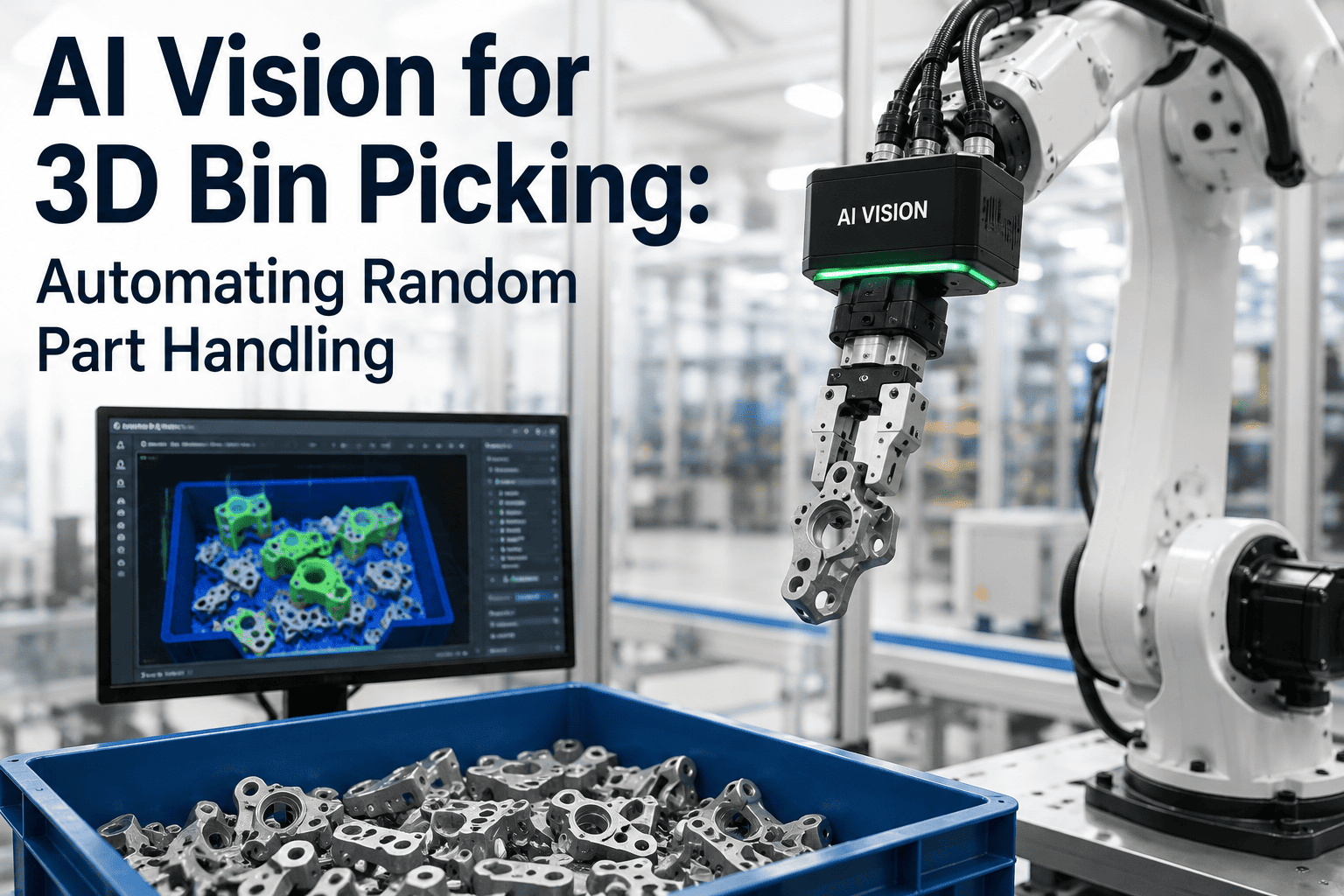
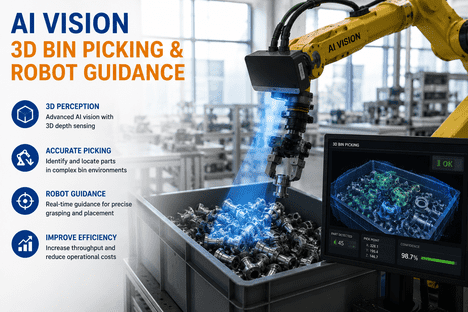
3D cameras with AI locate randomly oriented parts in a bin, calculate a collision-free grasp pose, and guide the robot arm to pick — with no fixture, no bowl feeder, and no fixed part orientation required.
The Market Is Moving Fast
Why Bin Picking Is Suddenly Everywhere in Automation Budgets
Bin picking sat on the "someday" list for automation planners for years, held back by a technology gap: 3D vision and AI processing were not fast or reliable enough to trust with production throughput. That gap has closed. The figures below show a market moving from experimental pilots to mainstream deployment across automotive, electronics, and logistics operations, with growth outpacing most other categories of industrial robotics investment.
$3.2B
Global bin picking system market value in 2026
12.5%
Annual growth rate (CAGR) projected for the category
52%
Share of the market held by 3D-specific bin picking systems
44%
Automotive's share of bin picking deployments, the largest single industry
±1–3mm
Typical positional accuracy of vision-guided bin picking at production speed
<0.5 sec
Time for an industrial 3D camera to capture a full point cloud of bin contents
Why This Task Resisted Automation for So Long
Fixtures Solve One Problem and Create Three More
Traditional robotic pick-and-place depends on knowing exactly where a part will be before the robot arrives. That certainty comes from fixtures, vibratory bowl feeders, and trays loaded in a strict sequence — a whole chain of upstream equipment whose only job is to force a random part into a known position so a robot programmed for that one position can find it. It works, but every part of that chain is also a point of fragility, and the more steps in the chain, the more places a single misalignment can bring the whole cell to a stop.
When a part arrives slightly differently, when a bin loads off-center, or when a new part variant enters the mix, the fixture-dependent system stops and waits for a person to fix it. This is the real cost of fixture-based automation that rarely shows up on the original quote: not the fixture itself, but the ongoing labor of babysitting a system that cannot adapt to anything it was not explicitly built for. Every product revision, every new supplier, every model year change becomes a mechanical re-engineering project rather than a software update.
Random In, Precise Out
Let the Robot See the Bin Instead of Memorizing It
iFactory's AI vision platform captures a full 3D point cloud of bin contents, locates every part regardless of orientation, and guides the robot arm to a collision-free grasp — no fixture, no bowl feeder, no reprogramming when the part changes.
The Real Comparison
Manual Picking, Fixture-Based Automation, and AI Vision Bin Picking
Most facilities evaluating bin picking are really choosing between three approaches, not two. Laid out side by side, the trade-offs are clearer than any single vendor's pitch will show.
| Factor | Manual Picking | Fixture-Based Automation | AI Vision Bin Picking |
| Handles random part orientation |
Yes, inherently |
No — requires fixed presentation |
Yes, by design |
| Cost driver |
Ongoing labor, roughly 55–65% of total operating cost in comparable material handling roles |
Fixture and feeder engineering, rebuilt on every part change |
One-time vision and integration cost, model retraining on part change |
| Response to a new part variant |
Immediate, human adapts naturally |
New fixture or feeder required |
Days of model retraining, no new hardware |
| Error rate |
Up to 4% in comparable manual picking tasks |
Low, but brittle when conditions shift |
Consistently low with post-pick verification |
| Availability |
Limited by shifts and fatigue |
24/7 within fixture tolerance |
24/7, adaptive to bin condition changes |
The Labor Math Behind the Decision
What Manual Bin Picking Actually Costs Once You Add It Up
Labor is the largest single cost in most material handling operations, and bin picking is one of the most repetitive, fatigue-prone tasks within it. The figures below are why so many operations finance a vision-guided robot cell against the labor line rather than treating it as a discretionary technology purchase.
Labor's share of total warehouse operating cost
Fully loaded cost multiplier over base hourly wage
Manual picking error rate in comparable tasks
Typical automated picking accuracy rate
How the Robot Actually Sees the Bin
From Loose Parts to a Precise Grasp, in Four Steps
The technology behind fixtureless bin picking is not a single camera trick — it is a short pipeline that turns a messy pile of parts into an exact instruction the robot controller can execute within its cycle time.
01
3D Point Cloud Capture
A 3D camera captures depth data for every visible surface in the bin, revealing part positions and orientations invisible to a standard 2D camera.
02
AI Part Detection and Pose Estimation
A deep learning model locates every instance of the target part in the point cloud and estimates its full position and orientation in three-dimensional space.
03
Collision-Free Grasp Planning
Pick candidates are ranked by grasp quality and collision risk against the bin walls and neighboring parts, so the robot always targets the safest accessible pick.
04
Robot Guidance and Verification
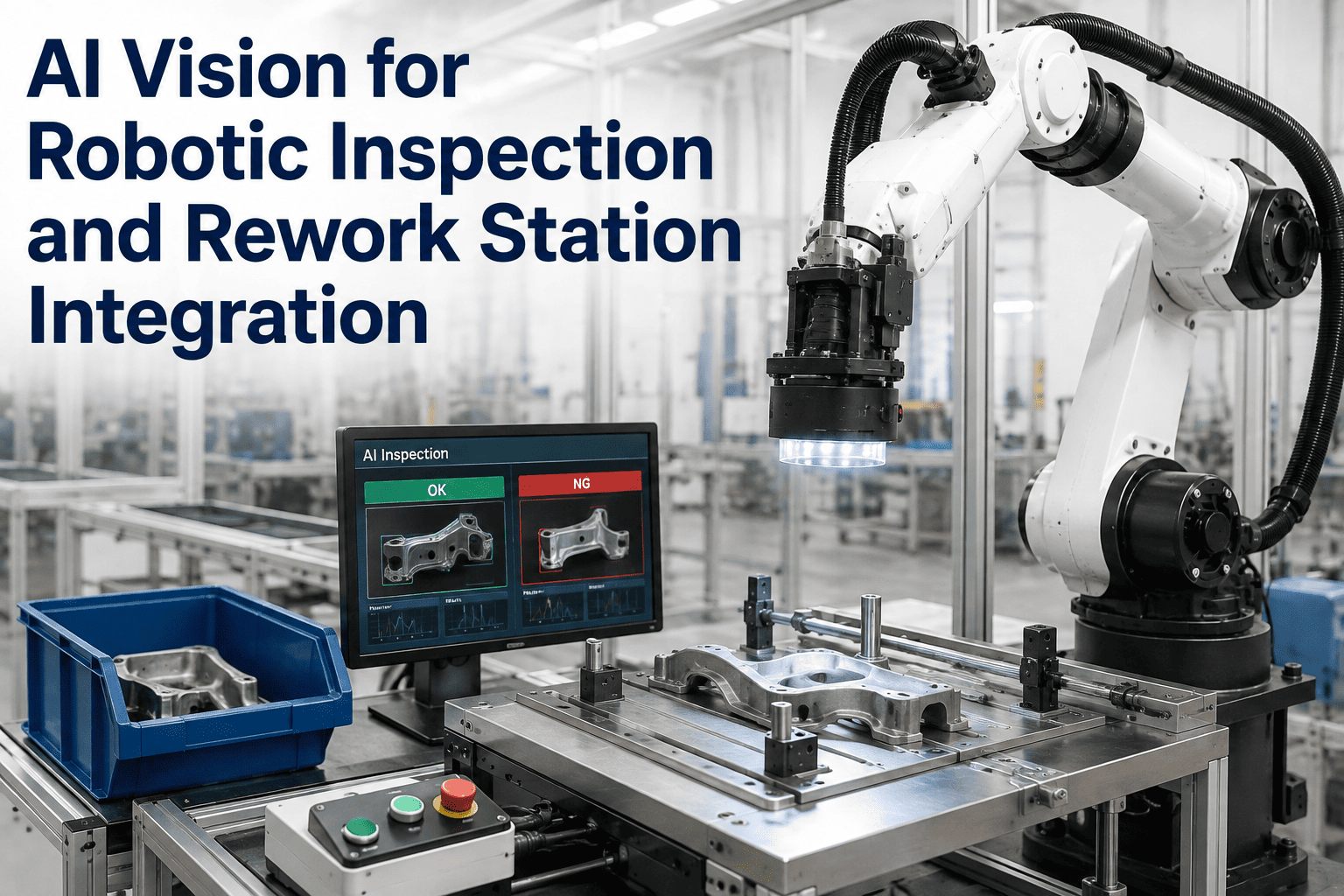
The highest-ranked grasp pose is sent to the robot controller, and a post-pick check confirms the correct part was retrieved before the cycle repeats.
What Changes on the Floor
Four Handling Tasks That Look Different Once the Robot Can See
The value of AI vision bin picking is easiest to see in specific handling tasks that have historically depended on manual labor or rigid fixturing. Each example below is a real production application, not a hypothetical.
Machine loading
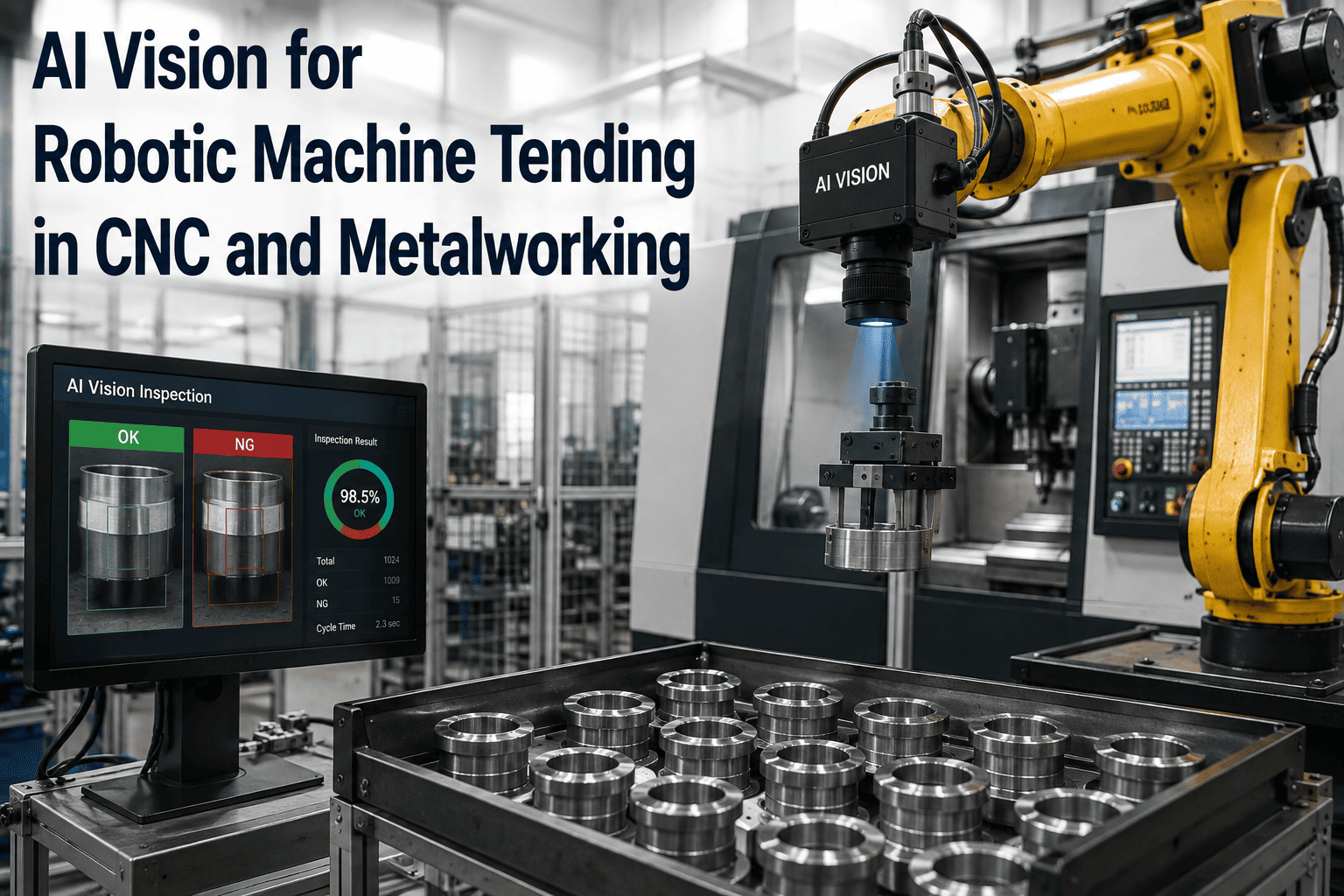
A CNC, press, or injection molding machine that once needed a person to load a raw part every cycle can be fed directly from a bin, with the robot picking, orienting, and placing the part into the fixture.
Depalletizing
Mixed or layered pallets of boxes and parts, previously unloaded by hand, can be processed with layer detection and pick-sequence planning that adapts as the pallet height changes.
Assembly feeding
Parts that must be presented in a specific orientation for downstream assembly get verified before placement, catching upside-down or wrong-orientation parts before they reach the next station.
Order kitting
Mixed-SKU bins in aftermarket, spare parts, or e-commerce fulfillment can be picked by specific part identity and quantity, rather than requiring pre-sorted single-SKU bins.
Where This Delivers the Fastest Payback
Operations Where Random Part Handling Is a Daily Bottleneck
Bin picking earns its cost fastest in operations where manual handling is either a scarce labor resource, a repetitive strain risk, or a hard cap on how fast a line can run — and where the part mix changes often enough that fixture-based automation would need constant rebuilding. The common thread across all four categories below is not industry, but the shape of the handling problem itself.
Automotive Component Handling
The largest single application category, covering engine components, body parts, and assembly feeding where part mix and volume both run high.
Electronics Assembly
Small, high-value parts that are difficult and slow to feed manually benefit from the sub-millimeter accuracy AI vision guidance delivers.
Logistics and E-Commerce Fulfillment
Rising order volumes and persistent warehouse labor turnover make random-item picking one of the highest-value automation targets in the sector.
High-Mix, Low-Volume Manufacturing
Facilities running many part numbers through shared handling cells avoid the constant fixture rebuilds that high-mix production otherwise demands.
Common Questions
Frequently Asked Questions
How is AI vision bin picking different from the vision-guided robots we already use for fixed positions?
Fixed-position vision guidance confirms that a part is in an expected location and makes small position corrections — it still depends on a fixture or feeder to present the part in a known general area. AI vision bin picking removes that dependency entirely, locating parts anywhere within a loosely filled bin regardless of how they landed there, and calculating a full six-degree-of-freedom grasp pose rather than a small correction to an assumed position. The two technologies solve related but fundamentally different problems, and many facilities run both — fixed-position guidance for high-volume single-part stations, and bin picking for the mixed, high-variability handling tasks that fixtures could never keep up with.
What pick accuracy and success rate can we realistically expect in production?
Vision-guided bin picking typically achieves positional accuracy in the ±1 to 3 millimeter range, which is precise enough for most industrial gripping and placement tasks. Pick success rates depend heavily on part geometry, surface finish, and bin fill level, but well-configured systems targeting a single part type commonly reach a high, production-grade success rate under standard operating conditions, with failed picks handled automatically by advancing to the next-ranked grasp candidate rather than stopping the cell.
Does switching to a new part number require rebuilding the whole system?
No — this is the core advantage over fixture-based automation. A new part number requires the AI detection model to be trained on the new part's geometry, typically using a combination of CAD-derived synthetic data and real scan samples, which takes a matter of days rather than the weeks a new bowl feeder or fixture redesign would require. No new mechanical hardware needs to be built for a routine part change.
Can this handle reflective or dark metal parts that are known to be difficult for 3D cameras?
Reflective and low-texture surfaces are genuinely the hardest condition for 3D vision, since they can produce noisy or sparse depth data. Camera technology choice and lighting configuration make a significant difference here, and a feasibility assessment on the specific part's surface properties is the right first step before committing to a deployment.
Support can evaluate a specific part's surface characteristics before any hardware commitment is made.
What does a typical deployment timeline look like from decision to production?
Deployment generally moves through feasibility assessment, AI model training on the target parts, robot cell integration and calibration, and a production validation period — a sequence measured in weeks rather than the months a comparable fixture-based automation project typically requires, since there is no custom mechanical tooling to design and build.
Book a demo to scope a realistic timeline against a specific part and robot cell.
Stop Building Fixtures for Parts That Keep Changing
Give the Robot Eyes Instead of a Blueprint
iFactory's AI vision platform guides robots to pick randomly oriented parts directly from a bin — no fixtures, no bowl feeders, and no rebuild every time the part mix changes.