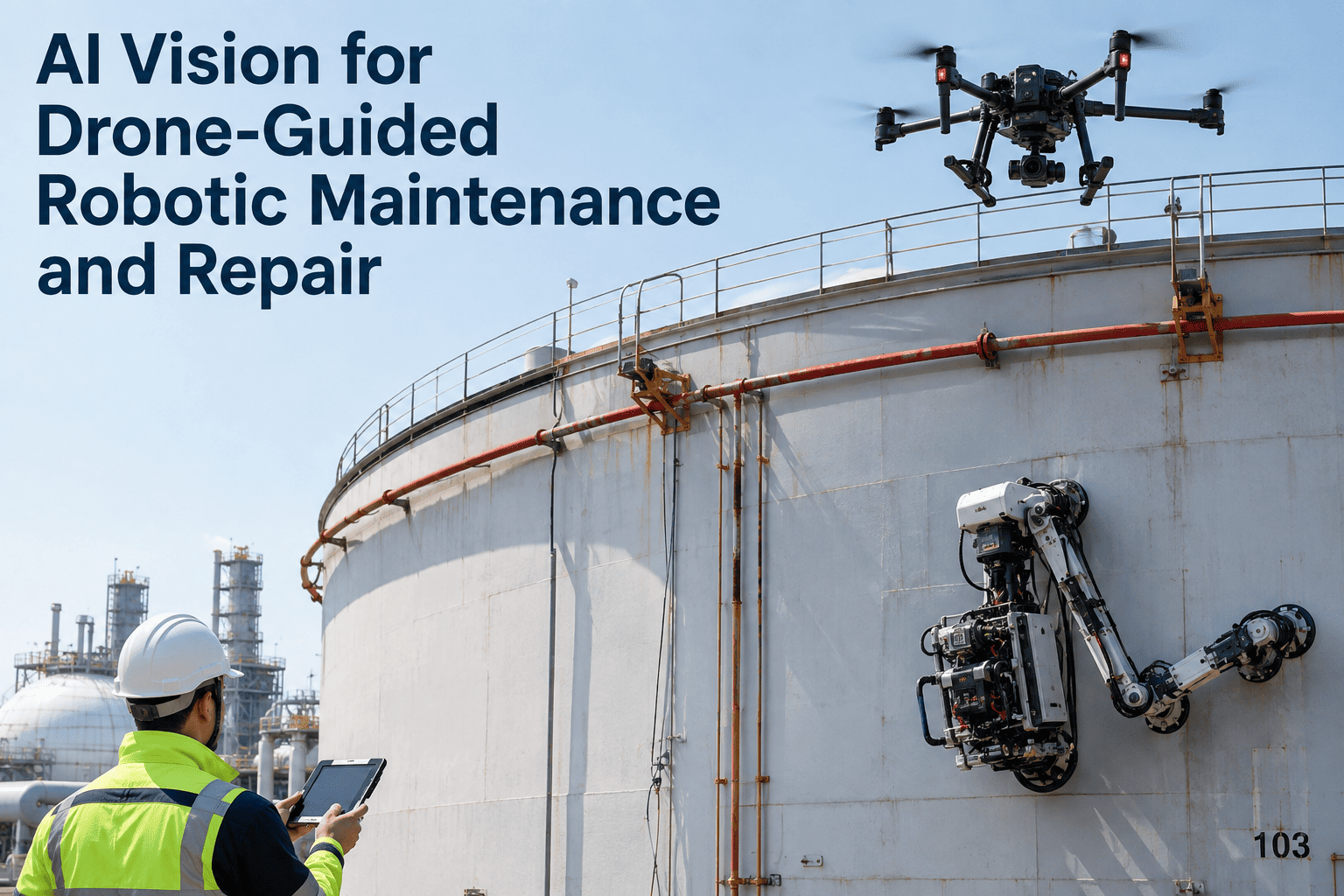
A wind turbine blade with a hairline crack does not care that a technician is 90 meters below it in a harness, or that the nearest rope-access crew is booked out for six weeks. The crack keeps propagating. The old maintenance model — inspect, schedule, climb, repair — breaks down the moment you scale it to hundreds of turbines, thousand-foot bridge spans, or ship hulls the size of a football field. Drone-guided robotic maintenance rewires that entire loop. A drone with AI vision finds and pinpoints the defect, calculates its 3D coordinates against the structure, then hands off those exact coordinates to a repair robot — magnetic crawler, delta manipulator, welding rover — that goes directly to the damage and fixes it. No re-inspection, no coordinate guesswork, no humans in the fall zone. To see how this coordination layer runs on your own asset data, visit the iFactory support team.
Robotic Guidance · AI Vision Systems
Drones That Find the Damage. Robots That Fix It. One Coordinate System.
AI vision cameras on autonomous drones map every crack, corrosion patch, and weld defect on turbines, bridges, and ships — then guide maintenance robots to the exact millimeter for repair, without a single climb.
65%
Cut in inspection cost
70%
Less high-risk site time
0.1mm
Crack localization error
50%
Shift to predictive work
The Coordination Gap
Inspection Drones Have Existed for Years. Why Are Humans Still Doing the Repairs?
Drone inspection is a solved problem. High-resolution cameras, thermal imaging, and AI defect classifiers have been reading cracks off wind turbine blades and bridge girders since 2018. What has not been solved — until recently — is the coordination layer between what the drone sees and what a robot actually does with that information. A crack image with a bounding box is useless to a repair manipulator unless it comes with 3D coordinates in the structure's frame of reference, the surface normal, the depth profile, and a confidence score. That is the gap AI vision now closes.
The regulatory environment has also finally caught up with the technology. In 2025 the FAA was directed to formalize rules enabling routine beyond-visual-line-of-sight drone missions, which is the single change that unlocks large-asset autonomous inspection at scale. Long linear corridors — power lines, pipelines, bridge networks — become viable for coordinated drone-robot programs rather than being permanently gated behind waiver applications. Market analysts now expect billions of dollars in maintenance spend to shift toward autonomous solutions before the end of the decade, and the operators moving first are the ones defining what "normal" looks like for their competitors two years from now.
Old Loop
Detect. Report. Wait.
- Drone captures images and generates a defect report
- Report goes to engineering for review and prioritization
- Rope-access team scheduled, sometimes weeks out
- Technician re-inspects the defect on-site to confirm location
- Manual repair performed with technician judgment on positioning
- Follow-up drone flight verifies the repair
Replaced by
Coordinated Loop
Detect. Localize. Deploy Robot.
- Drone captures images and AI localizes defects in 3D structure frame
- Coordinates, surface geometry, and repair type auto-generated
- Repair robot receives coordinates and mission plan directly
- Robot navigates to defect using drone-provided guidance
- Repair executed with sub-millimeter positioning accuracy
- Same drone verifies the repair before it leaves the site
The Vision-to-Robot Stack
What Actually Runs Between the Drone Camera and the Repair Head
Four layers sit between a pixel showing a crack and a robot depositing sealant on it. Each one has to be reliable, or the whole handoff breaks down. Here is what happens in the seconds between detection and repair.
01
Aerial Capture and Defect Detection
The drone flies a pre-planned mission around the asset, capturing 64MP RGB frames plus thermal imagery. Deep learning models trained on defect libraries classify each finding — crack, delamination, corrosion, erosion, hotspot — with a severity score. Nothing about this step is new; the accuracy is what has changed.
02
3D Localization to the Asset Frame
Every detected defect is mapped from the drone image back onto a 3D model of the structure using photogrammetry and LiDAR fusion. The output is not just "crack on blade three" — it is a coordinate, a surface normal vector, and a depth estimate. Recent research has demonstrated geometric error under 0.1mm from ground truth using LiDAR-camera fusion.
03
Repair Mission Planning
The system decides which robot handles which defect — a magnetic crawler for a steel girder, a delta manipulator for a concrete crack, an aerial platform for a hard-to-reach spar. Each defect gets a mission plan: approach path, repair method, material volume, safe retreat route. Priority is set by severity and access difficulty.
04
Robot Execution and Verification
The repair robot receives its mission and navigates to the defect. In many deployments the same drone stays airborne as a real-time positioning reference, correcting the robot's approach if it drifts. Once the repair is complete, the drone captures verification imagery and the AI compares before-and-after to confirm the fix.
Get Your Turbine, Bridge, or Fleet Onto a Coordinated Repair Loop
iFactory connects drone AI vision to any compatible maintenance robot, so defect coordinates become repair actions without human retyping.
Asset Playbooks
Where Drone-Guided Robots Are Already Replacing Rope Access
Three asset classes are far ahead of the rest. Each has its own drone-robot configuration, its own dominant defect types, and its own reason the old model stopped scaling. Below is how the coordinated loop is running today across wind, civil, and marine infrastructure. The pattern is remarkably consistent across all three: drones handle wide-area capture and localization, specialized robots handle physical intervention, and the coordination layer between them is the actual competitive edge. Operators who try to bolt drone data onto legacy maintenance workflows without that layer end up with better inspection reports but no meaningful change in repair throughput. Operators who close the loop see the full 40 to 65 percent cost reduction that the technology promises.
Wind Turbines
Blades That Get Bigger Every Generation
Turbine blades have grown past 100 meters, making rope access slower, more dangerous, and more expensive per inspection. Autonomous drones now capture close-range imagery of every square inch of blade surface, and AI classifies leading-edge erosion, delamination, and lightning damage on a four-level severity scale. Follow-up repair is increasingly handled by blade-crawling robots that receive defect coordinates directly from the inspection pass — no separate re-survey needed. Digital twins accumulate every inspection cycle, so predictive models flag which blades will need intervention before next season.
Bridges and Civil Structures
Girders, Decks, and Undersides Humans Cannot Reach
Steel bridges and concrete decks have always suffered from the same problem: the most critical structural points are also the least reachable. Under-deck girder inspections traditionally required snooper trucks, lane closures, and full-day operations. Drone AI now maps crack networks across an entire span in hours, and delta-manipulator aerial platforms have been demonstrated landing on cracks and depositing sealant autonomously under lab conditions. Ground rovers with magnetic feet handle steel members. The coordination layer keeps a running defect registry across inspection cycles so crack propagation is measured, not just observed.
Ships and Offshore
Hull Surfaces Larger Than a City Block
Ship hull inspection and repair has been one of the most manual domains in industrial maintenance — a mid-size cargo vessel has more surface area than an office tower. Aerial and underwater drones now split coverage above and below the waterline, and magnetic-adhesion crawler robots handle the vertical surfaces. Friction stir welding platforms have been prototyped for underwater hull repair, and reinforcement-learning-driven water-blasting robots handle corrosion cleaning. The bottleneck was never robot capability; it was getting the right coordinates to the right robot fast enough to matter.
The Numbers That Move
What Actually Changes on the Cost and Safety Side
The pitch for drone-guided robotic maintenance is not "cool robots." It is measurable movement on the four numbers that show up on every asset owner's dashboard: inspection cost, time-in-fall-zone, reactive-to-predictive ratio, and unplanned outage frequency. This is what the data from active deployments across wind, civil, and marine assets looks like when a coordinated drone-robot loop replaces the traditional manual inspect-and-climb cycle. The ranges below reflect real deployments rather than vendor projections, and the variability inside each range mostly comes down to how mature the operator's baseline data collection was before the coordinated loop went live.
Metric
Manual Inspection + Rope Repair
Drone-Guided Robotic Loop
Inspection cost per asset
Baseline
40 to 65 percent lower
Time in high-risk zones
Full inspection window
50 to 70 percent reduction
Reactive versus predictive mix
Mostly reactive
30 to 50 percent shifted to predictive
Emergency call-outs
Baseline
20 to 35 percent fewer
Defect localization error
Visual estimate, meters
Under 0.1mm with LiDAR fusion
Coverage per shift
One turbine or one bridge span
Full site autonomously
Under the Hood
The AI Vision Models That Make the Handoff Work
The coordination layer is only as good as the perception stack feeding it. Three model classes do the heavy lifting between the drone camera sensor and the repair robot's approach path. Understanding what they do is useful even if you never touch the code, because it explains why some deployments hit the sub-millimeter accuracy numbers and others plateau at "roughly the right area."
A
Defect Classification Networks
Deep learning models trained on hundreds of thousands of labeled defect images. For wind turbine blades these are trained on public datasets like the DTU annotated turbine collection plus proprietary imagery from operator fleets. The model outputs a defect class, a bounding box, a severity score, and a confidence value. The confidence value is what determines whether a repair robot gets dispatched automatically or whether a human reviewer is pinged first.
B
Photogrammetry and LiDAR Fusion
Multi-view geometry combined with LiDAR point cloud data builds and maintains the 3D model of the asset. Every drone flight refines the model. Every detected defect gets projected from the 2D image back into 3D space with a surface normal, so the repair robot knows not just where to go but how to approach. This is the layer where recent research demonstrated crack localization error under 0.1mm — the accuracy that makes autonomous sealant deposition realistic rather than aspirational.
C
Mission Planners and Robot Control APIs
Once a defect is localized and prioritized, a mission planner turns it into an executable robot task: approach vector, tool head selection, material volume, retreat path, and safety envelope. The plan is dispatched over standard robot control APIs, which is what makes the system robot-agnostic. Whether you deploy blade crawlers this year and add a delta manipulator platform next year, the drone side does not change — only the mission plan output changes.
Turnkey AI Deployment
How iFactory Ships a Drone-Guided Maintenance System
A drone-to-robot coordination platform is not a piece of software you install on a laptop. It is a stack — computer vision models, edge compute, robot control APIs, and the integration work that connects them to your existing PLCs, SCADA, and CMMS. iFactory ships this as a turnkey system so your team is running missions in weeks, not quarters.
Bundle
Hardware and Software Together
Pre-configured NVIDIA AI server ships racked and ready. The AI vision stack, drone mission planner, and robot coordination layer come installed and validated on the hardware before it leaves us. Rack it, plug power and Ethernet, and the AI is live.
Integration
Everything Between the Server and the Floor
Cabling, network segmentation, PLC and SCADA integration, robot control API wiring, operator training, and 24 by 7 remote monitoring. Included in scope. If it takes an integrator week to hook up, we do it before pilot week one.
Timeline
Live in 6 to 12 Weeks
Three-phase rollout — pilot on one asset in six weeks, expand to a full site by week ten, coordinated repair loop live by week twelve. No multi-year integration project. Trusted by more than 1,000 clients with 99.9 percent uptime.
Operators
The AI Talks to Your Team
Your maintenance lead types: "Show me blade three defects over four severity." The system responds with a ranked list, coordinates, and suggested robot deployment. No PhD in computer vision required to run the mission.
Deployment Roadmap
Your First Twelve Weeks on a Drone-Guided Repair Loop
Weeks 1 to 2
Asset survey and baseline scan
Drone captures the first full-coverage inspection pass on the pilot asset. Photogrammetry generates the 3D model that becomes the coordinate frame for every subsequent mission.
Weeks 3 to 6
Pilot mission live
Repair robot integrated. First coordinated defect-to-repair loop executed under supervised control. Operator team trained on mission planner and verification workflow.
Weeks 7 to 10
Site expansion
Coverage extended to the full asset group — turbine fleet, bridge span, or hull section. Defect registry populated and predictive models start ranking future intervention windows.
Weeks 11 to 12
Autonomous operation
Coordinated repair loop running with light supervision. Predictive maintenance dashboard live for planning. Handover to internal team with continued remote support.
From the Field
What Operators Are Telling Us After the First Season
The change was not that we found more defects — our drones were already finding them. The change was that the coordinates were good enough that a repair crawler could go straight to the crack without a re-inspection climb. We collapsed a two-visit cycle into one, which sounds small until you multiply it by 60 turbines.
Wind Operations Lead, Offshore Wind Portfolio, Northern Europe
We stopped scheduling lane closures for routine bridge deck inspections. The drone maps the whole span in one flight, the crack registry updates automatically, and we only mobilize a repair robot when severity actually crosses threshold. Emergency call-outs are down noticeably in the first year.
Infrastructure Asset Manager, Regional Transport Authority
Common Questions
Drone-Guided Robotic Maintenance — Buyer Questions
How is drone-guided robotic maintenance different from a normal drone inspection service?
A standard inspection service ends at a defect report. Someone still has to translate that report into a repair job, schedule access, and send technicians to the exact location — usually with their own re-inspection to confirm. Drone-guided robotic maintenance closes that loop: defect coordinates from the drone flow directly to a repair robot as an executable mission plan, so the same site visit that identifies the defect also positions the equipment that will fix it. That is why the savings scale into the 40 to 65 percent range rather than the incremental gains you see from inspection-only drone programs.
Book a demo to see the full loop on your asset type.
What kinds of repairs can maintenance robots actually perform once the drone guides them?
The repair envelope is wider than most operators expect. Blade-crawling robots handle leading-edge erosion patching and localized coating repair on wind turbine blades. Delta-manipulator aerial platforms have been demonstrated depositing sealant into concrete cracks under autonomous control. Magnetic-adhesion crawlers handle steel bridge girder and ship hull work — corrosion cleaning, weld inspection, and localized welding using friction stir welding heads for underwater applications. The important thing is that the coordination layer is robot-agnostic, so as new repair end-effectors mature they plug into the same drone guidance pipeline you already have running.
How accurate is the defect localization when a robot has to physically hit the right spot?
Localization accuracy depends on the sensor fusion approach, but the state of the art has moved a long way past "roughly here on this blade." Recent published research on LiDAR-camera fusion for autonomous crack detection has demonstrated geometric errors under 0.1mm from ground truth, which is well inside the tolerance most repair robots need to deposit sealant or start a weld. For applications where the robot uses the drone as a live positioning reference during the repair itself, effective accuracy improves further because drift is corrected in real time rather than assumed at handoff.
Does this replace our existing CMMS and predictive maintenance software?
No — it feeds them. The coordination layer publishes structured defect data, repair actions, and verification results into whatever CMMS or asset management system you already run. The point is not to rip out your maintenance planning stack; it is to give it inputs that are richer and more current than what a quarterly human inspection can provide. iFactory integrates with common industrial CMMS and SCADA systems as part of the standard deployment, so the defect registry, repair history, and predictive models all show up where your planners already work.
Contact support for the integration list specific to your stack.
What is the honest deployment timeline, and what does the team on our side need to do?
A pilot on a single asset — one turbine, one bridge span, one hull section — runs live in about six weeks from kickoff. Full site coverage typically lands between weeks ten and twelve. On your side, we need a technical lead who can coordinate site access for the initial drone survey, someone from your IT team for network and integration work, and one or two maintenance operators who will become the day-to-day users of the mission planner. The turnkey scope covers hardware, software, integration, cabling, PLC and SCADA hookup, and operator training, so the internal effort is scoping and coordination rather than building anything. Most customers reach a positive return on investment inside the first full inspection season, primarily through reduced rope-access hours, lower emergency call-out frequency, and the shift of routine work from reactive to predictive that the coordinated defect registry makes possible.
Stop Sending Humans to the Damage. Send Coordinates Instead.
iFactory's drone-guided robotic maintenance platform turns AI vision defects into executable repair missions — for wind turbines, bridges, ships, and any large structure where climbing is the bottleneck.