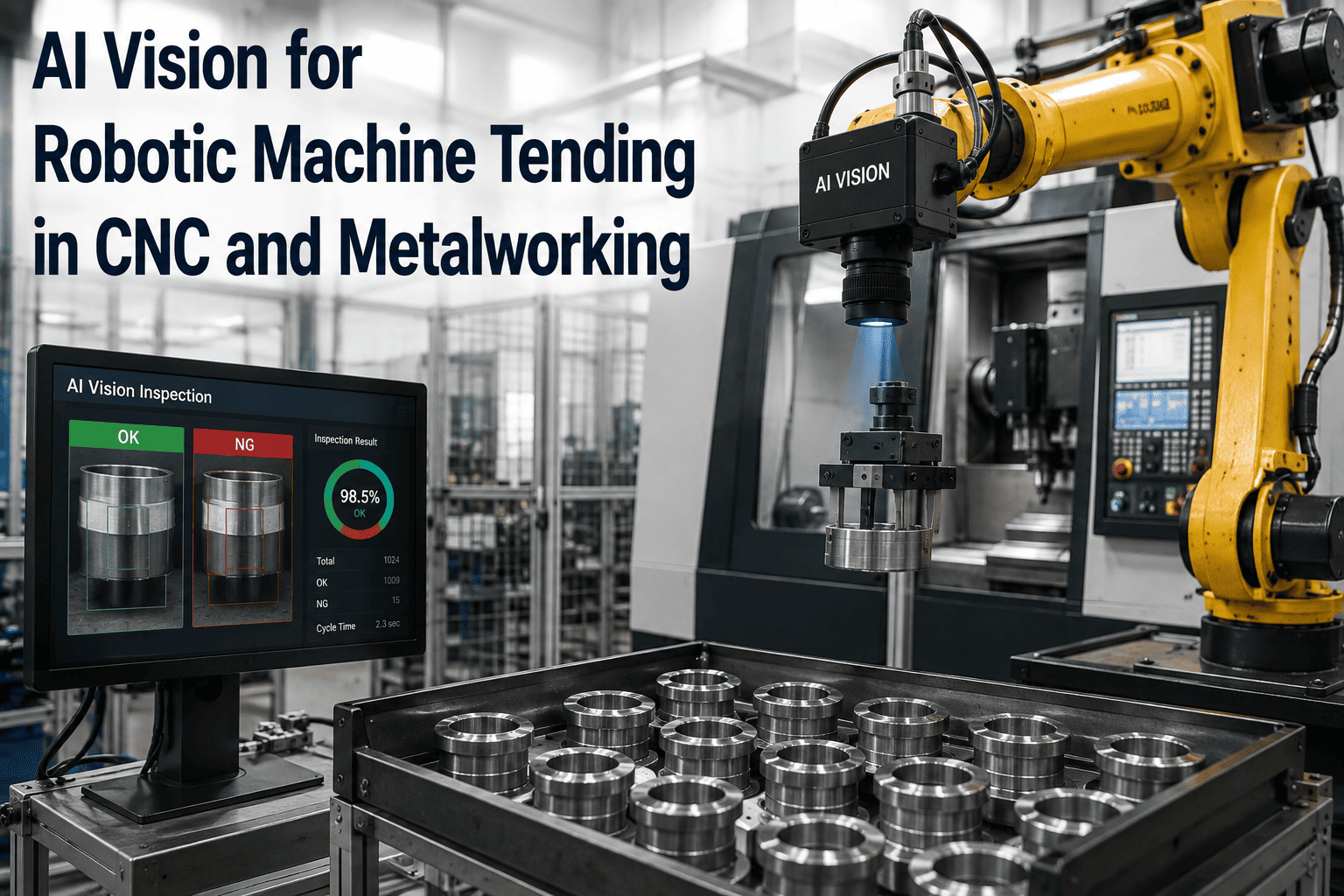
A CNC lathe runs the same twenty-second cycle whether a machinist is standing in front of it or the lights are off — the difference is that a person needs breaks, weekends, and paychecks, and the machine does not. That gap is why machine shops running skilled-labor shortages against volatile order books keep looking at robotic tending, and why the ones that succeed are the ones that gave the robot eyes. A blind robot needs a fixture for every part variant and a jam alarm every time something arrives crooked; a vision-guided robot handles a bin of raw stock, verifies orientation before it closes the chuck, and inspects the finished part on the way out. Shops evaluating this shift usually start by choosing to book a demo to see how vision-guided tending would run against their actual part mix.
AI VISION FOR ROBOTIC MACHINE TENDING
Give the Robot Eyes. Run the Shop Lights-Out.
iFactory turns a blind pick-and-place robot into a vision-guided tending cell — locating raw stock in bins, verifying part orientation in the chuck, and inspecting finished geometry before the pallet leaves the cell.
USD 15.1B
Machine vision and vision-guided robotics market size in 2025, projected to reach USD 36.2B by 2034
12–24 mo
Typical payback window when vision-guided tending replaces manual loading on multi-variant part runs
6 DoF
Degrees of freedom the vision system resolves — X, Y, Z, pitch, roll, yaw — for every pick
2–4 hrs
Changeover time saved per part variant when vision replaces custom fixturing on the cell
The Blind Robot Problem
Why Traditional Machine Tending Stops at the First Part Variant
A robot with no vision is a very precise arm that assumes the world never moves. Its entire job depends on the raw stock arriving in exactly the same position, rotation, and height, every single cycle, forever. That assumption costs shops in three specific ways — and every job shop running mixed part families runs into all three.
01
Fixture Multiplication
Every part variant needs a custom-built presentation fixture — machined, aligned, stored, swapped in and out at changeover. A shop running twelve part families ends up with twelve fixtures gathering dust between runs, and the fixture inventory grows with every new job.
02
Changeover Kills Utilization
Swapping a fixture, re-teaching the robot to the new pick point, and validating the first-off part burns two to four hours of cell time on every changeover. On a shop running short-batch work, changeover cost quietly eats a third of available capacity before anyone measures it.
03
Any Deviation Jams the Cell
A blank arriving upside down, a chip on the locating pad, a part that slid two millimeters — each one crashes the cell and drops throughput to zero until an operator resets the fault. Overnight lights-out runs die the first time raw stock does not cooperate.
What Vision Adds
The Four Vision Layers That Make Lights-Out Actually Work
A vision-guided tending cell does not add cameras just for inspection at the end — it adds sight at every decision point in the cycle. Each of the four layers below runs continuously, and the value of the deployment comes from all four working together rather than any single capability in isolation.
LAYER 01 · LOCATE
3D Bin Localization and Grasp Planning
Structured-light or laser-line 3D scanners generate a point cloud of the raw stock bin, and a deep learning model identifies the topmost pickable part even under random stacking and partial occlusion. Grasp planning generates a collision-free approach vector for the robot in under half a second per pick, eliminating the vibratory feeder and precision fixture from the front end of the cell.
Point cloud segmentationCollision-free approach< 0.5s per pick
LAYER 02 · VERIFY
Part Orientation and Presentation Check
Before the robot loads the part into a chuck, vise, or fixture, a secondary vision station confirms the pose is within tolerance for machining. A shaft blank arriving with the wrong end up, a plate rotated ninety degrees, a casting with a runner still attached — each gets rerouted to a re-presentation stage rather than crashing the spindle. This layer is the reason lights-out runs survive contact with real raw material.
Pose verificationReject re-presentationSpindle crash prevention
LAYER 03 · GUIDE
Load, Unload, and Multi-Machine Handling
The robot loads the CNC, retreats behind the guarding, and cycle starts. On unload, vision confirms the part is fully released from the chuck before retract, and — on cells tending two or three machines — the same vision stack tracks which machine is finishing, which is loaded, and which needs the next blank, coordinating queue priority without a hardcoded schedule.
Multi-machine coordinationChuck release verificationAdaptive queue priority
LAYER 04 · INSPECT
Finished Part Inspection Before Pallet
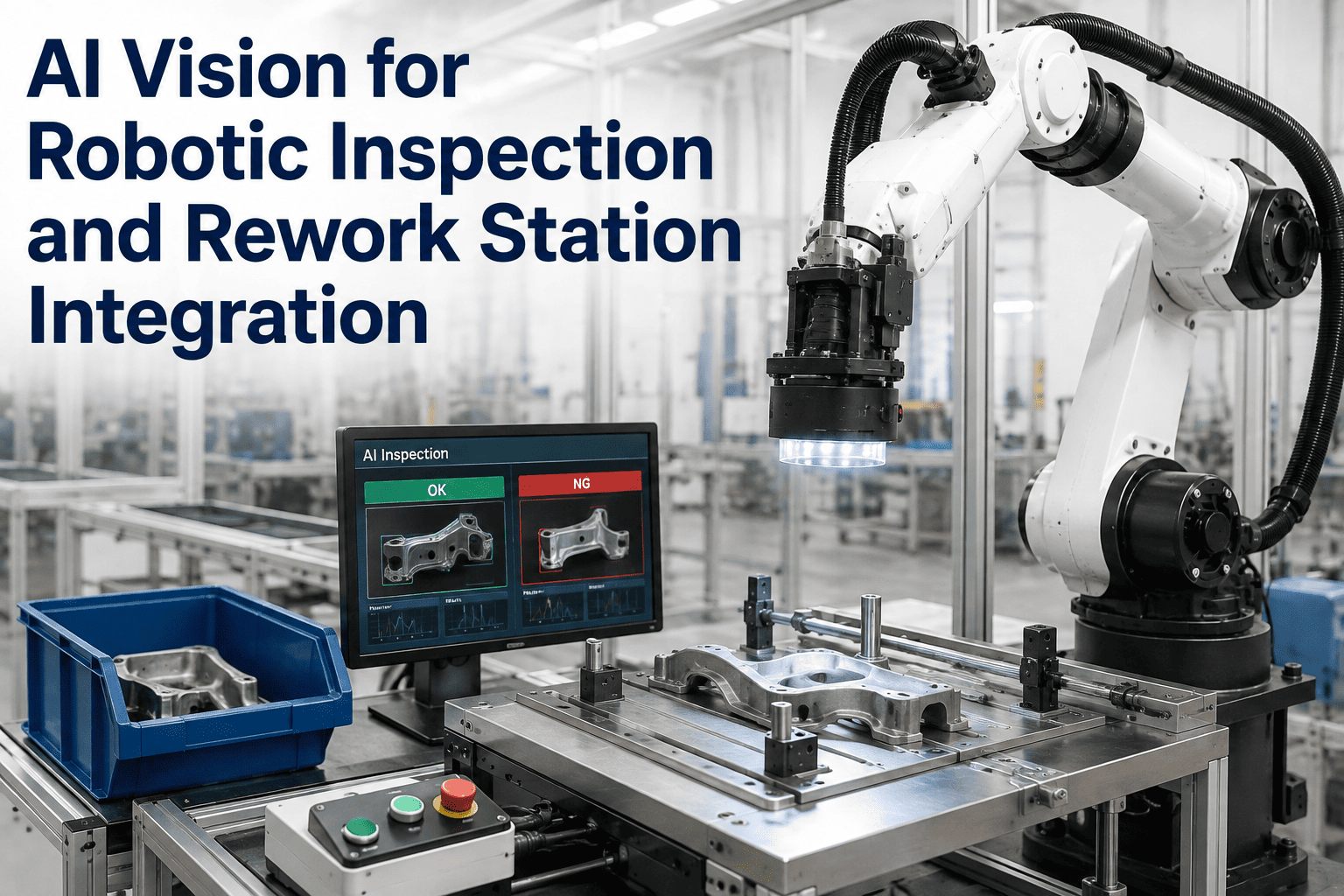
Every part leaving the cell passes an inspection station — dimensional check on critical features, surface defect scan, presence-of-thread or presence-of-hole verification, and burr detection at machined edges. Bad parts are diverted to a quarantine bin with a timestamped image record, so the morning shift walks into evidence rather than a mystery reject.
Dimensional gaugeSurface defect scanTimestamped reject log
STOP BUYING FIXTURES FOR EVERY NEW PART
See Vision Handle Your Actual Part Mix
The demo runs on the same messy bin of raw stock, the same variant lineup, and the same changeover pain your shop lives with today — not a sanitized case study.
A Day in the Cell
What a 24-Hour Lights-Out Shift Actually Looks Like
The romantic version of lights-out manufacturing is a dark, empty factory humming through the night. The real version is more useful: a first-shift operator preps the day, hands the cell over, and comes back the next morning to a queue of finished parts and a small log of decisions the vision system made without them. Here is the actual timeline.
06:00
Morning Handoff
Operator loads three bins of raw stock — two variants for the morning batch, one for overnight — verifies coolant, and confirms the vision system has the current job's part reference model loaded. No fixture swap required for the variant change.
08:30
First Variant Runs Out
Bin one empties. The vision system recognizes the next bin holds a different part geometry, pulls the second reference model automatically, and continues without operator intervention. Historical fixture-swap time: eliminated.
14:00
Rejected Blank Handled
A casting arrives with excess flash on the locating surface. Layer 02 flags orientation-out-of-tolerance, the robot places it in the re-presentation stage, retries once, then routes it to the reject bin with a photo record. Cell keeps running.
18:00
Second Shift Ends
Last operator leaves. Cell enters unattended mode, tightens fault-tolerance thresholds, and switches inspection to full-frame scan on every part rather than sampling. Live status streams to the shop's monitoring dashboard.
23:30
Overnight Anomaly
A finished part shows a dimensional deviation on a critical bore diameter. Part quarantined, image logged, next three parts inspected at higher scrutiny. Deviation stays within control limits — cell continues instead of stopping the run.
06:00
Next Morning Review
Operator returns to 340 finished parts palletized, three rejects with photo evidence, a tool-wear trend suggesting insert change by mid-morning, and a full production log tied to timestamps. Half a shift of work done overnight — with a record.
Application Fit
Where Vision-Guided Tending Pays Off Fastest
Not every CNC cell is a good tending candidate on day one. The applications below tend to hit payback fastest because they combine high labor content, meaningful part variety, and a production window where lights-out or lightly-attended running actually captures throughput a shop cannot currently reach.
| Application | Part Profile | Vision Focus | Payback Signal |
| Turned Shaft Production |
Cylindrical stock, mixed lengths and diameters |
Bin localization, end-orientation check |
High-volume, night-shift labor gap |
| Prismatic Milled Parts |
Castings or bar stock, multi-face machining |
Pose verification, feature-presence inspection |
Fixture inventory growth on new jobs |
| Multi-Machine Cells |
Same part across 2–4 CNCs with staggered cycles |
Cross-machine queue coordination |
One robot underutilized tending one machine |
| Small Job Shop Batches |
50–500 pieces per job, weekly changeover |
Automatic variant recognition |
Changeover cost above 25% of cycle time |
| Casting and Forging Finish |
As-cast raw stock with variable presentation |
3D pose from irregular geometry |
Manual staging is current bottleneck |
| Welded Fabrication Feed |
Sheet metal parts, sub-assemblies |
Bin picking, orientation for weld fixture |
Welder shortage on second shift |
Robot Compatibility
Works With the Robot You Already Have
One of the largest risks in vision-guided tending is committing to a stack that only runs on one robot brand — because the next capex cycle inevitably brings a different one. iFactory's vision layer talks to the standard controllers, so the same deployment carries across robot families without application-specific reprogramming.
FANUC
Standard integration for LR Mate, M-10iD, and M-20iD tending arms across turning and milling cells, with vision offsets streamed through the R-30iB controller.
KUKA
KR AGILUS and KR CYBERTECH cells receive pose data via the KUKA Ethernet KRL interface, supporting bin picking and multi-machine tending on the same controller.
ABB
IRB 1200, 1300, and 2600 series integrate through RobotWare, with grasp planning and rejection logic handled at the vision layer rather than embedded in RAPID programs.
Yaskawa
MotoMINI and GP-series arms connect through the YRC1000 for cell-tending applications, including the multi-station coordination cases common in high-mix machine shops.
Universal Robots
UR5e, UR10e, and UR16e cobots receive vision guidance through URCap integration, enabling collaborative tending cells that share space with operators during day shifts.
Doosan & Techman
Cobot-class tending arms from Doosan and Techman are supported for shops standardized on collaborative robots for their machine-tending fleet.
The Numbers Behind the Business Case
What Actually Moves in the Payback Math
Vision-guided tending is not sold on any one number — it is sold on a stack of them. The four rows below are the specific line items that shift when a shop moves from blind-robot tending to vision-guided operation, and any real ROI conversation with the plant CFO ends up walking through all four.
2–4 hrs
Saved per Changeover
Vision replaces fixture swap and re-teach on variant changeovers. On a cell running weekly variant changes, that is 100–200 machine hours per year returned to running parts instead of being reset.
Vision handles the raw-stock variation that used to generate scrap from mis-positioning. First-pass yield on the same job climbs measurably once the cell stops feeding badly-oriented stock into the spindle.
5–20 variants
Handled by One Cell
A blind robot cell typically handles one to three variants before fixture proliferation becomes unmanageable. Vision-guided cells routinely cover five to twenty variants on the same hardware, changing over via software.
3rd shift
Staffed by the Robot
The throughput math shifts hardest when vision-guided tending captures a shift human labor could not sustain — nights, weekends, holidays. That capacity does not compete with day-shift headcount; it adds hours a shop could not otherwise run.
Voice from a Job Shop
Field Perspective
M
Marcus T.
Operations Director, 22-Machine Precision Job Shop
Our old rule was one fixture per part number and one operator per two machines. We ran the numbers on hiring for a third shift and it did not close — the wages were there but the people were not. Vision-guided tending on four of our lathes now runs from ten at night to six in the morning unattended, and we walk in to finished parts and a decision log. It is not sci-fi; it is just the third shift finally happening.
Common Concerns
Vision-Guided Machine Tending — Real Questions from the Floor
Does this work with the CNCs we already have, or do we need new machines with built-in robot interfaces?
Vision-guided tending works with the CNC controllers you already run — FANUC, Siemens, Mitsubishi, Haas, Mazak, DMG MORI, and others — provided the machine has door-open, chuck-clamp, and cycle-complete I/O available, which nearly all modern machines do. The vision layer sits between your raw stock bin and the robot's motion path, not inside the CNC control, so the machine keeps running its existing programs unchanged. Older machines without native robot I/O can usually be brought in through a small interface panel that reads the machine status via existing sensors — the deployment team walks through this during scoping, and rip-and-replace of the CNC fleet is essentially never required.
How long does it take to teach the system a new part variant?
A new part variant typically comes online in one to two days when representative samples are available, and often faster when a 3D CAD model of the part is provided. The vision model uses few-shot transfer learning, so it does not require thousands of images per part — a modest set of scans across expected orientations is usually enough to build a reliable pose estimation and grasp plan. Compared to the old workflow of machining a custom fixture, aligning it on the cell, and re-teaching robot pick points, the software-based variant onboarding is measured in hours instead of the weeks that hardware changeover used to consume, and the same cell then holds every variant in its library without swapping anything physical.
What happens when a part arrives in an orientation the vision system has never seen before?
The system does not require every possible orientation to be pre-taught — the deep learning pose estimation handles novel orientations of a known part shape by inferring 6-DoF pose from the point cloud rather than matching against a fixed library of poses. When confidence in the pose estimate drops below the operating threshold, the part is routed to the re-presentation stage for a second scan attempt, and if that also fails, it goes to a reject bin with an image record so the morning shift can see what confused the system. This graceful-fallback behavior is what separates a cell that survives real-world raw stock from a demo cell that only works on cleanly-arranged parts, and it is the specific reason blind-robot cells fail overnight while vision-guided cells keep running.
Can one vision system tend multiple CNC machines, or do we need one per machine?
One vision-guided robot cell can tend two to four CNC machines when cycle times allow, with the vision system coordinating which machine is due next, which is finishing, and which needs the next blank staged. This multi-machine configuration is often where the strongest payback shows up, because a single robot arm and single vision stack replace the labor content of tending three or four machines individually, and the utilization of the robot itself climbs above what any single-machine cell can achieve. Sizing the ratio of machines per robot depends on cycle time, load-unload duration, and travel distance — for detailed layout guidance on your specific machines, the team can walk through it during a scheduled
demo.
How does the vision inspection at the end of the cycle compare to a dedicated CMM or gauge?
In-cell vision inspection is fast, non-contact, and catches the categories of defects that account for most day-to-day rejects — missing features, gross dimensional deviation, surface anomalies, burrs at machined edges, and presence of threads or bores. It does not replace a coordinate measuring machine for tight-tolerance inspection at the micron level, and it is not intended to; the two work together, with in-cell vision catching every part in production and CMM sampling reserved for tolerance work that genuinely requires it. The value of the in-cell layer is that no bad part leaves the cell to reach a downstream station or a customer, and every finished part carries a timestamped image record — for how this fits with your existing quality workflow, the fastest path is to raise the specifics through
support.
LOCATE · VERIFY · GUIDE · INSPECT
Turn Your CNC Cell Into a Lights-Out Cell — Without Buying New Machines
iFactory adds the vision layer that lets your existing robot and existing CNCs run a mixed part queue overnight, with every pick verified, every load checked, and every finished part inspected and logged.