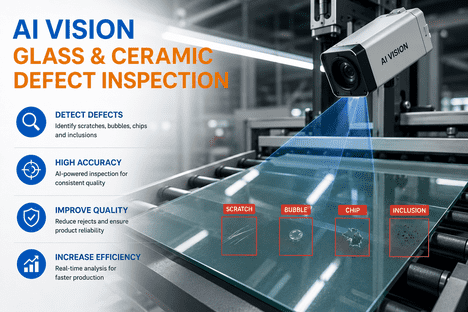
Glass and ceramics manufacturing presents one of the most difficult defect detection challenges in industrial quality control. The same optical properties that make glass and glazed ceramic products valuable — transparency, reflectance, and surface uniformity — make their defects exceptionally hard to detect consistently at production speed. Bubbles and gaseous inclusions trapped during melting, stone and crystalline inclusions from refractory contamination, cracks and checks from thermal stress during forming and annealing, chips on edges from handling impact, and coating voids on coated glass products each carry distinct optical signatures that legacy rule-based machine vision systems struggle to classify without generating unacceptably high false rejection rates on conforming product. iFactory's AI Vision Camera applies deep learning defect detection calibrated specifically for the optical properties of glass and ceramic materials — distinguishing genuine defects from the normal optical variation inherent to transparent and glazed surfaces, at full production line speed, with detection accuracy that rule-based systems cannot match. Quality engineers evaluating AI inspection platforms for glass and ceramics lines are encouraged to Book a Demo with iFactory to see how the platform performs on their specific product and defect profile.
Why Legacy Machine Vision Fails on Glass and Ceramic Lines
Rule-based machine vision systems define detection logic through fixed intensity thresholds and geometric filters — an approach that works adequately for opaque, uniformly colored materials but breaks down on glass and ceramics. Transparent glass refracts, reflects, and transmits light in ways that change with viewing angle, product thickness, glass composition, and line speed, causing the same genuine defect to produce different image signatures at different moments. Glazed ceramic surfaces add natural variation in glaze thickness, color, and texture that occurs even in fully conforming products fired under correctly controlled kiln conditions. When a rule-based system is tuned tightly enough to catch subtle inclusions or pinhole glazing defects, it begins flagging normal optical variation as defects — driving false rejection rates that destroy yield on good product. When thresholds are loosened to reduce false rejects, genuine defects escape to packaging and customers. This trade-off is not a configuration problem; it is a fundamental limitation of rule-based inspection logic on optically complex materials. AI-based deep learning inspection resolves the trade-off by learning the full distribution of acceptable product appearance and genuine defect signatures from real production data — enabling it to distinguish a surface scratch from a lighting glint and a glaze crawling defect from an acceptable texture variation without the binary threshold constraints that make rule-based systems fail.
Glass and Ceramic Defect Classes That iFactory AI Vision Detects
Glass and ceramic products fail across a consistent set of well-documented defect classes, each with distinct visual signatures and distinct downstream risk profiles. iFactory's AI Vision Camera detection models are trained specifically on these defect classes — not on generic surface anomaly data — ensuring that the system is calibrated for the optical signatures that actually appear on glass and glazed ceramic production lines. Quality managers can Book a Demo to see detection performance on their specific product type and defect history.
| Defect Class | Description & Origin | Product Risk | AI Vision Detection Method |
|---|---|---|---|
| Bubbles & Gaseous Inclusions | Gas pockets trapped during glass melting from batch impurities or furnace wear; visible as spherical voids within the glass body | Reduce glass strength; in tempered glass, can cause spontaneous breakage — serious safety risk in automotive and architectural glazing | Backlighting and transmitted-light imaging with AI classification distinguishing bubble signatures from natural glass optical variation |
| Stone & Crystalline Inclusions | Undissolved batch materials or refractory particles from furnace walls that remain embedded in finished glass | Create stress concentration points that initiate cracking under thermal or mechanical load; high structural failure risk | High-resolution transmitted-light detection trained to distinguish crystalline inclusion optical signatures from surface contamination |
| Cracks, Checks & Fractures | Thermal stress during forming, annealing, or tempering processes; handling impact; internal stress concentration from inclusions | Direct structural failure risk across all glass and ceramic product categories; primary cause of in-service breakage claims | Multi-angle illumination with AI crack detection trained to differentiate propagating fractures from surface scratches and edge marks |
| Chips & Edge Shells | Impact damage during handling, conveyance, or packaging — typically appearing on product edges and corners | Injury risk from sharp edges in consumer products; sealing failure in container glass; aesthetic rejection in tableware and architectural glass | Edge-focused inspection with AI classification trained to distinguish chips and shells from acceptable edge finishes and corner geometry |
| Coating Voids & Pinholes | Coverage failures during application of low-E films, anti-reflective coatings, or decorative coatings on glass surfaces | Compromise thermal performance in architectural glass, optical performance in display and lens products, and aesthetic appearance | Coaxial and polarized lighting with AI detection for sub-millimeter coating coverage gaps that standard imaging cannot resolve on transparent substrates |
| Glaze Defects (Ceramics) | Crawling, pinholing, crazing, and uneven glaze coverage from kiln temperature variation, glaze formulation inconsistency, or application errors | Aesthetic rejection in tile and tableware; structural weakness in technical ceramics; moisture penetration in wall and floor tile applications | AI texture and color analysis trained to distinguish genuine glaze defects from the natural variation envelope of correctly fired glazed surfaces |
Core Capabilities of iFactory AI Vision Camera for Glass and Ceramics Inspection
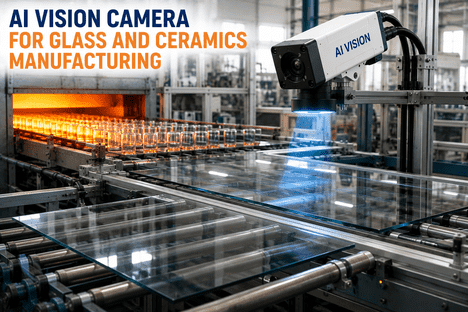
iFactory's AI Vision Camera is deployed directly into glass and ceramics production lines — inspecting flat glass sheets, containers, tiles, tableware, and technical ceramic components at full line speed without requiring production to slow or stop for quality verification. The platform generates a digital inspection record for every unit, enabling quality teams to track defect frequency by type, production shift, and equipment zone — data that drives process improvement and reduces overall defect rates over time.
AI Vision vs. Legacy Inspection: Glass and Ceramics Quality Control Comparison
The operational and financial case for replacing rule-based machine vision and manual inspection with AI-based defect detection is clearest in glass and ceramics — the material category where legacy inspection fails most consistently at acceptable false rejection rates.
| Inspection Dimension | Manual Visual Inspection | Legacy Rule-Based Vision | iFactory AI Vision Camera |
|---|---|---|---|
| Defect Detection Consistency | Variable — shifts with inspector fatigue, shift changes, and lighting conditions | Threshold-dependent — misses defects outside fixed parameter ranges | Consistent deep learning classification across all units and all shifts |
| Transparent Material Handling | Relies on manual lighting positioning; internal defects frequently missed | Fixed illumination logic fails on optical variation from glass composition and product geometry | Specialized imaging configurations designed for transparent and glazed surface optical behavior |
| False Rejection Rate | High under production pressure — good product rejected on ambiguous appearance | Persistently elevated when tuned for sensitive defect detection | Up to 60% lower — AI distinguishes genuine defects from normal optical variation |
| Inspection Coverage | Sampled — full-line inspection impractical at production speed | Theoretically 100% but accuracy degrades on complex product types | 100% in-line inspection at full production speed with traceable records |
| Audit Traceability | Paper logs or spreadsheet records — gaps under production pressure | Limited digital records; defect evidence not retained per unit | Automated per-unit digital record with image evidence and defect classification data |