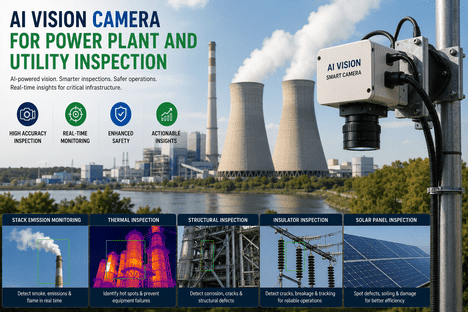
A forced outage at a thermal generation unit rarely begins with a sudden, unpredictable event — it begins as a small, visible signal that nobody happened to be looking at when it formed. A boiler tube wall thinning from creep damage radiates a thermal signature for weeks before it ruptures. A switchgear connection loosens and begins running hot for days before the bus bar fails. A turbine blade develops coating loss and erosion that a borescope would catch — if an inspection happened to be scheduled at the right moment. Quarterly walkthroughs, annual infrared surveys, and scaffold-based visual inspections were never designed to provide continuous coverage; they provide a snapshot, taken a few times a year, of equipment that is degrading every hour in between. AI Vision Camera technology closes that gap by giving power generation and utility assets a permanent set of eyes: thermal imaging that tracks every degree of temperature drift across boilers, turbines, and switchgear, and high-resolution optical monitoring that catches corrosion, coating breakdown, and mechanical wear the moment a visible defect appears. With NFPA 70B now mandating annual infrared inspection of electrical equipment and boiler tube failures still accounting for the largest share of forced outages industry-wide, continuous AI-driven vision is becoming the layer that turns periodic compliance checks into constant, documented verification. Book a Demo with iFactory's engineering team to see how AI Vision Camera maps to your specific generating units.
Why Periodic Inspection Cannot Keep Up With Power Plant Degradation
The Gap Between Scheduled Surveys and Continuous Equipment Reality
Power generation assets degrade continuously, but the inspection programs built to catch that degradation operate on a calendar — an annual infrared survey of switchgear, a quarterly borescope inspection of turbine blades, a scaffold-based visual walk of boiler waterwalls scheduled around an outage window. Every one of these methods produces a snapshot of equipment condition at a single moment in time, and the hours and days between those snapshots are where the most damaging failures actually originate. A loose bus bar connection that begins running hot two weeks after an annual IR scan has eleven and a half months to progress toward failure before anyone scans it again. A boiler tube developing a creep-driven hot spot may not be visible to a crew walking the catwalk unless that crew happens to look at exactly the right panel at exactly the right time.
The consequence of this coverage gap is measured in some of the most expensive failure events in industrial operations. Boiler tube failures remain the leading cause of unplanned outages at coal and gas steam units, and a single undetected switchgear hot spot can escalate from a loose connection to an arc flash incident and a full station outage. AI Vision Camera technology removes the calendar constraint entirely: thermal and optical cameras observe critical surfaces continuously, every detection is compared against an established baseline, and any deviation — whether a fraction of a degree on a stator winding or a visible coating defect on a turbine blade — is flagged the moment it appears rather than at the next scheduled survey.
Boiler Tube and Furnace Monitoring: Catching Creep and Corrosion Before Rupture
Continuous Thermal Mapping Across Waterwalls, Superheaters, and Economizers
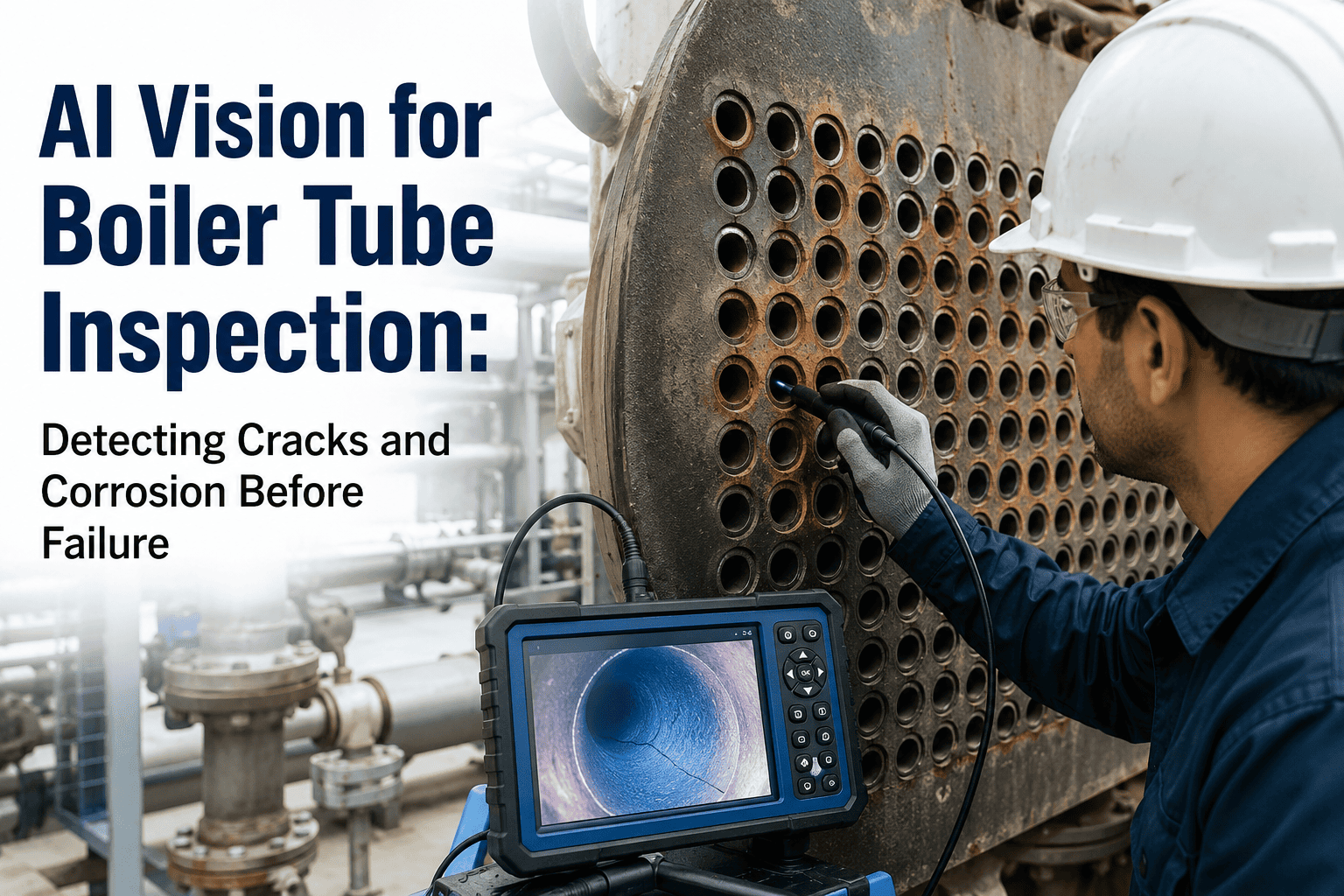
Boiler tube failures from corrosion, thermal fatigue, and water chemistry imbalance develop a measurable thermal signature long before a tube actually ruptures, because tube wall thinning and localized slagging change how heat transfers through the tube surface relative to the surrounding panel. AI thermal imaging maps surface temperatures across every accessible boiler zone continuously, comparing each reading against the previous operating cycle's baseline to identify not just where a hot spot exists, but how quickly it is progressing — a distinction that separates a finding requiring monitoring from one requiring an immediate planned outage.
This continuous thermal coverage extends naturally to refractory condition monitoring, where a hot spot on the boiler casing signals refractory breakdown that, left unaddressed, risks casing burnout and an unplanned shutdown. Because the camera observes the same furnace zones on every operating cycle rather than during a single scheduled walk, iFactory's AI Vision Camera platform builds a progression history for every flagged location — giving boiler reliability engineers a trend line they can plan around instead of a single data point discovered during the next outage window.
Turbine and Generator Surface Inspection: Visual and Thermal Coverage Together
Detecting Coating Loss, Erosion, and Bearing Thermal Drift in Real Time
Turbine blades, bearing housings, and generator stators each fail through mechanisms that produce a visible or thermal signature well before the failure event itself — coating loss and erosion progress visibly across a blade surface, bearing housings run measurably warmer as lubrication or alignment degrades, and stator winding connections develop hotspots that precede ground faults. Traditional inspection of these signatures depends on a borescope crew accessing the turbine during an outage or a thermographer walking the turbine hall on a quarterly schedule — both of which observe the equipment for a few hours out of thousands of operating hours per year.
AI Vision Camera combines high-resolution optical monitoring with thermal imaging across turbine halls and generator bays, tracking bearing housing temperature against established baselines, cross-correlating thermal elevation with any available vibration data to distinguish a genuine mechanical fault from ordinary load variation, and flagging visible coating degradation or erosion progression on accessible surfaces between major outages. The same continuous coverage applies to exciter rectifiers, collector rings, and cooling air filters — components where a developing fault is subtle enough that periodic inspection routinely misses it until the failure has already begun.
Cooling Tower and Condenser Inspection: Seeing What a Quarterly Walk Cannot
Visual Monitoring of Fill Packs, Heat Exchanger Surfaces, and Fouling Deposits
Cooling towers and condensers lose efficiency gradually as fill packs foul, heat exchanger surfaces scale, and structural components like fill media and drift eliminators degrade from continuous water exposure — none of which produces a sudden failure, but all of which erode plant heat rate and efficiency in ways that are difficult to attribute to a specific cause without continuous visual evidence. Manual inspection of cooling tower cells typically requires confined-space entry procedures or scaffold access that limits how often a full visual survey actually happens, and the resulting reports rarely connect what was seen on the structure to what the thermal performance data was showing on the same equipment over the same period.
AI Vision Camera applies continuous optical monitoring to cooling tower fill packs and condenser tube surfaces, identifying fouling deposits, coolant seepage, and structural degradation as they become visible, and correlating those visual findings against thermal efficiency trends from the same equipment. When declining condenser performance and visible fouling on the same cell appear in the same condition record, reliability engineers get a combined picture that identifies the mechanism and the urgency far faster than either data source would on its own.
Electrical Switchgear and Substation Monitoring: Meeting NFPA 70B With Continuous Coverage
From Annual IR Surveys to Permanent Thermal Vigilance
NFPA 70B's 2023 update made infrared thermography of electrical equipment a mandatory annual minimum rather than a recommended practice, and that shift reflects a long-standing reality in electrical maintenance: a loose connection, an overloaded circuit, or a degrading insulation system can progress from a minor thermal anomaly to a fire or arc flash event well within the gap between two annual scans. A single point-contact temperature sensor reports a reading at one fixed location, and a manual thermal-camera survey is a snapshot taken a handful of times per year — both leave blind spots in space and in time that a developing fault can exploit.
AI Vision Camera deploys continuous thermal monitoring across switchgear cabinets, breaker contact faces, bus bar connections, cable terminations, and transformer windings, comparing measured temperatures against both ambient conditions and equivalent components under similar load — the same comparison NFPA 70B's thermography requirements call for, performed continuously rather than once a year. Loose terminations, the most common finding in electrical thermal surveys, are typically detected three to eight weeks before they would otherwise progress to contact failure, giving maintenance teams a planned repair window instead of an emergency response to a tripped breaker or a switchgear fire.
| Asset Class | What AI Vision Camera Monitors | Detection Method | Typical Lead Time |
|---|---|---|---|
| Boiler Waterwalls & Superheaters | Tube wall thinning, creep damage, slagging-driven hot spots | Continuous thermal mapping | Weeks to months ahead |
| Boiler Refractory & Casing | Refractory breakdown, casing hot spots, burnout risk | Continuous thermal imaging | Weeks ahead of casing failure |
| Turbine Blades & Bearings | Coating loss, erosion progression, bearing thermal drift | Optical + thermal monitoring | 2–6 weeks ahead |
| Generator Stators & Windings | Winding connection hotspots, insulation degradation signals | Thermal imaging, 0.5°C resolution | 3–8 weeks ahead |
| Cooling Towers & Condensers | Fill pack fouling, coolant seepage, structural degradation | Continuous visual inspection | Ongoing trend tracking |
| Switchgear & Substations | Loose terminations, bus bar hotspots, breaker contact faults | Continuous thermography, NFPA 70B aligned | 3–8 weeks ahead |
From Detection to Documented Work Order: Closing the Loop
How AI Vision Findings Become Actionable, Audit-Ready Maintenance Records
A thermal anomaly or visible defect that is detected but never reaches the right team is operationally equivalent to never having been detected at all, which is why iFactory's AI Vision Camera platform is built to close the loop between observation and action automatically. Every flagged hot spot, coating defect, or fouling event is converted into a structured work order containing the asset identification, the nature of the finding, a severity classification, and the supporting thermal or visual image — giving the receiving maintenance team a complete record rather than a vague alert that requires a follow-up site visit just to understand what was found.
This same evidence trail satisfies the documentation burden that NFPA 70B, insurance carrier requirements, and internal reliability audits all impose on electrical and mechanical inspection programs. A time-stamped detection log with attached thermal imagery, generated automatically and continuously rather than compiled manually after an annual survey, gives plant reliability teams a far more complete and defensible record than periodic contractor reports have historically provided — without adding documentation work to anyone's daily task list. Book a Demo to see how the platform's evidence trail maps to your existing compliance and audit requirements.
Conclusion
Power plants and utilities do not lack inspection programs, thermography standards, or skilled reliability engineers — what most facilities lack is continuous visibility into the physical conditions those programs are meant to govern between scheduled surveys. AI Vision Camera technology does not replace the NFPA 70B thermography program, the borescope inspection schedule, or the mechanical integrity process a plant already operates; it makes those programs more reliable by supplying the continuous observation layer that turns an annual snapshot into year-round verification. A boiler tube hot spot, a loosening switchgear connection, a turbine blade losing coating — each becomes a detected, documented, and routed event the moment it forms, rather than a discovery made months later during the next scheduled inspection window.
The generating facilities making this shift in 2026 are not replacing their reliability engineers — they are giving those engineers a set of eyes that never leaves the plant floor and never waits for the next outage to look. The first boiler hot spot caught before rupture, the first switchgear connection repaired before failure, and the first turbine defect flagged before a borescope would have found it are the proof points that turn a pilot deployment into a fleet-wide standard.