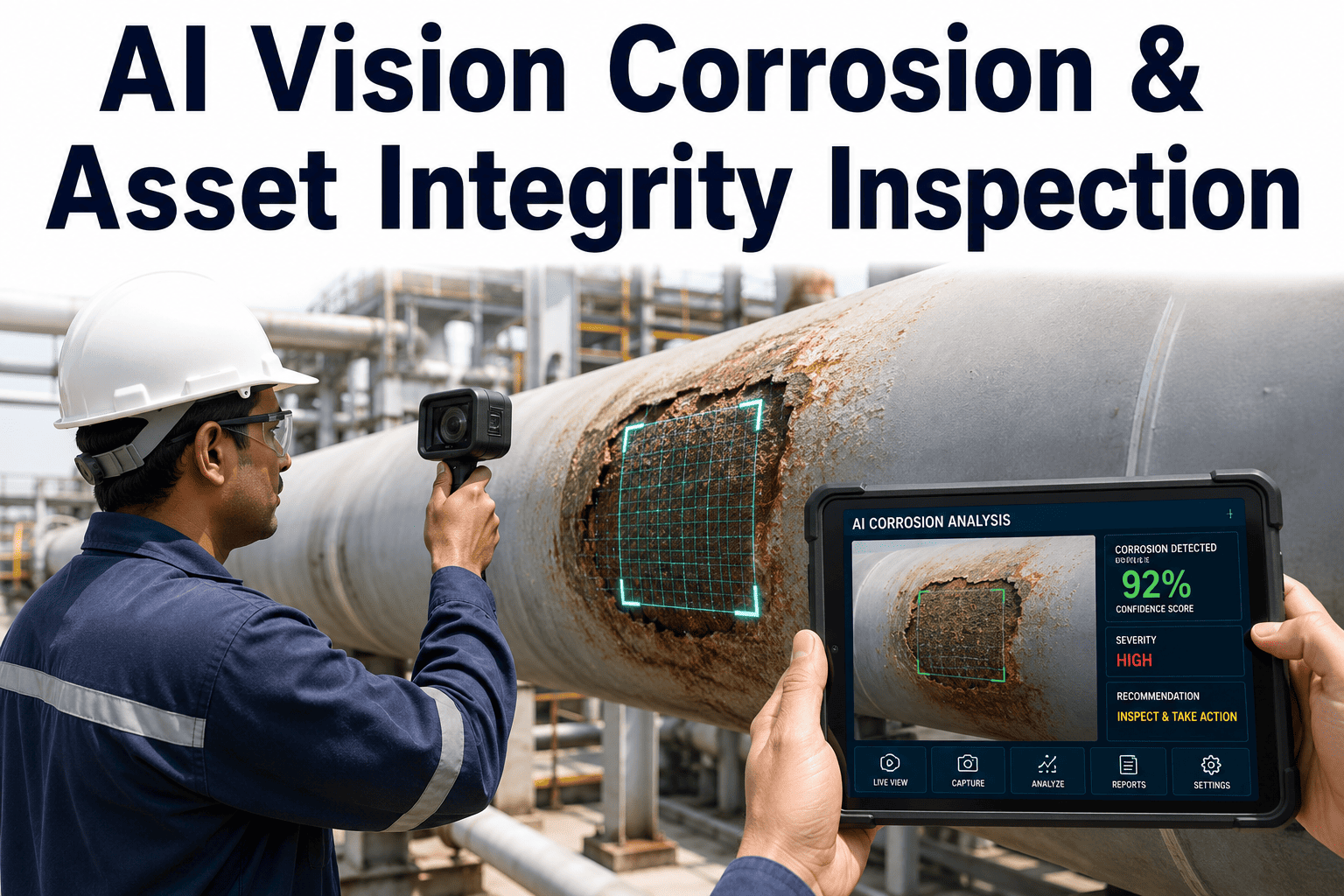
Corrosion and coating degradation on chemical plant assets — pressure vessels, storage tanks, process piping, heat exchangers, and structural supports — represent one of the industry's most persistent and costly asset integrity challenges. The global cost of corrosion in chemical manufacturing is estimated at over $170 billion annually when direct repair costs, unplanned production losses, regulatory penalties, and catastrophic failure consequences are combined. Yet the inspection programs that chemical facilities rely on to manage this risk remain fundamentally periodic and human-dependent: API 510 and API 570 external visual inspections conducted at fixed intervals, ultrasonic thickness measurement surveys requiring scaffold or rope access, and coating condition assessments that depend heavily on the individual inspector's experience and reporting discipline. These periodic programs leave inspection windows during which corrosion progresses unchecked — and the most consequential corrosion events typically initiate and accelerate precisely in the locations and during the intervals that periodic inspections miss most consistently. iFactory's AI vision camera platform with vision defect detection brings continuous, automated corrosion and coating integrity monitoring to chemical plant assets — deploying deep learning models trained on corrosion morphology to detect rust formation, pitting initiation, coating disbondment, and mechanical damage on asset surfaces in real time, at standoff distances that require no access disruption, with structured defect records that feed directly into the facility's inspection management and CMMS workflow. Asset integrity engineers and inspection managers evaluating alternatives to increasingly unsustainable manual inspection schedules regularly choose to Book a Demo with iFactory's engineering team to see how AI vision defect detection maps to their specific asset portfolio and regulatory compliance obligations.
Detect Corrosion, Pitting, and Coating Failure Before They Reach Your Inspection Threshold.
iFactory's AI vision defect detection platform provides continuous corrosion and coating integrity monitoring across tanks, piping, and pressure vessels — connecting every detected defect to a structured inspection record and prioritised maintenance work order.
Corrosion and Coating Defect Classes Detected by AI Vision
Effective corrosion monitoring requires detection coverage across a range of defect classes that differ in morphology, progression rate, and structural consequence. iFactory's AI vision defect detection models are trained on corrosion imagery captured across chemical plant asset types — covering the full range of corrosion mechanisms, coating failure modes, and surface damage categories found in operating process facilities. Each defect class is identified and classified by the AI model independently, with severity scoring based on defect area, depth indicators, and spatial distribution, enabling prioritised maintenance response based on the actual integrity risk rather than a uniform inspection schedule.
General and Uniform Corrosion
Broad surface oxidation and metal loss across tank shells, piping exteriors, and structural supports — detected by surface colour change, rust formation patterns, and texture deviation from the clean metal or intact coating baseline of the monitored asset surface.
Pitting and Localised Corrosion
Highly localised metal loss that creates discrete pit formation on vessel and pipe surfaces — detected by shadow patterns and surface geometry anomalies that distinguish pit formation from surface contamination or staining in the AI model's classification output.
Coating Disbondment and Blistering
Protective coating failure manifesting as blistering, peeling, delamination, and disbondment from the substrate surface — detected by surface profile changes, edge lifting signatures, and the characteristic colour and texture pattern of substrate exposure beneath failed coating.
Crevice and Under-Insulation Corrosion
Corrosion at insulation termination points, support saddles, pipe-to-support contact zones, and cladding edge interfaces — detected by rust staining and moisture-driven discolouration patterns at the specific geometry locations where crevice corrosion mechanisms are most active.
Four Critical Gaps in Conventional Corrosion Inspection Programs
Periodic corrosion inspection programs structured around API, NACE, and ISO 55001 requirements provide a compliance framework — but the inspection interval, coverage limitations, and human-dependence of these programs create structural gaps that allow corrosion to progress undetected between assessments. Understanding these gaps is the starting point for building a risk-based inspection architecture that provides the continuous coverage chemical plant asset integrity programs require.
Inspection Interval Blind Windows
API 510 and API 570 external inspection intervals for chemical plant equipment range from one year to ten years depending on equipment classification and corrosion rate history. During these intervals, corrosion progresses at rates that are not constant — a coating breach can initiate within months of a clean external inspection and accelerate significantly under the weather cycling of a single season. Corrosion events that develop and reach structurally significant thresholds within an inspection interval are only discovered at the next scheduled inspection — often after they have required more costly intervention than early detection would have necessitated. AI vision continuous monitoring eliminates the inspection interval blind window entirely by providing detection the moment a corrosion initiation signature appears on the asset surface.
Access-Constrained Coverage Limitations
Physical inspection of elevated vessel surfaces, overhead piping, and equipment in congested process areas requires scaffold erection, rope access deployment, or elevated work platform mobilisation — with associated cost, time, and confined space and working-at-height safety management overhead. The practical consequence is that full-surface inspection coverage is conducted only during major turnarounds, while normal interval inspections focus on accessible surfaces. The elevated and inaccessible zones of the same equipment — where water accumulation and coating damage from weathering are often most severe — are inspected least frequently. AI vision cameras mounted at strategic positions in the process unit provide continuous coverage of elevated and difficult-access surfaces that manual inspection cannot monitor between turnarounds.
Inspector Consistency and Documentation Variability
Visual corrosion assessment conducted by human inspectors produces results that vary with inspector experience, lighting conditions, time pressure, and individual threshold judgements about what constitutes a reportable coating defect or corrosion observation. The same surface condition assessed by two inspectors at different times may generate significantly different defect records — creating an asset history that does not reliably reflect actual surface condition progression over time. This documentation variability makes trend analysis for risk-based inspection interval adjustment unreliable and creates audit trail gaps that regulators and insurers increasingly flag during integrity program reviews. AI vision defect detection produces consistent, quantified defect records for every inspection event — independent of lighting conditions, inspector fatigue, or individual threshold judgement.
Prioritisation Without Quantified Defect Data
Risk-based inspection programs require quantified defect data — defect type, area, severity, and progression rate — to prioritise inspection resources toward the assets and locations with the highest integrity risk. When inspection records contain qualitative observations rather than measurable defect parameters, the RBI prioritisation model is built on incomplete inputs that produce rankings more reflective of historical inspection attention than actual current risk. AI vision defect detection generates quantified defect metrics — defect class, detected area, severity score, and spatial location — that provide the structured data inputs that RBI prioritisation models require to allocate inspection resources accurately. Book a Demo to review how iFactory's defect records integrate with your existing RBI framework.
How iFactory's AI Vision Defect Detection Works for Asset Integrity
iFactory's corrosion and coating integrity monitoring platform combines high-resolution visual imaging, deep learning defect classification, and quantified defect record generation into a continuous monitoring system that operates at standoff distances compatible with safe deployment in operating chemical plant environments. The architecture follows the same edge-compute approach that eliminates cloud dependency for safety-critical monitoring applications.
Four-Layer Detection and Documentation Architecture
Cameras mounted at optimised standoff positions capture high-resolution imagery of asset surfaces continuously or on configured inspection cycles. Camera specifications — resolution, lens focal length, and illumination configuration — are engineered for the specific asset dimensions, standoff distance, and minimum detectable defect size at each monitoring position. Weatherproof IP66 enclosures with air purge maintain image quality in chemical plant outdoor environments.
Edge-deployed AI models classify detected surface anomalies against a corrosion defect taxonomy covering general corrosion, pitting, coating disbondment, blistering, and mechanical damage. Models are trained on real corrosion imagery from chemical plant environments — not laboratory samples — and calibrated during deployment to the specific substrate, coating type, and environmental conditions at each monitored asset position. Classification confidence scores are included in every defect record.
Detected defects are mapped to a spatial coordinate system referenced to the asset geometry, enabling defect location to be recorded consistently across successive inspection cycles and defect growth tracked between monitoring events. Severity scoring combines defect class, detected area, and spatial concentration to generate a quantified integrity risk indicator for each monitored asset zone that feeds directly into risk-based inspection prioritisation models.
Every monitoring cycle generates a structured inspection record — asset ID, detection date and time, defect class, severity score, defect location coordinates, and annotated inspection image — routed to the facility's inspection management system and CMMS via REST API. Alert-level defects above configured severity thresholds generate immediate maintenance work orders with defect evidence attached. Trending records across multiple monitoring cycles provide the defect progression data that risk-based inspection interval adjustment requires.
API, OSHA PSM, and Risk-Based Inspection Compliance
Chemical plant asset integrity programs operate within a regulatory framework that imposes both inspection frequency requirements and documentation standards across multiple overlapping standards. iFactory's AI vision platform generates the structured defect documentation that satisfies these requirements as a natural output of normal monitoring operations — without additional record-keeping effort from the inspection team.
API 510 and 570 external visual inspection requirements are satisfied by iFactory's continuous monitoring records, which provide documented surface condition assessments at frequencies that exceed the API inspection interval requirements. Defect records with quantified severity data support the corrosion rate calculations and inspection interval adjustments that API RBI methodology requires.
OSHA PSM 29 CFR 1910.119 Mechanical Integrity requirements for inspection and testing of pressure vessels and piping are supported by iFactory's timestamped, immutable inspection records. The platform generates the documentation evidence that PSM auditors require — inspection coverage, defect identification, severity assessment, and corrective action tracking — without manual record compilation.
ISO 55001 asset management system requirements for documented asset condition assessment and evidence-based maintenance decision-making are directly satisfied by iFactory's defect records. The structured, quantified defect data provides the objective condition evidence that ISO 55001 auditors require as proof of systematic asset condition monitoring.
Risk-based inspection programs built on API 580/581 methodology require quantified corrosion rate and defect severity data to generate defensible inspection interval recommendations. iFactory's defect progression tracking across monitoring cycles provides the corrosion rate evidence that RBI models require — replacing qualitative inspector observations with measurable defect metrics.
Industrial property insurers increasingly require evidence of continuous asset integrity monitoring as a condition of coverage for pressure vessels and storage tanks. iFactory's platform generates the continuous inspection coverage documentation that satisfies insurer requirements for asset condition monitoring between formal inspection surveys — potentially supporting favourable premium treatment for facilities with documented continuous monitoring programs.
Pre-turnaround inspection scope development benefits from the accumulated defect mapping data that iFactory's continuous monitoring generates between major outages. Turnaround planners receive a quantified defect inventory for each asset — with locations, defect classes, and severity trending — that enables targeted repair scope development rather than the broad surface-condition assumptions that limited pre-turnaround visibility typically requires.
Deploy Continuous AI Vision Corrosion Monitoring Across Your Chemical Plant Asset Portfolio.
iFactory's AI vision defect detection platform provides continuous corrosion, pitting, and coating integrity monitoring across pressure vessels, tanks, and process piping — generating quantified defect records that satisfy API, OSHA PSM, and RBI program documentation requirements without additional inspection team effort.
The Asset Integrity Program of 2026 Is Continuous, Not Periodic
The regulatory and operational demands on chemical plant asset integrity programs are converging on a single requirement: continuous, documented condition monitoring that provides defensible evidence of asset health between formal inspection surveys — not a paper trail assembled from periodic manual rounds. The corrosion events that cause the most consequential failures in chemical plant environments do not wait for the next inspection interval; they initiate, progress, and reach structurally significant thresholds on their own timeline. AI vision defect detection is the technology that closes the gap between the continuous monitoring that asset integrity requires and the periodic inspection programs that most chemical facilities still operate. iFactory's platform delivers detection accuracy and documentation completeness that manual inspection cannot match — at standoff distances that require no access disruption, on an edge-compute architecture that operates independently of network availability, and with integration to inspection management and CMMS systems that generates maintenance response without manual data transcription. For chemical plant asset integrity programs ready to move from periodic to continuous monitoring, the starting point is a demonstration of iFactory's detection performance on assets matching your specific corrosion risk profile. Book a Demo with iFactory's asset integrity engineering team to see the platform's detection and documentation capabilities applied to your specific vessel, piping, and tank configurations.
AI Vision Corrosion Detection — Common Questions
What is the minimum detectable corrosion defect size at typical chemical plant standoff distances?
Minimum detectable defect size depends on the camera-to-surface standoff distance and the lens specification selected for each monitoring position. For typical tank shell and pressure vessel monitoring distances of 5–15 metres, iFactory's standard configuration achieves reliable detection of coating defects above approximately 10 mm² in area and pitting above approximately 3 mm diameter — sufficient to detect early-stage corrosion initiation before structural significance has been reached. For closer monitoring positions — piping and nozzle connections at 1–3 metres — detection resolution extends to defects below 5 mm². Each site deployment includes a resolution assessment that confirms the achievable defect detection sensitivity at each specific monitoring position before installation is finalised.
How does the AI model distinguish genuine corrosion from surface contamination, staining, and weather-related discolouration?
This distinction is the core classification challenge in visual corrosion detection, and it is where deep learning significantly outperforms threshold-based image processing approaches. iFactory's corrosion classification models learn the morphological signatures that distinguish genuine corrosion defects — the characteristic colour progression, texture change, and edge geometry of rust formation, coating blistering, and pitting — from the appearance of surface contamination, mineral staining, and weather-driven discolouration on the same surfaces. The models are trained on real chemical plant surface imagery across a range of coating ages, substrate types, and environmental conditions, enabling classification specificity that an inspector working from photographic evidence under time pressure cannot consistently achieve. Site-specific calibration during deployment further refines classification accuracy for the specific coating system and surface conditions at each monitored asset.
Does AI vision monitoring replace or supplement traditional ultrasonic thickness inspection for pressure vessels?
AI vision external surface monitoring and ultrasonic thickness measurement address complementary dimensions of pressure vessel integrity — they are supplementary, not mutually exclusive. Visual AI detection identifies surface corrosion initiation and coating failure at the earliest external manifestation, enabling targeted UT inspection at the specific locations where corrosion has been detected rather than on a grid-survey basis across the full vessel shell. This targeted approach reduces UT inspection scope while increasing the probability of detecting the specific locations of active metal loss — making the combined program both more efficient and more effective than either method deployed independently. Many chemical plant integrity programs use iFactory's continuous visual monitoring as the trigger mechanism that identifies where and when targeted UT measurements are most needed between scheduled full-survey intervals.
How does iFactory's platform integrate with inspection management systems and CMMS for defect record and work order management?
Integration is delivered via REST API to inspection management systems and CMMS platforms. Structured defect records — containing asset ID, inspection date and time, defect class, severity score, defect location coordinates, and annotated inspection images — are pushed to the connected inspection management system at each monitoring cycle, building a longitudinal defect history record for each asset. Alert-level defects above configured severity thresholds simultaneously generate CMMS work orders pre-populated with the defect evidence and recommended maintenance action. Standard integration has been validated with major inspection management systems and CMMS platforms including SAP PM, IBM Maximo, and Infor EAM. The platform's data output schema is configurable to match the field structures and asset identification conventions of the customer's existing systems. Book a Demo to review the integration architecture against your specific inspection management and CMMS environment.
Can the platform monitor insulated piping and vessels where the substrate surface is not directly visible?
AI vision surface monitoring detects defects that are externally visible — on the insulation cladding exterior, at insulation termination points, and on uninsulated sections of piping and vessels. For insulated assets, the platform detects the external indicators of under-insulation corrosion that are visible without insulation removal: water staining and rust bleed-through at cladding seams, cladding surface damage and deformation caused by expansive corrosion product formation beneath the cladding, and moisture-driven discolouration at support saddle locations where crevice corrosion is most active. These external signatures provide earlier warning of developing under-insulation corrosion than waiting for the defect to become apparent at the next scheduled insulation removal inspection — enabling targeted insulation removal and UT investigation at the specific locations where AI vision has identified external risk indicators.