AI vision tank and level monitoring is transforming how chemical plants manage one of their most persistent operational risks: the reliance on manual inspection rounds in hazardous process zones. In chemical manufacturing, accurate tank level data, flare stack status, and process anomaly signals are critical inputs for safe, continuous operations — yet most facilities still depend on scheduled operator rounds, paper log entries, and analog gauge readings that introduce delays, human error, and direct safety exposure. iFactory's AI vision camera platform deploys edge-based deep learning models that continuously monitor tank levels, interpret visual level gauges, classify flare stack combustion states, and detect process anomalies — without requiring personnel to enter pressurized, toxic, or explosion-risk zones. The result is real-time visibility into chemical process conditions that supports faster decision-making, reduced excursion frequency, and a measurable reduction in the safety incidents associated with manual inspection in hazardous areas.
Why Chemical Plants Need AI Vision for Tank and Level Monitoring
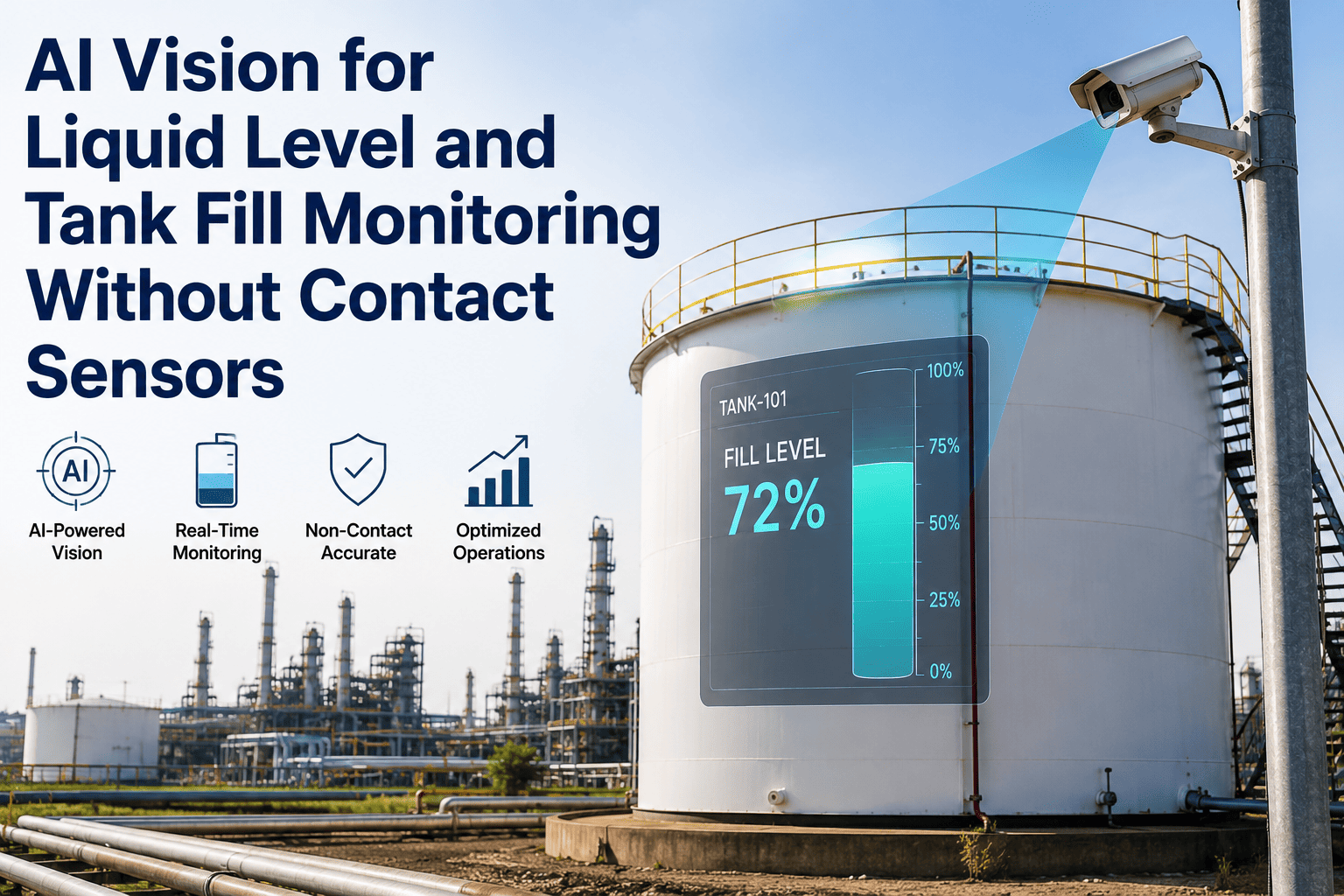
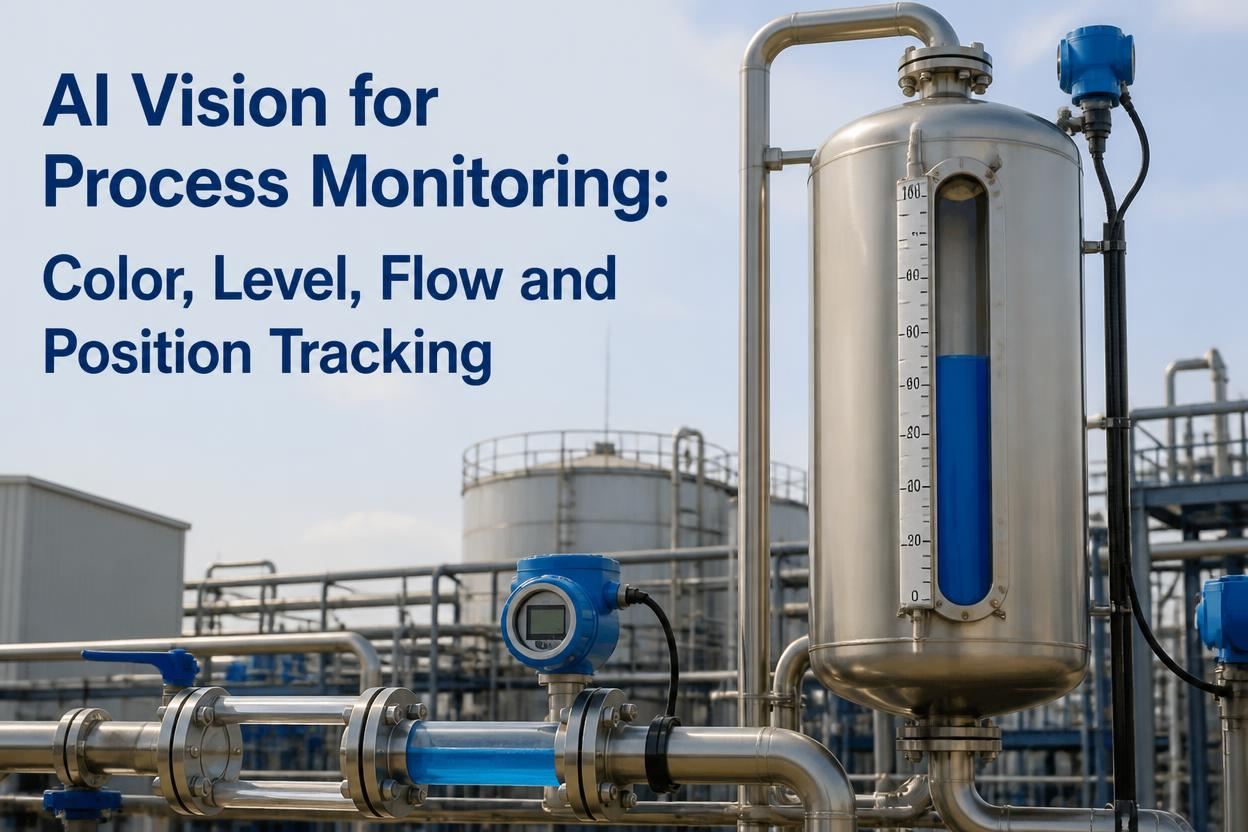
Chemical tanks storing solvents, acids, caustics, and reactive intermediates require level monitoring that is both continuous and safe. Traditional level measurement relies on float-based transmitters, guided wave radar, or pressure differential sensors — but these instruments require maintenance access, are subject to fouling, and provide no secondary visual confirmation when readings drift. Visual level gauges remain installed on most chemical tanks as a backup verification method, yet reading them requires operator entry into areas where a single valve failure can produce toxic vapor exposure. AI vision cameras mounted at safe standoff distances resolve this contradiction by continuously reading sight glass indicators, liquid level columns, and tank surface markers using trained deep learning models. The system identifies the meniscus position, compensates for lighting variation and condensation on gauge glass, and delivers accurate level readings to control room dashboards at configurable intervals — typically every 30 to 60 seconds. For storage tanks holding flammable or reactive materials, this continuous visual record also serves as an independent audit trail for regulatory compliance and incident investigation, providing timestamped evidence that level thresholds were monitored and that operators were alerted when conditions approached alarm setpoints.
Flare Stack Monitoring with Deep Learning Vision Models
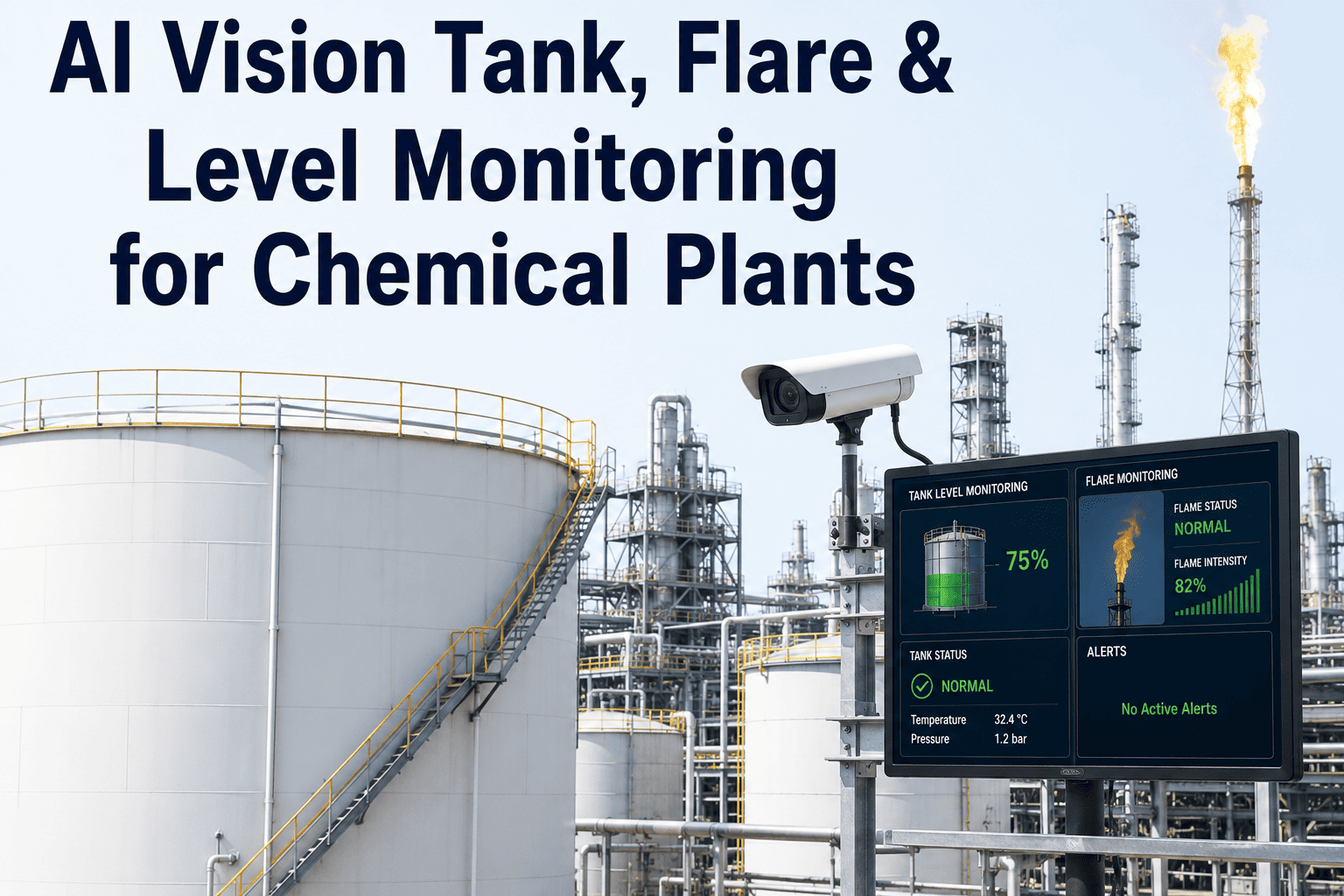
Flare stacks are a primary safety relief mechanism in chemical plants, used to combust waste gases and vent pressure during process upsets. Monitoring flare status is both a regulatory requirement and an operational necessity — abnormal combustion patterns, excessive smokiness, unstable flame behavior, and unlit flare conditions all indicate process anomalies that require immediate response. Conventional flare monitoring uses flow meters and gas composition analyzers, but these instrument-based approaches do not provide direct visual confirmation of combustion quality or detect the visual indicators that experienced operators recognize during manual surveillance. Deep learning vision models trained on flare stack imagery classify combustion states — stable combustion, unstable or lifting flame, excessive black smoke, partial extinguishment, and full extinguishment — in real time from camera feeds positioned at safe distances. iFactory's vision anomaly detection models achieve classification accuracy above 97% across varying daylight, weather, and wind conditions by combining spatial feature extraction with temporal pattern analysis across sequential image frames. When the model detects an abnormal flare state, an alert is generated within seconds and routed to the control room via OPC-UA or REST API integration, triggering a defined response protocol without requiring a field operator to approach the flare structure.
AI Vision Capabilities for Chemical Tank Monitoring
iFactory's vision platform delivers a suite of monitoring functions specifically configured for chemical process environments, covering the full range of visual observations that operators perform during manual inspection rounds.
| Monitoring Function | Detection Method | Output | Integration |
|---|---|---|---|
| Visual Level Gauge Reading | Meniscus detection, sight glass segmentation | Continuous level % with alarm thresholds | SCADA, DCS, historian |
| Flare Stack Status Classification | Deep learning combustion state model | Real-time flame class + alert on deviation | OPC-UA, REST API, CMMS work order |
| Tank Surface Anomaly Detection | Thermal and optical anomaly baseline model | Anomaly heatmap and deviation score | Dashboard, email, mobile alert |
| Overflow and Spill Detection | Liquid boundary tracking, ground-plane analysis | Immediate spill alert with location map | Emergency response protocol trigger |
| Foam and Phase Layer Detection | Multi-layer visual segmentation | Interface position and foam depth measurement | Process control system, operator HMI |
| Valve and Equipment State Monitoring | Object state classification (open/closed/partial) | Equipment state log with deviation alert | Permit-to-work system, audit trail |
Each monitoring function runs as an independent model instance on the iFactory edge AI processor, ensuring that a processing load spike from one detection task does not delay alerts from another. All model outputs are logged with full image evidence, enabling post-incident review and regulatory reporting without reliance on operator recall or paper records.
Eliminating Manual Rounds in Hazardous Process Zones
Manual inspection rounds in chemical plants represent one of the highest-frequency sources of occupational exposure to toxic, flammable, and corrosive substances. Operators entering tank farms, storage battery areas, and flare infrastructure carry direct exposure risk every time a scheduled round brings them into proximity with pressurized vessels, vapor release points, or corrosive liquid spills. Beyond the safety case, manual rounds are operationally inefficient: a single inspection circuit in a mid-sized chemical plant can require 60 to 90 minutes to complete, during which process conditions at unvisited assets are unobserved. AI vision monitoring replaces this periodic visibility with continuous coverage — cameras observe every asset in their field of view simultaneously, every second of every shift, without fatigue, lighting constraints, or distraction. When AI monitoring detects a deviation at a tank or flare, the response time from condition onset to control room alert is measured in seconds rather than the 30 to 90 minutes that might elapse before the next manual round. Chemical plants that have deployed AI vision monitoring report manual round frequency reductions of 60 to 80% in covered zones, with the remaining rounds redirected to tasks requiring physical interaction such as sampling and equipment adjustments. The safety and efficiency gains compound: operators spend less time in hazardous zones, process anomalies are addressed earlier before they escalate into incidents, and the continuous data record supports root cause analysis that prevents recurrence.
Process Anomaly Detection in Chemical Environments
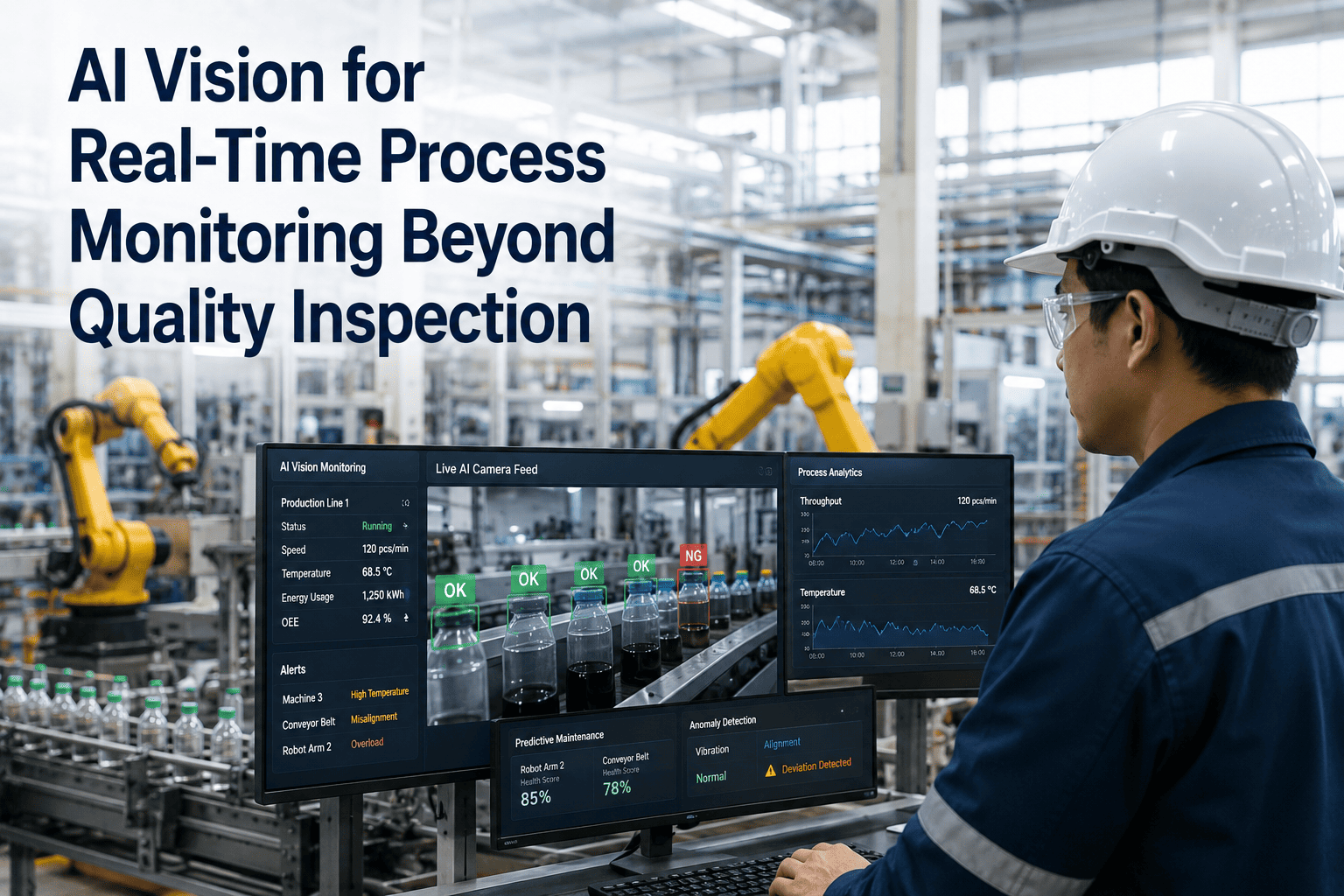
Process anomalies in chemical plants often have visual signatures that appear before instrument alarms trigger. Unusual vapor plumes above open-top tanks, discoloration in liquid streams, unexpected crystallization on vessel surfaces, and abnormal condensation patterns on pipework are all visual indicators that trained operators recognize — but that are only observed when someone is physically present to see them. iFactory's vision anomaly detection models establish a visual baseline for normal process appearance at each monitored asset during an initial calibration period, then continuously evaluate live camera feeds for deviations from that baseline using statistical process control logic applied to visual feature vectors. Anomalies are scored for severity and classified by type — color change, texture change, geometric change, unexpected material presence — and alerts are ranked by confidence and predicted impact to reduce operator alarm fatigue. The system is particularly effective in chemical environments where process appearance is closely correlated with product quality and safety status: reaction color in batch vessels, foam height in fermentation or mixing tanks, and precipitation or settling in storage vessels are all visual process indicators that can be monitored at scale without additional instrumentation. Integration with the plant's existing SCADA, DCS, and CMMS platforms ensures that vision-detected anomalies become part of the plant's maintenance and process response workflow rather than a separate siloed data stream.
Edge AI Deployment for Hazardous Area Compliance
Deploying AI vision monitoring in chemical plant environments requires hardware and network architectures that meet the safety and reliability standards of hazardous classified areas. iFactory's edge AI processors are designed for industrial deployment with IP66-rated enclosures, wide operating temperature ranges, and intrinsically safe camera options for Zone 1 and Zone 2 classified areas under IECEx and ATEX standards. Processing at the edge — on the iFactory unit mounted near the monitored asset rather than in a central server — reduces network dependency for critical alerts and ensures that flare status and tank level alarms are generated and delivered even during network interruptions. Each edge unit stores a rolling buffer of image data locally, enabling post-incident forensic review without dependence on continuous network connectivity to a central archive. Cybersecurity architecture follows IEC 62443 guidelines for industrial control system environments, with encrypted data transmission, role-based access controls, and network segmentation that prevents the vision system from becoming a lateral attack surface for the plant's operational technology network. The deployment model supports integration with OPC-UA servers, REST API endpoints, MQTT brokers, and historian platforms including OSIsoft PI and Honeywell Uniformance, ensuring compatibility with the existing data infrastructure of most chemical manufacturing facilities.
Measurable Outcomes from AI Vision Tank Monitoring
Chemical plants that have deployed iFactory's AI vision monitoring for tank levels, flare stacks, and process anomaly detection report consistent improvements across safety, operational efficiency, and regulatory compliance metrics. The shift from periodic manual observation to continuous AI-powered monitoring produces improvements that scale with the number of assets covered and the criticality of the monitored parameters.
The highest-performing chemical plant monitoring programs connect AI vision detection directly to the plant's maintenance and process response workflows. When iFactory's vision system detects an abnormal tank level trend, flare instability, or process anomaly, the alert does not stop at the control room screen. Through OPC-UA and REST API integration, the detection event can automatically create a work order in the CMMS with the anomaly image, location, and classification data attached — ensuring that the maintenance response is documented, prioritized, and tracked from detection to resolution. For flare stack events with regulatory reporting implications, the system generates a timestamped evidence package that supports compliance documentation without requiring retrospective reconstruction from operator memory or paper logs. Chemical plant operations teams that want to see this closed-loop detection-to-response workflow can Book a Demo with iFactory's process monitoring engineering team for a live walkthrough of the platform configured for chemical industry applications.
Frequently Asked Questions About AI Vision Tank and Level Monitoring
iFactory's level gauge reading models are trained with data augmentation that specifically includes condensation, glare, partial obscuration, and low-light conditions typical of chemical plant tank areas. The meniscus detection algorithm compensates for refraction artifacts and glass surface contamination by using multi-frame averaging and contrast normalization techniques. For sight glasses with heavy fouling, the system flags the gauge as requiring maintenance rather than returning an inaccurate reading — providing an honest indication that physical intervention is needed rather than silently producing erroneous level data. In environments with highly variable lighting such as outdoor tank farms transitioning between daylight, dusk, and artificial illumination, the cameras use adaptive exposure and the edge model applies lighting-condition classification before passing frames to the level reading model, maintaining accuracy across the full lighting envelope.
The flare monitoring model classifies combustion states across a defined taxonomy that is configured during deployment to match the plant's specific flare design and regulatory requirements. Normal combustion variation — flame color oscillation, moderate wind-induced deflection, routine steam assist patterns — is characterized during the initial baseline period and assigned to the stable combustion class. Reportable states such as excessive black smoke indicating incomplete combustion, visible unburned gas escape, flame lifting or detachment, and full extinguishment are classified as distinct alert states with configurable severity levels. The system applies a temporal confidence window before generating an alert — requiring the abnormal state to persist for a defined number of consecutive frames — to prevent false alarms from momentary visual disturbances such as birds crossing the field of view or brief lighting changes. Alert thresholds and classification parameters can be adjusted by the plant's process safety team through the configuration interface without requiring model retraining.
iFactory's edge AI units support OPC-UA server and client modes for direct integration with DCS and SCADA platforms from Honeywell, Emerson, ABB, Siemens, and Yokogawa. REST API endpoints allow integration with CMMS platforms, ERP systems, and custom operator dashboards. MQTT broker connectivity supports IIoT hub architectures and cloud historian platforms. For OSIsoft PI and Honeywell Uniformance historian integration, the system publishes vision-derived process variables — level readings, flare state codes, anomaly scores — as standard PI tags or Uniformance points, making vision data accessible alongside traditional instrument data in existing operator displays and reporting tools. The integration scope and configuration is assessed during a deployment scoping session, and iFactory provides integration support through commissioning and acceptance testing to ensure data flows correctly into the plant's existing workflow before handover.
A standard chemical plant deployment covering tank level monitoring, flare stack surveillance, and process anomaly detection for a defined asset scope typically requires four to eight weeks from site survey to live monitoring. The timeline includes camera positioning design, hazardous area classification review, edge unit installation and network commissioning, model calibration on site-specific imagery, integration testing with the plant's SCADA and CMMS, and operator training. Projects with larger asset scopes, more complex integration requirements, or ATEX/IECEx certification needs for camera equipment in Zone 1 areas may extend to twelve weeks. iFactory recommends a phased deployment approach — starting with the highest-criticality assets such as primary product storage tanks and the main flare stack — to deliver monitoring value quickly while the broader deployment continues. Book a Demo to discuss your specific site scope and get a deployment timeline estimate from the iFactory engineering team.
For level gauge reading and flare stack classification, the core detection models are robust to normal product changes because they detect visual features — meniscus position, combustion flame characteristics — rather than product-specific properties. Significant changes in gauge hardware, camera field of view, or flare design require recalibration but not full retraining. For process anomaly detection models, a baseline recalibration is recommended when tank contents, operating temperature, or process chemistry changes significantly, because the visual appearance of a healthy process will shift. The recalibration process takes 24 to 72 hours of baseline data collection at the new operating condition and does not require manual labeling — the system builds its new normal baseline automatically from confirmed-normal operating periods. iFactory's model management interface allows plant engineers to initiate recalibration directly, schedule it to coincide with product changeovers, and review the new baseline before activating it for live anomaly detection.