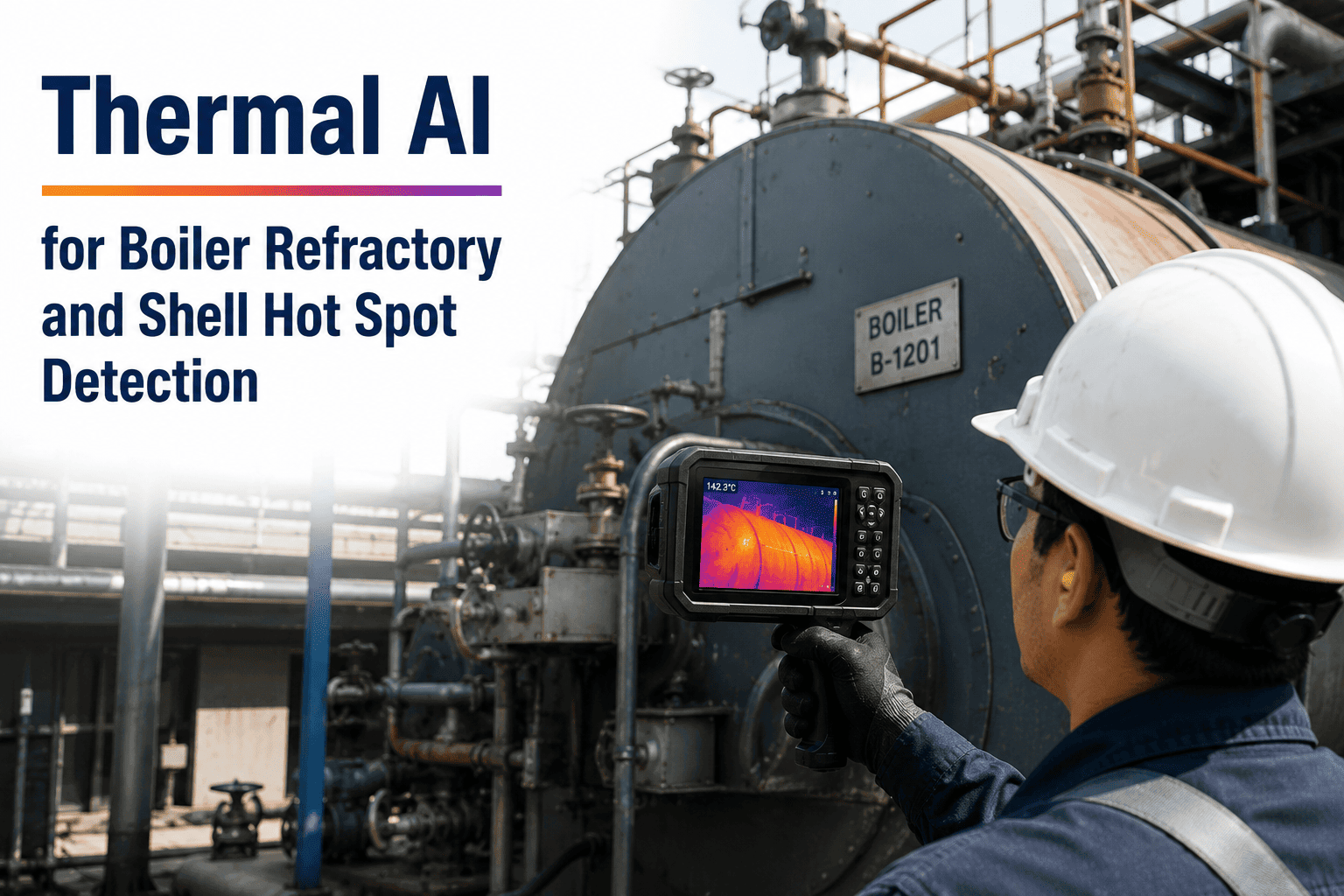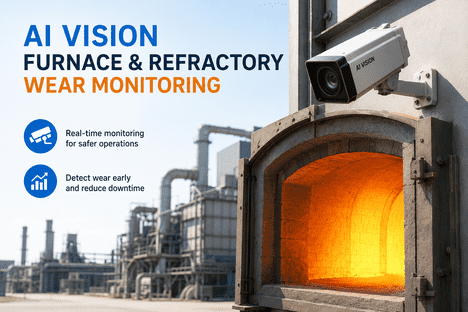
AI vision furnace and refractory wear monitoring gives reliability and operations teams continuous visibility into the single largest hidden risk in high-temperature industrial operations — the slow, often invisible degradation of refractory lining and furnace shell integrity that, left undetected, ends in unplanned shutdowns, burn-through events, and safety incidents that can take weeks to repair. Refractory wear progresses gradually under normal operating conditions, but it accelerates sharply at specific failure points: localized hotspots from lining thinning, shell distortion from repeated thermal cycling, and skull or buildup formation that masks the true condition of the lining beneath it. Conventional inspection relies on periodic shutdown surveys and handheld thermal imaging conducted by a technician walking the furnace shell on a fixed schedule — a method that, by design, cannot see the hours and days between inspections when a refractory hotspot can progress from a minor anomaly to a shell breach. iFactory's AI vision thermal monitoring platform replaces this episodic inspection model with continuous, automated thermal surveillance of the furnace shell, tracking every monitored zone in real time and generating predictive maintenance alerts the moment a thermal signature indicates developing refractory wear — well before the condition becomes a production-stopping emergency.
Why Periodic Furnace Inspections Miss the Critical Wear Window
Refractory degradation does not progress at a constant rate. Lining wears slowly under normal thermal and chemical exposure for most of its service life, but localized failure — from slag attack, mechanical erosion, thermal shock cracking, or installation defects — can accelerate sharply once a weak point develops. The shell temperature increase that accompanies this localized thinning is the earliest external indicator of the problem, but it often develops and intensifies over a period of days, not the weeks or months between scheduled handheld thermal surveys. A furnace inspected on a monthly or quarterly cycle can pass its inspection with shell temperatures within normal range, then develop a refractory hotspot that crosses critical thresholds well before the next scheduled inspection occurs. The consequence of missing this window ranges from costly emergency refractory repair during an unplanned outage to catastrophic shell breach events that pose direct safety risk to personnel and surrounding equipment. iFactory's AI vision camera platform closes this detection gap by maintaining continuous thermal surveillance of the entire furnace shell surface, identifying the earliest rate-of-change signatures that indicate accelerating refractory wear long before shell temperature reaches an alarm-level absolute threshold. Reliability teams managing furnace assets can Book a Demo with iFactory's engineering team to see how continuous thermal coverage applies to their specific furnace configuration.
What iFactory's AI Vision Thermal Monitoring Detects on Furnace Assets
iFactory's platform is trained to recognize the specific thermal signatures associated with the failure modes that drive unplanned furnace downtime and refractory replacement costs. Detection coverage spans the full furnace shell and structural envelope, with model classification tuned to distinguish genuine developing wear from normal operational thermal variation across different furnace types, fuel sources, and production cycles.
| Detection Category | Thermal Signature | Underlying Cause | Automated Response |
|---|---|---|---|
| Shell Hotspots | Localized temperature rise exceeding zone baseline | Refractory thinning, lining crack, slag line erosion | Predictive work order with location, severity, and trend data |
| Refractory Thinning Trend | Gradual shell temperature rise over days to weeks | Progressive wear from thermal cycling and chemical attack | Time-to-threshold projection for planned reline scheduling |
| Shell Distortion & Bulging | Geometric deformation visible in thermal and visual overlay | Repeated thermal cycling, structural fatigue, overheating | Structural inspection alert escalated to engineering review |
| Skull and Buildup Masking | Anomalous cool zones inconsistent with process state | Material buildup obscuring true refractory condition | Flagged zone for manual verification during next access window |
| Tap Hole and Burner Port Wear | Localized high-gradient thermal anomaly at fixed points | Erosion from repeated tapping or burner misalignment | Maintenance alert for component-specific inspection |
Each detection category carries an independent confidence score and severity grade, with alert routing configured to match the urgency of the underlying condition — immediate escalation for fast-developing hotspots that pose near-term failure risk, and scheduled inspection work orders for slower-developing trends that can be addressed during planned maintenance windows.
How the Platform Distinguishes Real Refractory Wear from Normal Thermal Variation
The central technical challenge in automated furnace thermal monitoring is separating genuine refractory wear signatures from the normal thermal variation that furnaces exhibit across charging cycles, fuel changes, ambient conditions, and process state transitions. A furnace shell legitimately runs hotter during certain production phases and cooler during others — a naive fixed-threshold alarm system either misses real wear hidden within normal variation or generates so many nuisance alerts during expected thermal swings that operators learn to ignore the system entirely. iFactory's AI models address this by establishing a process-state-aware thermal baseline for each monitored furnace zone, learning the normal thermal signature associated with each operating phase — charging, melting, holding, tapping, idle — over an initial calibration period. Anomaly detection then evaluates current thermal readings against the baseline expected for the current process state, not against a single static threshold. This approach allows the system to detect a genuine hotspot developing during the holding phase even though the absolute temperature reading might fall within the normal range observed during the melting phase, and conversely avoids flagging the expected temperature rise during melting as an anomaly. Reliability engineers evaluating this capability against their specific furnace operating profile can Book a Demo with iFactory's engineering team for a walkthrough of the baseline calibration methodology.
From Thermal Detection to Predictive Maintenance Work Order
Detecting a thermal anomaly is only valuable if it converts into timely corrective action. iFactory's platform is built around a closed-loop architecture that connects thermal anomaly classification directly to maintenance planning workflows, eliminating the lag between detection and response that characterizes manually reviewed thermography reports.
Continuous Thermal Imaging Across Furnace Zones
Radiometric thermal cameras positioned around the furnace shell and structural envelope capture continuous thermal image streams covering every monitored zone simultaneously — the shell barrel, tap hole area, burner ports, and structural support points that are most prone to wear-related thermal anomalies.
Process-State-Aware Anomaly Classification
The AI model compares incoming thermal data against the process-state-specific baseline for each zone, identifying deviations that indicate genuine refractory wear, shell distortion, or component erosion rather than expected thermal variation tied to the current production phase.
Severity Grading and Time-to-Threshold Projection
Detected anomalies are graded by severity and rate of progression, with the platform projecting an estimated time-to-threshold for trends that are advancing toward critical limits — giving maintenance planners a forward-looking window for scheduling rather than a single point-in-time alarm.
Automated Work Order Generation in the Connected CMMS
When an anomaly crosses the configured action threshold, iFactory automatically generates a structured work order in the connected CMMS through OPC-UA and REST API integration — including the thermal image, zone location, severity classification, and trend data — ready for maintenance planning without manual review or data transcription.
Industry Applications Across High-Temperature Operations
Furnace and refractory thermal monitoring delivers value across every industry that operates high-temperature vessels where refractory integrity directly determines production continuity and safety. In primary metals and foundry operations, continuous shell monitoring of melting furnaces, holding furnaces, and ladle refractory protects against the burn-through events that halt production and endanger personnel. In cement and lime manufacturing, kiln shell scanning identifies refractory brick wear and coating loss zones that drive both energy efficiency losses and structural risk in rotary kiln operations. In glass manufacturing, continuous monitoring of melting furnace crowns, walls, and floor refractory catches the gradual erosion that, if undetected, leads to glass breakout events with severe safety and cleanup consequences. In petrochemical and refining operations, monitoring of fired heaters, reformer furnaces, and process vessel refractory linings supports the mechanical integrity programs that regulatory frameworks increasingly require to be evidence-based and continuously documented rather than assembled from periodic survey reports. Facilities operating any class of refractory-lined high-temperature vessel can Book a Demo with iFactory's team to review camera placement and detection configuration for their specific furnace type.
Measuring the Impact of Continuous Furnace Thermal Monitoring
The operational and financial case for AI vision furnace monitoring rests on the gap between the cost of a planned refractory repair scheduled during an existing maintenance window and the cost of an unplanned shutdown triggered by an undetected hotspot reaching critical severity. Organizations that deploy continuous thermal surveillance consistently report measurable improvement across the following dimensions within the first year of operation.
Most furnace operators currently manage refractory replacement on a fixed calendar or campaign-length schedule, replacing lining at a predetermined interval regardless of actual remaining wear life. This approach either wastes remaining refractory life by relining too early or risks failure by relining too late when wear has been faster than the average assumption built into the schedule. iFactory's continuous thermal trend data gives reliability teams the evidence needed to shift toward condition-based reline planning — extending campaign length where wear is tracking slower than the baseline assumption, and scheduling early intervention where a specific zone is wearing faster than expected, before it forces an unplanned shutdown. This shift from calendar-based to condition-based refractory management is one of the most consequential changes a furnace-operating facility can make to both maintenance cost and unplanned downtime exposure. Operations and reliability leaders ready to evaluate this transition can Book a Demo with iFactory's engineering team.
Frequently Asked Questions About AI Vision Furnace and Refractory Monitoring
iFactory's AI models establish a process-state-aware thermal baseline for each monitored zone during an initial calibration period, learning the expected thermal signature associated with each operating phase — charging, melting, holding, tapping, and idle. Anomaly detection compares current readings against the baseline expected for the current process state rather than a fixed absolute threshold, allowing the system to detect genuine wear-related deviations even when they occur within a temperature range that would otherwise look normal at a different point in the production cycle. This approach significantly reduces false alerts from expected thermal cycling while preserving sensitivity to genuine developing refractory wear.
iFactory's platform is deployed across a wide range of refractory-lined high-temperature vessels including electric arc furnaces, induction furnaces, rotary kilns, glass melting furnaces, fired heaters, reformer furnaces, and process vessel linings in petrochemical operations. Detection models are calibrated to the specific thermal behavior, process cycle, and failure mode profile of each furnace type during deployment, since the expected baseline and the failure signatures that matter differ meaningfully between, for example, a batch melting furnace and a continuously fired process heater.
iFactory's platform tracks thermal trends for each monitored zone over time, identifying the rate of temperature rise associated with progressive refractory thinning and projecting an estimated time-to-threshold for zones where the trend is advancing toward a critical limit. This trend-based projection supports condition-based reline planning by giving maintenance teams a forward-looking estimate rather than only a point-in-time hotspot alert. The accuracy of these projections improves over time as the system accumulates more historical wear progression data specific to each furnace and refractory configuration.
iFactory integrates with CMMS platforms through OPC-UA and REST API connections, automatically generating structured work orders the moment a thermal anomaly crosses the configured action threshold. Each work order includes the thermal image, zone identification, severity classification, and trend data needed for maintenance planning, eliminating the manual review and data entry steps that delay response when findings come from a periodic thermography report. Integration is configured during deployment to match the work order fields and asset hierarchy of the facility's existing maintenance management system.
iFactory typically structures initial furnace monitoring engagements as a six-week pilot covering one or two priority furnace assets, allowing the facility to validate detection accuracy and integration workflow before committing to a full-fleet rollout. Camera installation and edge AI configuration are completed in the first one to two weeks, followed by a baseline calibration period during which the system learns the process-state-specific thermal signatures for the monitored furnace. By the end of the six-week pilot, most facilities have observed at least one genuine detection event that validates the platform's value against their specific furnace operating conditions. Facilities interested in starting a pilot can Book a Demo to scope the engagement.