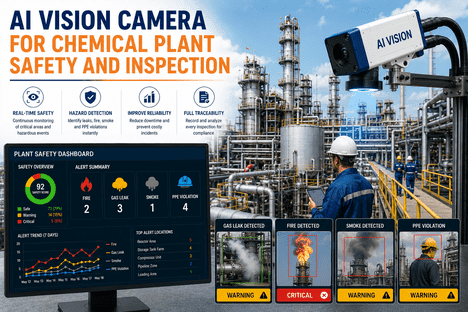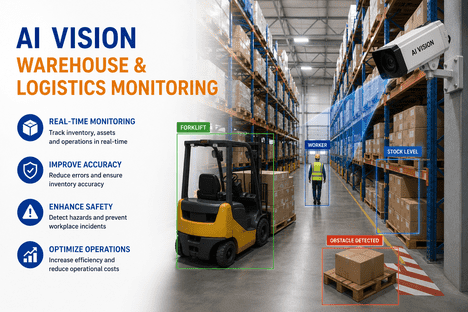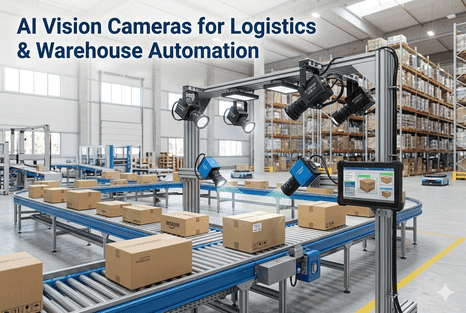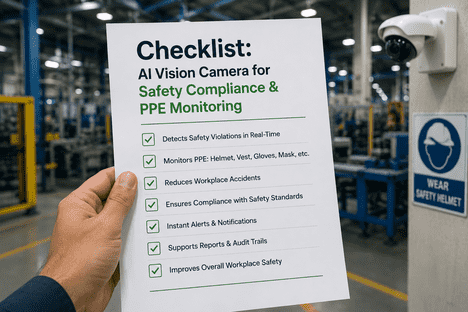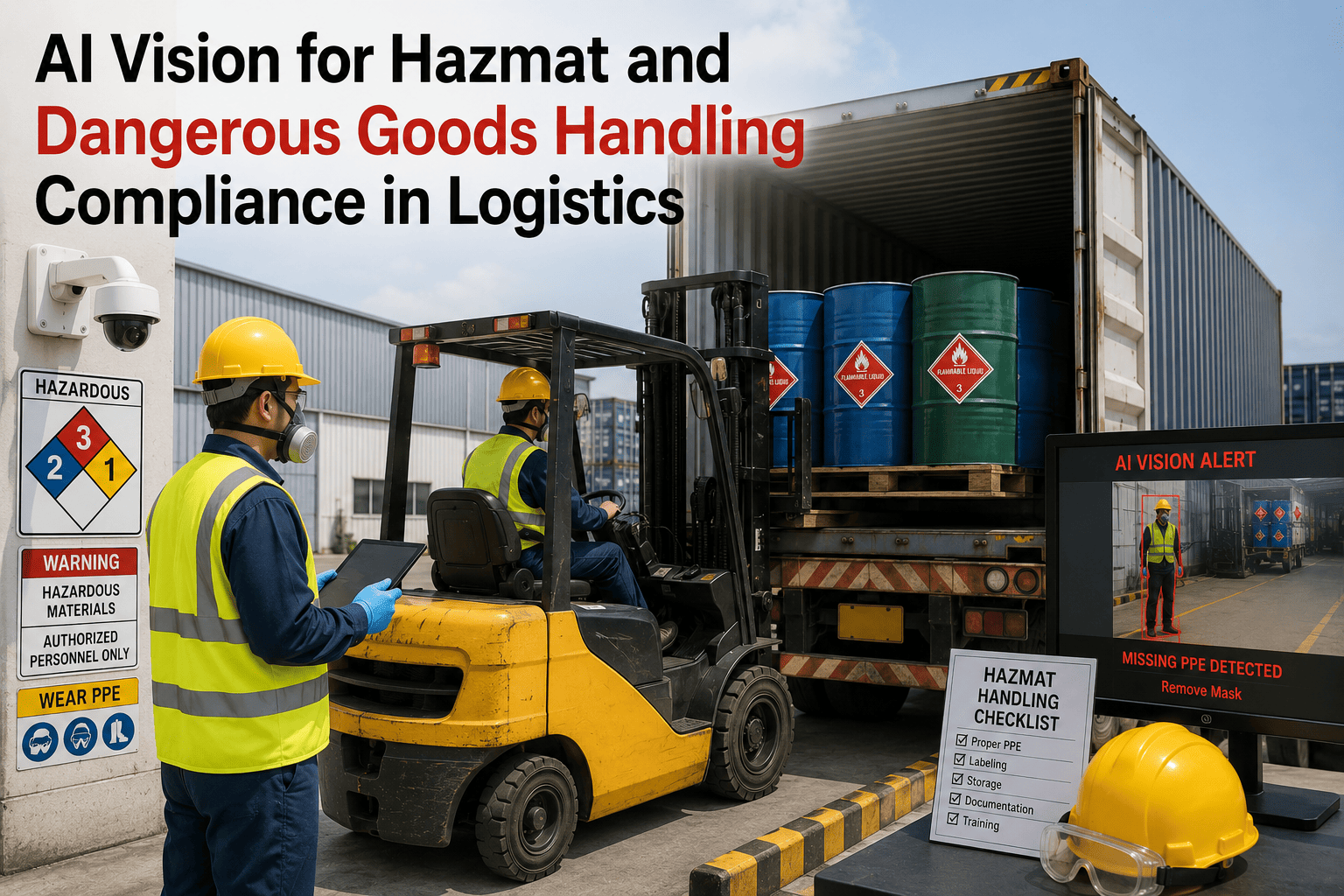
A mislabeled Class 3 flammable pallet on a Class 5 oxidizer rack. A driver loading Division 1.1 explosives adjacent to Class 8 corrosives. A picker handling Class 6.1 toxics without a respirator. Each is a $102,348 federal penalty exposure — and each is invisible until an inspector, an incident, or a fire finds it first. AI vision watches every pallet, PPE moment, and dock loading event continuously — turning DOT hazmat compliance from a paperwork audit into a live, evidence-backed system. See the coverage map on a 30-minute facility walk.
AI Vision for Hazmat & Dangerous Goods Handling Compliance
Continuous camera-based verification of hazmat labeling, PPE compliance, storage separation, and loading rules — mapped to 49 CFR 172, 173, 176, and 177. Every pallet, every handler, every dock door, every shift.
The True Cost of a Hazmat Violation — Line-Item Ledger
Most facilities budget for the DOT fine and stop there. The actual cost of a single serious hazmat handling event runs multiples higher when downstream exposures are counted honestly. The ledger below breaks a mid-severity incident into every P&L line it touches — the number your operations VP quotes in the board room is usually the smallest item on the list. When incident-response labor, product write-offs, shipment rejection fees, insurance renewal uplift, and workers comp claims are added to the DOT civil penalty, the true cost of a single mid-severity hazmat handling event lands in the mid-six-figure range for most logistics operations. This is the number that makes the AI vision business case obvious.
One prevented incident pays for the platform. The next twenty run to the bottom line. Book a fully loaded cost-per-event walkthrough — iFactory will build the number against your facility profile.
Four Compliance Pillars — Each Watched by a Dedicated AI Model
A compliant hazmat operation is not one control — it is four interlocking ones. Labels have to be right on the package. PPE has to be on the handler at the moment they touch it. Segregation has to hold in storage. Loading has to match the manifest at the trailer door. Miss any one and the other three do not save you. iFactory runs a dedicated computer vision model at each pillar, wired to a single compliance dashboard your safety and operations leaders share. Every model is trained on hazmat-specific imagery — placards, hazard diamonds, class-specific PPE combinations, rack configurations, and trailer-load geometries — so accuracy holds even at the operational edges where generic vision systems fall apart. The four pillars are described in sequence below, but they run in parallel from the day the platform goes live.
UN Number, Hazard Diamond, Proper Shipping Name — Verified Package by Package
Cameras at receiving, packing, and dispatch decode every hazard diamond, UN number, and proper shipping name against the shipment manifest and the 49 CFR 172.101 hazardous materials table. Wrong class diamond, missing subsidiary risk label, illegible UN number, or placard-vehicle mismatch is flagged before the pallet moves. Improper labeling is one of the most cited hazmat compliance violations at carrier docks — this pillar eliminates it at the source.
Right Gear, Right Class, Right Person — Zone-by-Zone Enforcement
PPE rules are hazmat-class specific. Class 8 corrosive handling requires chemical gloves and eye protection. Class 6.1 toxic transfer requires a respirator. Class 3 flammable pack lines require anti-static footwear. iFactory pairs zone rules to hazard class and continuously verifies every handler wears the right gear the moment they enter the zone — using existing IP cameras with no wearables required. Sustained PPE compliance climbs from the 60–75% typical of manual observation to 90–98% within 60 days of go-live.
DOT Segregation Table Enforced in Real Time — Not in the Next Audit
The 49 CFR 177.848 segregation table dictates which hazard classes cannot share a rack, which need a minimum separation distance, and which are absolutely prohibited from co-location. iFactory tracks every hazmat pallet's rack coordinates and continuously compares neighbouring loads against the segregation table. Class 8 corrosive liquids adjacent to Class 4 flammables — flagged. Class 5 oxidizer within the minimum separation of a Class 3 flammable — flagged. Every warehouse move becomes a compliance decision, not a discovery.
Right Placard, Right Trailer, Right Segregation on Deck — Verified at the Dock Door
The last chance to catch a hazmat violation is at the dock door before the trailer seals. iFactory's dock camera verifies vehicle placarding matches the load manifest, confirms segregation holds on-deck, checks that incompatible classes are not co-loaded, and validates that quantity thresholds triggering full placarding are correctly declared. Every load event is image-linked to the shipping papers and archived for the retention window regulators expect.
The Segregation Enforcement Matrix — How the AI Reads the Rules
The AI does not "guess" at compatibility. It encodes the DOT segregation table directly. Below is a simplified view of the rule set the vision layer enforces at every warehouse move and every load event. X means never co-locate. O means allowed only with commingle-proof separation. A blank means no restriction. Class 9 has no table row because DOT segregation rules do not apply to it.
| Class | 1.1/1.2 | 1.3 | 2.1 | 2.3 | 3 | 4.1 | 4.2 | 4.3 | 5.1 | 5.2 | 6.1 | 7 | 8-Liq |
|---|---|---|---|---|---|---|---|---|---|---|---|---|---|
| 1.1 / 1.2 | · | X | X | X | X | X | X | X | X | X | X | X | X |
| 1.3 | X | · | X | X | X | X | X | X | X | X | O | X | X |
| 2.1 Flam Gas | X | X | · | · | O | O | O | O | O | O | · | · | O |
| 3 Flam Liq | X | X | O | · | · | · | · | · | O | O | · | · | O |
| 5.1 Oxidizer | X | X | O | · | O | O | O | O | · | · | O | · | O |
| 6.1 Toxic | X | O | · | · | · | · | · | · | O | O | · | · | · |
| 7 Radioactive | X | X | · | · | · | · | · | · | · | · | · | · | · |
| 8 Corr Liquid | X | X | O | · | O | O | O | O | O | O | · | · | · |
Special rule enforced automatically: Class 8 corrosive liquids may never be loaded above or adjacent to Class 4 flammable or Class 5 oxidizing materials — the vision layer flags this as a hard-stop violation even when the segregation table would otherwise permit conditional co-location.
Every Hazmat Move Should Leave an Image Trail — Not a Compliance Gap
iFactory deploys AI vision across labeling, PPE, storage, and loading zones — mapped to 49 CFR 172, 173, 176, and 177 rules from day one. Fixed price. 90-day timeline. Existing IP cameras. Compliance dashboard your DOT auditor can read.
What the Vision Layer Actually Detects — Class by Class
Different hazard classes carry different handling risks and different PPE requirements. The vision layer is trained class by class — the rule enforcement for a Class 3 flammable pack line is not the rule enforcement for a Class 6.1 toxic transfer. Below is what the deployed system watches for at each of the highest-volume hazmat classes in a typical logistics operation. The class-specific detection rules ship with the platform and are tuned to your facility during the shadow-mode phase, so accuracy is calibrated to your actual product mix, container types, and handler workflows before a single alert reaches an operator screen.
Flammable Liquids
Ignition-source detection near open containers, anti-static footwear verification at pack lines, bonding cable presence during pour-off, minimum separation from Class 5 oxidizer racks maintained continuously.
Toxic Substances
Respirator compliance at every handling event, spill-kit accessibility within the zone, permanent segregation from all food-grade SKUs enforced, split-shipment quantity thresholds monitored against manifest.
Corrosive Materials
Chemical-glove and eye-protection verification at every touch event, eyewash station accessibility check, hard-stop enforcement against loading above or adjacent to Class 4 or Class 5 materials on the trailer.
Compressed Gases
Cylinder cap presence, upright orientation on rack, chain or strap securement, minimum separation from ignition sources for flammable gases, oxygen-cylinder separation from combustibles enforced continuously.
Oxidizers
Absolute exclusion from Class 3 and Class 4 racks under the minimum separation distance, packaging integrity check on every touch, ban on wooden pallet contact where regulations require inert-material handling.
Miscellaneous (incl. Lithium)
Lithium-battery placarding validation, watt-hour threshold compliance against carrier bulletins, damaged-cell visual inspection, quarantine-zone integrity for defective or recalled battery inventory.
Incident-Prevention Sequence — From Detection to Documented Closure
A vision system is only useful if the alert lands with the right person, at the right moment, with the evidence attached. The sequence below traces what happens the instant a hazmat violation is detected — from the camera frame to the closed corrective action, timestamped and audit-ready. The whole loop closes inside minutes, not shifts. This is the sequence that separates a compliance dashboard from a compliance system — detection alone changes nothing, but a documented, timestamped intervention with a supervisor signature closes the gap that would otherwise become an incident or a citation.
Vision model flags the event — missing respirator at Class 6.1 zone, wrong placard on trailer, Class 8 pallet racked adjacent to Class 4.
Structured alert with violation type, zone, timestamp, and annotated image lands with the on-shift supervisor and safety lead through the compliance dashboard.
Supervisor intervenes at the zone — PPE corrected, pallet relocated, placard changed, trailer held. The corrective action is logged with the operator response.
Event captured with image, video clip, personnel ID, and corrective action becomes a durable compliance record — presentable to a DOT inspector on request.
Recurring violation patterns roll up by zone, shift, and handler — feeding targeted retraining that closes the same gap at the root, not just at the event.
Manual Compliance Program vs iFactory AI Vision — Head to Head
Most hazmat programs rely on trained handlers, periodic supervisor walks, monthly audits, and paper-based logs. That model was industry-standard for decades. It is also, honestly, structurally incapable of catching a violation the instant it happens — which is the only moment when preventing the incident is still possible. The comparison below is the specific delta, mapped to the capabilities that matter most in a modern hazmat operation — coverage window, alert latency, evidence quality, and root-cause visibility.
| Capability | Manual Program | iFactory AI Vision |
|---|---|---|
| Coverage window | Shift-boundary spot checks | 24 / 7 continuous per zone |
| PPE compliance sustained | 60–75% typical | 90–98% within 60 days |
| Detection to alert latency | Discovered at next audit | Under 4 seconds |
| Label / placard verification | Sampled per shipment | Every pallet, every dock |
| Segregation rule enforcement | Periodic rack walks | Every warehouse move |
| Loading-compliance audit | Manual dock inspector | Trailer-door vision + manifest |
| Evidence for DOT inspector | Paper logs, gaps common | Timestamped image per event |
| Recordable incidents (yr-1) | Baseline | 40–55% reduction |
| Root-cause pattern analysis | Ad-hoc, incident-triggered | Zone / shift / handler rollup |
Want the delta modeled against your current audit frequency and PPE compliance rate? Book a 30-minute benchmark session and iFactory will build the comparison with your numbers.
Deployment Outcomes — What Facilities Actually See
The numbers below are what logistics facilities running iFactory AI vision for hazmat handling have documented across the first year of operation. Not projections — deployment outcomes, tied to specific control mechanisms in the platform. Every metric below can be traced back to a defined pillar and a defined enforcement rule, which is how the platform holds up to scrutiny in a DOT audit or an insurance renewal conversation. The results below represent the median across mid-sized and large logistics operations running the full four-pillar deployment for at least twelve months.
Frequently Asked Questions
Can AI vision really enforce the full DOT hazmat segregation table in real time?
Yes. The 49 CFR 177.848 segregation table is a finite rule set — nine hazard classes, defined X, O, and blank interactions, plus a hard-stop rule for Class 8 corrosive liquids against Class 4 and Class 5 materials. iFactory encodes the full table directly into the segregation-check model, then couples it to rack-coordinate awareness so every warehouse move is validated against the neighbouring loads before the move is confirmed. The system runs continuously, not at audit intervals — which is the only way to catch a violation before an inspector or an incident does. To see the encoded rule set walked through against your rack layout, book a segregation-model demo.
Do we need new cameras and hardware for a hazmat compliance deployment?
In most facilities, no. iFactory works with existing IP and CCTV camera infrastructure — 2MP or higher resolution RTSP streams feed the on-prem edge inference cabinet, and the vision models run against your current feeds. Where a specific hazmat zone lacks camera coverage or has lighting or angle issues that would compromise label decoding or PPE detection, iFactory scopes supplemental cameras and lighting during the facility walk in phase one. Most deployments add coverage in fewer than a dozen strategic spots and reuse the rest of the existing camera plant, which is why the 90-day timeline holds even for large distribution operations.
How does the system handle handler privacy — is this employee surveillance?
The vision layer is compliance-scoped, not identity-scoped. The default model detects PPE presence, handling posture, and hazmat class interaction — not individual employee identity. Alerts route to the on-shift supervisor with an annotated frame of the zone and event, not a personnel dossier. Facilities that choose to enable handler-linked violation tracking for training and retraining do so through a separate opt-in module reviewed with HR, labor relations, and legal — and it is never a required part of the deployment. The primary value the platform delivers is intervention at the event, not surveillance of the workforce.
How does the compliance evidence hold up in a DOT inspection or a carrier dispute?
Every AI-vision-detected event — every label verification, PPE check, segregation confirmation, and load-manifest reconciliation — is written as an image-linked, timestamped record with the zone, hazard class, and corrective action attached. When a DOT inspector requests documentation for a specific date range, hazard class, or handler zone, the compliance team pulls a filtered log with visual evidence attached to every entry. In carrier-dispute scenarios, the trailer-door load image and the segregation record settle condition and configuration disputes on evidence rather than word. To review the audit-log format iFactory generates, reach out to the compliance team.
What does a realistic deployment timeline and ROI look like for a hazmat operation?
The standard iFactory hazmat deployment runs 90 days from signature to live routing at all four pillars — facility walk and baseline in phase one, camera and lighting engineering in phase two, integration and shadow-mode operation in phase three, threshold tuning and go-live in phase four. Payback timing is driven by the incident-avoidance value at your specific hazmat volume — most operations cross break-even inside the first year, and facilities with recent enforcement history or high Class 3, 6.1, or 8 volumes typically see it faster. To get a facility-specific ROI projection built against your handling volume, incident history, and current audit frequency, book a 30-minute assessment.
Turn Every Hazmat Move Into a Verified, Evidence-Backed Event
Labels verified at pack. PPE confirmed at handling. Segregation enforced at every rack move. Load compliance checked at the trailer door. All four pillars, one dashboard, 90-day deployment, fixed price. Start with one zone, prove the compliance delta, then scale to the operation.