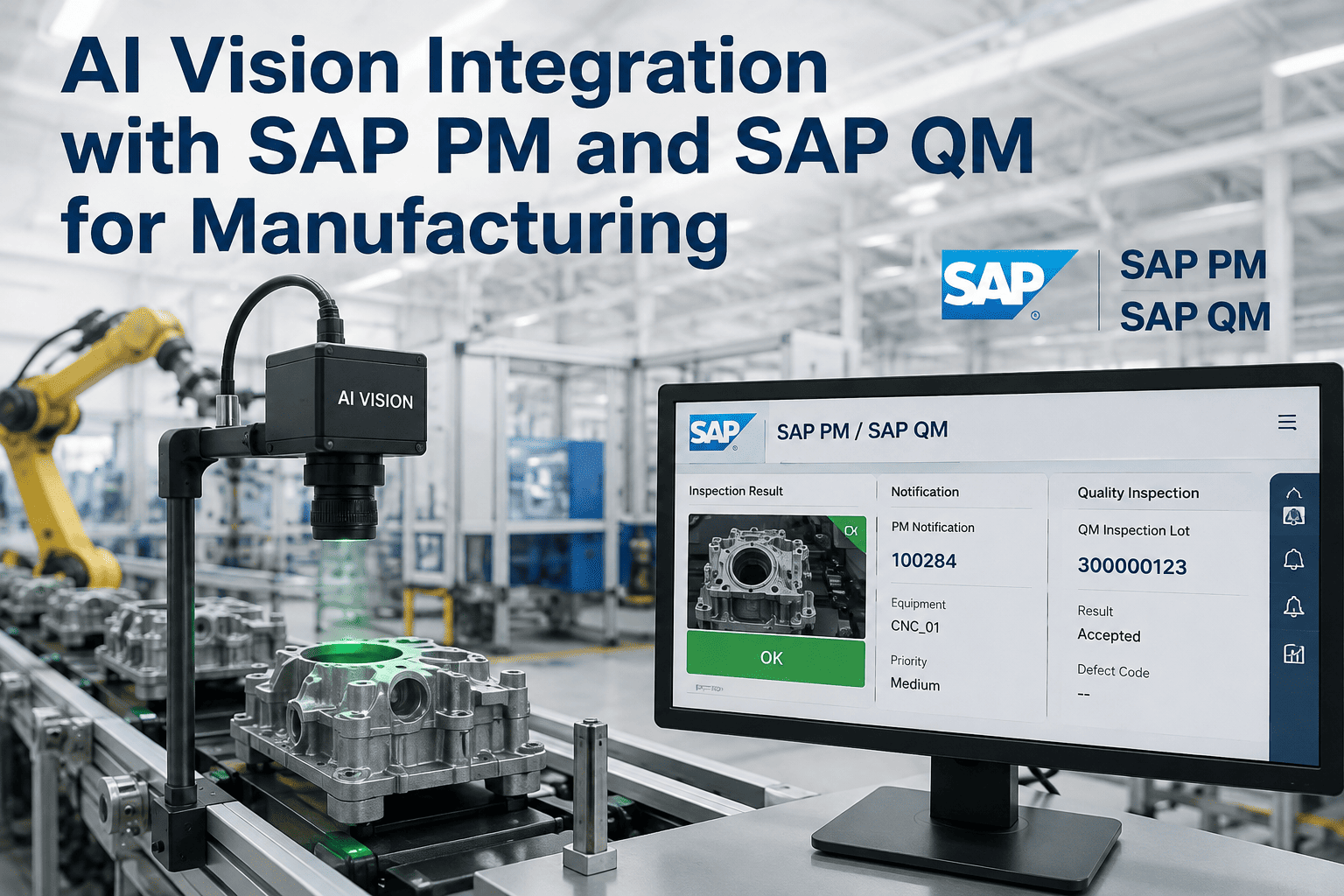
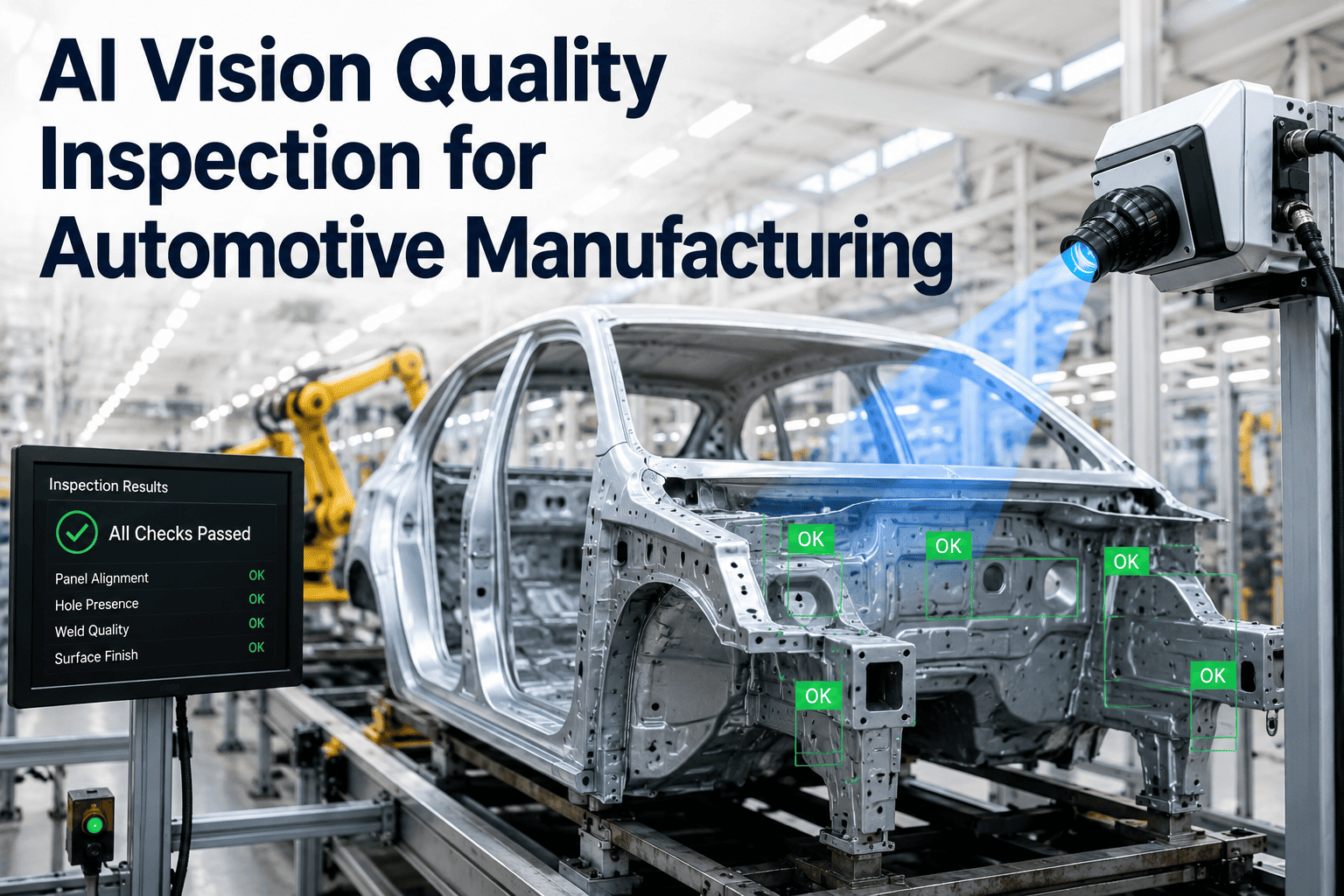
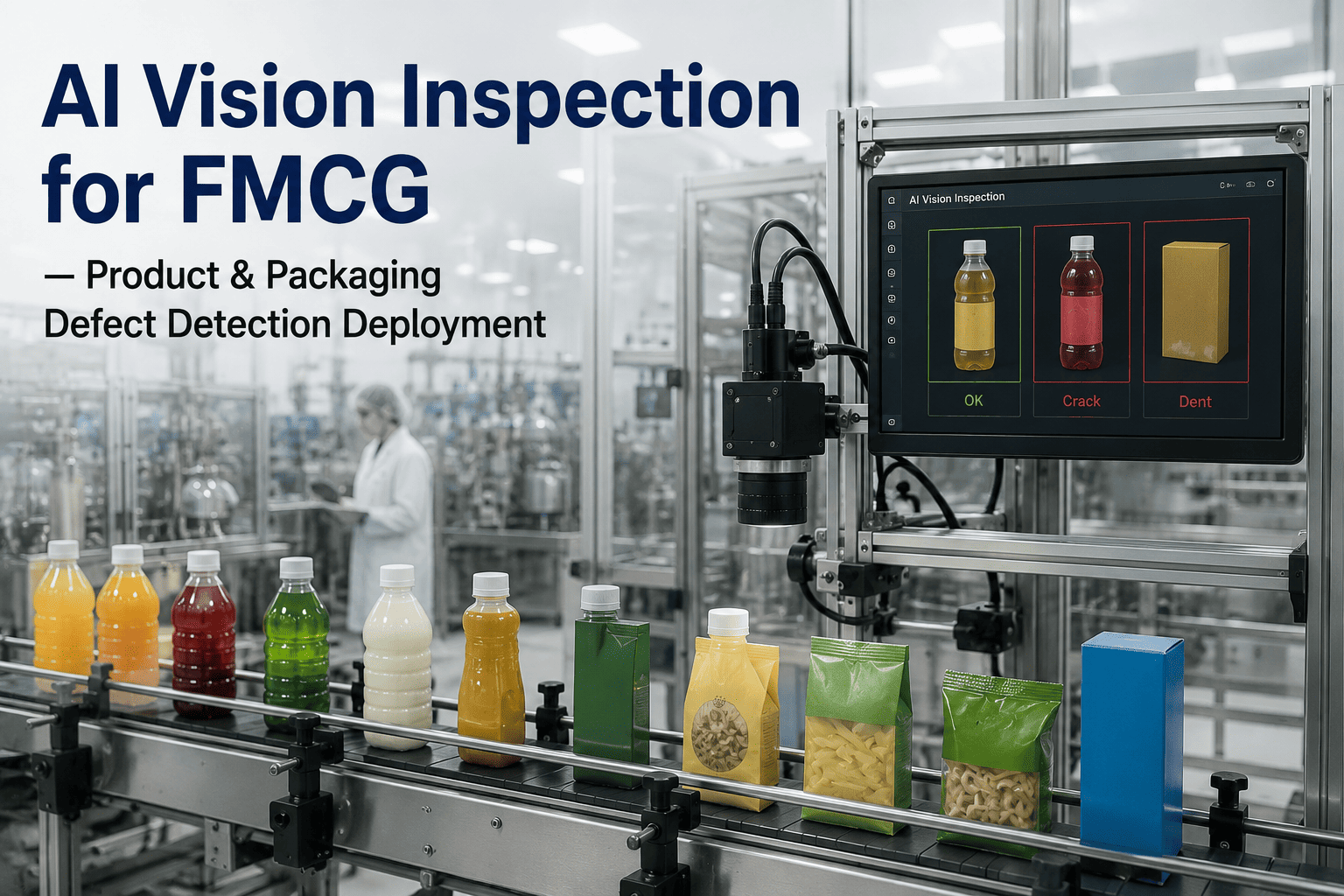
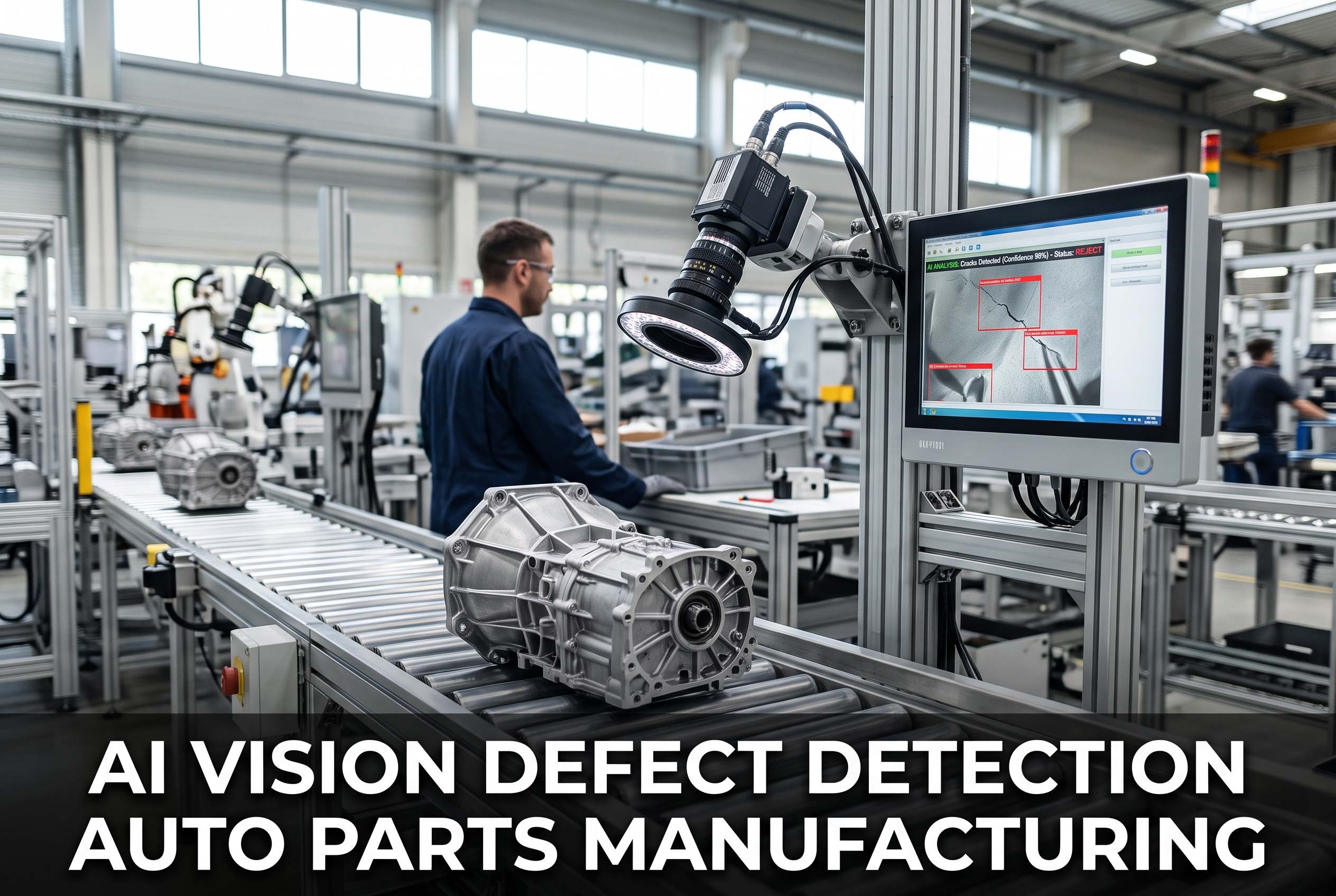
Every SAP-run manufacturing plant sits on the same paradox: the quality data your inspectors capture rarely lives in the same system as the maintenance data your reliability engineers act on, and by the time a defect trend translates into a maintenance notification, the same failure has already produced weeks of scrap. AI vision integration with SAP PM and SAP QM closes that loop — every defect a camera detects flows straight into an SAP QM inspection lot, and every recurring failure pattern raises an SAP PM maintenance notification against the exact equipment causing it. No spreadsheets, no manual transcription, no delay between what the line sees and what SAP knows. Plant IT and quality leaders who want to see a live bi-directional data flow mapped to their own SAP landscape can book a demo with the iFactory integration team.
SAP INTEGRATION · AI VISION · MANUFACTURING · 2026
AI Vision + SAP PM + SAP QM, Working as One System
Real-time defect detection feeds SAP QM inspection lots. Failure trends trigger SAP PM notifications. Bi-directional data flow via OPC UA and REST APIs — no rip-and-replace, no custom middleware sprawl.
Sub-90s
Latency from vision detection to SAP QM inspection lot update via OPC UA event stream
25%
Typical reduction in cost of poor quality once vision events auto-post to SAP QM and SAP PM
6-12 Weeks
Deployment window for a full SAP QM + SAP PM integration, including model training and shadow-run validation
Zero
Manual data entry — every defect logs image evidence, station ID, batch, and equipment tag automatically
The Integration Gap Most SAP Plants Are Living With
Walk any SAP-enabled plant floor in 2026 and you will find the same broken workflow: an operator spots a defect, writes it on a paper log, later transcribes it into a QM inspection result, and only weeks later — after enough repeat defects accumulate — someone raises a PM notification against the equipment that caused them. The delay is not a training problem. It is an architecture problem. Quality data and maintenance data are captured in different systems, at different times, by different people, and SAP QM and SAP PM only start talking once a human bridges them. AI vision integration removes the human bridge entirely. The camera becomes the inspector, the OPC UA stream becomes the data pipeline, and SAP QM and SAP PM update in near-real-time from the same event.
The financial impact of this integration gap is rarely visible in a single line item, which is exactly why it survives budget review after budget review. Scrap generated between a defect first appearing and the corresponding PM notification being raised gets buried in cost-of-quality reports. Repeat maintenance calls on the same equipment tag look like separate incidents in SAP PM rather than symptoms of a single root cause. Warranty claims traced back to escape defects show up months later on a different cost centre. In every case the underlying pattern is the same: quality events and maintenance events are being managed as parallel workflows when they are, in reality, a single closed loop. AI vision integration with SAP QM and SAP PM is the fastest way to make that loop visible in the SAP data model your finance, operations, and reliability teams already use.
Manual Inspection → SAP QM Entry
4-8 hours
Defect Trend → SAP PM Notification
2-6 weeks
AI Vision → SAP QM Inspection Lot
under 90s
AI Vision → SAP PM Notification
2-5 minutes
Time-to-SAP-record: manual inspection workflows versus AI vision integration with SAP QM and SAP PM, based on typical discrete manufacturing benchmarks.
The Bi-Directional Data Flow, Layer by Layer
A working SAP integration is not one connection — it is four coordinated layers moving data both ways. Vision detections flow up through OPC UA into SAP QM and SAP PM. Master data, inspection plans, and equipment hierarchies flow back down from SAP so the camera knows what it is looking at and which equipment tag to attribute a defect to. This is where most standalone vision projects stall: they can post an inspection result, but they cannot receive a product changeover signal from SAP, and they cannot map a defect to the right SAP equipment number. The layered architecture below is how iFactory keeps both directions live.
The four-layer split matters because each layer has a different owner in most manufacturing organisations. The edge layer belongs to the automation team. The transport layer belongs to OT and IT infrastructure. The SAP layer belongs to the business systems team. The feedback layer touches all three plus quality engineering. Trying to build a monolithic integration that ignores those ownership boundaries is exactly why so many vision-to-SAP projects run past their timeline and land under-scoped. iFactory's layered architecture gives each team a clean interface: automation owns the OPC UA node structure, IT owns the REST endpoint authentication, SAP Basis owns the inspection lot and notification objects, and quality owns the mapping between vision defect classes and SAP defect catalogue codes. Everyone stays in their swim lane, and the integration is faster to build, easier to audit, and simpler to hand over to steady-state support.
LAYER 1 · EDGE
Camera + NVIDIA Edge Inference
On-prem GPU runs the vision model at sub-50ms per part. Every inspection produces a structured event: PartID, DefectClass, Confidence, Timestamp, ImageRef, and Station ID.
→
LAYER 2 · TRANSPORT
OPC UA + REST API Broker
OPC UA nodes expose inspection results to SCADA, historian, and MES clients. REST endpoints handle scheduled batch synchronisation with SAP QM and SAP PM. MQTT is available for high-frequency event fan-out.
→
LAYER 3 · SAP
SAP QM Inspection Lot + SAP PM Notification
Confirmed defects post to SAP QM as inspection results with usage decision recommendations. Defect patterns above threshold raise SAP PM notifications with equipment tag, damage code, and priority pre-filled.
→
LAYER 4 · FEEDBACK
Master Data + Model Reload
SAP pushes product changeover signals, inspection plan updates, and equipment hierarchy changes back to the vision system, which reloads the correct model in under two seconds.
SAP Object Mapping: What Ends Up Where
Every SAP integration lives or dies on how cleanly vision events map to SAP master data. The table below is the reference mapping iFactory uses across discrete manufacturing SAP landscapes. It works with SAP S/4HANA and legacy SAP ECC without modification to the SAP data model — the vision system adapts to your existing configuration, not the other way around.
SAP AI VISION INTEGRATION · MANUFACTURING · 2026
Map This Integration to Your SAP Landscape
Walk through a live SAP QM inspection lot and SAP PM notification flow, seeded with sample data from your own asset structure and defect catalogue.
Where Vision Events Become SAP Business Value
Integration is only worth building if it changes an SAP business process. The four scenarios below are where AI vision integration with SAP PM and SAP QM produces measurable, auditable savings — the ones plant controllers and quality directors sign off on. Each one replaces a manual bridge with an automated data path, and each one produces its own line of SAP-native evidence for audit, cost-of-quality analysis, and continuous improvement reporting. What separates these scenarios from generic vision deployments is that the value shows up inside SAP itself: inspection lot processing time drops in SAP QM, notification-to-work-order lead time drops in SAP PM, and cost-of-quality figures in SAP CO reconcile against production output in the same reporting cycle rather than a month later. That is the difference between a vision project that adds another dashboard and a vision integration that changes how the SAP-run plant operates.
01
Auto-Posted Usage Decisions
Vision confidence above the accept threshold posts an automatic usage decision to the SAP QM inspection lot. Lots below threshold route to a human reviewer with the annotated defect image already attached — cutting inspection lot processing time by roughly 60% on high-volume lines.
02
Defect-Triggered PM Notifications
When the same defect class recurs on the same equipment tag above a set frequency, the vision system raises an SAP PM notification with the damage code, cause, and priority pre-populated. The reliability engineer sees the pattern before it becomes a breakdown.
03
Closed-Loop Traceability
Every defect image, timestamp, PartID, and inspection result links to the same SAP QM lot, SAP PM notification, and downstream SAP PM work order — auditors follow a single thread from detection to verified correction without touching a spreadsheet.
04
Real-Time Cost of Quality
Aggregated vision data feeds SAP QM defect statistics and SAP CO cost centre reports live, so scrap, rework, and quality-linked downtime show up on the same dashboard as production output — no monthly reconciliation cycle required.
Deployment Path: From First Camera to Full SAP Integration
The mistake most SAP plants make with vision integration is trying to connect every camera to every SAP object on day one. The proven path is phased — prove the pipeline on one line, one inspection type, and one SAP object first, then expand the mapping. The four phases below track the standard iFactory deployment for SAP QM and SAP PM integration. The phasing exists for a specific reason: SAP QM configuration decisions taken at go-live are difficult to reverse, and SAP PM notification rules that generate too many alerts on day one damage maintenance planner trust in the whole system. A shadow-run phase where vision events post to a parallel test client, and PM notifications are logged but not raised, gives the quality and reliability teams time to tune thresholds against real production data before any SAP business process is affected. Plants that skip that step almost always end up rolling back and starting over.
Weeks 1-2
SAP Landscape Audit
Map existing SAP QM inspection types, SAP PM equipment hierarchy, and OPC UA / REST availability. Confirm whether the target line is S/4HANA or ECC, and document the current defect catalogue and damage codes.
Weeks 3-5
Pipeline Build & Model Training
Historical defect images train the vision model. OPC UA nodes are published, REST endpoints authenticated against SAP, and inspection lot / notification payloads are validated against a sandbox SAP client.
Weeks 6-8
Shadow-Run Validation
Vision events post to a parallel SAP QM inspection lot without affecting production quality decisions. Quality engineers review model accuracy against manual inspection results before cutover.
Weeks 9-12
Go-Live & SAP PM Escalation
Full production integration goes live on the pilot line. SAP PM notification triggers activate. Continuous model retraining begins, and the integration pattern is templated for scale-out to remaining lines.
Security, Governance, and On-Premise Control
SAP-run manufacturing environments have specific security and governance requirements that most cloud-first vision platforms cannot meet. Plant data cannot leave the site. Access to SAP QM and SAP PM must respect existing SAP role authorisations. Every integration touchpoint has to be auditable. iFactory's SAP integration architecture is built for those constraints from the ground up: the vision inference layer runs on an on-premise NVIDIA server that never sends inspection data to an external cloud, the REST calls into SAP use standard SAP authorisation roles so a user who cannot raise a manual PM notification cannot indirectly raise one through the vision system either, and every event that touches SAP is logged with the originating vision inference ID for full traceability.
This governance model matters more in 2026 than it did even two years ago. Regulated sectors — automotive under IATF 16949, aerospace under AS9100, medical devices under FDA 21 CFR Part 11 — increasingly require that every automated data flow into a validated quality system be traceable back to a specific model version, a specific inference instance, and a specific reviewer or approval rule. iFactory's integration layer stores the model version hash, the inference confidence, and the SAP user context on every event, so an auditor asking "how was this SAP QM inspection lot result generated" gets a complete answer without a forensic exercise. Regulated plants can walk through their specific compliance requirements with the integration team on a
book a demo session.
What Plant IT and Quality Leaders Are Reporting
Before the integration, our QM data lived in one silo and PM notifications in another — and the bridge between them was a maintenance planner with a spreadsheet. Now every recurring defect on the trim line raises an SAP PM notification the same day, with the annotated image already attached. Our repeat-defect rate on that line dropped by roughly a third in the first quarter after go-live, and our SAP QM audit prep time is a fraction of what it used to be.
Plant IT Lead · Tier-1 Automotive Component Manufacturer · SAP S/4HANA Landscape
Frequently Asked Questions
The questions below are the ones SAP Basis teams, quality directors, and reliability engineers ask most often in the first scoping call. Each answer is written to be a straight, technical response rather than a marketing summary — the level of detail an SAP-run manufacturing plant actually needs to make a build-versus-buy decision on a vision integration project. If your specific SAP landscape, defect catalogue configuration, or equipment hierarchy raises a question that is not covered here, the fastest path to a precise answer is a walkthrough with the integration team against your own SAP environment.
Does this integration work with SAP S/4HANA and legacy SAP ECC?
Yes, iFactory AI vision integration works with both SAP S/4HANA and legacy SAP ECC landscapes without requiring modification to the SAP data model. The integration layer uses standard SAP interfaces — OData services and REST APIs on S/4HANA, BAPIs and IDoc structures on ECC — so the vision system adapts to your existing configuration rather than forcing an SAP upgrade. Plants running a mix of S/4HANA and ECC across different sites can standardise the vision pipeline while each site keeps its current SAP version. Teams with a specific landscape can
book a demo for a live compatibility walkthrough.
How does the vision system decide when to raise an SAP PM notification versus a QM inspection lot entry?
Every confirmed defect flows to SAP QM as an inspection lot result — that is the default path for every part inspected. SAP PM notifications are triggered separately, when a defect pattern crosses a configurable threshold on the same equipment tag: for example, three of the same defect class in a rolling window, or a defect rate above a set percentage over a defined production count. The thresholds are configured per equipment class during deployment, so a critical station can escalate quickly while a lower-risk station accumulates more evidence before raising a PM notification. This prevents alert fatigue on the maintenance side while keeping every quality event traceable.
What protocols does the integration actually use — OPC UA, REST, or IDoc?
All three, depending on the data type and latency requirement. High-frequency, event-driven data — individual part inspection results, product changeover signals, and model reload commands — travels over OPC UA for sub-second responsiveness. REST APIs handle structured business object exchange with SAP: creating inspection lots, posting usage decisions, raising maintenance notifications, and attaching image evidence. IDoc-based exchange is available for legacy SAP ECC landscapes where REST endpoints are not exposed, and MQTT is available for high-fan-out event distribution to historian and analytics platforms. The choice per interface is made during the Weeks 1-2 landscape audit.
Do we need to replace existing SAP QM inspection plans or defect catalogues?
No. The vision system reads your existing SAP QM inspection plans, characteristics, and defect catalogue during master data sync, and maps its own detection classes onto your existing SAP objects. If your defect catalogue codes a scratch as DEF-042 and a paint drip as DEF-108, the vision model outputs the same codes so downstream SAP reports, cost-of-quality analytics, and audit trails continue to work unchanged. This is the single biggest reason SAP quality teams approve the integration: it enhances the SAP QM configuration you already have rather than asking you to rebuild it.
How long does a full SAP QM and SAP PM integration take to deploy?
A full integration for one production line — including landscape audit, model training, shadow-run validation, and go-live for both SAP QM inspection lot posting and SAP PM notification triggering — typically runs 6 to 12 weeks. Plants with an existing OPC UA layer and a well-maintained SAP PM equipment hierarchy tend to fall on the shorter end of that range, while landscapes with heavy custom SAP enhancements or legacy ECC without exposed REST endpoints fall on the longer end. Subsequent lines deploy much faster because the integration pattern is templated after the first success. Teams can reach
support for a landscape-specific timeline estimate.
SAP AI VISION INTEGRATION · MANUFACTURING · 2026
Ready to Close the SAP QM and SAP PM Loop?
See a live bi-directional integration between AI vision, SAP QM inspection lots, and SAP PM notifications — mapped against your own SAP landscape, defect catalogue, and equipment hierarchy.