A single leaking fuel rod in an operating reactor sets off a chain reaction of costs that most people outside the industry never see: elevated primary coolant activity, increased liquid and solid radioactive waste volumes, additional demineralizer bed replacements, personnel dose accumulation from investigation and handling, and eventually special handling costs for the spent assembly on its way to storage. Every one of those costs traces back to a defect that either escaped manufacturing inspection or developed during service and was not caught early enough. AI vision inspection changes the economics on both ends — catching manufacturing defects before assemblies leave the fabrication facility, and enabling remote poolside inspection of spent assemblies without putting inspectors in high-dose zones. Nuclear fuel facilities evaluating AI-based visual inspection can Book a Demo to see how iFactory tracks rod-level defects, assembly geometry, and handling compliance in one platform.
AI VISION · NUCLEAR FUEL · REMOTE INSPECTION
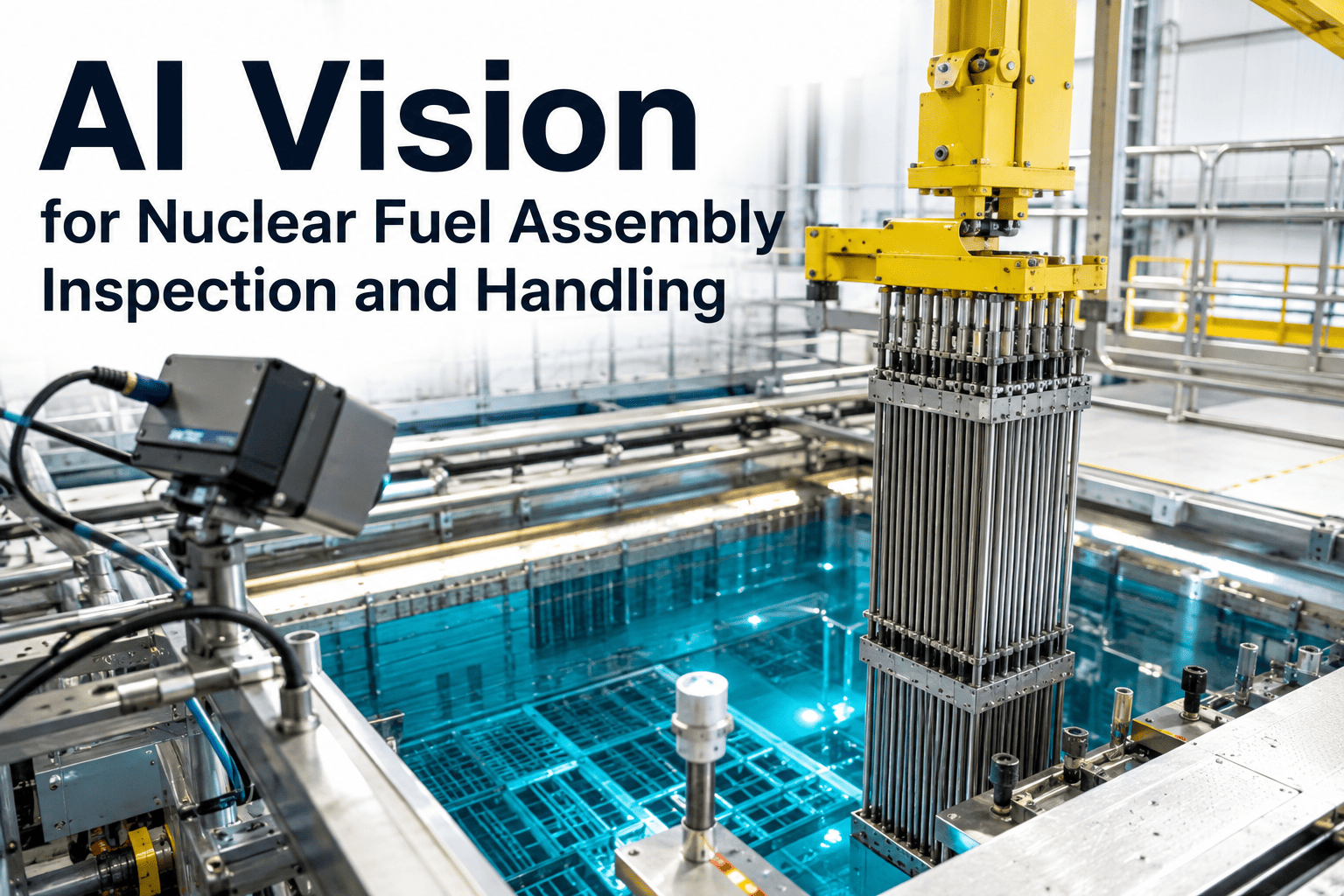
AI Vision for Nuclear Fuel Assembly Inspection and Handling
How high-resolution cameras and deep learning models inspect fuel rod condition, assembly geometry, and handling compliance in fabrication facilities and spent fuel pools — reducing radiation exposure to personnel while improving defect detection reliability across the fuel cycle.
ALARA
Reduced personnel dose accumulation
100%
Rod-by-rod inspection coverage
Audit
Traceable evidence per assembly
Why Fuel Assembly Inspection Is Different From Every Other Manufacturing Inspection
A fuel assembly is not a normal industrial component. It is a bundle of 200 to 300 zirconium-alloy cladding tubes, each roughly 4 meters long, each containing a stack of ceramic uranium dioxide pellets, held in position by spacer grids and end fittings, arranged in a precisely spaced array where every rod position and every geometric dimension matters to safe reactor operation. The cladding itself is the primary containment boundary for radioactive fission products — a barrier in the industry's defense-in-depth safety approach — and inspection of anything that could compromise cladding integrity is treated with a level of rigor that few other manufacturing inspections match. Zero-defect targets are not aspirational language here; they are the working assumption of the entire fuel qualification program.
The second thing that makes fuel inspection different is radiation. Fresh unirradiated assemblies at the fabrication facility can be inspected under normal conditions, but once an assembly has been in a reactor, it becomes intensely radioactive and remains so for years. All post-irradiation inspection happens underwater in spent fuel pools, at distance, through the shielding of the water column — and every minute a technician spends near the pool contributes to their dose accumulation. This is the ALARA principle in practice: dose is kept As Low As Reasonably Achievable, which in inspection terms means using remote camera systems, longer-reach tooling, and increasingly automated visual analysis to keep humans further from the source while still meeting the inspection scope regulators require.
The Fuel Cycle Inspection Map: Where AI Vision Deploys
AI vision does not deploy at one point in the fuel cycle — it deploys at four distinct points, each with different objectives, different radiation environments, and different inspection scope. Understanding which point a facility needs to address first is the sequencing question that determines the entire deployment plan. The map below traces the fuel cycle from fresh assembly fabrication through spent fuel storage, calling out where AI vision inspection creates the most value at each point.
STAGE 1
CLEAN ZONE · NO RADIATION
Fabrication & Fresh Assembly
Rod-level inspection during and after manufacture: cladding surface integrity, end-plug weld quality, dimensional verification, pellet stack integrity via non-destructive techniques. AI vision inspects each rod at full production line speed before it enters an assembly, and inspects the completed assembly for grid position, rod spacing, and overall geometry.
→
STAGE 2
CONTROLLED ZONE · SHIPPING
Shipping & Receipt at Reactor
Pre-shipment inspection at the fabrication facility documents baseline condition. Post-receipt inspection at the reactor site verifies no shipping damage, no debris ingress, no dimensional change. Camera-based documentation creates the reference record against which all future in-service inspections compare.
→
STAGE 3
RADIATION ZONE · UNDERWATER
In-Service & Refueling Outage
Between operating cycles, assemblies are inspected underwater in the spent fuel pool. Objectives include identifying leaking rods for classification, characterizing corrosion and crud deposits, checking grid spring integrity, and documenting any wear from grid-to-rod fretting or debris fretting.
→
STAGE 4
HIGH RADIATION · DRY STORAGE PREP
Long-Term Storage Transfer
Before spent assemblies transfer from pool to dry cask storage, each is inspected and classified. Damaged assemblies require different handling and containment. AI vision inspection at this stage generates the compliance record supporting the classification decision.
FUEL INSPECTION · RADIATION SAFETY · AUDIT COMPLIANCE
Move Personnel Further From the Source, Not Further From the Inspection
iFactory operates AI vision inspection at every stage of the fuel cycle — fabrication, receipt, in-service, and storage transfer — with full traceability per assembly and per rod, keeping personnel dose down and inspection coverage up.
The Defect Taxonomy: What AI Vision Actually Looks For on a Fuel Rod
Fuel rod defects fall into three broad categories that each require different inspection techniques. The taxonomy below draws from IAEA fuel failure investigations, NRC inspection guidance, and hot-cell examination records — the defects listed are the ones that have historically driven fuel classification decisions, licensee event reports, and fuel design changes. Understanding which defects a facility is most likely to see determines what the AI vision model needs to be trained on and what camera and lighting configuration will actually catch them reliably underwater and at distance.
MECHANICAL
Debris Fretting & Grid-to-Rod Fretting Wear
Debris entering the fuel bundle can lodge between spacer grid and rod, causing wear that can penetrate the cladding. Grid-to-rod fretting from coolant-induced vibration produces similar wear at grid contact points. AI vision inspects rod surface at spacer grid elevations for characteristic wear patterns, correlating position against known grid locations for the assembly design.
STRUCTURAL
Grid Damage, Missing Springs, Assembly Bow
Broken or missing grid straps, damaged grid springs, sheared tie rods, and assembly bow are classified as structural defects that affect handling and coolability. Cameras document grid geometry from multiple angles, and pattern-matching against the reference design flags deviations that require classification review under damaged fuel assembly criteria.
CLADDING
Waterside Corrosion, Oxide Flaking, Hydride Localization
Zirconium-alloy cladding oxidizes in service, and excessive oxide thickness or spalling can concentrate hydrogen in cold spots, creating brittle hydride regions that threaten integrity at high burnup. AI vision analyzes cladding surface color and texture across full rod length, flagging localized oxide spalling and unusual color patterns that indicate hydride concerns.
CLADDING
Cladding Cracks, Pinhole Leaks, Hairline Fractures
Anything greater than a hairline crack or pinhole leak classifies the assembly as damaged for storage purposes. AI vision cannot always resolve pinhole leaks directly, but flags surface indicators — discoloration, crud accumulation patterns, localized deposits — that correlate with leak locations identified by complementary techniques such as sipping.
WELD
End-Plug Weld Defects, Incomplete Welds, Seal Anomalies
End-plug welds are the primary seal at each end of the fuel rod. Weld defects are a documented root cause of rod failures. AI vision inspects weld geometry, surface finish, and completion during fabrication before rods enter assembly, catching manufacturing weld defects at the point they can still be corrected without downstream consequence.
SURFACE
Crud Deposits, Contamination Patterns, Surface Discoloration
Crud accumulation patterns and unusual surface discoloration are early indicators of coolant chemistry issues, heat flux anomalies, or localized corrosion. AI vision documents surface condition across every rod, building the historical baseline that lets subsequent inspections flag change rather than absolute condition.
The ALARA Case: Why Remote AI Vision Matters More Than Better Cameras
The most important argument for AI vision in nuclear fuel inspection is not that the cameras see better than human inspectors — although modern high-resolution underwater cameras do resolve detail that direct visual observation cannot. The important argument is dose reduction. Every minute a health-physics-qualified technician spends near a spent fuel pool contributes to their annual dose accumulation. Automated visual analysis, remote camera operation, and AI-based defect flagging reduce the human time required at the poolside — moving the actual analysis to a control room where dose exposure is effectively zero. The comparison below shows what the workflow shift looks like in practice.
TRADITIONAL POOLSIDE INSPECTION
Higher personnel dose · slower coverage
Personnel position
At poolside for full inspection duration
Coverage per shift
Limited by camera positioning time and inspector attention
Defect record
Written notes, tape-recorded video, subjective classification
Repeat inspection
Requires returning personnel to poolside
Consistency
Varies with inspector experience and fatigue level
AI VISION REMOTE INSPECTION
Reduced personnel dose · higher coverage
Personnel position
Control room, camera setup only requires brief presence
Coverage per shift
Continuous automated scanning of full assembly geometry
Defect record
Automated defect map, position-tagged imagery, model-classified severity
Repeat inspection
Reprocess stored imagery without returning to pool
Consistency
Trained model applies same criteria across every inspection
The ability to reprocess stored imagery without returning to the pool is one of the most under-appreciated benefits of the modern inspection stack. When a new defect concern emerges — a new failure mechanism identified industry-wide, a specific assembly flagged by a downstream indicator, or an emerging pattern seen across a fuel type at other operating plants — the AI vision archive can be re-analyzed against the new criteria without any additional personnel exposure. Traditional inspection cannot do this: if a concern emerges months or years after the original inspection, someone has to return to the pool to look again, adding dose that was not planned in the original inspection budget. The archived imagery approach also supports peer review, third-party expert consultation, and regulator review of specific assemblies without ever requiring the physical assembly to be moved or re-imaged.
Dose reduction is not the only ALARA argument for AI vision, though it is the most visible one. The second argument is consistency across time. A human inspector's judgment about what counts as significant oxide spalling or unusual crud deposit pattern varies with experience, fatigue, and the particular examples that inspector has seen recently. An AI model applies the same classification criteria to every rod, every assembly, every shift — and when the criteria need to be updated to reflect new industry experience, the update applies uniformly across the entire inspection archive rather than being caught in the training curve of each individual inspector. Regulators reviewing licensee inspection programs increasingly recognize this consistency as a defensible property of the inspection method, not just an efficiency gain.
The Inspection Stage-Gate Workflow: How a Single Assembly Moves Through
Nuclear fuel inspection is not a single event — it is a stage-gate process where an assembly passes through defined checkpoints, and only assemblies passing each gate advance to the next. Traceability across the stages is what regulators expect and what auditors verify. The stage-gate diagram below walks a single assembly through the inspection workflow AI vision can now automate end-to-end, from raw cladding tube to shipped fresh assembly, with the audit record generated automatically at each gate.
G1
Cladding Tube Incoming Inspection
Raw zirconium-alloy tubes inspected for surface condition, dimensional conformance, and helium leak integrity. AI vision inspects surface at high resolution for any inclusion, scratch, or dimensional anomaly outside specification. Pass/fail record captured per tube by serial number.
G2
Pellet Loading & Column Integrity
Fuel pellets loaded into cladding tube, column verified against specification for count, orientation, and continuity. AI vision inspects pellet surface condition before loading and column integrity after — flagging missing pellet surfaces or pellet-to-pellet gaps that can compromise cladding integrity in service.
G3
End-Plug Welding & Seal Verification
End-plug welds applied at both ends of the loaded rod, then inspected for weld completion, geometry, and surface integrity. AI vision analyzes weld visually against reference specification and flags any anomaly requiring further examination before the rod advances.
G4
Rod-Level Final Inspection
Completed rod inspected end to end for surface finish, dimensional conformance, straightness, and marking legibility. Full rod imagery captured and archived by serial number, creating the baseline reference record for all subsequent in-service inspections across the rod's life in the reactor.
G5
Assembly Build & Geometry Verification
Rods installed in the assembly skeleton with spacer grids, top and bottom nozzles, and control-rod guide tubes. AI vision inspects rod position at each grid elevation, verifies rod spacing across the array, and confirms overall assembly geometry against the design envelope.
G6
Pre-Shipment Documentation & Handoff
Completed assembly photographed and dimensionally verified in shipping configuration. Full inspection archive across all six gates compiled per assembly and delivered with the shipment as the qualification record supporting reactor loading and future in-service inspection reference.
Handling Compliance: Where Vision Watches the Process, Not Just the Part
Fuel handling has its own set of inspection concerns, distinct from fuel condition inspection. Handling errors — a fuel bridge crane movement outside authorized envelope, a fuel handling tool improperly attached to the top nozzle, an assembly placed in an unauthorized storage location, a foreign object entering the pool area — are procedural events that regulators track carefully because they create the conditions for handling accidents. AI vision applied to handling operations watches the process itself: crane position, tool attachment, assembly identity verification against work order, destination location match, and foreign material control. The categories below map where vision-based handling monitoring creates the most value in day-to-day operations and refueling outage sequences.
The distinction between condition inspection and handling monitoring matters because they answer different questions and are typically owned by different parts of the plant organization. Condition inspection answers "is this assembly in acceptable condition to continue in service or transition to storage" — a fuel engineering question. Handling monitoring answers "did every movement of every assembly happen inside procedure with correct authorization" — a fuel handling and operations question. Both benefit from AI vision, and integrating the two into a single platform means the handling record and the condition record are linked per assembly across the entire fuel life cycle rather than sitting in separate systems that have to be reconciled after the fact.
01
Crane Position & Envelope Compliance
Camera tracking of fuel bridge crane position against authorized movement envelope for the current lift, flagging any deviation from planned path or unauthorized zone entry.
02
Tool Attachment & Grip Verification
Visual confirmation that the fuel handling tool has correctly engaged the top nozzle before lift begins — one of the highest-consequence procedural checks in the fuel handling sequence.
03
Assembly Identity Verification
Reading of assembly serial number or identifier against the work-order expected identity, catching cases where the wrong assembly is about to be moved before the movement begins.
04
Destination Location Match
Verification that the destination location — pool rack position, cask cell, or reactor core position — matches the work order specification before the assembly is set down and released.
05
Debris & Foreign Material Watch
Continuous monitoring of the pool surface and handling area for foreign material or debris that could enter the fuel bundle and become the source of future debris fretting events.
06
Time-Stamped Event Log
Every handling action logged with time stamp, imagery, and operator identity — building the traceable record regulators and internal auditors expect for every movement of every assembly.
Frequently Asked Questions
How does AI vision inspection work underwater in a spent fuel pool where lighting and clarity vary?
Underwater fuel pool inspection uses radiation-hardened cameras positioned on remote-operated tooling that provides controlled lighting geometry relative to the assembly under inspection. The water column itself is optically clear when pool water chemistry is maintained to spec, and the depth provides shielding without significantly degrading image quality at the working distances used. AI vision models are trained on underwater imagery from actual pool conditions, so the classification remains reliable across normal variation in water clarity and lighting. Facilities evaluating this can
Book a Demo to see underwater inspection imagery and model output from live deployments.
Can AI vision replace ultrasonic testing and sipping for fuel classification decisions?
No — and any vendor claiming it can should be treated with skepticism. Ultrasonic testing, sipping, and visual inspection each provide different information, and NRC-tracked events have documented cases where ultrasonic testing alone produced misclassifications later corrected by hot-cell examination. AI vision is a strong complement to these other techniques: it improves visual coverage and consistency, generates traceable evidence per assembly, and reduces personnel dose — but the fuel classification decision remains a multi-technique judgment supported by all available inspection data, not any single method in isolation.
What is the difference between inspection during fabrication versus in-service inspection?
Fabrication inspection happens in a clean, controlled, non-radioactive environment where cameras can be positioned freely at optimal distance and lighting, and any rod that fails inspection is simply removed from production. In-service inspection happens underwater on radioactive assemblies where camera positioning is constrained by the remote tooling, lighting is limited to what the tooling can deploy, and the inspection outcome drives operational decisions about assembly disposition rather than production accept-reject. Both use AI vision techniques but with different camera hardware, different training data, and different tolerance envelopes tuned to the operating environment.
How does the inspection record integrate with regulatory reporting and licensee event tracking?
Every inspection generates a traceable record per assembly and per rod, including captured imagery, model classification output, position tags, and inspector confirmation where required. That record integrates with the facility's existing quality management and configuration control systems so the inspection evidence is available for regulatory review, internal audit, and licensee event report support when needed. The audit trail is generated automatically as a byproduct of the inspection workflow — not compiled after the fact — which is what makes the evidence defensible under regulatory scrutiny. Facilities can contact
iFactory Support for integration guidance with existing quality systems.
What personnel dose reduction is realistic to expect from moving to AI vision inspection?
Actual dose reduction depends heavily on the baseline — a facility already using remote camera systems with control-room operation sees less absolute reduction than a facility still doing significant hands-on poolside work. The consistent finding across deployments is that AI vision moves the analytical work from poolside to control room, which reduces the qualified-personnel time near the pool by a large factor even when the physical camera positioning still requires some poolside presence. Under ALARA principles, this reduction is significant regardless of magnitude, because dose reduction is cumulative across a career and reducing exposure that was not strictly necessary is always the right operational choice.
NUCLEAR FUEL · AI VISION · ALARA COMPLIANCE
Bring Fuel Inspection Into the Control Room and the Audit Record Into One Platform
iFactory operates AI vision inspection across fabrication, receipt, in-service, and storage transfer stages of the fuel cycle — with rod-level defect tracking, assembly geometry verification, handling compliance monitoring, and traceable per-assembly evidence records for regulators and internal audit.