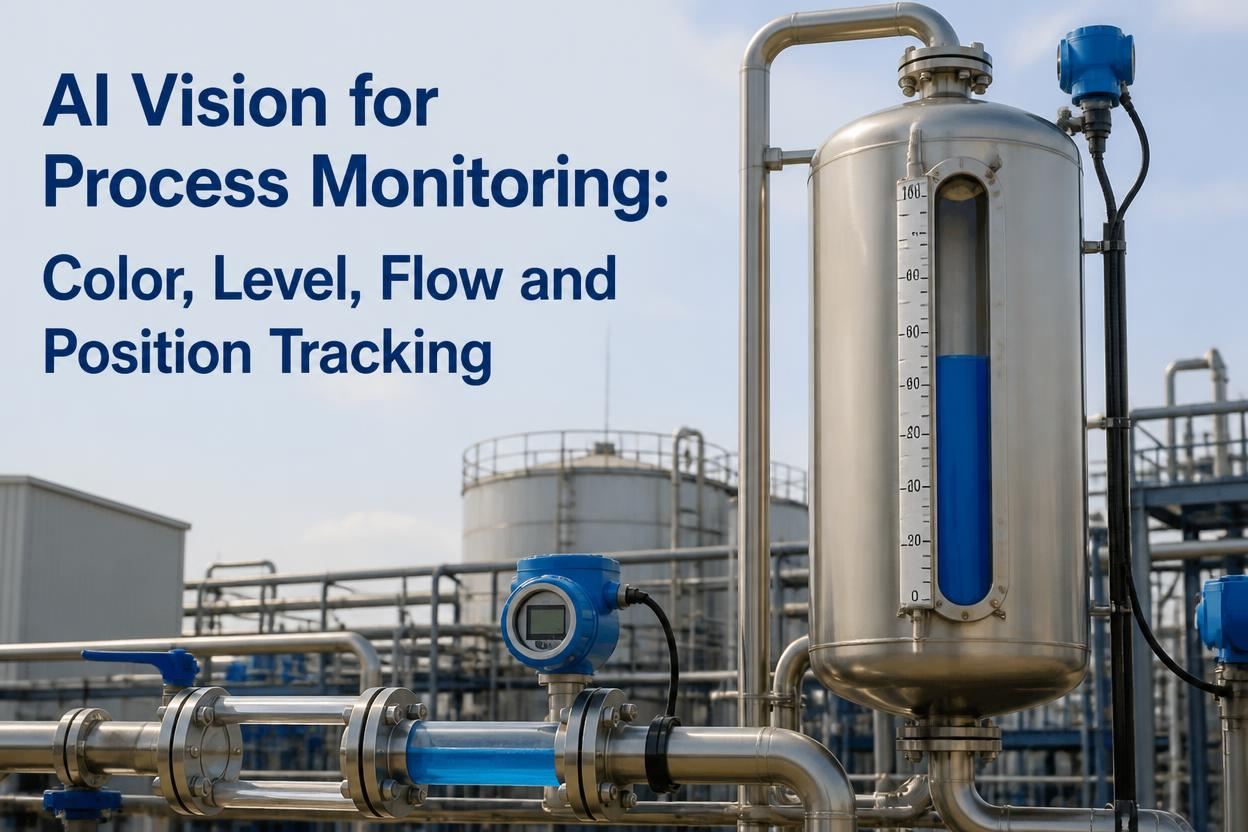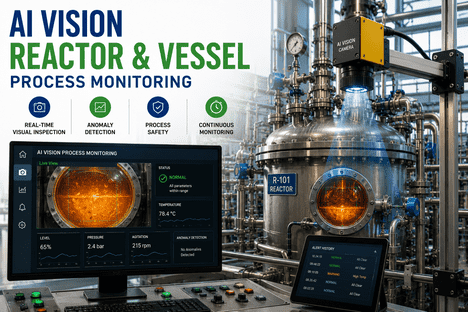
AI vision reactor and vessel monitoring is redefining process safety and operational reliability in chemical manufacturing by delivering continuous, automated anomaly detection at every critical process vessel — without the blind spots, fatigue-related lapses, or limited coverage that manual rounds-based monitoring introduces. Reactors, mixers, and process vessels in chemical production environments undergo rapid and sometimes dangerous condition changes: foaming events that risk pressure relief activation, exothermic color shifts that signal runaway reaction onset, sight glass fouling that obscures critical process visibility, and surface anomalies that precede equipment failures with costly or hazardous consequences. iFactory's AI vision camera platform deploys deep learning anomaly detection models trained on the specific visual signatures of each vessel type and process chemistry — enabling the system to detect foaming onset, reaction color change, sight glass status, condensate accumulation, and surface-level process deviations in real time, at every vessel simultaneously, around the clock. When an anomaly is detected, the system generates an immediate alert to the process team and automatically creates a work order in the connected CMMS with the event image, timestamp, and vessel identification — providing both the fastest possible human response and a structured investigation record for root cause analysis and regulatory compliance documentation.
Why Chemical Reactor and Vessel Monitoring Demands AI Vision
Chemical reactors and process vessels present a monitoring challenge that conventional instrumentation cannot fully address. Pressure, temperature, and flow sensors provide critical process data — but they cannot detect the visual process conditions that precede the most dangerous and costly events: the early foam layer forming at the liquid surface before a foaming excursion pressurizes the vessel, the subtle hue shift in reaction media that indicates an off-spec batch 20 minutes before analyzer confirmation, the sight glass clouding that leaves operators blind to actual vessel contents, or the condensate accumulation pattern on insulated vessel surfaces that signals heat trace failure. iFactory's deep learning vision AI fills the gap between what sensors measure and what trained process operators actually observe during manual rounds — capturing the visual process intelligence that experienced chemists and operators use instinctively, and making it available continuously across every monitored vessel without requiring operator presence. The platform's edge AI architecture processes camera feeds locally at the vessel, enabling sub-second anomaly detection response times without cloud latency dependency — critical in fast-moving exothermic or pressure-sensitive reaction environments where a detection delay of even 60 seconds can mean the difference between a controlled intervention and a process safety event.
AI Vision Anomaly Detection Capabilities for Reactor and Vessel Monitoring
iFactory's AI vision platform covers the full range of visual process monitoring requirements across reactor and vessel types in chemical manufacturing environments. Each monitoring application uses dedicated camera configurations, lighting optimized for the vessel surface and process chemistry, and AI models trained on process-representative image sets for the specific vessel, reaction type, and operating conditions. The platform integrates monitoring data from all vessels into a unified process safety and reliability dashboard, enabling process engineers and operations managers to view anomaly events, trend patterns, and vessel status across the entire monitored fleet in real time.
| Monitoring Application | Visual Signals Detected | AI Capability | Response Output |
|---|---|---|---|
| Foaming Detection | Foam layer formation, foam height progression, surface turbulence change | Deep learning surface state classification with SPC threshold alerting | Immediate operator alert + CMMS work order with foam onset image and timestamp |
| Reaction Color Change Monitoring | Hue shift, color gradient deviation, opacity change, phase separation onset | Spectral AI classification trained on reaction-specific color signature baselines | Real-time deviation alert with color trend log and batch correlation data |
| Sight Glass Status Monitoring | Fouling, condensate accumulation, product deposition, visibility loss | Clarity classification model with fouling progression scoring | Maintenance alert with sight glass condition image and cleaning work order generation |
| Surface and Vessel Anomaly Detection | Corrosion, coating degradation, insulation damage, leak indication, discoloration | Anomaly detection model trained on clean-vessel baseline images | Severity-classified alert with location map and inspection work order |
| Mixer and Agitator Monitoring | Agitation pattern deviation, vortex anomaly, shaft seal leakage, vibration signature | Motion and surface AI analysis with baseline deviation scoring | Operational alert with agitator condition trending and maintenance trigger |
| Level and Interface Monitoring | Liquid level deviation, phase interface shift, emulsion layer formation | Vision-based level measurement as redundant check on instrument readings | Cross-referenced level alert with image evidence and instrument comparison log |
Foaming Detection and Sight Glass Monitoring: The Highest-Value Vision AI Applications
Among all reactor monitoring applications, foaming detection and sight glass status monitoring represent the highest-value AI vision deployments in chemical manufacturing — because both conditions directly affect process safety, product quality, and the operator's ability to make informed control decisions in real time. Foaming events in reactors and fermenters can escalate from initial surface foam layer to pressure relief activation, product loss, or cross-contamination of downstream equipment within minutes. Manual monitoring cannot detect early-stage foam formation between operator rounds, and traditional level instruments cannot distinguish foam from liquid — meaning the first instrument indication of a foaming event often comes when the vessel is already in a hazardous condition. iFactory's AI vision system monitors the vessel surface continuously through sight glasses or camera ports, detecting the characteristic visual signatures of foam onset — surface texture change, bubble layer formation, optical density shift — and generating an alert within one second of detection. This early warning window allows operators to intervene with anti-foam dosing, agitation adjustment, or feed rate reduction before the event escalates, dramatically reducing the frequency of reactive interventions that consume anti-foam inventory, disrupt batch timing, and generate process deviation records. Sight glass monitoring by AI vision addresses an equally critical operational gap: fouled, obscured, or condensate-covered sight glasses are one of the most common sources of operator blind spots in reactor monitoring, and cleaning them requires vessel approach and manual inspection that is hazardous in certain chemical environments. The AI vision system monitors sight glass clarity continuously, detecting fouling progression and triggering a cleaning maintenance order before the sight glass becomes non-functional — maintaining the operator's visual access to the vessel at all times without requiring hazardous manual checks to assess sight glass condition. Learn more about how iFactory's AI vision camera platform is deployed for foaming and sight glass monitoring in chemical production environments, or Book a Demo to see these detection capabilities demonstrated on your reactor type.
Reaction Color Change Detection and Process Anomaly Monitoring
Reaction color change is one of the most informative visual indicators available to process chemists and operators — and one of the most difficult to monitor reliably at scale. In organic synthesis, polymerization, fermentation, and specialty chemical production, reaction color provides real-time indication of conversion progress, catalyst activity, pH deviation, thermal excursion onset, and off-spec product formation. Experienced operators recognize these color signatures intuitively; training new operators to detect and interpret them reliably requires months of supervised observation. iFactory's AI vision color change detection models encode this expert visual knowledge into a continuously operating monitoring system that evaluates reactor contents against batch-specific color baseline profiles, detecting deviations in hue, saturation, and optical density that indicate process anomalies — often 15–30 minutes before offline analytical sampling would confirm the same condition. The system generates graded alerts based on the severity and rate of color deviation, giving operators both the warning signal and the contextual data — trend rate, deviation magnitude, comparison to historical batch profiles — needed to make rapid, informed control decisions. For process vessels where color change indicates a safety-critical condition, such as exothermic runaway onset or incompatible reactant introduction, the system can be configured to trigger an immediate emergency alert to the control room alongside the standard monitoring notification. The iFactory AI vision platform supports color monitoring through standard sight glasses, camera ports, and specialized optical access fittings compatible with pressure vessel requirements in chemical manufacturing environments.
Traditional reactor monitoring relies on pressure, temperature, pH, and flow instrumentation that measures scalar process variables — but cannot capture the multidimensional visual information that trained process operators use to assess reactor health. AI vision monitoring adds a continuous visual intelligence layer to existing instrumentation, detecting process anomalies that appear visually before they cross instrument alarm thresholds. Foaming events, reaction color shifts, sight glass fouling, surface corrosion, and agitator anomalies all have visual signatures that precede instrument detection by minutes to hours. iFactory's deep learning models, trained on vessel-specific image datasets, capture these early visual signals continuously — giving process teams the earliest possible warning of developing process and equipment anomalies across every monitored reactor and vessel simultaneously. Integration with the connected CMMS converts every anomaly detection event into a structured maintenance and investigation record, enabling root cause analysis, failure mode trending, and regulatory documentation that sensor-only monitoring programs cannot provide.
Process Safety Integration and CMMS Connectivity
iFactory's AI vision reactor monitoring platform is designed for integration into existing chemical process safety and maintenance management infrastructure. The platform connects to CMMS systems via OPC-UA and REST APIs, automatically generating work orders from anomaly detection events — a foaming excursion, a sight glass fouling alert, a surface corrosion finding, or a color deviation detection all trigger structured work orders with image evidence, severity classification, vessel identification, and batch context attached. Integration with distributed control systems (DCS) and safety instrumented systems (SIS) provides the process control context needed to correlate visual anomaly events with concurrent instrument readings — enabling process engineers to reconstruct the full sequence of events leading to a process deviation with both visual and instrument evidence. For regulated chemical manufacturers operating under OSHA PSM, EPA RMP, SEVESO III, or site-specific process safety management frameworks, iFactory's platform generates the monitoring records, anomaly event logs, and response documentation that support process hazard analysis updates, management of change documentation, and regulatory inspection evidence. The system's audit trail records every anomaly detection event, alert notification, and operator response action with timestamp and user attribution — creating the complete documentation chain that chemical process safety audits require. Facilities interested in piloting AI vision monitoring on their most critical reactor can Book a Demo with iFactory's chemical industry engineering team for a live demonstration of the anomaly detection and CMMS integration capabilities relevant to their specific vessel types and process chemistries.
Implementation and Deployment for Chemical Process Environments
Deploying AI vision monitoring in chemical reactor environments requires camera hardware, mounting configurations, and AI model training approaches that address the specific challenges of chemical production facilities: corrosive atmospheres, explosion-hazard area classifications, high-temperature vessel surfaces, pressure-rated sight glass access points, and process lighting conditions that vary with reaction stage. iFactory's implementation process begins with a site survey that maps camera mounting positions for each vessel, specifies camera hardware ratings for the hazardous area classification of each installation zone, and designs the lighting configuration needed for reliable visual monitoring of each specific vessel geometry and process chemistry. For hazardous area installations, the platform supports ATEX and IECEx certified camera hardware and remote-mounted edge AI processing units located outside the hazardous zone — ensuring full monitoring capability without compromising area classification compliance. AI model training for each vessel uses image data collected during the site commissioning period, annotated in collaboration with the facility's process engineers and operators to ensure the models learn the specific visual signatures — foaming characteristics, color baselines, sight glass fouling patterns, surface anomaly types — that are relevant to each vessel's chemistry and operating conditions. Model validation is conducted against the facility's own quality acceptance criteria before the system transitions to live monitoring operation. Implementation timelines for chemical reactor AI vision monitoring deployments typically range from eight to fourteen weeks from site survey to live monitoring, depending on vessel count, hazardous area classification requirements, and CMMS integration complexity. Learn more about iFactory's AI vision camera platform and its deployment process for chemical and process industry environments.
Frequently Asked Questions: AI Vision Reactor and Vessel Monitoring
How does AI vision detect foaming events earlier than conventional level instruments?
Conventional level instruments — radar, guided wave radar, differential pressure, and capacitance transmitters — measure the position of a defined interface or aggregate level signal that responds only after foam has developed sufficient density and height to register as a level change. AI vision cameras observe the actual vessel surface continuously, detecting the characteristic optical signatures of early foam formation — bubble nucleation, surface texture change, optical density shift — before the foam layer is thick enough to affect instrument readings. In practical terms, this means AI vision typically detects foaming onset 3–10 minutes earlier than level instrumentation in well-instrumented reactors, and much earlier in vessels where level instruments are positioned above the initial foam formation zone. This detection time advantage is the intervention window that allows operators to respond with anti-foam dosing or agitation changes before the event reaches a hazardous or product-loss-generating severity.
Can AI vision reactor monitoring operate in hazardous area classified chemical environments?
Yes. iFactory's platform supports deployment in ATEX Zone 1, Zone 2, and equivalent IECEx classified areas using certified camera hardware rated for the specific hazardous area classification of each installation location. For Zone 0 environments or cases where certified in-zone camera hardware is not suitable, the system can be configured with remote viewing through existing vessel sight glasses or camera ports, with the camera hardware positioned outside the hazardous zone boundary. Edge AI processing hardware is typically mounted in a control room or classified enclosure outside the primary hazardous zone. Each installation is designed in compliance with the facility's area classification drawings and electrical equipment selection procedures, with documentation supporting the facility's ATEX/IECEx compliance records for the installed monitoring system.
What types of chemical reactors and vessels can iFactory's AI vision platform monitor?
The platform supports monitoring across a broad range of vessel types including stirred tank reactors (STR), continuous stirred tank reactors (CSTR), plug flow reactors, fermenters and bioreactors, distillation column sight glasses, liquid-liquid extraction vessels, crystallizers, evaporators, mixing tanks, and storage vessels with visual monitoring requirements. Each vessel type uses a monitoring configuration tailored to its geometry, sight glass access points, and the specific visual anomalies relevant to its process function. The platform is chemistry-agnostic — AI models are trained on the specific visual signatures of each facility's processes, enabling monitoring across organic synthesis, polymer production, fermentation, specialty chemical, agrochemical, and pharmaceutical API manufacturing environments.
How does the AI vision system handle lighting variation and process condition changes during reaction cycles?
iFactory's AI models are trained on image datasets that capture the full range of lighting conditions and process states the vessel experiences across its normal operating cycle — including startup, reaction phase, completion, and cleaning conditions. This multi-state training approach enables the model to correctly classify vessel status across different reaction stages without generating false anomaly alerts from normal process state transitions. For vessels with significant lighting variation, the platform uses dedicated LED illumination systems at the camera position that provide consistent, controlled lighting independent of ambient facility conditions. Models are periodically retrained as the system accumulates additional production data, improving detection accuracy and reducing false alert rates over time as the model becomes more representative of the full range of normal operating conditions for each vessel.
What process safety and regulatory documentation does the AI vision monitoring system generate?
The platform generates a complete electronic monitoring record for every vessel at every point in time, including continuous status logs, anomaly detection event records with image evidence and timestamp, alert notification records with operator response documentation, and trend reports showing anomaly frequency and severity over time by vessel. These records support OSHA PSM compliance documentation, EPA RMP monitoring evidence requirements, SEVESO III major accident hazard reporting, and site-specific process safety management program audits. For pharmaceutical and FDA-regulated chemical manufacturers, the system generates 21 CFR Part 11 compliant electronic records with full audit trail. Investigation records generated from CMMS work orders triggered by anomaly detection events provide the root cause analysis documentation required by chemical process safety management standards and quality management system corrective action procedures.
Start a Reactor Monitoring Pilot with iFactory AI Vision
Chemical manufacturers evaluating AI vision monitoring for reactor and vessel applications can begin with a focused pilot on their highest-priority vessel — the reactor or vessel where foaming events, sight glass failures, or process anomalies have historically caused the greatest safety, quality, or production impact. iFactory's pilot program includes site survey and camera specification for the selected vessel, AI model training on the vessel's specific process chemistry and visual monitoring requirements, CMMS integration configuration for automated anomaly work order generation, and a 90-day performance evaluation against the facility's defined detection accuracy and false-alert rate targets. Pilot results provide the detection performance and ROI evidence needed to support a facility-wide deployment decision, with the pilot vessel's trained AI models forming the foundation for the broader fleet monitoring configuration. Chemical process engineering teams ready to evaluate AI vision anomaly detection for their reactor monitoring program can Book a Demo with iFactory's chemical industry team for a live demonstration of foaming detection, color change monitoring, sight glass assessment, and CMMS integration on vessel types representative of their production environment.