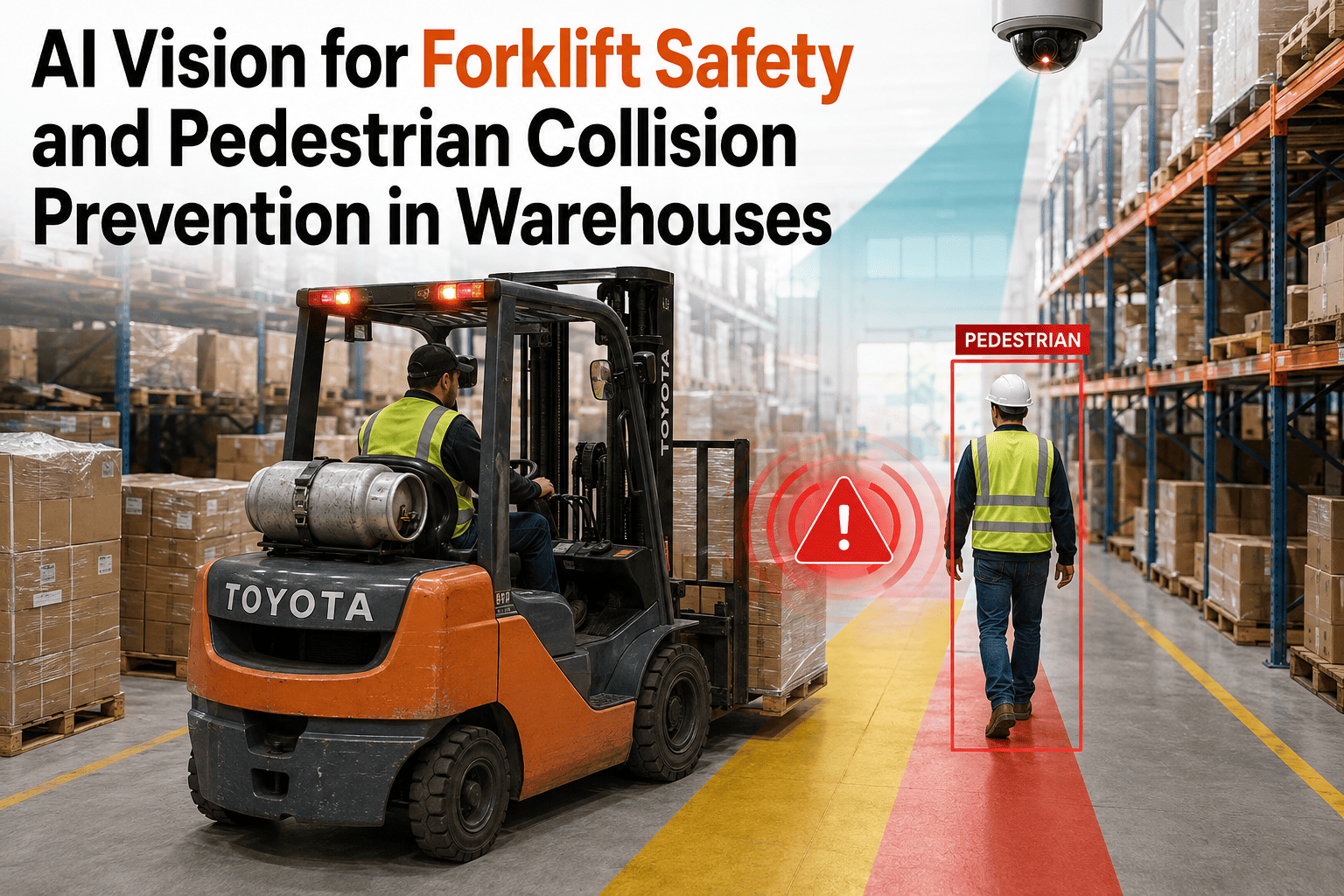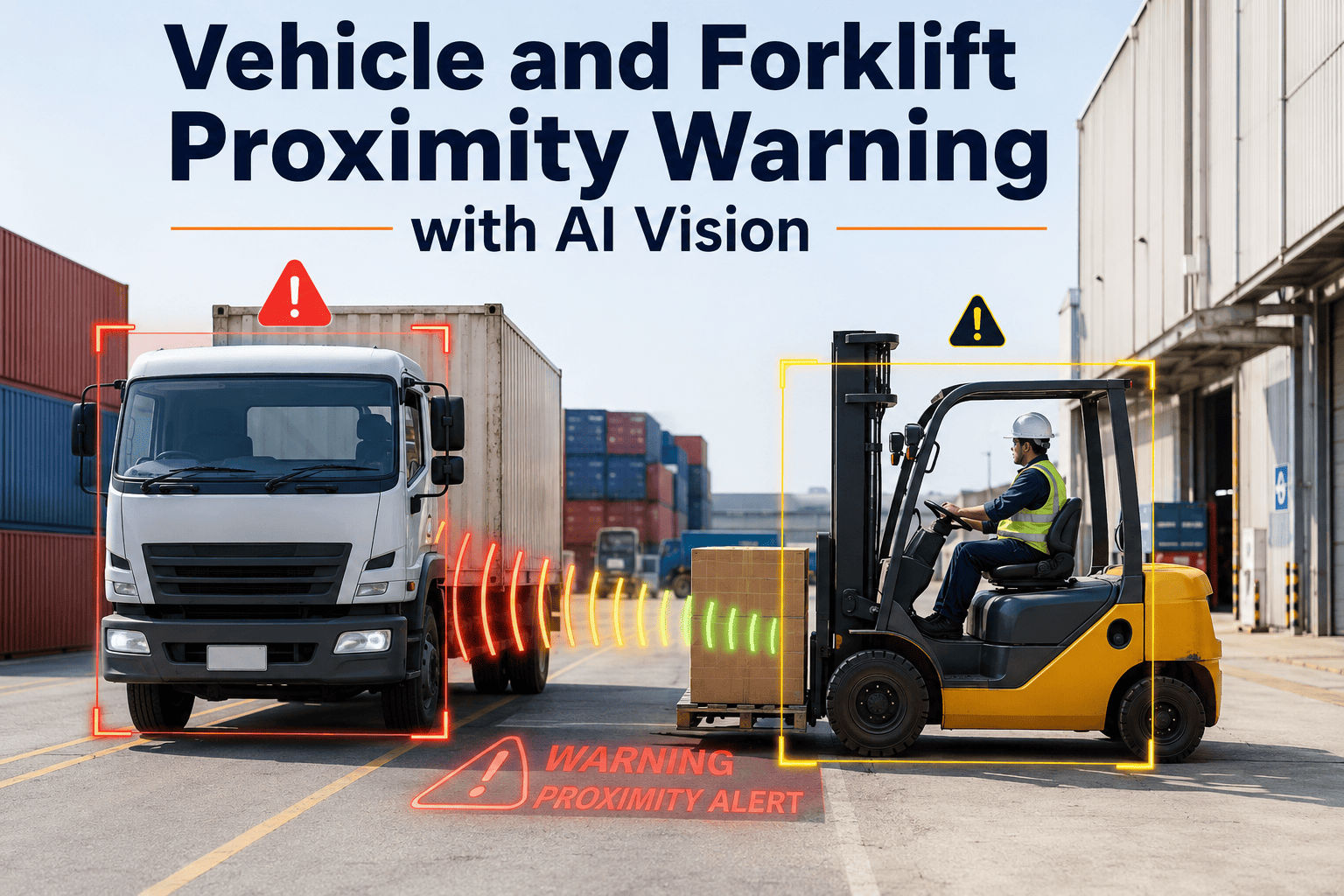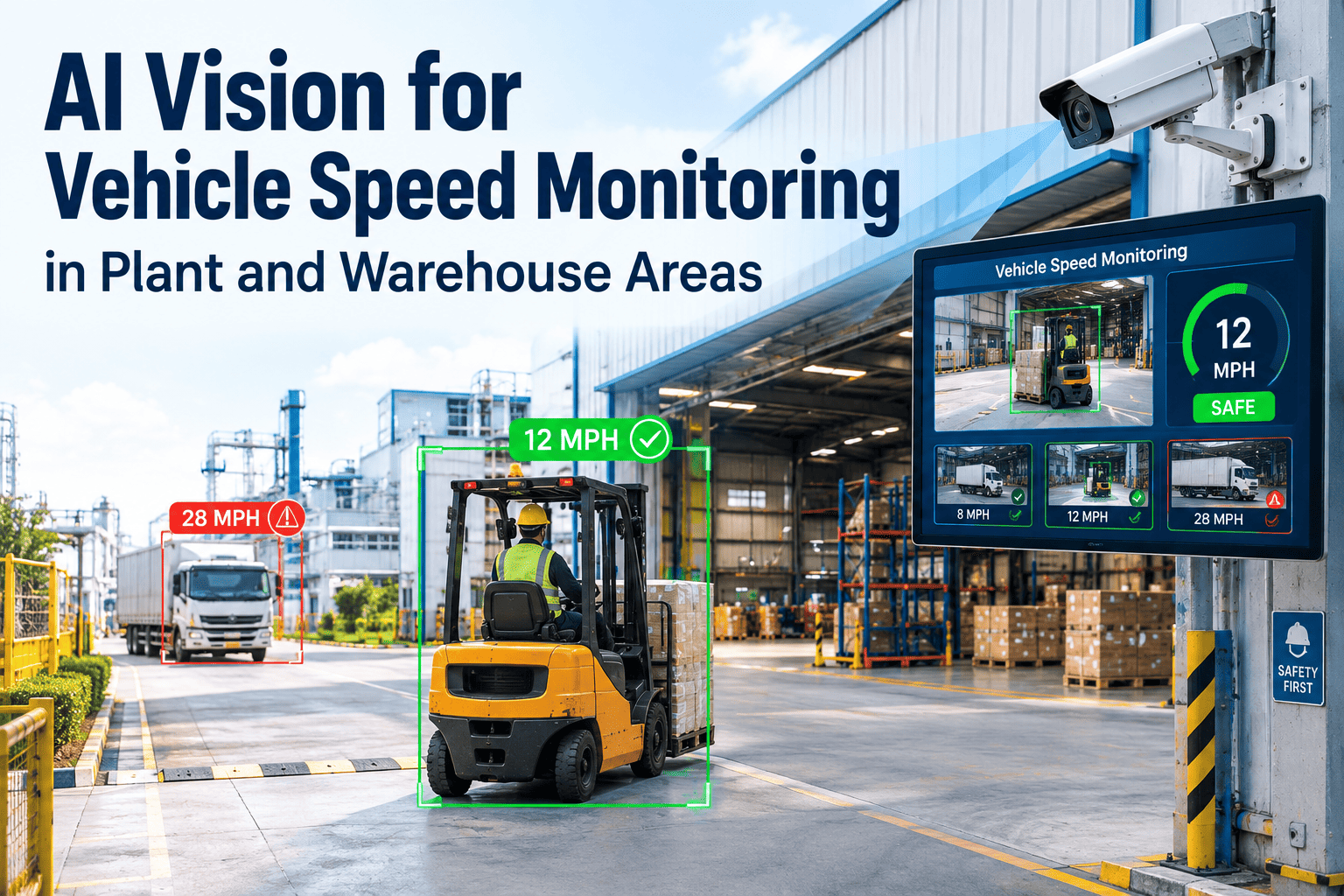
Speed is the variable nobody watches until it causes a rollover. Forklift tip-overs account for roughly 42% of fatal forklift accidents, and the common thread behind most of them is the same: a sharp turn taken too fast, a load carried too quickly through a narrow aisle, an operator racing to hit a pick rate. Posted speed limits exist in almost every plant and warehouse, but enforcement usually depends on a supervisor happening to be looking at the right aisle at the right moment. AI vision removes that dependency, measuring the actual speed of every forklift and vehicle in every zone, continuously, and logging every violation the moment it happens. See how it works on your floor — book a demo with our team.
Every Speed Zone, Every Vehicle, Every Moment
AI cameras measure forklift and vehicle speed against your posted zone limits in real time — triggering instant alerts on violations and building the audit-ready log your fleet and safety program actually needs.
Why Speed Is the Variable That Turns a Turn Into a Tip-Over
A forklift's stability triangle is unforgiving. Sharp turns taken at excess speed push the center of gravity outside that triangle, and the rear-wheel steering design that makes forklifts maneuverable in tight aisles is exactly what makes them prone to rollover when the back end swings wide under speed. Operators under pressure to hit a pick rate take corners they know are borderline, and because there is rarely anyone watching, the borderline behavior repeats until the day it doesn't. OSHA does not set a single numerical speed limit for powered industrial trucks — instead it requires a speed that allows the vehicle to stop safely for the surface, load, and pedestrian traffic in that zone, which means every facility effectively writes its own limits and needs its own way to actually verify operators follow them. That verification gap is the real problem. A posted sign or a line painted on the floor tells an operator what the rule is, but it does nothing to confirm the rule is being followed once the forklift is out of a supervisor's line of sight, and most facilities have far more aisles than they have people watching them.
Speed Isn't One Number — It's a Zone-by-Zone Rule
A safe speed in an open receiving yard is reckless in a narrow picking aisle. Facilities that actually control speed effectively don't post one site-wide limit; they define different thresholds by area, and AI vision is built to enforce exactly that structure, reading the zone a vehicle is in and applying that zone's rule automatically. This zone-aware approach also matches how risk actually distributes across a facility — a handful of intersections and aisles typically account for a disproportionate share of near-misses, and enforcing a uniform limit everywhere wastes attention on low-risk open space while under-protecting the corners and crossings where incidents actually cluster.
Pedestrian Crossings & Intersections
Blind corners and shared aisles where forklifts and foot traffic cross paths. Tightest thresholds, since pedestrians struck by forklifts are the number-one cause of lift-truck fatalities.
Narrow Storage Aisles
Turns into racking with limited sightlines. Speed here is the direct input to tip-over risk given rear-wheel steering geometry and reduced stopping distance.
Dock Doors & Staging Areas
Frequent stop-start traffic with trailers, ramps, and uneven surfaces. Requires speed that accounts for load handling, not just travel.
Yards & Open Floor
Longer sightlines allow higher posted limits, but still require enforcement — open-floor speeding is where operators most often drift above policy unnoticed.
How AI Vision Turns a Camera Feed Into a Speed Log
The underlying mechanics are straightforward, even though the value they unlock is significant. No wearables, no vehicle-mounted radar, and no manual logging — the same fixed cameras already covering your floor become the enforcement layer.
Vehicle Detection & Tracking
The system identifies each forklift or industrial vehicle in frame and tracks its position continuously across the camera's field of view, distinguishing vehicles from pedestrians and static equipment.
Speed Calculation From Motion
Frame-by-frame displacement is converted to real-world speed using calibrated camera geometry, giving a continuous speed reading for every tracked vehicle without radar hardware mounted on the truck.
Zone-Specific Threshold Check
Each measured speed is checked against the limit configured for the specific zone the vehicle occupies at that instant, so the same forklift is judged against different rules in the aisle versus the yard.
Instant Alert & Timestamped Log
A violation triggers an immediate alert to the operator and safety team, and every event is logged with time, location, vehicle, and severity — the record your fleet and safety program runs on.
Supervisor Observation vs AI Speed Monitoring
| Capability | Manual Supervision | AI Vision Speed Monitoring |
|---|---|---|
| Coverage | One supervisor, one aisle, sometimes | Every zone, every vehicle, continuously |
| Detection consistency | Depends on attention and shift fatigue | Consistent across every shift |
| Zone-specific limits | Hard to enforce differently by area | Automatic per-zone thresholds |
| Violation record | Rarely documented, if at all | Timestamped log, every event |
| Feedback speed | After the fact, if noticed | Instant alert at time of violation |
| Audit / OSHA readiness | Sparse, inconsistent | Exportable violation history |
Map Your Own Zones, Set Your Own Limits
iFactory configures speed thresholds per zone against your existing camera infrastructure — no new hardware on every forklift, no wearables, no retrofit downtime.
What an Unmonitored Speed Violation Actually Costs
The financial exposure behind an unenforced speed limit is larger than most safety budgets account for. Roughly 1 in 10 forklifts is involved in an incident every year, and OSHA's own estimates put forklift-related injuries between 35,000 and 62,000 annually across U.S. facilities. When a speeding-related incident happens, the costs stack fast and land in more places than the incident report.
Beyond the direct claim, a serious incident raises the experience modification rate that sets workers' comp premiums for years afterward, and OSHA's warehousing inspection program continues to name powered industrial trucks among the most commonly cited hazards. A speed-violation log that shows the policy is actually enforced — not just posted — is exactly the evidence that supports both insurance conversations and inspection outcomes. It also shifts the conversation after an incident: instead of reconstructing what happened from memory and conflicting accounts, a safety team can pull the exact speed, zone, and timestamp leading up to the event, turning an investigation that might otherwise take days into one that takes minutes.
What Fleet & Safety Teams Get From Continuous Monitoring
The value extends well beyond catching individual violations as they happen. Over weeks and months, the aggregated data becomes a management tool in its own right.
Real-Time Correction, Not After-the-Fact Review
Instant alerts reach the operator and supervisor the moment a threshold is crossed, turning a habit that would otherwise repeat for months into a behavior corrected the same shift it occurs.
Objective Data for Coaching, Not Guesswork
Instead of a supervisor's impression that "someone" drives too fast in the picking aisles, the violation log identifies which vehicle, which zone, and how often — turning safety coaching into a targeted conversation backed by evidence.
Fleet-Wide Pattern Detection
Aggregated violation data surfaces recurring problem zones — a blind intersection, a congested dock approach — the same way it flags recurring high-risk operators, so physical layout fixes get prioritized where they matter most.
Audit-Ready Documentation
Every violation is timestamped, located, and retrievable, giving safety teams a defensible record for internal audits, insurance reviews, and OSHA inspections without reconstructing events from memory.
Where Speed Enforcement Matters Most
Every facility running powered industrial trucks carries speed risk, but the shape of that risk changes with layout, traffic mix, and what's moving through the space. These are the environments where continuous speed monitoring closes the widest gap between posted policy and actual practice.
High-Throughput Distribution Centers
Pick-rate pressure is the single biggest driver of speeding behavior in warehousing. Operators racing against a quota take corners they wouldn't otherwise risk, and with dozens of forklifts moving simultaneously across shared aisles, a single supervisor cannot watch every intersection on every shift. Continuous monitoring holds the same enforcement standard whether it's the first hour of a shift or the last.
Manufacturing Plant Floors
Mixed vehicle types — forklifts, tow tractors, pallet jacks — cross production lines, staging areas, and pedestrian walkways in the same footprint. Speed risk compounds where vehicles must also navigate around fixed equipment and work-in-process inventory, and zone-specific limits matter more here than almost anywhere else in a facility.
Cold Storage & Food Distribution
Wet or icy floor surfaces from temperature transitions extend stopping distances significantly, meaning a speed that's safe on dry concrete becomes dangerous at a cold-dock threshold. Continuous monitoring lets facilities enforce tighter zone limits specifically where surface conditions increase tip-over and collision risk.
Multi-Tenant & 3PL Warehouses
Third-party logistics operations manage shifting volumes, staffing, and client requirements throughout the year, making periodic observation an unreliable way to maintain a consistent safety standard. A documented, site-wide monitoring program provides the behavioral visibility that changing headcount and traffic patterns otherwise erase.
Beyond Compliance: The Operational Case for Watching Speed
Speed monitoring is often framed purely as a safety requirement, but the data it produces has value that extends well past incident prevention. Facilities running continuous monitoring find the same violation log that protects against rollovers also improves how the operation runs day to day.
Identifies Training Gaps Early
A pattern of violations from a specific operator surfaces long before that pattern turns into an incident, giving safety teams a chance to intervene with targeted coaching or refresher training rather than reacting after the fact.
Informs Layout & Traffic Flow Decisions
When violation data clusters around a specific intersection or aisle, that's a signal the physical layout itself may be contributing to the risk — evidence that supports a mirror, a barrier, or a redesigned traffic pattern where it will actually reduce incidents.
Strengthens Insurance & Audit Conversations
Underwriters and inspectors respond to demonstrated controls, not stated policy. A history of continuous enforcement and declining violation rates is concrete evidence a safety program is active, which matters directly to premium calculations and inspection outcomes.
Builds a Safety Culture Backed by Data
When enforcement is visible and consistent rather than occasional, operators internalize the standard faster. Objective data also removes the friction of subjective policing, replacing "someone said you were speeding" with a specific, verifiable record.
Frequently Asked Questions
How accurate is camera-based speed detection compared to radar or telematics?
Vision-based speed detection calibrates against known camera geometry and fixed reference points in the facility, converting frame-by-frame vehicle displacement into real-world speed without requiring a radar unit mounted on every truck. Because it works from your existing camera infrastructure, accuracy is tuned to your specific zones and layout during setup rather than relying on a one-size-fits-all sensor. This approach avoids the per-vehicle hardware cost and maintenance burden that radar or telematics retrofits typically carry across a mixed fleet. Book a demo to see accuracy validated against your own aisles.
Can we set different speed limits for different areas of the same facility?
Yes, and this is central to how the system is designed to work. Since OSHA does not mandate one universal speed number and instead expects a safe speed for the conditions of each area, zone-specific thresholds are exactly what facilities need to enforce in practice. You can define distinct limits for pedestrian crossings, narrow aisles, dock staging, and open yard space, and the system automatically applies the correct rule to each vehicle based on which zone it currently occupies. Contact support to map your zones during setup.
Do we need to install new cameras or hardware on our forklifts?
In most deployments, no new vehicle-mounted hardware is required. The system works with existing fixed camera infrastructure covering the zones you want monitored, avoiding the cost and downtime of retrofitting sensors, tags, or radar units onto every truck in a mixed fleet. This also means the monitoring stays in place even as vehicles are added, leased, or rotated through the facility, since the enforcement lives in the zone, not the vehicle. Book a demo for a compatibility review of your current camera layout.
What actually happens when a violation is detected?
The moment a tracked vehicle exceeds the threshold set for its zone, an alert is triggered to the operator and, depending on configuration, to the safety team or supervisor on shift. The event is simultaneously logged with a timestamp, location, vehicle identifier, and severity, building a permanent, exportable record rather than a moment that passes unnoticed. Over time this log becomes the dataset that reveals which zones, shifts, or vehicles carry the most risk. Contact support to see a sample violation report.
How does a speed violation log actually help during an OSHA inspection or insurance review?
Warehousing inspections continue to name powered industrial trucks among the most common hazards reviewed, and insurers price workers' comp premiums heavily on claims history and demonstrated risk controls. A documented, timestamped violation history shows an active enforcement program rather than a posted policy nobody checks — evidence that supports both audit outcomes and conversations with your carrier about experience modification rates. Book a demo to see what an exportable report looks like.
Turn Posted Speed Limits Into Enforced Ones
A limit painted on a wall doesn't stop a tip-over. Continuous AI vision monitoring does — measuring every vehicle, applying every zone's rule, and logging every violation so your safety program has proof, not just a policy.