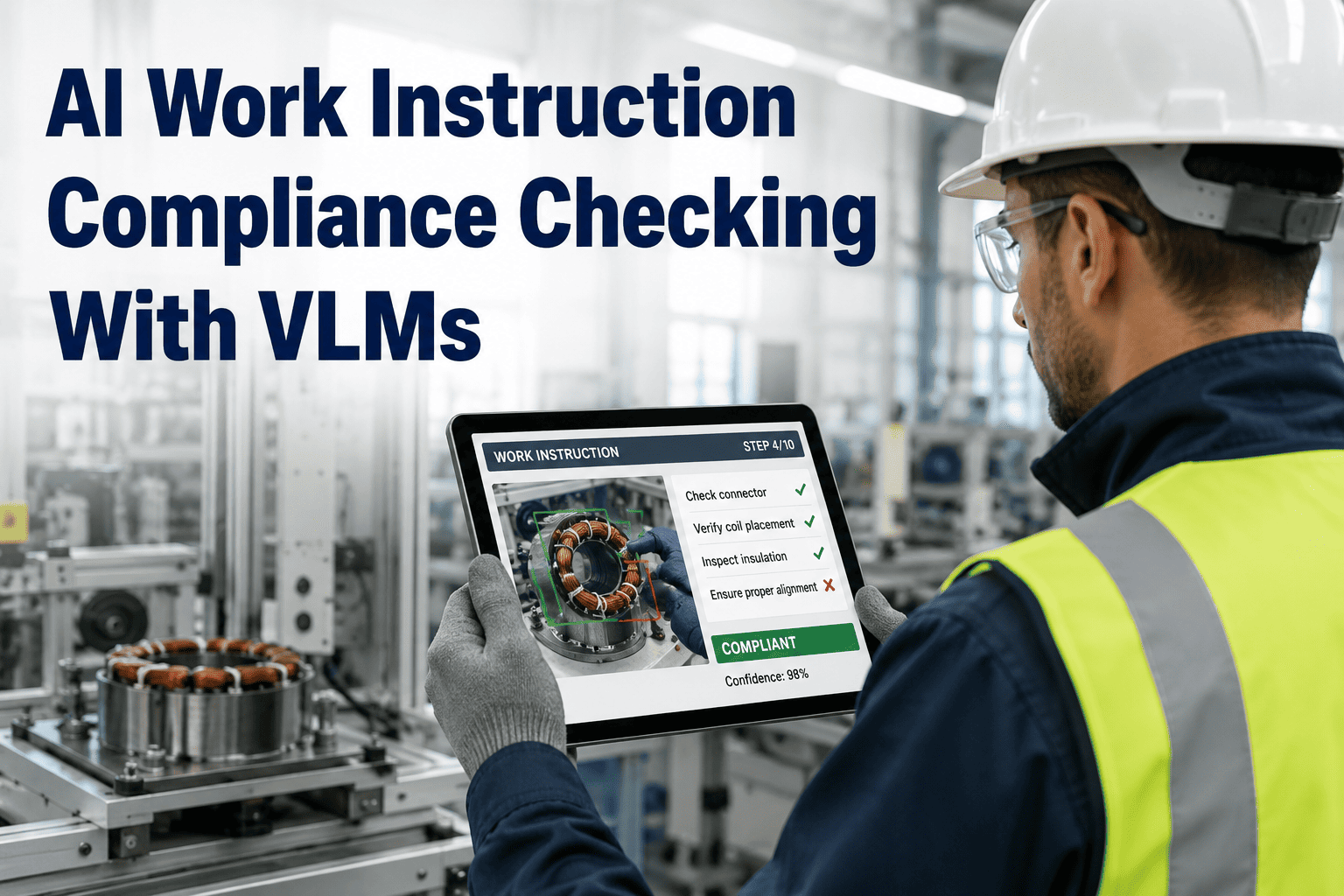
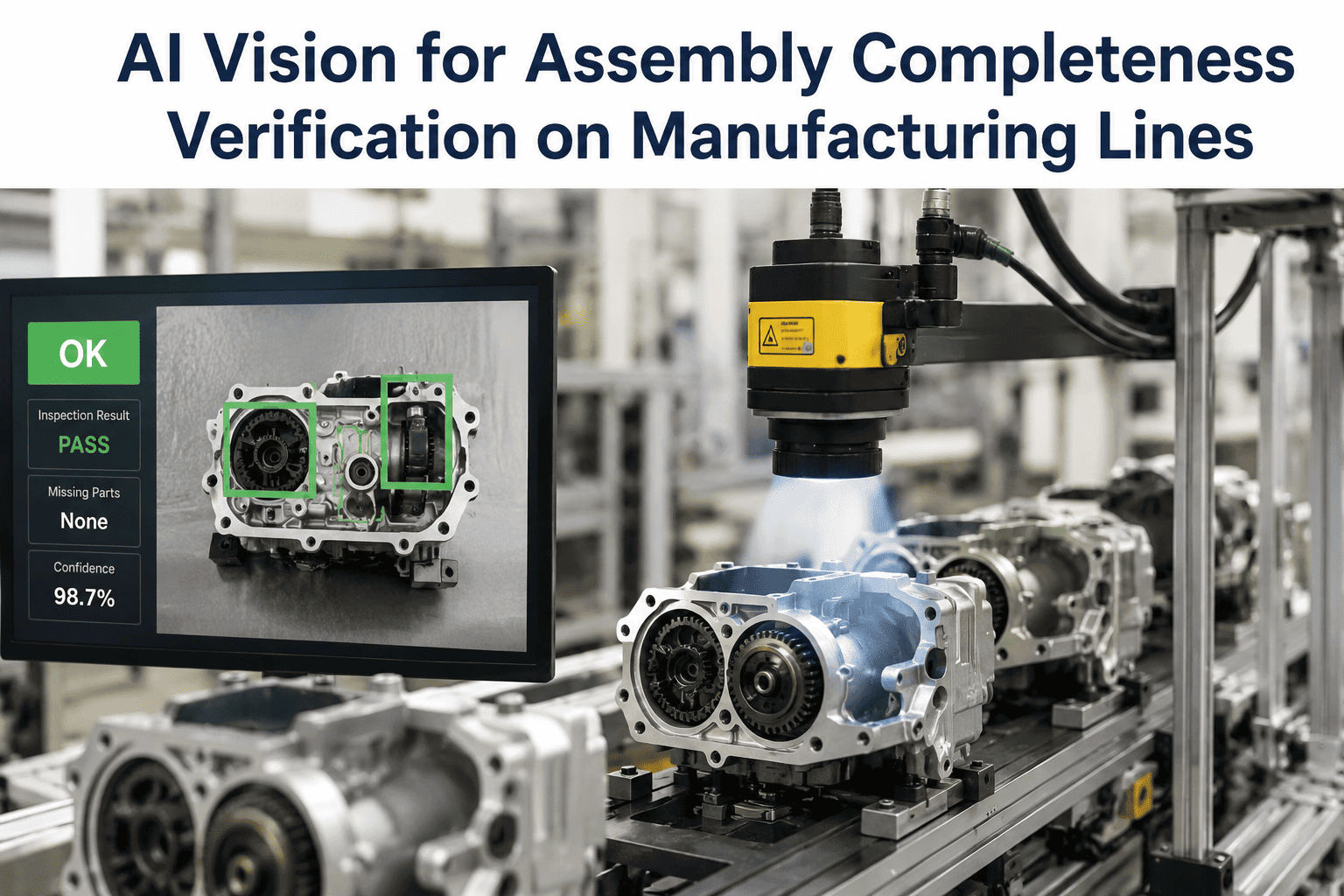
Human error accounts for roughly 80 percent of quality defects on production lines, and the majority of those errors are not carelessness, they are skipped steps, wrong sequence, or a swapped part that looked close enough in the moment. Written work instructions and laminated SOPs cannot catch any of this because nobody is standing at every station cross-checking each motion against the document. Vision language models change that by watching the actual work happen and comparing it, step by step, against the approved procedure in plain language rather than a rigid template. iFactory deploys VLM-based work instruction compliance checking directly at the station, verifying that each step was performed, in the right order, with the right parts, before the unit ever reaches a downstream inspection point. You can book a demo to see a real work instruction verified against your own station footage.
VLM COMPLIANCE CHECKING · WORK INSTRUCTIONS · REAL-TIME VERIFICATION
Was the Step Actually Done Right, Not Just Was Something There
Traditional vision answers "what object is in the frame." iFactory's vision language models answer the question quality actually depends on: was this task performed correctly, in the right order, and according to the approved work instruction, at the exact station where getting it right or wrong determines everything downstream.
TRADITIONAL VISION
"Is there a bolt in this location?"
VS
VLM COMPLIANCE CHECK
"Was the bolt torqued to spec, in the correct sequence, after the gasket was seated?"
WHY WRITTEN SOPs QUIETLY FAIL ON THE FLOOR
Four Ways Manual Procedure Adherence Breaks Down
Work instructions are written with full confidence that operators will follow them exactly, every cycle, every shift. In practice, procedure adherence degrades in a small number of predictable, well-documented ways, and none of them show up until the defect appears somewhere downstream, often after the unit has already left the station where the deviation happened. Researchers studying manual assembly classify these deviations into a small, consistent taxonomy, and the pattern holds across industries from automotive to electronics: the failure is rarely a single catastrophic mistake, it is a small, repeatable deviation from the written sequence that nobody was watching for in real time. A supervisor walking the floor might catch one instance in a shift. A camera paired with a model that actually understands the work instruction can catch every instance, on every cycle, without slowing the operator down.
OMISSION
A Step Is Skipped Entirely
A fastener is never installed, a label is never applied, or a cleaning step is missed under time pressure, and nothing downstream catches it until final test.
COMMISSION
A Step Is Done Incorrectly
A part goes in backward, a connector is seated at the wrong angle, or the wrong tool setting is used, producing a unit that looks complete but is not compliant.
TRANSPOSITION
Similar Parts Are Confused
Two components that look nearly identical, such as screws of different length or connectors of different rating, get swapped without any visible sign of a mistake.
TIMING
Steps Happen Out of Sequence
A part is installed before a prerequisite step is complete, which can trap defects, block access for later steps, or compromise a torque or cure requirement.
HOW VLM VERIFICATION ACTUALLY WORKS
From Camera Feed to Pass or Hold Decision in Six Steps
A vision language model compliance system is not a single detection model bolted onto a camera. It is a pipeline that grounds every judgment in the actual written work instruction, so the system's reasoning stays traceable back to the approved procedure rather than a black-box pattern match. This is the fundamental architectural difference from older approaches: a conventional object detector has to be retrained on thousands of labeled images every time a part number, fixture, or sequence changes, while a vision language model can be pointed at the updated text of the work instruction itself and immediately reason about what compliant execution should look like. That difference is what makes real-time, explainable verification practical on a production floor rather than a research demo.
1
Work Instruction Ingestion
The approved SOP, including step sequence, required parts, torque values, and reference images, is loaded as the ground truth the model checks against.
2
Station Camera Capture
Cameras positioned at the workstation capture the operator's hands, tools, and parts throughout the full cycle, not just a single end-of-line snapshot.
3
Action & Object Recognition
The model identifies which step is in progress, which parts and tools are in use, and the sequence position relative to the full work instruction.
4
Language-Grounded Comparison
Rather than matching a rigid template, the VLM reasons in natural language about whether what it observed satisfies the specific requirement written in the SOP step.
5
Pass, Flag, or Hold Decision
Compliant steps pass silently. Deviations trigger an immediate operator alert or a station hold, depending on severity, before the unit advances.
6
Traceable Compliance Record
Every cycle produces a timestamped, unit-linked compliance record that can be pulled for a quality audit, a warranty claim, or a training review.
See Your Own Work Instruction Verified Step by Step
Bring one SOP from a station where errors keep recurring. iFactory will show how a VLM compliance check would have caught the deviation before the unit left that station.
TRADITIONAL COMPUTER VISION VS VLM COMPLIANCE
Why Object Detection Alone Cannot Verify a Procedure
Object detection models such as standard YOLO-class systems are excellent at answering narrow, fixed questions like whether a bolt is present in a bounding box. Verifying a full work instruction requires reasoning about sequence, context, and intent across an entire task, which is exactly the gap vision language models are built to close. The distinction matters most in the messy middle of real production, where a part is present but installed at the wrong angle, or a tool made contact with the right location but at the wrong point in the sequence. A bounding box model has no vocabulary for describing that kind of deviation, while a language-grounded model can express it in the same terms a quality engineer would use when writing up a deviation report.
| Capability |
Traditional Object Detection |
VLM Compliance Checking |
| Question it answers |
Is object X present in this frame |
Was this step performed correctly per the SOP |
| Sequence awareness |
None, evaluates single frames independently |
Tracks step order across the full task cycle |
| New SOP or variant setup |
Requires retraining on new labeled images |
Reconfigured from the updated written instruction text |
| Explaining a flagged deviation |
Confidence score with no readable reasoning |
Plain-language explanation tied to the specific SOP step |
| Handling near-identical parts |
Struggles without extensive fine-grained training data |
Uses contextual and textual cues to disambiguate |
| Audit and training use |
Raw detection logs, limited readability |
Human-readable compliance record per unit and step |
WHAT SHOWS UP IN THE NUMBERS
The Cost Picture Work Instruction Drift Creates
The financial case for real-time compliance checking is not theoretical. Independent studies of manual assembly and quality data point to a consistent, sizable share of defects, downtime, and recalls tracing directly back to procedure deviations that nobody caught in the moment. What makes these numbers persuasive to a plant controller is that they are not concentrated in one exotic failure mode. They show up across categories, in recall costs, in unplanned downtime, in warranty claims, and in the everyday scrap and rework line that quality teams already track, which means a reduction in procedure drift shows up as a broad, compounding improvement rather than a narrow fix to a single problem.
80%
Of quality defects traced to human error, including skipped steps and incorrect sequence
20-30%
Of unplanned production downtime traced back to manual procedure errors
39%
Of manufacturers reporting a single recall event cost over 10 million dollars
17.7%
Share of electronics assembly defects attributed to human error in one documented study
Put a Number on What Procedure Drift Is Costing Your Line
iFactory can estimate the scrap, rework, and downtime tied to procedure deviations on your specific station before you commit to a pilot.
STATIONS THAT BENEFIT MOST
Where Step-by-Step Verification Pays Off Fastest
Not every workstation needs real-time compliance checking. The return is highest where a missed or reversed step is expensive to catch later, where sequence genuinely matters, or where two similar parts are easy to confuse under normal working pace. Plants that have already tried to prioritize stations for this kind of monitoring typically start by pulling the last twelve months of scrap and rework tickets and sorting for the stations where the same root cause keeps reappearing, since that repetition is usually the clearest signal that a written procedure is not being followed consistently rather than a one-off equipment fault.
Torque & Fastening Stations
Confirms every fastener in a multi-bolt pattern is present and torqued in the specified sequence before the assembly moves on.
Wire Harness & Connector Assembly
Verifies each connector is seated fully and routed correctly, catching the near-identical connector swaps that traditional vision misses.
Kitting & Component Staging
Checks that the correct parts and quantities were pulled for the build before they reach the line, preventing a transposition error upstream.
Sealant, Adhesive & Gasket Application
Confirms application coverage and cure-time sequencing where a rushed or skipped step is invisible until a leak or seal failure appears later.
Regulated & Safety-Critical Builds
Creates the unit-level, timestamped compliance record that audits and warranty investigations in regulated industries require.
New Operator Onboarding Stations
Gives new hires real-time correction during the first weeks on a station, shortening the ramp period where error rates are historically highest.
FROM PILOT TO PRODUCTION
How a Deployment Actually Rolls Out
Work instruction compliance checking is deployed station by station rather than as a plant-wide rollout on day one, so the first result lands on the stations with the clearest error history and the fastest payback. The staged approach also protects trust on the floor. Operators and supervisors need to see the system agree with their own judgment before they will rely on it to flag a hold, and the shadow-mode phase is where that confidence gets built, quietly, with real production data rather than a lab demo.
PHASE 1
Station Selection & SOP Digitization
Identify one or two stations with the highest recurring deviation rate and convert their written work instructions into structured, model-readable steps.
PHASE 2
Shadow Mode Validation
The system runs alongside normal production without intervening, logging every step comparison so accuracy can be validated against known outcomes before it starts flagging in real time.
PHASE 3
Live Compliance & Operator Feedback
The system begins issuing real-time alerts and holds, with confidence thresholds tuned to the station's actual tolerance for false positives before expanding to additional stations.
FREQUENTLY ASKED QUESTIONS
What Quality and Production Teams Ask First
How is this different from the machine vision inspection we already run at end of line?
End-of-line machine vision inspects the finished unit for defects that are already visible on the outside, which is valuable but happens after every upstream step has already been completed, meaning rework is the only option once a problem is found. Work instruction compliance checking observes the process as it happens at the station where the step occurs, so a missed fastener or reversed part is caught and corrected in that same cycle, before the unit ever reaches end-of-line inspection. The two approaches are complementary, with station-level checking preventing the defect and end-of-line inspection catching anything that slips through, and together they close a gap that neither one closes alone: prevention at the source plus a final safety net before shipment. You can
book a demo to see both layers working together on a sample line.
Do we need to rewrite our existing SOPs in a special format for the system to use them?
The system is designed to ingest the work instructions you already have, including step lists, reference images, and torque or tolerance callouts, and structure them into a format the model can check against without requiring a full SOP rewrite. Some light structuring is typically needed to make step boundaries and pass criteria explicit, but this is a configuration exercise rather than an authoring project. Our team can
review a sample work instruction from your line and describe exactly what structuring would be involved.
What happens when the system flags something incorrectly and stops a good unit?
Every deployment begins in shadow mode, where the system logs its judgments against real production without issuing any holds, which allows the false positive rate to be measured and the confidence threshold tuned before the system is allowed to intervene live. Once live, flagged units can be routed to a quick human review step rather than an automatic hard stop, especially in the early weeks of a rollout, and thresholds are adjusted based on that reviewed feedback. This staged approach is what keeps false stops from disrupting a station's throughput. You can
book a demo to see the shadow mode validation report from a comparable deployment.
Can the system handle a station where multiple product variants are built on the same line?
Yes, and this is one of the areas where vision language models offer a real advantage over traditional detection models, because the system can be pointed at the specific work instruction for the variant currently in production rather than requiring a separately trained detection model for every variant. As the line changes over, the applicable SOP is selected and the compliance checks update accordingly without retraining. This makes high-mix, low-volume stations a strong fit rather than a limitation. Our support team can
walk through your specific variant mix to confirm fit before a pilot.
How long before we see a measurable reduction in defects after going live?
Because the system intervenes at the moment the deviation would have occurred rather than after a batch has accumulated, most pilots show a measurable drop in the specific defect the station was targeted for within the first two to four weeks of live operation, once the confidence threshold has been tuned during shadow mode. Broader improvements in operator behavior, since workers adjust once they know steps are being verified in real time, tend to compound over the following months. You can
book a demo to review the typical timeline against your production volume.
Stop Finding Out About Skipped Steps at End of Line
Every recurring defect traced back to human error has a specific step where it happened. iFactory catches it at that step, in that cycle, before the unit moves on. Bring one work instruction to the demo and see it checked live.